$200,000 microscope donated to Lakehead University
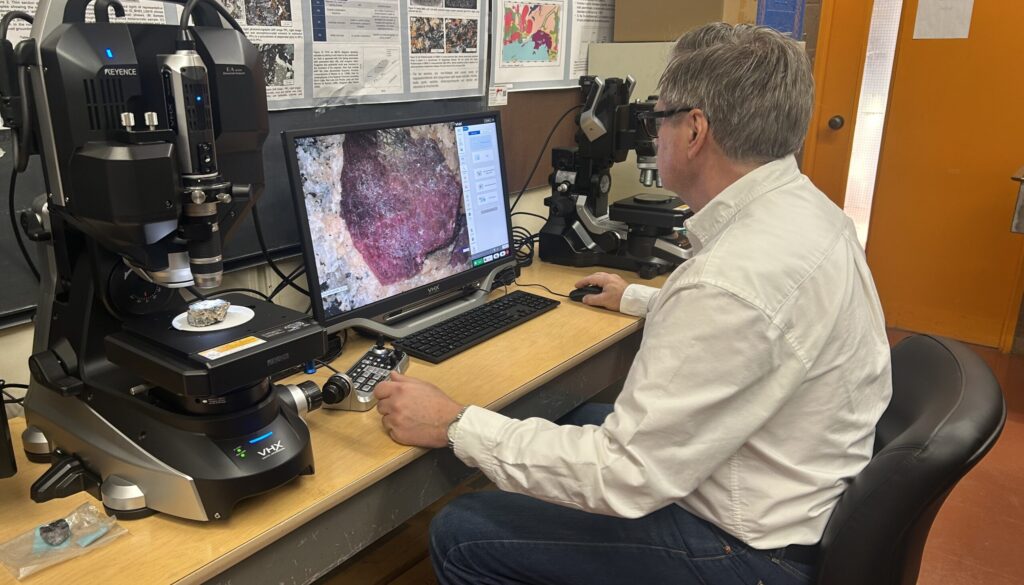
Rock lovers rejoice: the Lakehead University geology program is getting a major boost from a brand new $200,000 Keyence digital petrographic microscope.
A petrographic microscope (or polarizing microscope) uses polarized light to identify minerals and rocks in thin slices by analyzing their unique optical properties. The state-of-the-art microscope is one of only two available at any university in Canada.
The Nuclear Waste Management Organization (NWMO) announced the donation Tuesday. The NWMO has been working with Lakehead’s geology program for over seven years.
“This is a really cool piece of equipment,” said Alec Blythe, Manager of Geoscience Research and Development at the NWMO. “It’s got an elemental analyzer built into it, so it goes down just a fraction of a millimeter and it vaporizes that rock and can tell you the main ion chemistry of that sample.”
“It’s amazing to be able to do that on a very, very fine scale.”
Blythe said the NWMO chose to donate this equipment to Lakehead in large part because of the work of Dr. Shannon Zurevinski, Lakehead Associate Professor of Geology.
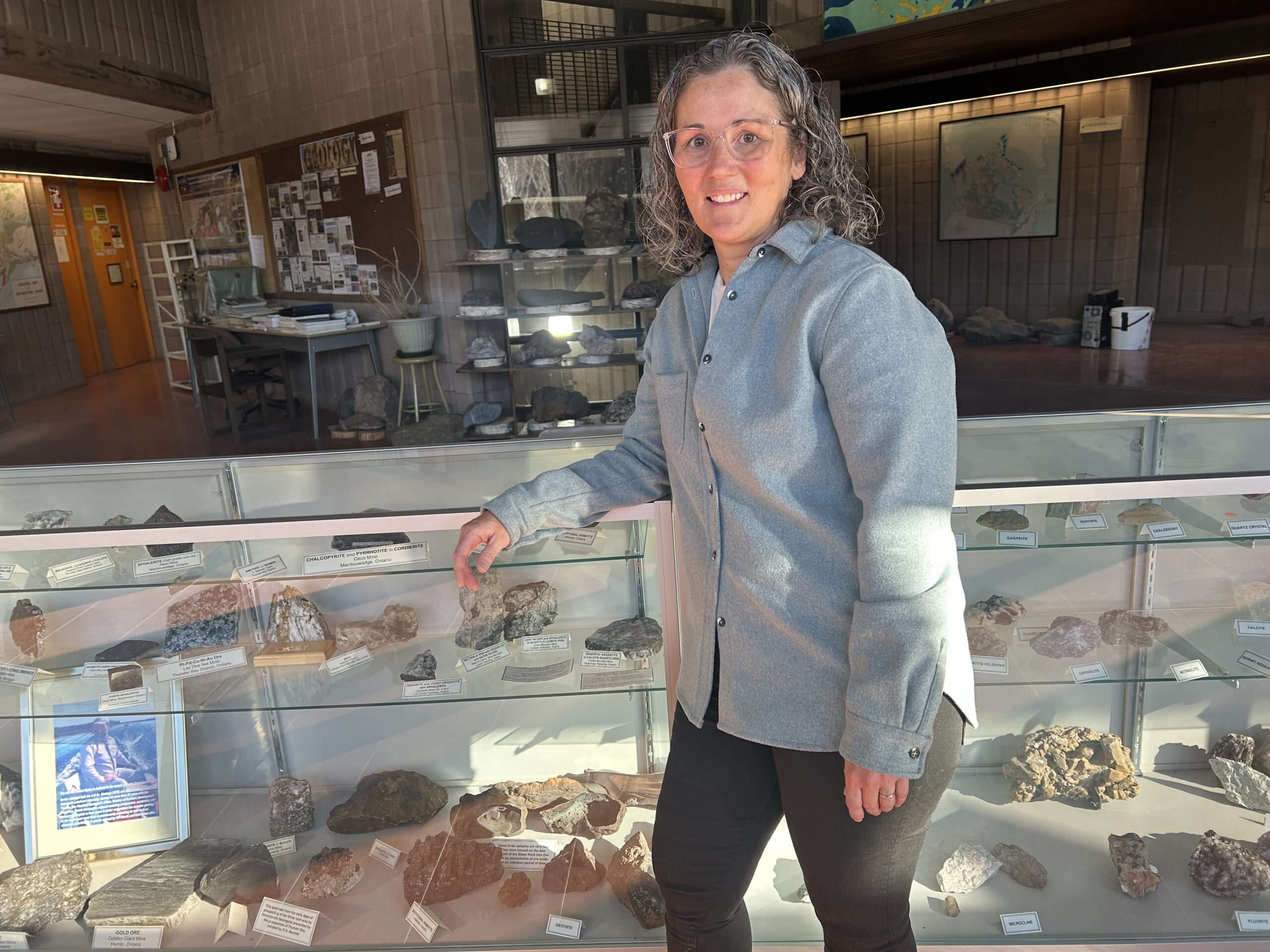
“There’s no strings attached,” Blythe said. “Shannon does with it as she pleases.”
Zurevinski says the new equipment will allow for vital research about the unique geology of northwestern Ontario.
“We have a lot of collaboration with industry and government at Lakehead in the geology program,” Zurevinski said. “These kinds of tools just add to the wealth of the collaboration.”
She said three Lakehead students — one honours, one masters and one postdoctoral — are already using the machine for their thesis projects.
“Students will be able to analyze their samples, and instead of just a basic imaging that can be done with a microscope, they’ll be able to perform elemental analysis on those minerals. That will provide them with some semi-quantitative measurements on their samples,” she said.
The honours student is working on a lithium exploration project analyzing concentrations of lithium across different grains. The masters’ student is working on a mineralogical-based assessment using Laser-Induced Breakdown Spectroscopy (LIBS). The postdoctoral student is investigating grain boundaries between the minerals on highly metamorphic rocks around Thunder Bay.
Geologists aren’t the only students who will benefit from the microscope, as Zurevinski says it will be used in the biology and engineering programs as well.