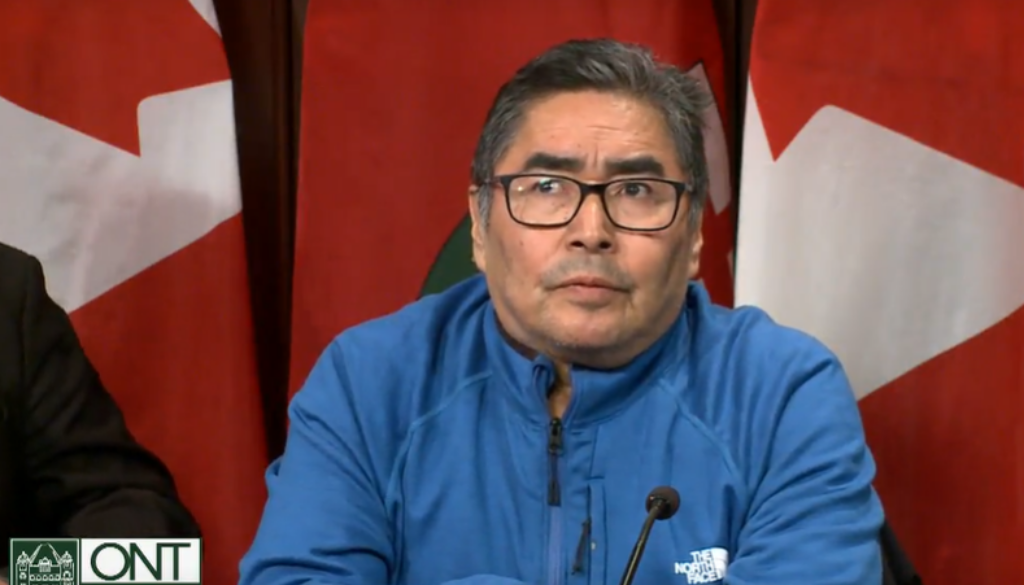
Number of large projects worries First Nations group chair
By Matt Prokopchuk, Local Journalism Initiative Reporter
Source: TBnewswatch.com
The chair of a group of six First Nations says the latest step for a proposed nuclear waste site is yet another cause for concern.
Rudy Turtle, with the Land Defence Alliance, says it’s the newest bit of news that’s worrying Indigenous communities concerned about the environment and the long-term future of the lands and water in northern Ontario.
“We’re just surrounded by resource development and this is a difficult fight we’re facing,” he told Newswatch in a phone interview. “There’s mining north of us here in Red Lake, and there’s more mining coming in.”
“It won’t be long.”
The alliance consists of representatives from Grassy Narrows, Kitchenuhmaykoosib Inninuwug, Muskrat Dam, Neskantaga, Onigaming and Wapekeka.
Turtle is a former chief of Grassy Narrows (Asubpeeschoseewagong) and a longtime environmental advocate, particularly around the ongoing and widespread effects of mercury poisoning in his First Nation caused by historical industrial activity in Dryden in the 1960s and early 70s.
On Monday, the Impact Assessment Agency of Canada publicly posted the initial project description submitted by the Nuclear Waste Management Organization — the government-mandated and industry-funded not-for-profit tasked with the long-term management of Canada’s nuclear waste — for its proposed deep geological repository in the Ignace area.
The project has drawn longstanding opposition over concerns about long-term environmental impacts, given the radioactivity of the spent fuel the site would store; the NWMO has consistently said what it is proposing is safe and is grounded in international best practices for the long-term storage of nuclear waste.
Turtle said it feels like groups like his are being “bombarded” with projects — both proposed and ongoing — that will leave large footprints, “and the potential for disaster.”
“So, that’s why we keep speaking up — because we’ve had to live with it. We have firsthand experience of how It affects your health and how it affects your way of living.”
In 2025, developing mining in the Ring of Fire was heavily championed by the Ford government as Ontario’s key to economic independence and combating tariffs from the United States. The provincial and federal governments also passed legislation last year aimed at fast-tracking resource development efforts.
“These developments will have an impact on the environment and it will impact our way of life,” Turtle said. “It’s just change to the environment that causes great concern because we still eat the fish, we still eat moose and deer and other wildlife.”
“They do get affected by any kind of pollution and, therefore, it affects our diet and the way we eat.”
As for the deep geological repository, in its initial project description summary document, the NWMO says “the project will result in some unavoidable changes to land and resource use,” and that “their extent, nature and the appropriate mitigation measures will be further defined through the impact assessment and licensing processes.”
The organization says “proven environmental protection measures” drawn from other large projects will be in place, and “the likelihood of significant adverse environmental effects is expected to be low.”
Turtle said he remains worried about what these developments will mean for the region long after their immediate purposes are fulfilled.
“It just seems like nothing is going to be natural anymore because of the potential chemicals that will be used in mining or, in this case, in the nuclear deposit in Ignace,” he said.
“So, it’s just a slow doing away of the natural environment and we’re not too pleased about that.”