Residential subdivision hinges on meeting conditions
By Carl Clutchey, Local Journalism Initiative Reporter
Source: The Chronicle-Journal
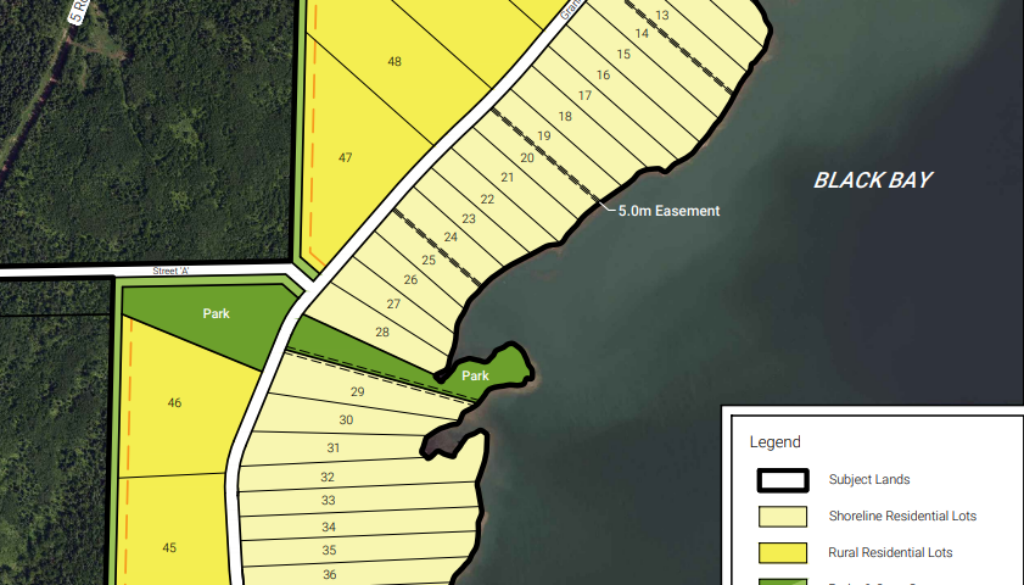
Allowances for wetlands, some wildlife species like bats and turtles, as well as shoreline access, are included among 25 conditions that must be met before a residential subdivision that would overlook Lake Superior’s Black Bay can receive final approval.
The proposed Grann Drive development, which would contain about 50 lots about an hour’s drive east of Thunder Bay, received draft approval in October from the Municipality of Shuniah.
“The proposed development is comprised of 43 lots fronting onto the shores of Black Bay, and nine lots fronting onto Grann Drive from the west,” the proponent says in an application.
Project proponent Glenn Grann has three years to meet the conditions.
The 101-hectare property, which has never been developed except for the construction of a gravel road in 2022, is currently zoned shoreline residential.
It is across the water from the Black Bay Peninsula, which environmental groups like Ontario Nature have described as a 50,000-hectare carbon sink “home to a stunning array of natural features and wildlife.”
The proposed Grann Drive subdivision “is not considered premature, as it represents the final phase of the existing Pearl Harbour subdivision,” a submission by the proponent says.
“The new lots will provide additional housing supply for the greater Thunder Bay area, as the proposed subdivision is located approximately one hour away from (the city),” the submission adds.
Shuniah chief administrator Paul Greenwood said on Wednesday a subdivision proposal containing more than 20 conditions isn’t unusual in rural Ontario, “given there are more site-specific conditions compared to larger urban centres with established design and engineering standards.”
“Once the plan of subdivision receives final approval and registration, lots can be sold and transferred,” Greenwood added.
According to the list of conditions that can be viewed on a link on the municipality’s website, the proponent is required to ensure that bird nesting areas and roosts for bats are not disturbed when vegetation or trees are being removed or trimmed.
The proponent is also “responsible for the permitting and construction to support access over or around (an) existing wetland” on the property, one of the conditions reads.
Environmental signs must be erected for the protection of turtles and “species at risk and sensitive wildlife habitats,” another condition says.
According to the proponent’s submission, “a 30-metre vegetation buffer is proposed to be around Lake Superior to protect any potential fish species or habitats, if present.”
“Lands for a trail will be transferred to the municipality, so that a future connection between the rural back lots may be established, and to add to the municipality’s existing trail network,” the submission says.
The conditions also require “that prior to final approval,” the owner complete an archeological assessment to the satisfaction of (Ontario’s) Ministry of Citizenship and Multiculturalism.
Any recommendations are to be included in a subdivision agreement between the municipality and the proponent, “including any arising from Indigenous consultation,” the conditions say.