Report reveals healthcare language concerns
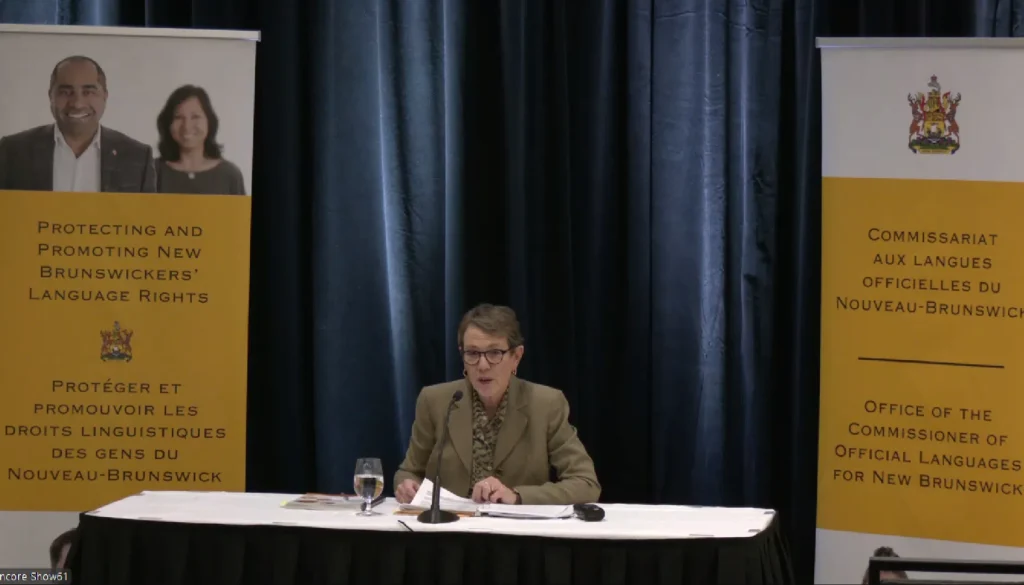
The Office of the Commissioner of Official Languages for New Brunswick has released the 2024-2025 Annual Report.
The Office of the Commissioner received 125 complaints between Apr. 1, 2024 and Mar. 31, 2025. Of that number, 62 were admissible. 19 were based on the lack of service in English and 43 on the lack of service in French.
Sixty-three complaints were deemed inadmissible as they either did not come under the Commissioner’s authority or did not concern an institution within the meaning of the Official Languages Act.
The Office of the Commissioner also received 80 requests for information.
Commissioner Shirley MacLean said there is not a day that goes by that the issue of access to healthcare is not in the news in the province.
“We continue to see healthcare-related complaints representing the highest percentage of admissible complaints received. This includes complaints targeting both Vitalite and Horizon.”
“In December 2024, my office issued a press release outlining complaints from individuals who were able to navigate MyHealthNB in their official language (English) but were unable to access their medical test results in that language,” said the commissioner.
“Although my office continues to receive and investigate numerous complaints related to the MyHealthNB platform, the Department of Health has not taken steps to address the ongoing situation or to implement my recommendations.”
Quoting a statement from the Department of Health, MacLean said, “The health information in the MyHealth records section for an individual is displayed ‘read-only’ as received from the original source system, including regional hospitals, community pharmacies, and public health. These are official health records that cannot be modified or interpreted. As our disclaimer on our website states, this information is displayed in the language of its originator and may appear in English, French, or both.”
The commissioner explained that while medical records are generally internal work tools and not subject to the Official Languages Act, her office holds the opinion that the records constitute communication between a member of the public and the government institution and therefore fall under the act.
“I have taken issue with that position. Firstly, the Official Languages Act allows no exceptions; an institution bound by the act must fulfill its language obligations at all times. Secondly, I was both dismayed and strongly objected to the use of a disclaimer as a liability waiver. Institutions cannot opt out of their legal obligations under the act by using liability waivers, and the Department of Health has ceased doing so.”
MacLean said that in cases where technology is used to create new ways to access services, it appears that official language obligations are not considered or ignored.
Another issue that MacLean raised in previous annual reports was a review of the Official Languages Act, which she perceives as a missed opportunity to make meaningful progress towards language equality.
“When I tabled my previous annual report, I called on Premier Susan Holt to adopt further recommendations that were contained in the Finn-McLaughlin report,” MacLean explained.
“I was therefore very encouraged by the announcement that the Standing Committee on Official Languages of the Legislative Assembly will be reviewing the Finn-McLaughlin report and the Official Languages Act this year.”
The commissioner said she is happy to see a second opportunity to make progress towards true equality for languages in the province.
“I fervently hope to see strong leadership and vision from the standing committee on official languages and from the Premier, who is ultimately the person responsible for the administration of the Official Languages Act,” MacLean said.
The full 2024-2025 Annual Report from the Office of the Commissioner of Official Languages for New Brunswick can be found here.