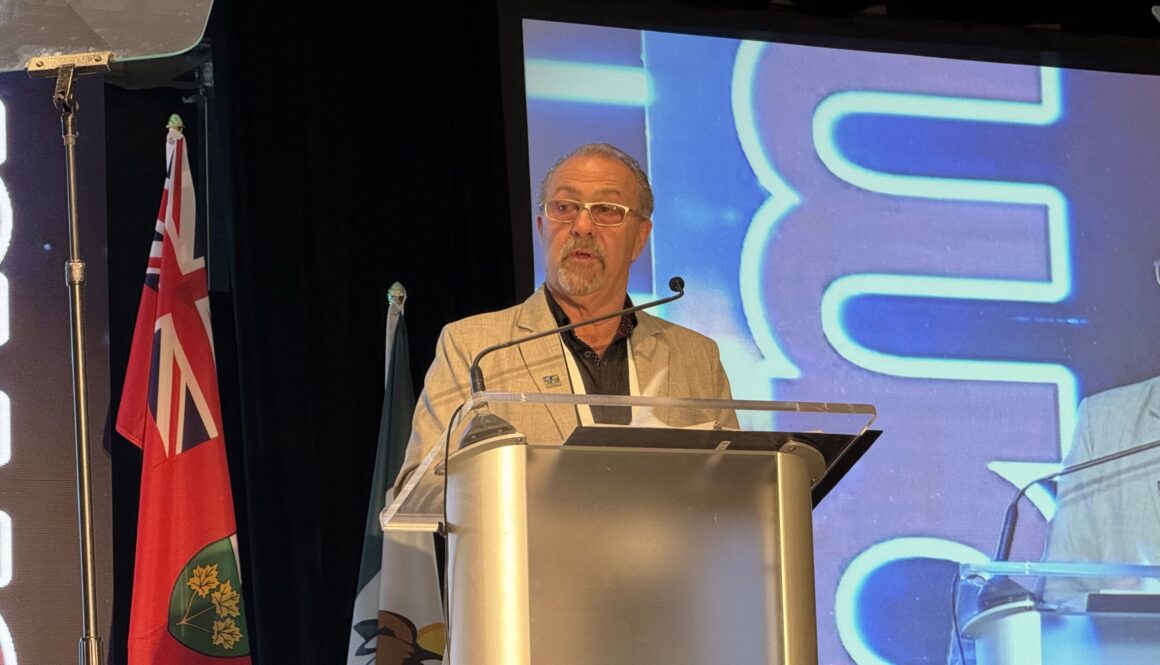
Sam Goldstein is a 2025 graduate of the Seneca Polytechnic journalism program. Sam’s great passions are for history, politics, and food. Born and raised in Toronto, he works as a multimedia journalist in Thunder Bay. You can reach him at goldsteins@radioabl.ca.
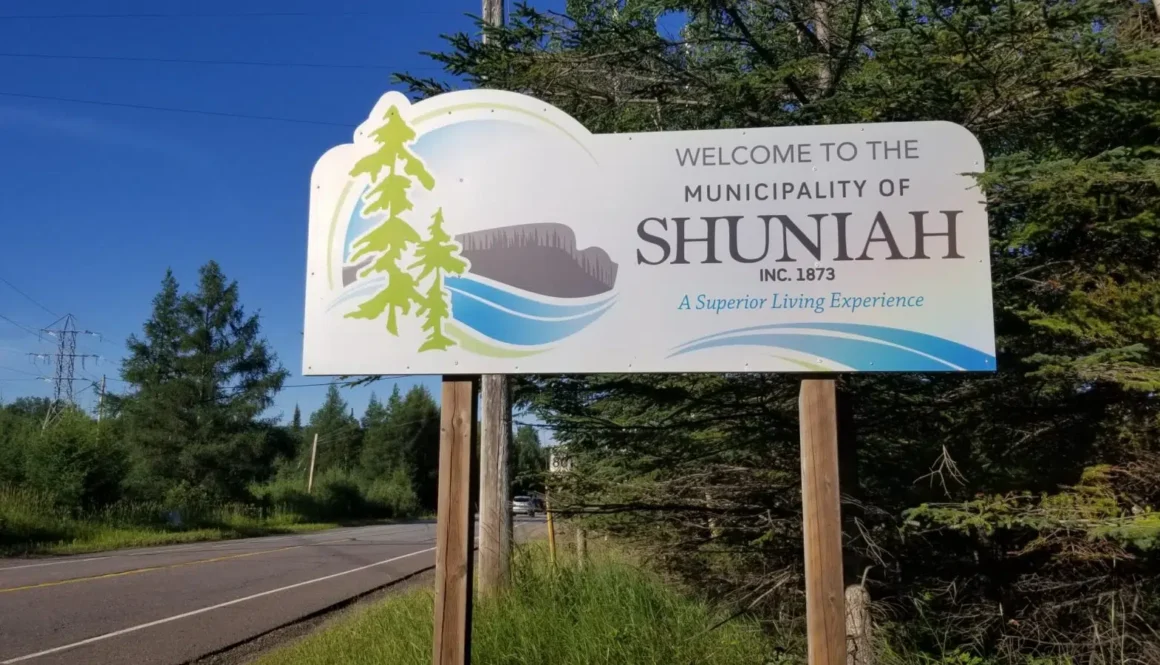
The unofficial results of the sole contest in the municipality of Shuniah are in: With 140 votes, Jenna Hodder will be the new councillor for McTavish Ward.
Her opponent, Kylee Maunula, secured 86 votes.
The rest of Shuniah’s council, including Mayor Wendy Landry and MacGregor Ward councillors Donna Blunt, Meghan Chomut, and Don Smith, are all returning incumbents who faced no opponents at the ballot.
With a well run campaign Moe Comuzzi knocked off two veterans of Thunder Bay council to become only the 3rd female elected mayor in Thunder Bay.
“I’m humbled and very blessed,” says Comuzzi of her win. “We’re turning the page. We are looking to the horizon and Thunder Bay’s best days are ahead of us.”
Moe Comuzzi [left] being introduced at victory party. PHOTO: SAM GOLDSTEIN/ACADIA BROADCASTING/OCTOBER 26, 2026
Comuzzi says her first priority will be to sit down with council and administration to implement her 100-day-plan.
She also wants to sit down with Fort William First Nation Chief Michele Solomon to “start our thoughtful discussions and build our relationship.”
Moe feels her willingness to address the issues while staying positive earned her the support of the voters: “we have to stop looking at the doom and gloom and obviously we’re doing that tonight, and looking towards the horizon.”
Aldo Ruberto, who came out of retirement from municipal politics, finished second by about 1,000 votes followed by another veteran of council Trevor Giertuga.
For Councillor At Large, incumbents Mark Bentz and Kasey Etreni, and former councillor Peng You lead the way, followed by Julie Ann Colquhoun and Jamie Nichols. Rajni Agarwal lost her spot at the council table.
Several familar faces will be back after winning their ward seats. Andrew Foulds was re-elected in Current River, Brian Hamilton will represent McKellar, Albert Aiello won again in McIntyre while Greg Johnson had a large margin of victory in Neebing.
Among the new faces on council will be Stephen Margarit for Westfort and John Ongaro who won a close race in Northwood. Jamie Scrimger took the Red River Ward seat by less than 300 votes over Michael Giardetti.
With the polls closed, the City of Thunder Bay reports that in total, just 40.6 per cent of eligible voters turned out — the lowest turnout in a municipal election since 2006, when just over 38 per cent of voters went to the polls.
The election discourse has been dominated by discussions of homeless and addictions, public safety, housing, infrastructure maintenance, and the use of green spaces for development.
There were two significant races for school board trustee in the Thunder Bay district. Here are the results:
Polling stations for in-person voting will be open from 10 a.m. to 8 p.m. on Monday.
Most voters will have received a Voter Information Letter from the city, which indicates which polling station a voter should go to.
The letter also provides a voting PIN for use by those who prefer online voting, which will also close at 8 p.m.
Those who have not received a letter can seek help in locating their polling station at City Hall, through calling 807-622-VOTE (8683), or by emailing ThunderBayVotes@thunderbay.ca.
The following locations are listed as polling stations:
Current River: Current River Community Centre, 450 Dewe Avenue North End Community Centre, 954 Huron Avenue
Red River: Thunder Bay 55 Plus Centre, 700 River Street Algonquin Avenue Public School, 160 Algonquin Avenue South
McKellar: Oliver Road Community Centre, 563 Oliver Road CLE Heritage Building, 425 Northern Avenue
McIntyre: North McIntyre Recreation Centre, 2051 Government Road Woodcrest Public School, 867 Woodcrest Road
Northwood: Kinsmen Youth Centre, 609 James Street North École Elsie MacGill Public School, 130 Churchill Drive West
Westfort: Kingsway Park Public School, 315 Empire Avenue West Thunder Community Centre, 915 Edward Street South
Neebing: West Arthur Community Centre, 1914 Arthur Street West
On the ballot, you will vote for one mayoral candidate, one ward councillor, and up to five At Large councillors.
You will also vote for trustees for your representative school board: either the English Public, English Catholic, French Public, or French Catholic school board.
All candidates for the French-language school boards are already acclaimed, meaning they have no opponents.
To vote, you must meet the following criteria:
a Canadian citizen
at least 18 years old
a resident of Thunder Bay, or the owner or tenant of land in Thunder Bay, or the spouse of such a person
not prohibited from voting
If you are already registered to vote, you must simply bring one piece of valid I.D.
If you are not registered, you must bring a second piece of I.D., and must have some proof of your residential address, such as a driver’s license, a copy of a lease, a bank statement, or a piece of mail.
Voters in Thunder Bay will find 14 candidates on the ballot for At Large Councillor positions, which do not represent a specific ward.
Residents can cast a vote for up to five candidates: the five with the most votes will become the new crop of councillors.
Heather K. Dahlstrom did not respond to an interview request from the Acadia Newsroom.
Rajni Agarwal (incumbent)
Councillor Rajni Agarwal at a meet-and-greet at County Park Library. PHOTO: SAM GOLDSTEIN/ACADIA BROADCASTING/OCTOBER 14, 2026
Rajni Agarwal is coming off of her first term as a city councillor, and says there is still plenty of work to be done at City hall.
She is focused on attracting commerce and industry to the city, “so that we can take that pressure off of the residential tax base, so that people can do more with their families in the community.”
She is most proud of council’s work on a project to place memorial banners around the city for Remembrance Day, and the South Core Roar festival.
Looking ahead to the next term, she wants the city to focus more on cleanliness.
“If industry, business, or people are going to be looking at moving to our community, we need to keep it clean. It’s our first impression and it’s the one that will pay off tenfold.”
Mark Bentz (incumbent)
Councillor At Large Mark Bentz, left, speaks at a city council meeting. PHOTO: SAM GOLDSTEIN/ACADIA BROADCASTING/SEPTEMBER 16, 2025
Mark Bentz represented Northwood Ward from 2003 to 2014, and returned as a Councillor At Large in 2018, serving ever since.
Though he considered retiring from politics, he decided to run again knowing there will be many new faces on City Council in the coming term: “I thought I could help the new council, help mentor and impart some knowledge about governance and finance and all those good things.
Going forward, Bentz wants to see the city do more to address its $30 million infrastructure deficit, which the city plans to do over the next 30 years.
“I don’t think we’re going to make it, I just don’t see the plan that’s in place as getting us there, so I’ve asked for administration to look at that.”
In his last term, he is most proud of the efforts to beautify the south core.
“That’s going to change that area of the city dramatically.”
Kasey Etreni (incumbent)
Councillor Kasey Etreni meets voters at a meet-and-greet at Halfway Motors. PHOTO: SAM GOLDSTEIN/ACADIA BROADCASTING/OCTOBER 20, 2026
If re-elected, Kasey Etreni will be entering her second term looking to keep up the momentum of city council on growth, public safety, and housing.
She says voters are typically coming to her concerned about affordability, transit, safety and well-being.
Etreni is very glad to see the Temporary Shelter Village finally opening. She acknowledges that it took longer than many residents hoped — “but we have to recognize the population that we’re asking to come into this space.”
She supported the development at 791 Arundel Street, though she distinguishes green space from parkland, which she says she wouldn’t develop.
She points out that “If I were to build 360 individual homes, that amount of space would actually be substantially more than this multi-residential unit. So in my world, we’re actually saving greens space by building a multi-residential unit instead of having single-dwelling homes. And we have to recognize we need housing.”
Etreni maintains that she has always and will always listen to the public on these projects, but “we have to look at all of the pieces, and then come up with a decision. And those decisions aren’t easy.”
Gene Capar
Gene Capar at a meet-and-greet at Halfway Motors. PHOTO: SAM GOLDSTEIN/ACADIA BROADCASTING/OCTOBER 20, 2026
Gene Capar says his experience working at The Gameshelf in the south core has placed him directly in the middle of Thunder Bay’s homelessness and addictions crisis.
“I’ve seen the crime. My store’s been broken into. Usually once a week I have to ask someone to move away from our doors, you know, checking on people who are passed out in our parking lot,” he says. “Not because we don’t want them there, but because I don’t want them to get run over.”
Capar says he grew up in poverty, raised by a single mother on benefits, and lost both of his parents to addiction.
“I’ve been there and I want to be a voice for people who are closer to that situation,” he explains.
On developing housing, he feels “there are better ways,” than using green space: “I look around and I’m looking at lots that are empty, places that we could be building. Green Space is an absolute last resort because one of the best things about living in Thunder Bay is the green space and the natural beauty that our city possesses. So paving over that, no thank you. I think Joni Mitchell warned us about that like 50 years ago.”
Gary Christian
Gary Christian at a meet-and-greet at County Park Library. PHOTO: SAM GOLDSTEIN/ACADIA BROADCASTING/OCTOBER 14, 2026
Gary Christian currently works as the Executive Director of the North Superior Workforce Planning Board, and has also worked with the government of Ontario and the Royal Canadian navy.
He says homelessness has personally affected his family, and is motivated to “get those people in the places they need, the support they need,” which he says will also bring down crime rates.
He says a problem with city politics is that “no one’s talking to our kids,” and is proposing that Thunder Bay establish a youth council to help city council address issues affecting youth, such as the fact that three quarters of young people who leave Thunder bay don’t come back.
“We’re losing a whole lot of talent. Our retention levels are extremely low,” he says.
On a similar note, Christian says senior safety is a huge issue right now, with seniors in TBDSSAB properties “saying they’re afraid to leave their unit, because you know there’s someone doing drugs in the hallway or there’s a drug deal going on… These are people who worked all their lives, built Thunder Bay as what we are today. All they want is a nice quiet place to go, that they can afford to go too.”
On the use of green space for housing, Christian points out that Thunder Bay has enough vacant land for 20,000 units, arguing that “if there’s infrastructure already there, should we not use that first?”
Julie Colquhoun
Julie Colquhoun at a meet-and-greet at County Park Library. PHOTO: SAM GOLDSTEIN/ACADIA BROADCASTING/OCTOBER 14, 2026
With a background in medical education and experience working in policy-making, Julie Colquhoun hopes to bring a different perspective to City Hall: “the work that I do and the way that I approach things is very data-driven, evidence informed, while integrating social determinants,” she says.
“I’m looking at the bigger picture so that when a decision is made, it’s followed through on.”
She feels the city needs to lobby the province more on highway safety and resources for homelessness, mental health and addictions.
“we really need long-term care facilities or homes for them where they’re provided with the care and they’re not living on the streets,” says Colquhoun, connecting the current crises with a decline in funding for crucial services, as well as the closure of the Lakehead Psychiatric Hospital.
She also wants the city to grow its tax base in order to address aging infrastructure and continue funding services, which she says means growing the population, and examining “how we attract and retain people.”
Patrick Cully
Patrick Cully. PHOTO: SUBMITTED VIA PATRICK CULLY
Patrick Cully is a stay-at-home-dad to a First Nations daughter with autism, which has informed his activism over the past few years.
“I’ve done nothing but fight for the last six years for my little girl… It’s always one battle after the next, whether we’re advocating for services, supports, or you know, extra funding from Ottawa,” he says.
“I want to take that same fight to City Hall and make sure that we are not forgotten about, that we’re able to access the resources that would help make Thunder Bay a safer, more inclusive, brighter community for everyone,” Cully adds.
He feels that a program like the Temporary Shelter Village, despite some concerns, “is necessary right now because people are dying,” but he also worries that the shelter is built a bit too much like a jail.
“It doesn’t mean I don’t think we need those places, but I think there’s a little bit more we could be doing in terms of compassion and empathy for all the parties involved.”
When it comes to using green space for housing, he says “I am absolutely vehemently opposed,” and instead suggests redeveloping areas like the Simpson Street south end corridor: “It would breathe new life into an entire neighbourhood.”
Stephanie Danylko
Stephanie Danylko at a meet-and-greet at Halfway Motors. PHOTO: SAM GOLDSTEIN/ACADIA BROADCASTING/OCTOBER 20, 2026
Stephanie Danylko was motivated to run for office because of the Arundel Street development, which she is very opposed to.
“We have thousands of constituents that were against taking away the green space. That is a biodiverse forest. It’s an area that was never clear cut… So I really started to question, who do the councillors represent?”
Danylko draws attention to the fact that Thunder Bay has vacant and underutilized lands that could accommodate more than 20,000 homes, “so it’s not true that we need to get rid of green space.”
She believes that the city is not paying enough attention to the condition of its roads.
“I’ve been driving for 33 years and this is the worst it’s been,” remarks Danylko.
She was very excited about the Temporary Shelter Village, but has grown increasingly concerned as individuals in the city’s homeless encampments have told her they don’t intend to use it.
“A lot of our money went there, no one wants to see people living in tents, and yet there’s a lot of people living in tents.
Danylko became embroiled in a controversy involving Movati Athletic’s change room policy in 2023, which has became the subject of some discussion in the current election.
The At Large challenger encourages the public to consult a letter she published on Facebook, and adds that “I look at all people as being equal. Doesn’t matter where they’re from. People are humans, and that’s really all there is to it.”
Tyler Goode
Tyler Goode at a meet-and-greet at County Park Library. PHOTO: SAM GOLDSTEIN/ACADIA BROADCASTING/OCTOBER 14, 2026
Tyler Goode is a cultural mental health worker at Matawa Education.
He decided to run for public office because he says that in surveys, 90 percent of students at Matawa say they do not feel safe in Thunder Bay.
“So that’s one statistic I would like to see hopefully changed. I don’t know how we’re going to go about doing it, but I think number one would be more community events, more gatherings, just enlightening people on who we are and how we do things.”
Goode has mixed feelings about this term of council: he approves of the new Smart Growth Action Plan and the Temporary Shelter Village (“we just need to give it a chance,”) but he was unhappy to see green space used for the development of housing.
“I’m a family man, I listen, I’m a fighter, and I’ve come from poverty. Like I’ve come from nothing. My parents weren’t really in my life. Everything I’m doing right now is something I’ve done for myself and for my children,” he says. “And I want that to be reflected in the city as well. This city was my fresh start, and I want it to be everyone else’s, like, whatever it needs to be. I just want everyone to be happy in the city and have the chances that I’ve had to succeed.”
Dino Menei
Dino Menei at a meet-and-greet at County Park Library. PHOTO: SAM GOLDSTEIN/ACADIA BROADCASTING/OCTOBER 14, 2026
Dino Menei hopes to bring his experience in construction, demolitions, recycling, and dealing with hazardous materials to the city council chamber.
“I don’t think I’ve ever seen anybody in council in the past 30, 40 years that’s got the experience that I have in there, and I think that would be a good thing to bring to the table.”
He feels that the city can do more to address homelessness, and argues that there is more than enough land in the city to find places to establish campsites, shelters, or other means of housing individuals.
Menei recognizes that in city hall, “you’re not going to please everybody… so the best thing you can do is the best you can, try to give the taxpayers what they want.”
Menei feels confident that he’ll be able to navigate local democracy with ease.
“I get along good with everybody and I do business with a lot of different contractors in town. I get along with every single one of them,” he says. “And I’ve got no problem dealing with other people. Doesn’t matter if they’ve only got a dollar in the bank or they’ve got $1 million, doesn’t make a difference to me. Doesn’t matter what colour, race, or whatever, we’re all humans. We all have a name.”
Jamie Nichols
Jamie Nichols. PHOTO: VIA THE CITY OF THUNDER BAY
The founder and CEO of Rose N Crantz Roasting Company, Jamie Nichols says he wants to use his experience as a small business owner to reduce barriers for business owners in city bureaucracy.
“Small businesses are struggling right now. Things are changing globally and locally,” he says. “I’m running for council to hopefully make it easier for small businesses to cut through the red tape, to break down the barriers that prevent businesses from thriving.
Nichols says crime is a big challenge for businesses right now.
“I’m not going to suggest I have all the answers, but I don’t think the needle has moved on a lot of those things over the last few years, and I want to change that.”
The coffee business owner believes there is a nuanced answer somewhere between ‘lock them all up’ and ‘left everybody run rampant in the streets.’
Nichols hopes to see the city spend less time and money on large projects, and more on maintaining what it already has.
“I’m not really big on flashy prestige projects. I think we need to focus on the little things, the boring stuff like city infrastructure.”
This interview was produced by Jake Henriksen-Willis.
Robert Trevisan
Robert Trevisan. PHOTO: VIA THE CITY OF THUNDER BAY
Having recently retired from running a chiropractic clinic, Robert Trevisan is ready to take on a new challenge and feels that he has a lot to offer the city: “I’ve been dealing with people for over 38 years, so I have the ability to listen when necessary.”
Trevisan is looking for the city to attract more businesses, but says that “you want businesses that are going to help keep our youth here instead of moving away.”
He wants the city to pay more attention to intimate partner violence, and to ensure that the city makes sure everyone has access to proper housing and food, “because that is a form of prevention, and prevention is always better than trying to fix something because you get nickeled and dimed otherwise.”
He adds that “Prevention initially looks more expensive, but in the long term it benefits everybody and prevents unnecessary financial strain in the city.”
Trevisan argues that the city needs to be firmer and less wishy washy in the way it carries out its plans.
“As far as housing, that’s been just ridiculous. I mean, once you have all the information at the time based on everybody’s inputs, you have to act on that. Right or wrong, deal with it. To just constantly change this, no, we don’t want to do that, not in my backyard… That doesn’t benefit anyone,” he says. “All it does is it costs more in the long run, creates irritation throughout the citizens and businesses.”
Peng You
Peng You. PHOTO: VIA THE CITY OF THUNDER BAY
Peng You formerly served as a Councillor At Large from 2018 to 2022, and is perhaps best known in the city for providing free Tai Chi classes for more than 30 years.
“I’m a community person,” he says. “I’m a results-driven guy. Many people, especially seniors, know that I’m reliable and trustworthy, so that’s how I’ve earned my reputation.”
You was a big advocate for the Smart Growth Action Plan, and feels he has more ideas for ways to bring change Thunder Bay for the better.
He says that on the campaign trail, voters are telling him that they want better accountability from the city in how it spends its money: “Why do we spend that much? What’s the result?”
The Tai Chi master and small businessman believes public engagement is a critical piece of good governance.
“This is not a city council’s city. It is a citizen’s city… You have to have our citizens get engaged, involved. And poor engagement to me is kind of worrisome.”
Ontario’s municipal elections are set for October 26, 2026.
More information about Thunder Bay’s election can be accessed on the city website.
Incumbent councillor for McKellar Ward Brian Hamilton is seeking a third term at City Hall. In a crowded race, four new candidates are attempting to become the ward’s next representative: Donnalee Morettin, Marco Cupelli, Tony DiPaolo, and Tracey MacKinnon.
Brian Hamilton (incumbent)
Incumbent for McKellar Ward Brian Hamilton says the city has done a lot of great work over the past eight years, and many big projects are “about to come to fruition,” such as the indoor turf facility, the revitalization of the north and south cores, and upgrades to various parks and infrastructure pieces.
“I look forward to continuing that work,” he says.
Hamilton says the ward’s residents are concerned with affordability and “making sure their tax dollars are working for them and providing value to their quality of life,” as well as neighbourhood safety, property crime, and the state of the homelessness crisis.
“I’m hearing a lot of concern around the plight of folks that are unhoused and what they’re going to be doing this winter.”
He worries that debates on the issue of homelessness and addictions have become very polarized, and very “us and them,” even though in his own experience, working in that field every day, he finds a lot to praise in the efforts of individuals, organizations, and city programs to uplift struggling folks.
“I’ve seen success stories. I’ve seen folks migrate out of poverty, through their own efforts and the efforts of system navigators and organizations… It’s actually incredibly inspiring.”
Though the new Temporary Shelter Village is facing concerns that it may be moving too slowly to take in its first group of individuals, Hamilton believes “the slow and methodical approach” will produce better results: “You’re dealing with a population that often has very complex social challenges.”
Looking back at his past two terms on council, he celebrates accomplishments like the restoration of the Centennial Botanical Conservatory, which he says will “serve the community for generations to come,” or the work to develop or upgrade parks and public spaces like Marina, Vickers, and Centennial Parks.
“Even with that, we’re still trying to fix infrastructure, pull lead pipes out of the ground, and build things that make living in Thunder Bay attractive and affordable,” he remarks.
Hamilton says going forward, the city needs to build confidence in its governance.
“For us to really build the city that we want to build, it can’t just be a City Hall proposition. Through good fiscal stewardship, through good management, we have to inspire local businesses, international businesses, institutions, and other agencies to be a part of the city-building effort.”
Marco Cupelli
Having left Thunder Bay as a young adult to study and work in theatre and film set design, Marco Cupelli now feels passionately that Thunder Bay needs to work harder to provide opportunities to its youth: “I’d like to create a more thriving city so that our young people have reasons to stay — especially when we bring in, you know, part-time contractors on a two-year contract. They want to leave as soon as they get here.”
Cupelli, who now works in property management, feels the city needs to do more long-term thinking if it wants to solve its issues with crime, addictions, and homelessness.
“We need to start with what makes a city thrive and work backwards from that,” he says.
The set designer-turned-property manager is worried about the way the city is approaching some of its projects, such as the Victoriaville reimagining.
Though he supports the idea, he worries it was carried out in the wrong way, rebuilding the attraction itself before rejuvenating the surrounding area into an appealing destination.
“We’re not creating a moment where the city is all of a sudden going to be using Victoria Avenue. They’re not because right out the gates of that is empty desolate properties with plywood on them,” he argues. “They should have thought backwards: how do we incentivize these landlords to sell their properties, to use their properties?”
Cupelli is also critical of the way the city has worked on its improvements to the north core.
“The Red River area has seen four straight summers of constant roadblocks and renovations. How do you think that’s affected all of the businesses?”
On housing, Cupelli believes that some green spaces may need to be developed, but the city could be more transparent about its plans.
He suggests that the city should clearly designate certain areas as protected, and certain areas as potential grounds for future developments.
At the same time, Cupelli takes some inspiration from cities like Toronto, and hopes to see the city protect certain green spaces to allow for more multi-use bike and walking paths to be built, connecting Thunder Bay for active commuters.
“I’m all for protecting green spaces, but I’m also all for developing more units because our city needs it.”
To voters, Cupelli promises that “i have a backbone and I’d stand up for the ideas that are brought towards council that don’t improve the McKellar Ward,” though he also says that councillors sometimes think too much about their own wards, and hopes that council will have ideas that “aren’t just about Current River and Red River and McKellar and McIntyre. They’re about Thunder Bay as a whole.”
Tony DiPaolo
With 30 years of experience in the bar and restaurant scene, most recently in running Monty’s Joint, and a few years working with the Fort William BIA, Tony DiPaolo it was time to up his involvement in city affairs.
“I’ve seen the good that comes when people work together and focus on doing good for businesses and residents,” he says. “To be the voice for them is something I’m willing to do and proud to do.
DiPaolo says street safety is a top priority in the election: “You can’t avoid it. Doesn’t matter what part of the city you’re in. I think everybody realizes that if we don’t do something right away, it’s just going to keep spiraling.”
He says residents are concerned about where their taxes are going, and want to get as much out of their tax dollars as they put in.
He feels the last term of city council saw “too much conflict, too much time wasted in back and forth, too many differences of opinions. I’m hoping this council is more like-minded, and it kind of sounds like it. A lot of people’s platforms are all the same, so I think the goal of everybody is to do better for the city.”
Now that the city’s Temporary Shelter Village is open, the gastro pub proprietor is hoping progress can begin to inch forward on the city’s homelessness and addiction issues.
“It looks great… I’m just hoping it has more success across the country. This type of village is not progressing and getting people to transition into permanent housing, and right now they don’t have the answer for that,” DiPaolo remarks. “They’re new at it, the city’s new at it, these people have never dealt with it before. I’m hoping that we move forward, but we’ll have to see.”
When it comes to using green space for housing, he says that “it should be the absolute last thing on the table. We have so much space here in Thunder Bay, so many areas that are not utilized need refurbishing. We have to build up where the infrastructure already is.”
DiPaolo points out that a key pillar of the city’s Smart Growth Action Plan is being an environmental steward, “and this council is already going against it, approving Arundel. How are you being an environmental steward? Yes, we’re in a desperate situation where we need housing, but you can’t vote versus desperation. You want to do a smart plan, stay smart and do things properly.”
The McKellar challenger says the reason there are so many candidates in the ward’s race is “they’re unhappy with the way things have been going, and it’s time for change.”
As for his own candidacy, DiPaolo feels his work with the community, whether with the BIA, Wake the Giant, South Core Roar, or other events, has given him a familiarity with budgets and problem solving.
“I’m community driven, I’m business driven, I see the problems that need to be addressed.”
Tracey MacKinnon
Though she initially had not intended to run, Tracey MacKinnon says her own experiences with public safety motivated her to get involved.
She lives in a TBDSSAB building which has faced consistent fallout from the city’s social crises.
“There always seems to be something going on. Even last night at 3 a.m. we had the police, they actually had their guns drawn behind our building. So like that’s unnerving, right?”
She says during the campaign, voters have told her that they “don’t feel like they have a voice,” and says her current councillor only shows up “when they have security in some media event, with the big wigs. And it seems to be more of a photo op than anything. And I’m not that person.”
MacKinnon has a long background working with social and human rights organizations, focusing on homelessness and anti-poverty, with groups including the Women’s National Housing and Homeless Network, Social Housing & Human Rights, Poverty Free Thunder Bay, and several more.
She is very focused on working to provide more social and affordable housing in the city, “so people don’t have to work two or three jobs and still try and live… So you’re not just working to pay rent, you’re working so that you have so freedom.”
MacKinnon adds that social housing is not getting enough attention in the race: “people in social housing need to have their voices heard, and I want to be that voice.”
On the Temporary Shelter Village, she supports any effort to get individuals off of the streets before winter.
“We need people in a place where they can call home. Just four walls and a roof, right? Just to get that stability again,” she says. “And then they can get back on their feet, can just kind of feel grounded and at peace… I’ve heard it said that this is like the building block or a stepping stone to the next part of their life.”
MacKinnon was critical of city council’s past focus on large, expensive projects, which she calls “vanity projects,” including buildings like the Tbaytel Multiplex and the Thunder Bay Art Gallery.
Rather than these large projects, she would prefer to see the resources used go towards “renovating, remodeling, repurposing housing instead of building… Yeah, just use what we have instead of building more on land that we need for green spaces, walkability and trails, and parks and open spaces.”
When it comes to those green spaces, MacKinnon wants to find other spaces to develop, arguing parks, pathways, trails, and other green infrastructure are needed just as they are.
She feels she is prepared for the challenges of working in a local democracy thanks to her personal advocacy and community work, interacting with a diverse assortment of people.
“Everyone’s voice deserves to be heard, whether or not we agree with it. That’s when you can give some constructive feedback… Maybe sometimes it’s just a little piece of education you weren’t aware of. It could be just simple things that could change your mind, sway your vote the other way. And I’ve seen that happen.”
Donnalee Morettin
With a background in hospitality management, Donnalee Morettin, who currently works as assistant manager at the Holiday Inn, is hoping to steer the ship of Thunder Bay to port.
“I truly do believe we have the big picture,” she says of the city’s strategic plans and ideas for improving the city. “But the operations, which is the rowing of the ship, the day-to-day work… the left hand needs to know what the right hand is doing, and I think sometimes we don’t have that.”
Morettin has distinguished herself among the many candidates across the city as a champion of the idea that being a city councillor should be a full-time job, at least for the ward councillors.
“The reality is that today’s issues are no longer part-time problems. Infrastructure, homelessness, addictions, economic development, housing, public safety, downtown revitalization, all of these things require attention and leadership,” she explains. “And I think if we expect professional level leadership from council, they need to be all in.”
The hotel manager says her background has given her skills in problem solving, budgeting, people skills, “and most importantly, getting things done. You’ve got to look after a building and you’ve got to look after your stuff. And I’ve always been proactive in dealing with issues as soon as they crop up.”
Morettin worked as a coordinator of the Waterfront District BIA from 2012 to 2017, which she says was “a very big eye-opener for me, and showed me how well council worked together with the board, with City Hall administration.”
She repeatedly emphasizes the importance of unity in the council chamber, saying that “everyone’s got to be on the same page.”
On the city’s response to homelessness, Morettin appreciates the work the city has done to keep residents informed about things like encampment locations and city programs.
She understands picking a place for the Shelter Village or for Designated Encampment Sites will be controversial, but “there is never going to be a perfect place to put people who are homeless,” and adds that the city needs to find its roots when it comes to taking care of its community.
Morettin promises to be accountable, to stay informed, and to keep her ears open to the community.
“We’re not the same Thunder Bay we were 10 years ago. Things are moving faster, and we need to catch up,” she remarks. “We need to open the doors to our youth, to enterprise, to economic development… I’ve been living here for 50 years, and I know it’s changed in a lot of ways, but it has to continue to change and grow, and there’s some things that we’ve given up that we need to bring back.”
“I have great hopes and great visions, and am passionate about where this city is going to go, and I’m excited to be a part of it.”
Ontario’s municipal elections are set for October 26, 2026.
More information about Thunder Bay’s election can be accessed on the city website.
Red River Ward council Michael Zussino is not seeking re-election, producing a crowded race with five candidates seeking the empty seat: Cory Bagdon, Dino Cicchitano, Michael Giardetti, John Murray, and Jamie Scrimger.
Dino Cicchitano and Michael Giardetti did not respond to interview requests from the Acadia Newsroom.
Cory Bagdon
With a brand new master’s degree in ecological economics, Cory Bagdon has just returned home from the United Kingdom ready to dig into a new challenge.
A former small business owner who spent a decade in woodworking, he says municipal government is the level with the largest impact on the day-to-day lives of the people in his community.
Bagdon thinks it’s important for residents to “recognize the value that we have in our public institutions and our public goods,” like the library or the public transit system.
“Our public library system does incredible community services work for everybody, and to spend time humming and hawing over how much money they should be working with fails to recognize the return on invest we get when in invest in it,” he argues.
He illustrates a metaphor for public transit’s importance: that “small businesses are the backbone of our economy, and the transit system is the circulatory system that connects everybody and makes business even possible.”
He wants to see the city offer more respect to bus drivers and their working conditions.
In his own ward of Red River, Bagdon is very concerned with the city’s decision last term to begin selling off surplus public land.
“There’s this weird urgency to sell of our land real quick, and I think that’s a really bad thing to do. I don’t think we should be surplusing any publicly owned land because land is very valuable,” he explains. “Land is sacred. Once we sell it, we never get it back.”
Bagdon believes the city’s strategic plans, which it creates for different services, need to be more flexible: “They should all be living documents,” he says. “I think when conditions change, we shouldn’t have to go back to the drawing board a redo a whole new strategic plan just because, for example, we value wind turbines more now, right?”
When it come to items like the Temporary Shelter Village, Bagdon says while it’s unlikely to substantially reduce the number of homeless individuals in the city, it will help a specific subset of the group.
“It’s easy to focus on all those other things like how much it costs, and it’s really, really easy to forget that it’s going to help people, right? That’s the most important thing.”
If elected, Bagdon hopes to take a more deliberative approach to the democratic process, suggesting that it should be less about one specific person or group’s idea either passing or failing a vote, and more about letting everyone put their own ideas forward.
“Put them on an equal footing, and judge the ideas on their merit, not on the party or interest group that’s trying to push advocate for their own agendas, right? The deliberative approach, it needs cooperation, it needs collaboration, reciprocity is a big thing in this approach.”
John Murray
Head chef and owner of Red Lion Smokehouse John Murray has entered the race hoping to take his involvement in city affairs to the next level.
Murray is a member of the board (and former Chair) of the Waterfront District BIA, a board member of the Shelter House, and sits on a tourism committee for the Thunder Bay Community Economic Development Commission (CEDC).
The restauranteur feels confident that he’ll be prepared for the challenges of navigating local democracy.
“We have a very large team of staff that I’ve managed, and there’s obviously conflicting personalities and opinions in any team,” he remarks. “I’m a good listener. I think I can weigh two sides of any coin. There’s valid arguments that you can see from both sides.”
Murray believes that green space and parkland should not be used for development.
“I think an infill and densification plan for housing and for any development is something that should we be looking at. We have plenty of spaces that we can be developing that aren’t actual parks,” he says.
He also adds that “it’s been proven as a development tactic that densification is actually far more equitable in terms of capital infrastructure and maintenance… It’s frankly something we should get better at as a city.”
Rather than for development, Murray is eyeing Hillcrest Park as a potential spot for some improvements, including new trails and exercise equipment, on the recommendation of some local interest groups.
On homelessness and addictions, Murray credits the Temporary Shelter Village as a positive step for the city.
“Finding more shelter opportunities and getting more heads in beds in the shelter program is a positive thing,” he says.
Murray says residents in the ward have made clear that they want the issue addressed, and want to see less encampments, “so again, find humane ways to house our homeless… having a good measure of how you deal with your vulnerable populations is something that is a measure of a good, healthy, working society. “
In a crowded field, he believes his work in different city boards position him nicely to take on the role of a councillor, with plenty of hands-on experience dealing with the municipal budgeting process and the city’s shelter system.
“I bring a lot to the table with some real-world, practical experience.”
Jamie Scrimger
With a background in emergency management, as well as working as an advisor to First Nations, Jamie Scrimger is coming to the table with critical infrastructure and community safety as chief priorities.
Scrimger, who hails from Kenora but has lived in Thunder Bay for almost two decades, worries that the city is not taking care of its infrastructure, when considering how it continues to sprawl outwards.
“Take care of what we have and really be careful about what we’re building to make sure we can maintain,” she says. “It’s not just a problem of if we can build it now, it’s can we take care of it in 10, 20, 30 years.”
Scrimger says in her door knocking efforts over the campaign, the development of green space has been a recurrent issue.
“I would protect green spaces. We do have to do some densification to get that population up, make sure our infrastructure is cared for,” she says. “However, to build on those green spaces, we’re not going to get them back, so I would not be for that.”
Looking back at the last term of council, Scrimger hesitates to lob too much criticism.
“Being an outsider, I don’t want to pass too much judgement there. I’m not running because everything’s broken and wrong. I’m running because I think I can bring something to the table.”
The Red River hopeful was able to tour the Temporary Shelter Village alongside many candidates, and feels that it gives the city some new options for taking care of the vulnerable with dignity.
She calls the village “a tool in the toolbox that we can use. It’s not going to be the be all end all solution, it’s not going to magically make things better. But it is going to give us a tool.”
Looking ahead at potentially being the ward’s next councillor, Scrimger feels her experience in emergency management will help her work well with a potentially disparate council of differing personalities and ideas.
“In emergency management, it’s all about working together. You’re dealing with really complex problems, multiple response agencies, difficult jurisdictions, so you have to bring everybody to the table and that’s what I do,” explains Scrimger. “Just because you’re in a heated debate, doesn’t mean it’s an argument. It doesn’t have to be aggressive. So being respectful at that table — and that is part of my platform — is how to have those relationships and debate and ask hard questions, but be respectful as well.”
Ontario’s municipal elections are set for October 26, 2026.
More information about Thunder Bay’s election can be accessed on the city website.
Longtime incumbent of Current River Ward Andrew Foulds is facing a new opponent in Stéphane Kuziora.
Andrew Foulds (incumbent)
Current River Ward’s representative, Councillor Andrew Foulds, works as a vice principal with Lakehead Public Schools when not at City Hall.
Foulds has been a fixture on council for twenty years, but still feels he has more to offer.
“My family and I have been such beneficiaries of the city… I feel it’s my duty to give back because I’ve been so lucky,” says Foulds. I think that everyone deserves happiness, success, joy, and a quality of life. And I really want to be a part of that.”
He says residents are living through a time when democracy is declining around the world, and people are losing confidence in governments.
“There will be some that are critical of debate and sometimes decisions taking a little longer than they should. And I would say, sometimes that is frustrating. But, democracy is messy and different views are good. Sometimes decisions may take a little longer, but often they come out a bit better,” says Foulds.
But he acknowledges that there are exceptions, such as the Temporary Shelter Village, which experienced a long back-and-forth of debate over its location; Foulds believes there were better choices for the village, though he also admits that the debate is now in the past, and the city can finally move forward with the location council ultimately chose.
“I know people are starting to move in and I’m looking forward to a little bit more dignity for those individuals,” says the councillor.
Foulds is proud of much of the work done by city council over the past term, and hopes the largest capital project on the docket, the indoor turf facility, will become an iconic spot over the coming decades.
“I know it is a bit controversial, but I’ll tell you, I look at the Canada Games Complex, and the tens of thousands of people that use it every year — we are so lucky to have that as a municipality,” he says. “Although the indoor turf facility may be controversial now, I’m hoping 40 or 50 years from now, people go ‘man, that was a good decision.'”
In Current River Ward, he is happy with upgrades done to Centennial Park and Boulevard Lake, with accessible playgrounds set up in both locations, as well as development on walking trails and roads.
But the new development at 791 Arundel Street is an animating controversy for the ward: Foulds opposed the rezoning and has many concerns about the project.
In general, he says that “we should not be developing in terms of urban sprawl. We have a huge geographic footprint given our population, and it is very expensive and inefficient to deliver services to such an expansive city, so we do need to develop on existing services.”
Foulds argues that tax increases can be more modest when the city builds more densely, as it doesn’t need to expand services like water and sewage to new areas.
Because the candidates for mayor in the election are themselves split on whether they would use Strong Mayor Powers, Foulds warns voters to think very carefully about how they vote.
He warns that a candidate might end up winning with 20 per cent of the vote, or even less because of how many choices there are, and could deploy “extraordinary powers… hiring, firing, vetoing budgets,” without an extraordinary mandate from voters.
Looking ahead to the next term, Foulds says “I don’t want to be the person that just festers on the negative. We have challenges and I’m up to meeting those. But I also want to be aspirational and hopeful. I believe this city is on the verge of greatness, and I would like to be a part of that.”
Stéphane Kuziora
After returning home from almost a decade spent completing a master’s degree and a PhD in Norway, Dr. Stéphane Kuziora, who wants to unseat Current River Ward’s incumbent councillor, was shocked by the homelessness crisis that has come to dominate Thunder Bay’s political landscape.
“It really spurred me to think about the ways I could help the city because it’s my hometown. I grew up here,” he says.
Though homelessness is casting a large shadow on the election, Kuziora is also very passionate about efficient transit planning, thanks to his engineering background.
“There’s so many inefficiencies in our transit system. It costs Canadians so much time sitting at a traffic light,” he remarks, adding that a friend of his jokes that “people live 60 years in Thunder Bay, have a great life, and the 10 of those years are spent sitting at a traffic light.”
Kuziora wants to see the city adopt roundabouts to replace many traffic lights, and if up to him, he would work to slowly build them out at key intersections all over the city, over time.
“Hopefully in the long run it will translate to people driving from point A to B in a quicker amount of time. And that quicker amount of time translates to people having more time to work, more time for leisure, just more productivity and happier, healthier lives,” he explains.
On the other side of the coin for transit, Kuziora is also looking at rethinking many bus routes in Current River, which he believes are “basically outdated. I’m going to push really hard on administration to justify why these routes are structured the way they are.”
Kuziora has made his own suggestions for ways to reroute certain bus lines, such as having the southbound path of line 17 go straight south down Grenville Avenue, rather than snaking back and forth through side streets.
“The more our busses are better at connecting to people and being efficient with the flow of people from point A to B, the more people are going to use the bus,” says Kuziora.
Though he approves of the idea of the Temporary Shelter Village, he has some serious criticisms of the way it was implemented.
Kuziora believes the village should have been built in an indoor warehouse, which would improve the quality of life of the residents inside.
“It prevents individuals from kind of socializing in more of a common area.. the only place that these residents can communicate is in the very specific community building that they’ve built, unless it’s a very hot beautiful day,” he remarks.
He also points out that with only six bathrooms for the 80 units, there may be problems, and moreso in the winter since those bathrooms require a user to venture outdoors from the warmth of their unit to use them.
“It’s going to be very inconvenient for these people who are already socially distressed, so I think we’re going to see a lot of bathroom use in the units or just immediately outside.”
Kuziora is strongly opposed to the development at 791 Arundel Street, and on a more general note, says “I don’t think we need to trade green space for housing when there are other places across the city that we can develop,” adding that “I want to be crystal clear, I’m not against development. I do think the city needs more highly concentrated housing developments, but not at the cost of green space.”
Though he initially stated he was in favour Strong Mayor Powers in some cases, after thinking more about it and speaking with other candidates for council in other races, Kuziora has decided that with a few very specific exceptions, like extreme emergencies such as from wildfires, he would be opposed to their use.
Kuziora hopes voters will support him because he believes he has a very clear and distinct vision for the ward, with plans such as designating the western forest of Boulevard Lake as protected space, paving new walking routes through the ward’s parkland, and the aforementioned ideas for redesigning bus routes and building more roundabouts to replace lights.
Ontario’s municipal elections are set for October 26, 2026.
More information about Thunder Bay’s election can be accessed on the city website.
McIntyre Ward’s incumbent councillor, Albert Aiello, is facing a challenge from one other candidate: Brian Phillips.
Albert Aiello (incumbent)
Councillor Albert Aiello is eyeing a third term representing McIntyre with the feeling that “there’s a lot of work that still needs to be completed after decades of stagnant growth in the city.”
Aiello feels that the city has “finally turned a corner and you can see it, you can touch it, you can feel the changes that are happening in a very positive way in regards to growth.”
He presents the city’s last term as one focused on getting the ball rolling on several issues.
One such big ticket item, the Temporary Shelter Village, he worries might not be the right approach: “I really feel like we’re enabling people,” he remarks.
But he also hopes it will be successful now that it’s open; and because council put it forward, he says of councillors who may have reservations that “we all have to get behind it.”
When it comes to opening up parkland or greenspace for development, Aiello argues for a nuanced approach.
He says parkland “pretty much shouldn’t be touched,” but believes that when it comes to green spaces, the city needs to look at developments on a case-by-case basis.
“Growth is vitally important to move the city forward. The additional tax dollars without a doubt are needed to tackle the deficit that we have,” he explains.
Aiello points out that growing the city’s tax base is also a way to alleviate a lot of citizen frustrations about the speed at which the city is able to tackle problems, such as its large infrastructure deficit.
“This 30 million dollar deficit — it’s generational — it didn’t happen overnight and in order to fix it, you have to chisel away at it,” he says, and draws attention to City Council’s decision over this past term to devote an additional 5 per cent of its capital budget towards infrastructure as a win for residents.
Though it was a massive project for the city, he argues that “these are the quality of life things that you need in communities,” in order to attract more growth, either through retaining skilled workers or enticing businesses and industries to move in.
“Will it be used? Absolutely. Will it bring in revenue? Absolutely,” remarks the councillor. “It’s just one of those things that was very much lacking in our community, and I’m glad I supported that.”
Looking ahead to the next term, he hopes residents will back him again: “You call me, I do return your calls. I do act. I will listen to you and provide information, whether it’s what you want to hear or not, but I follow it through. I work diligently, I form great partnerships with administration… I’m not somebody who does something halfway.”
Brian Phillips
Commercial property manager Brian Phillips says that he has “always had a love for politics,” and that after running for an At Large Councillor position in 2022, he feels that he could be well-suited for the comings and goings of City Hall.
“I wanted to do something good for this city that’s given back to me for many years,” he adds.
Phillips says for him, the chief issues of the election are safety, street lighting, traffic concerns and general road issues including signage and maintenance.
On the campaign trail, he says voters “want results,” and want transparency from City Hall.
“They don’t want skirted-around issues or answers. They want to know what’s going on,” explains Phillips.
He believes that if taxes are going to be raised, citizens “want bang for their buck,” and are concerned that some wards are giving up more than they’re getting.
Phillips was able to tour the Temporary Shelter Village alongside many other councillors, and feels the project is “a great idea,” and that “the facility is awesome.”
He hopes the project can offer the city some bandwidth in its efforts to counteract the crises of homelessness, addictions, and mental illness that are so dominating this election’s discussions.
On the development of housing, Phillips wants the city to prioritize vacant lots and buildings before it turns to green spaces or park spaces, which he says “nobody wants to see taken away.”
“Use up what we have first, then find other areas to utilize before parkland and green space,” he argues.
Looking back at the past term of council, McIntyre’s challenger feels that although city council did some good, they moved too slowly and were too indecisive.
“No more studies, no more going back and looking,” Phillips suggests. “Just make a decision and stick to it. Get the answers, get all the information and have the one vote and be done with it. Move on.”
To help the city with its finances, Phillips believes the city should look at selling properties it doesn’t need anymore to bring its deficit down. “Going after the taxpayers for the money isn’t the answer. There’s other solutions that have to be investigated, whether it’s taxing bigger business that are coming in or spreading it out to everybody so it’s a fair deal. There’s got to be another solution,” he muses.
If elected, he promises to leave his personal likes and dislikes at the door, rise above any disagreements with others on council, and remember that he’s there “for the betterment of the city… You’ve got to work as a team. You’ve got to get things accomplished. And you’ve got to move forward for positivity and growth.”
“The city’s hungry for change, and I’m hoping that my abilities and background and experience will help move that change forward.”
Ontario’s municipal elections are set for October 26, 2026.
More information about Thunder Bay’s election can be accessed on the city website.
Founder of the Underground Gym & Youth Centre Peter Panetta is vying for the city’s top job once more.
For almost three decades Panetta has worked to provide opportunities to children and youth through the chance to play sports, participate in arts and music, and eat free meals in a safe space.
“Last night, there must have been no less than 35, 40 kids there and they were just having the time of their lives,” says Panetta. “They’re doing whatever they want and they’re happy and they’re safe. And that’s what the Underground is all about.
Panetta has entered the mayoral race hoping to shine a light on children’s issues, which he says is “the only way we’re going to be able to stop crime, drugs, homelessness. All of it is connected in one way or another, and I think it’s through the children.”
He argues that his model for helping keep kids off of the streets, “causing havoc, vandalism, and whatever else they do,” is proven to work and should be applied all around the city, and particularly in areas where kids have less programming available, such as County Park and Limbrick.
The mayoral hopeful believes that stopping the flow of drugs into Thunder Bay is almost impossible, and thinks focusing on preparing children for the world’s challenges is a better way to prevent them from getting caught up in a life of addiction and hardship.
On public safety, he is advocating for the development of a neighbourhood watch as a model for community policing.
He even wants to see a sort “sub-police force” of trained civilians with the ability to make arrests.
Panetta suggests that in neighbourhoods, “everybody knows everybody, so if they see something that’s just not right, maybe we could stop the trap houses from happening because they’ll know that there’s a whole bunch of people going in and out that don’t belong. And that’s when you bring them in, and if they can’t handle the situation, then they call the cops.”
When it comes to the city’s response to homelessness, Panetta is not opposed to the idea of something like the Temporary Shelter Village, though he is concerned about how it will function the winter.
He believes a better approach would have been to copy cities like Minneapolis and Winnipeg in building their shelter villages indoors, inside a large warehouse or an old hotel.
“Inclement weather can affect individual buildings,” says Panetta. “If it was inside a building, it would really make a big difference, I think, and be much more controlled.”
With the housing crisis occupying much of the discourse in the election, Panetta makes clear that he is “completely and totally against” the use of green spaces for housing developments.
“These developers are building these huge apartment complexes that very few people can afford,” he explains. “It’s not affordable housing, unfortunately, and that’s what we need more of.”
One of the city’s largest capital projects over this term of City Council was the Tbaytel Multiplex, which will cost the Thunder Bay more than $36 million.
“I’m completely against the turf facility,” says Panetta of the project. “I’ve been from the beginning.”
He criticizes the fact that a small “special interest group,” the city’s soccer community, was able to leverage so much city money for a project that he worries will not benefit the sort of kids that the Underground Gym works with.
“I don’t know where and why we are not helping out the community that really needs it,” says Panetta, and points out that the money could be used for something like his neighbourhood watch model, or more shelter spaces.
“I’ll even go one step further,” he adds, “I would use that facility to house the homeless. I would put them in there and put in little houses or individual units for them to stay. That’s a perfect location actually.”
“I know it’s extreme,” he continues, “but… why is it that the well-to-do always get their way?”
Panetta suggests that the city is better off spending money on the maintenance of crumbling infrastructure and old buildings, rather than large capital projects.
“Have you seen Simpson Street? Have you seen Victoria? Have you seen May Street? That’s where they should be spending their money.”
He wants voters to think of him as the change candidate.
“If you want real change, I’m the only one that’s going to be able to give you the real change. I’m the only one that’s going to move Thunder Bay out of the crime capital of Canada,” says Panetta. “We have such a bad reputation in Canada. Put me in there, we’re going to get a reputation for the biggest turnaround a city’s ever known. I’m a very, very determined person.”
Ontario’s municipal elections are set for October 26, 2026.
More information about Thunder Bay’s election can be accessed on the city website.