The provincial government released its Comprehensive Minerals Strategy on March 2, 2026, in Toronto. Premier Susan Holt and Natural Resources Minister John Herron reiterated the prioritization of economic growth, development, and new jobs.
The province’s new strategy speaks to attracting outside investment and becoming competitive globally, but does not explain how it will protect the people and their communities that are affected by mining projects.
Conservation Council executive director Beverly Gingras says jobs and investment are not the only thing New Brunswickers are looking for.
“They want to be safe in those jobs, right? They want to make sure their environment is safe, they want to make sure their health is safe, they want to make sure the wellbeing of the communities is safe, and they want to make sure that that job is going to be long-lasting,” said Gingras.
Gingras says New Brunswickers are the most important investor that the government needs to reach to convince that mining in the province is a good idea.
“I don’t think that the strategy they have put together does a good job of that.”
The executive director says that although it makes sense to focus on attracting those in the mining industry with this new strategy, it also is a good idea to speak to people who are going to be impacted by these projects.
“Organizations that work with protecting people’s health, other indigenous groups such as the Grand Council, speaking to people that work and live locally about what is important to them in terms of industrial development, and what they would be looking for in a strategy that’s going to reassure them that their investment, time, money, environment, and health is going to be taken seriously when developing mining in the province,” she said.
Gingras points out that mining is not new to New Brunswick, that citizens can see the legacy that mining has left behind.
“There’s lots of evidence in this province where mining investors have come in, mined for a little while and then prices go down and the businesses leave. The local people are left behind to pick up the pieces, all the environmental damages, damages to their health, damages to their local economies,” said Gingras. “I am not reassured that cycle is going to be broken, and I don’t think most New Brunswickers who’ve lived through these cycles are reassured either.”
She referenced the Caribou Mine and Mount Pleasant Mine as a few examples of projects that have left a scar.
“With a lot of these mines, the ones that have tailings pawns, that means the public is paying for tailings management, making sure that there’s no toxic effluent going into our lands and streams. The public has to pay for that when the companies leave, so that’s coming right out of public purse,” said Gingras.
Gingras says she recognizes the importance of the province’s need for jobs and money coming into the province, but argues that the health of the public and their environment is equally important.
“The government has signaled that they want to review regulations, they want to make sure projects are done speedily in terms of environmental assessments. They are in a deficit, so are they going to be cutting money to environmental groups, to their own departments, the ones that are supposed to be monitoring and making sure that our health and safety are protected?” Gingras said. “If we see the government start to take shortcuts in terms of regulations and process and then also reduce budgets, then that is a signal to me that they are not concerned about how these large industrial activities are having an impact on New Brunswickers now and in the future.”
Premier Susan Holt in her recent State of the Province Address hinted her government would be looking at some ‘difficult but necessary’ budget decisions, as the province is currently in a deficit.
Following the circulation of a leaked government document containing ideas that target a post-secondary budget reduction of $35 to $50 million, New Brunswick universities and their communities have been faced with the possibility of cuts to post-secondary funding.
President and Vice-Chancellor of St. Thomas University Dr. Nauman Farooqi addressed STU faculty, students, and alumni in an email sent on the evening of Feb. 25.
The email explained that Premier Holt called Farooqi regarding ideas from the Department of Post-Secondary Education, Training, and Labour on the future of the province’s post-secondary sector.
Premier Holt assured Dr. Farooqi that the provincial government has no plans to close or merge St. Thomas University – despite suggestions of such in the leaked document – but Farooqi says the impending fiscal challenges for post-secondary institutions remain.
“Developments over (the last) two weeks have been concerning and led to great uncertainty. I trust that you find the Premier’s message to our community reassuring,” Farooqi wrote.
Professor Shaun Narine (Submitted: Shaun Narine)
Shaun Narine has been a political science professor at St. Thomas University for 24 years. He says the potential cuts were brought to the whole post-secondary sector very suddenly.
“One thing that the province keeps emphasizing is that ‘no decisions have been made’ and they are putting out these ideas, they want to see how universities react, they want to see what kind of feedback they get, what kind of counterproposals they get,” said Narine. “On the other hand, the [provincial] budget is coming in on March 17, and this whole thing was dropped on universities – the whole post-secondary sector – at the most a couple of weeks ago, which suggests that maybe a lot of decisions have been made.”
Narine says cutting 10 to 15 percent out of the budgets for the post-secondary sector would be shortsighted and devastating to universities like St. Thomas.
“It would destroy us in all likelihood or make it very difficult to run a credible university with credible programs.”
Creating this kind of uncertainty for the entire post-secondary sector would make it difficult for students to commit to higher education in New Brunswick, according to Narine.
Narine first arrived to New Brunswick in 2002. At the time, he noticed the province’s issue with outmigration due to people leaving for better job opportunities in other parts of Canada. Over the years he has been in New Brunswick, Narine has begun to notice a reversal in outmigration thanks to opportunities the province offers, one of which is the post-secondary sector.
Posters found on campus put out by St. Thomas University’s Student Union (Submitted: Wilfred Fraser)
“As it is, the entire post-secondary sector across Canada was being heavily hit by the federal government’s decision to make it much more difficult for international students to come in. Now, in New Brunswick, to be hit by this possibility of having the sector gutted by the Holt government, would be extremely harmful.”
“If you are going to hack out the post-secondary sector, you are actually doubling down on a situation where your population is not nearly as educated as it needs to be to be competitive in an international environment,” said Professor Narine. “People power, the knowledge base of your society, is what makes your economy function. You don’t build for the future by gutting your post-secondary institutions.”
The issue of a lack transparency is also a concern for many, including Narine, who thinks it displays a lack of confidence in the government’s plan.
“You are left with the suspicion that the reason the government is doing this with what appears to be extreme speed is because they want to do something that is going to be very unpopular as quickly as possible – a kind of fait accompli (accomplished fact) – and push it through before opposition can organize,” said Narine.
He says none of the recent occurrences between post-secondary institutions and the provincial government inspire faith and trust in what might be occurring.
“There are not a lot of examples of other industries in New Brunswick that have a pipeline to new people. This is something that I think the provincial government is at risk of fundamentally undermining,” concluded Narine.
Another up and down adjustment is expected at the pumps this week.
According to an industry source, the price of regular self-serve gas is expected to go up 2.4 cents a litre tonight.
But the same source is projecting diesel will drop by 6.5 cents per litre.
That will almost wipe out the seven-cent spike in diesel from Wednesday after the interrupter clause was used.
The maximum prices in New Brunswick are currently more than $1.39 per litre for regular gas and more than $2.01 per litre for diesel.
In Nova Scotia, regular self-serve ranges from $1.36 to $1.38 per litre while diesel is selling for between $1.87 and $1.89 per litre.
On Prince Edward Island, the maximum prices are $1.50 a litre for regular self-serve, $1.89 per litre for diesel, $1.29 per litre for home heating oil.
A provincial financial assistance program that has been around since 1945 is getting a refresh.
The Veterinary Assistance Programs provides grants to veterinarians and clinics that specialize in providing care to the agricultural community.
Funding can be obtained for things such as locum assistance, travel and continuing education costs.
The province says it is modernizing the program to include updated travel subsidies and a streamlined application process.
Veterinarians were previously nominated to the program through the Veterinarian Services Committees and the Northern Producer Animal Health Network.
They will now be able to submit an application directly to the Ministry of Northern Economic Development and Growth.
The province is also expanding the program to allow more vets and clinics to be eligible.
“In the face of economic uncertainty, our government is protecting Northern and rural Ontario’s agriculture sector by cutting red tape and streamlining this vital program to help the industry thrive,” states George Pirie, Minister of Northern Economic Development and Growth, in a release.
“The Veterinary Assistance Program has a long history of supporting veterinarians and farmers, and this redesign is an important first step in strengthening the program to better support agricultural production.”
The last review of the program came in 2004.
The province says it spoke with veterinarians, producers and others to identify ways to improve access, efficiency and long-term sustainability.
The province is also adding honeybees and fish as eligible livestock under the program.
The changes will take effect on April 1st.
“This initiative, together with others like the Veterinary Incentive Program, is making it easier for farmers and large animal owners to access veterinary care when and where they need it,” states Trevor Jones, Minister of Agriculture, Food and Agribusiness.
“Veterinary services are essential to the strength of Ontario’s agri-food sector, and our government is working to address the challenges farmers face in northern and rural communities to protect our province’s livestock industry.”
The program provides grants of up to $50,000 over five years to newly licensed veterinarians practicing in underserved areas of the province that care for animals such as cattle, sheep, goats and poultry.
The Ontario Queer Chamber of Commerce is hosting its first ever queer networking event Thursday night.
Northern Hub will connect 2SLGBTQIA+ professionals, businesses, leaders and allies together.
The event will start at 4:30 pm and features a drag show, food and conversation on how to make Thunder Bay and the North a better place to do business.
The Hub is one of many events on the agenda for the 2026 Frost Festival, a week-long celebration of winter and queer pride that wraps up on Sunday.
Provincial Police say the 36-year-old was arrested in connection with a break-in and the theft of a vehicle at a business in the 600 block of Kings Highway in Fort Frances.
It happened early Thursday morning.
OPP say they were able to locate the vehicle nearby using its GPS tracking device.
The suspect was found hiding in another vehicle.
Police also recovered a number of items that were also identified as having been taken.
The man remains in custody on several charges, pending a court hearing tomorrow.
He has been charged with;
Break enter and commit indictable offence Theft motor vehicle Fail to comply with judicial release Possession of property obtained by crime under $5000 Theft over $5000 Fail to comply with probation
A group of Harrison Trimble High School Trojans are walking today in support of Youth Impact.
Around 40 students will do a five-kilometre walk from their high school to Centennial Park and back on Thursday at 4 pm to help teens who are experiencing hurt, hunger and homelessness.
“All the funds that we raise stay local and support Youth Impact Jeunesse. They provide safe spaces, housing support, meals, and programs for youth who are struggling with homelessness or difficult life situations. That really touches us. This is such an important organization to raise funds for because they target specifically teens. So people our age who are going through all these struggles,” Trojans in Action Student Leader Olive Martin told our newsroom.
Trojans in Action is a student-led group that focuses on supporting the community.
This is their first time walking for this special cause. The annual Coldest Night of the Year event is scheduled for February 28.
With March break beginning on Saturday, many of the students are going away, and Martin said they are unavailable to do the scheduled walk, so they chose to do it in advance instead.
“If you visit the Coldest Night of the Year website, you can search up HTHS Trojans in Action, and we have a shareable link there. It also has our goal with a tally marker. We’re trying to reach $1,000,” Co-leader Chloe Nash-Leblanc added.
Guest speakers from Youth Impact Jeunesse visited the school to share stories about their organization, which inspired the students to want to help.
“Every little donation, no matter the amount, even a small contribution, will add up quickly and help provide real support to people who need it, especially teens in local areas. Not all teenagers have access to food shelters or homeless shelters. So they don’t have access to food or a place to sleep. They’re on their own, and there are no resources for them. So our goal is to help make that youth impact,” Nash-Leblanc stressed.
By Matt Prokopchuk, Local Journalism Initiative Reporter
Source: NWOnewswatch.com
Ontario First Nations leaders continue to push for resources to improve housing.
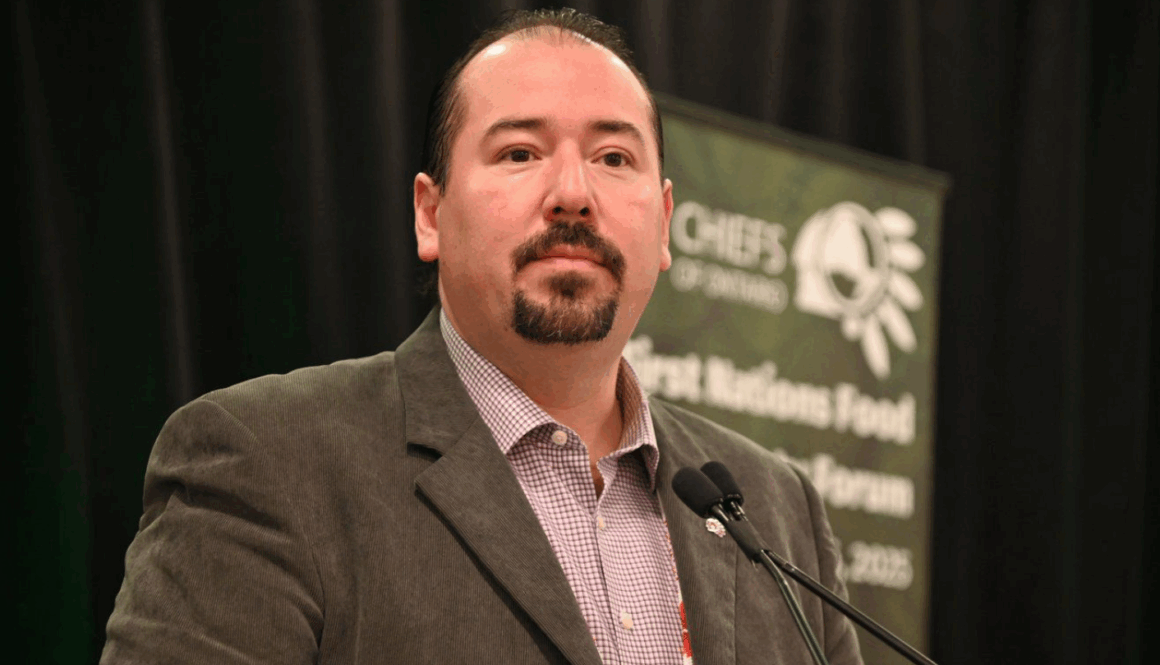
That’s according to Ontario Regional Chief Abram Benedict, who helped open the 23rd edition of the First Nations Housing Conference on Tuesday.
“Before the tariff war that has impacted … the economy in different ways, the Government of Canada was grappling with a housing shortage,” he said. “And, sadly, for many of our communities, the housing shortage, inadequate housing, overcrowded housing is nothing new.”
“We’ve had a crisis in our communities for a very long time.”
The conference brings together community leaders, housing managers, government funding agencies, builders and maintenance people, industry representatives and more to work to improve housing in First Nations through an Indigenous-led lens.
Benedict said gathering such a wide range of expertise in one place is a chance to learn and “to talk about the opportunities and the resilience that we have, together.”
Overall, though, he said making way on ensuring First Nations have the same standard of essentials like housing, clean water and electricity, “it seems like we’re continuing to push a boulder up a hill.”
Statistics published by Canada’s auditor general back the regional chief’s statement.
A 2024 report cited a study from three years prior by the Assembly of First Nations that found, Canada-wide, closing the housing gap (the state of housing as it existed in 2021 versus what is needed) was $44 billion.
That includes over 55,000 new units for homes that need replacement and to address overcrowding, another 78,000 new units for members returning to First Nations, repairing over 80,000 existing units, and providing services like water, wastewater and electricity to 112,000 lots.
“The report also estimated that an additional $16 billion would be needed for future housing needs related to population growth from 2022 to 2040,” the auditor general’s findings said.
The auditor general did also note that subsequent work by the Assembly of First Nations and Indigenous Services Canada found that $44 billion figure had roughly tripled due to inflation, significant increases in construction costs and additional factors that had not been previously considered, like climate change adaptation, energy efficiency and other maintenance.
Benedict also pointed to the importance of ensuring housing supports for members both on and off-reserve.
“It’s difficult to meet the needs in the community, it’s much more difficult to meet the needs of members outside of the community,” he said. “But they’re equally important parts of our nations.”
“Many of them want to be in our community but can’t for a lot of reasons.”
In his speech, Benedict referenced infrastructure improvements that senior levels of government have promised will happen alongside resource development in areas like the Ring of Fire “which are important to all of us.”
“But making sure that we’re doing that responsibly, we’re also making sure when we’re doing that, we’re doing that with community safety, community wellness at the front.”
“We want to make sure that we’re not compromising our jurisdiction, the jurisdiction of our communities and the sovereignty of our community in advance of that.”
By Mike Stimpson, Local Journalism Initiative Reporter
Source: SNnewswatch.com
The Impact Assessment Agency of Canada (IAAC) has decided not to conduct an assessment of the Eagle’s Nest mine project in the Ring of Fire, and at least one First Nation chief in the region is unhappy with the decision.
A thorough impact assessment must be done because Eagle’s Nest “is not an overnight project, it’s pretty much a lifetime project,” Neskantaga Chief Gary Quisess said Wednesday.
Quisess said an impact assessment for the proposed mega-mine “should be done properly — you know, it should not be rushed.”
“The Ring of Fire is a very historical area,” he added. “That’s our culture, our ancestors, where we survived from.”
Quisess said he was too busy dealing with a recent death in his remote community to comment further.
IAAC president Terrence Hubbard, in his explanation of the agency’s decision, said they considered “whether a means other than an impact assessment exists that would permit a jurisdiction to address the adverse effects within federal jurisdiction and the direct or incidental adverse effects.”
He concluded that there are other means, including mechanisms under Ontario’s Mining Act, other provincial statutes, and federal laws and regulations.
He also noted that the mine’s proponent, Australia-based mining giant Wyloo, “has been actively consulting with numerous Indigenous groups, working to address potential impacts of the project.”
The Eagle’s Nest property, located some 540 kilometres northeast of Thunder Bay, is rich in nickel, platinum group metals and copper.
Wyloo estimates its proposed mine could operate for at least 12 years and produce 15,000 tonnes of nickel annually.
The timeline on Wyloo’s Eagle’s Nest webpage has construction beginning in 2027 for production to start in 2030.
The Ontario government has signed partnership agreements with Webequie First Nation and Marten Falls First Nation to move Ring of Fire development forward.
Those deals include roads to link the remote Treaty 9 communities to Ontario highways.
Marten Falls submitted a comprehensive environmental assessment for its proposed all-season access road on Feb. 20.
The environmental assessment for the all-season Webequie Supply Road has also been submitted.
Webequie and Marten Falls are both aiming to begin construction of their roads this year.
Public consultations are underway for the Northern Road Link, a proposed all-season road that would run between the Marten Falls and Webequie roads.
The Marten Falls, Webequie and Northern Road Link roads are the core of what Premier Doug Ford’s government has called a “corridor to prosperity” — land access to the Ring of Fire, where Wyloo and other companies hope to establish mines.
Neskantaga has expressed opposition to Ring of Fire development moving ahead without its participation and consent, and even vowed to block the corridor.
By Nathalie Sturgeon, Local Journalism Initiative Reporter, The Courier
This is the first article in a two-part series that examines the province of New Brunswick’s decision not to make training mandatory for municipal officials, instead providing a voluntary option.
A recommendation by the Local Governance Commission (LGC) to make training mandatory for municipal leaders and staff will not be implemented by the Department of Local Government (ELG).
In September, the LGC said mandatory training would address the ongoing challenges many local governments have faced since municipal reform in 2023.
Commission Chair Gisele Goguen said in a release at the time that failure to complete the training should result in appropriate sanctions.
Local Government Minister Aaron Kennedy told Goguen in a letter that the department will work with the municipal associations to provide a “comprehensive orientation program” for elected officials and administrative staff following the May election.
However, the department rejected making it mandatory.
“The department has decided to focus [its] efforts in the coming months to address the barriers which may have prevented elected officials from engaging with the training offered in partnership with the municipal associations,” the letter reads.
In the months following the recommendation, the commission also released an advisory warning that code of conduct and conflict of interest meetings could not be held in closed session, and were wrongly being dealt with under Section 68(1)(j) of the Local Governance Act (LGA) as “labour and employment matters.”
The LGC cited two decisions that demonstrated elected municipal leaders could not be considered employees of the local government.
Several exemptions listed under Section 68(1) of the LGA in which council may enter closed session during a council meeting include legal advice and personal information as defined in the Right to Information and Protection of Privacy Act.
Both Eastern Charlotte and Saint Andrews raised concerns about the advisory, saying the complaint process could be used inappropriately. The council in Saint Andrews asked ELG to create a standardized process for councils in New Brunswick to follow, but the department said it would be up to each municipality to consult legal counsel on legislative interpretation.
In St. Stephen, the council removed all references to closed sessions in accordance with the advisory, apart from the exemptions under Section 68(1), particularly for legal advice.
“It’s only been three years — three years and a bit — since we started these communities. It takes time and it takes effort to build community, and training is a fundamental block of that. We need to ensure that all communities have access to the information they need, and the support, and the resources.” – Dan Murphy, Union of Municipalities of New Brunswick
Goguen said in a statement to The Courier that it was disappointed the department decided not to move forward with mandatory training.
“The commission continues to maintain that mandatory training in the key areas we have identified would be the best and most efficient way for the department to ensure that local government leaders have consistent access to the tools, information and foundational knowledge necessary to help them serve their communities,” she said.
Goguen said the commission will continue to advocate for mandatory training, calling it a “critical component of strengthening local governance across our province.”
Meanwhile, the executive director of the Union of Municipalities of New Brunswick (UMNB) said he was surprised by the department’s decision.
Local Government Minister Aaron Kennedy meeting with the Union of Municipalities of New Brunswick.
“Our association, the other municipal associations [and] our members came through loud and clear that they thought this was important. So it was surprising for us at the end of the day,” Dan Murphy said.
He said there is room for standardized training through the department.
“Having some type of requirement and creating [a] culture around ongoing training is important, and I think the department understands that. It’s something that we’re working on in collaboration with them, but I think the decision not to move forward with the mandatory training part means that there’s going to be a patchwork element to it, and so we need to figure out how to address that,” he said.
Murphy said he hopes that patchwork doesn’t put municipalities in the same situation they faced with code of conduct and conflict of interest.
“I think we were all working hard so that that doesn’t happen, but local governance reform is ongoing,” he said. “It’s only been three years — three years and a bit — since we started these communities. It takes time and it takes effort to build community, and training is a fundamental block of that. We need to ensure that all communities have access to the information they need, and the support, and the resources.”
Murphy said work with the department is ongoing, including some of the pre-election work mentioned by Kennedy and voluntary training offered through the two associations.
Jurisdictional scan, decision
The department did a jurisdictional scan, which identified six of nine provinces as requiring mandatory training for elected officials.
On Nov. 3, documents show the research identified Alberta, Manitoba, Quebec, Nova Scotia, Prince Edward Island, and Newfoundland and Labrador, with Nova Scotia and Prince Edward Island identifying code of conduct training as mandatory.
“The most common enforcement mechanism for non-compliance is the imposition of sanctions, including suspension of duties,” the advice-to-minister report on Nov. 3 said. “As part of the jurisdictional scan, in some instances no sanctions were identified for mandatory training requirements.”
It also said that in 2023, post-amalgamation, ELG hosted a local governance orientation that included seven virtual sessions for elected and non-elected officials and one in-person session over a three-week period. Average participation was 281 — more than two-thirds of the 401 officials elected in 2022.
Emails show the department decided in November it would not proceed with mandatory training, despite not notifying the commission until December.
On Nov. 14, department official Grace Lee Cutler wrote to Assistant Deputy Minister Jennifer Wilkins that mandatory training was “not proceeding.”
However, emails show department staff weren’t preparing draft responses to the commission’s recommendations until a month later. On Dec. 19, a letter from Kennedy was sent to Goguen saying the “department would not move forward with an amendment to the Act at this time.”
“We’re going to work together.” – Local Government Minister Aaron Kennedy
Several municipalities in New Brunswick have come under the supervision of ELG. Both Miramichi River Valley and Sunbury-York South were placed under supervision due to resignations and loss of quorum. Strait Shores and Lakeland Ridges are under supervision due to internal turmoil, code of conduct violations and dysfunction.
The local government minister said there is too much hang-up on the word mandatory.
“There [have] been [a] myriad of training opportunities over the last three years since local governance reform was put in place,” Aaron Kennedy said in an interview with The Courier. “There will be a robust post election training that will be available to the newly elected officials and folks who were previously elected, who get reelected, and we are going to do the best that we can to encourage those people to take part in the training.”
Kennedy said the plan is to identify the barriers for people who do or don’t participate and try to elevate them. He said the issue becomes whether mandatory training fits within the democratic process.
“If councillors … decide that, for whatever reason, they’re not taking part in mandatory training and then the minister of local government comes in and says, ‘well, that’s lovely, but that’s your decision not to take part in the mandatory training and now these are the repercussions,’ whether it’s a suspension or vacating the seat as extreme as that. I mean these people have been elected. That’s the democratic process,” he said.
The department will make participation part of the public record, he explained, adding constituents can view that for themselves, question the councillor or mayor, and hold those individuals to account during the next election.
“We’re going to work together,” he said. “The department is there daily to field calls from mayors and councillors and CAOs. If there’s any way that we can assist, sometimes on mundane day-to-day things, we’re able to do that.”
Kennedy said cost was not part of the decision not to move forward.
“I think when we look right now, we have three out of 77 local governments in New Brunswick that are under a supervisor. So that means 74 that aren’t,” he said.
He added the one thing the municipalities placed under supervision have in common is that they were all newly created.
“One could argue that they were victims of forced amalgamation from the previous government. They weren’t happy, I think it’s fair to say, becoming a municipality in areas that were formerly in local service districts, so there was that sort of frustration, is probably the best word to use going into that process.”