A youth allegedly involved in terrorist activities of the 764 Network has been placed on a terrorism peace bond.
Late last year, the RCMP Federal Policing – Eastern Region’s National Security Enforcement Section (ER NSES) in New Brunswick began an investigation into a youth who was an active member of an online group in the 764 Network.
The Fredericton Police arrested the youth for uttering threats and public mischief.
The RCMP continued the investigation into the youth’s alleged participation in activities of a terrorist group.
The youth appeared in Fredericton youth court on Wednesday and was placed under the conditions of a terrorism peace bond.
The youth can’t be identified under the Youth Criminal Justice Act.
According to police, the youth allegedly used social media to promote the “violent ideology” of 764. The group was recently added to the federal government’s terrorist entity list.
A press release from the RCMP describes 764 as a group that uses social media and online gaming platforms to recruit and radicalize individuals, spread propaganda and violent extremist narratives, and incite violence online and off-line.
The youth in this case is believed to have been actively extorting victims to self-harm, making threats to schools in New Brunswick and the United States, and producing and distributing online material with the aim of gaining notoriety for the 764 Network.
Police said the terrorism peace bond can be used when investigators are concerned a person’s actions could contribute to a terrorist offence, enabling the use of “robust monitoring and de-escalation tools.”
Insp. Aaron Glode, the officer in charge of the ER NSES said the investigation highlighted the threat of exposure to extremist online spaces and in peer-to-peer networks.
“Be aware of who your children are talking to online and take note if they start to become more private or withdrawn,” Glode said in a release.
ER NSES has been running an education campaign with New Brunswick law enforcement agencies to raise awareness of this trend.
More information and safety tips can be found here.
You can officially begin filing your taxes on February 23.
More than 614, 000 New Brunswickers chose to file their 2024 tax return online, which is 95 per cent.
More than 35,000 people in New Brunswick received assistance from a free tax clinic through the Community Volunteer Income Tax Program to help them file their returns.
Across Canada, the Canada Revenue Agency (CRA) received more than 33 million tax returns, with 93 per cent filed online. Over 19 million refunds were issued.
The deadline for most to file and pay without an interest penalty is April 30.
If you need assistance to complete your return, there are free tax clinics available.
UK police have reportedly arrested former Prince Andrew on the morning of his 66th birthday in connection on suspicion of misconduct in public office linked to the Epstein files.
Multiple outlets claim the arrest follows allegations that he shared confidential information with known child sex offender Jeffery Epstein while he was still serving in public office.
Andrew was stripped of his official royal title in October. Around that time, his friendship with Epstein was made public again after survivor Virginia Giuffre published a memoir naming Andrew. In it she claims to have been trafficked by Epstein and had sex with Andrew when she was 17.
Thames Valley Police originally released a report stating that they “understand the significant public interest in this case” but “will not be naming the arrested man, as per national guidance.”
The news comes just a day after reports suggested the former royal would begin receiving a significant state pension following his birthday today, February 19. Instead, he was taken into custody early this morning.
‘The law must take its course’: Buckingham Palace issues statement
King Charles has issued a statement following the arrest of his brother.
He says, “I have learned with the deepest concern the news about Andrew Mountbatten-Windsor and suspicion of misconduct in public office. What now follows is the full, fair and proper process by which this issue is investigated in the appropriate manner and by the appropriate authorities.
“In this, as I have said before, they have our full and wholehearted support and co-operation. Let me state clearly: the law must take its course. As this process continues, it would not be right for me to comment further on this matter. Meanwhile, my family and I will continue in our duty and service to you all. Charles R.”
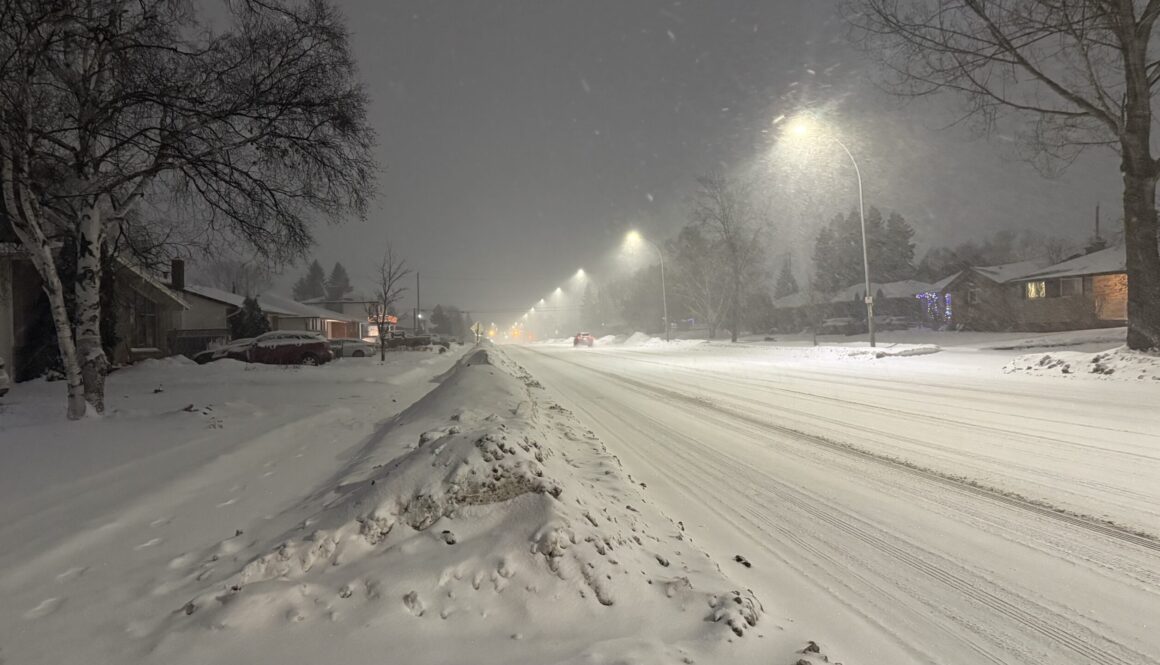
You may still be digging out from the storm Thursday morning, but more snow is on the way.
The bulk of it fell throughout the day Wednesday and stopped overnight.
But it has started up again for the city, and Environment Canada says you could see between 5 cm and 10 cm by Thursday afternoon.
If you have to go out, blowing snow will make it quite hard to see, they say, with gusts reaching up to 60 km/h. The worst of that wind will hit the shore of Lake Superior.
But Environment Canada says the conditions should improve this afternoon.
511 Ontario says many roads near and around the city are partly covered in snow, but as you head south toward the border, it only gets worse, with most roads totally covered in snow. Rural schools are closed, and there will be no rural transportation for the day, either. Here is a full list of schools.
The Northwest Region OPP is also warning drivers about road conditions. In a video posted to social media early Thursday morning, they show the conditions could vary significantly depending on the road.
The Board of Governors of St. Thomas University have appointed Sandra Irving as Chancellor.
Irving received an honorary degree for her societal contributions from St. Thomas in 2017. She earned her Bachelor of Arts with distinction from the University of New Brunswick Saint John and a Master of Arts from the University of Toronto.
“Sandra Irving has long been a champion of higher education and a leading supporter of students in the region, so we are honoured that she has agreed to become Chancellor during this exciting time in our development,” said Vaughn Sturgeon, Chair of the St. Thomas University Board of Governors.
Irving will succeed the Hon. Graydon Nicholas and will be installed at STU’s Spring Convocation on May 20, 2026.
“What Sandra Irving and her late husband, Arthur, liked to do best was help students. She is an advocate for young people, embodying the values of higher education and community service. As Chancellor, she will reflect the aspirations of our students and alumni,” said President and Vice-Chancellor Dr. M. Nauman Farooqi.
Farooqi added that Irving and her late husband have made an enduring and transformative contribution to higher education in New Brunswick and across Canada.
Irving is a member of the Order of Canada and the Order of New Brunswick for her contributions as a philanthropist and community volunteer. She has also received the Queen Elizabeth II Golden and Diamond Jubilee medals, a Paul Harris Fellowship from the Rotary Club, and the Canadian Red Cross in New Brunswick Humanitarian Award.
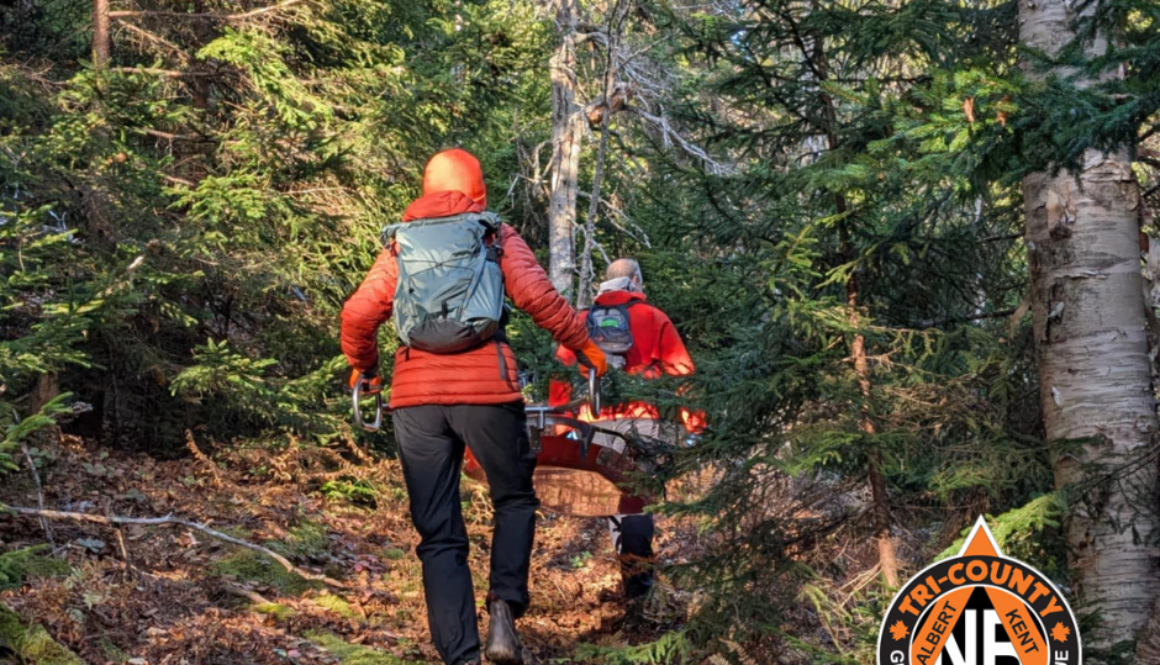
Tri-County Ground Search and Rescue was formed in November 1987 and has been operated on volunteer time since. The team is now approaching their 40th year in service.
Nick Kennedy, Vice President of External Affairs, has been with TCGSAR for four years.
Kennedy says the team started by looking for people predominantly in the wilderness or remote locations. Over the years of TCGSAR’s development, the team has done everything from evidence searches with the RCMP and local law enforcement to covering both national parks and the three counties in their area: Albert, Kent, and Westmoreland counties.
“We’ve expanded exponentially from some concerned citizens to a professional service of volunteers,” said Kennedy.
TCGSAR is 100% volunteer operated, so it can be activated by the agency having jurisdiction, which is typically an RCMP detachment. However, any agency can activate Tri-County, such as various police forces, Emergency Measures Organization (EMO), National Parks, or any of the other nine ground search and rescue teams, for a request for mutual aid services. TCGSAR also provides additional aid to civil power capabilities, such as mapping and door-to-door wellness checks during evacuation notices for wildfires.
Volunteers train three times a month, according to Kennedy.
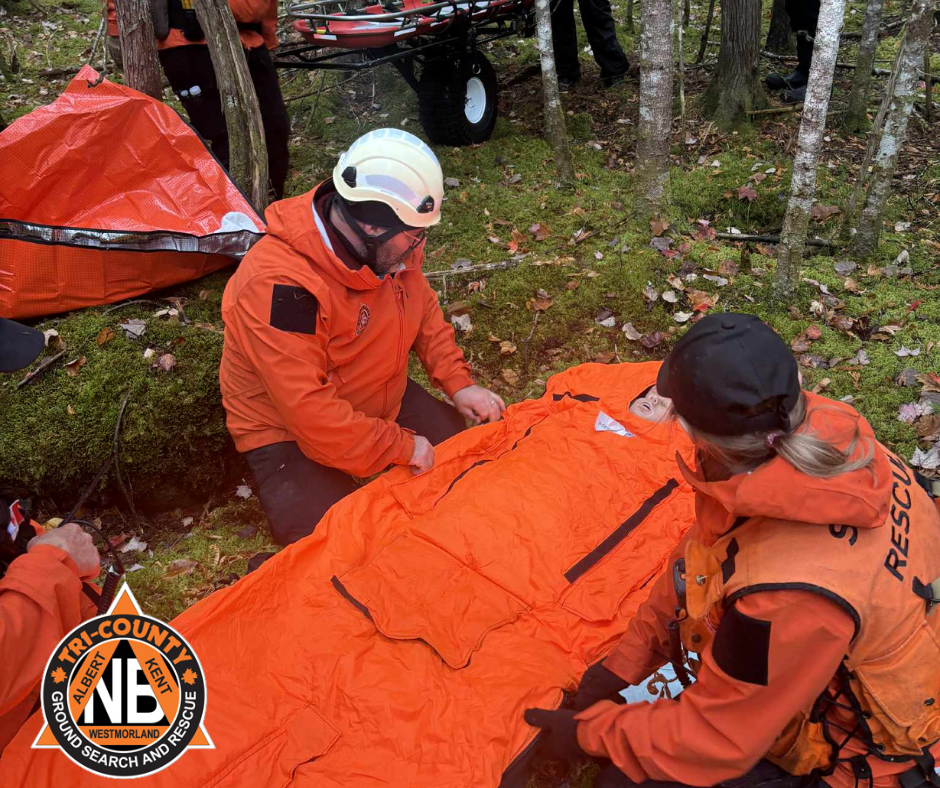
Members of TCGSAR performing a mock search (Submitted: Nick Kennedy, VP External Affairs)
“We train twice a month on evenings as well as one day long during the third Saturday of each month. We will come together and either do a mock search for a missing subject profile, map and compass, or various training, be it extrication, medical skills, or radio communications. We are on call 24/7/365, but there are also core skills and standards that we hit on a yearly basis to ensure that our members are ready to respond at a moment’s notice.”
One incident the team was involved in recently was in Upham, N.B., last winter, where they had an individual go missing in the woods for nearly 14 hours. With the assistance of K-9 police services and TCGSAR members serving as flankers, they were able to locate the individual and provide immediate medical assistance.
“We extricated the individual and did a proper handoff to Ambulance New Brunswick paramedics, resulting in an extremely positive outcome in a situation that otherwise might not have been,” said the executive director.
This was one of 36 activations for the group in 2025. The team did 66 percent of these activations in their coverage area, and the rest were aid to civil power or assisting another GSAR team.
“It’s no secret that we’re an aging population in NB, so we are seeing a lot more of Alzheimer’s or dementia wandering type calls where family would be concerned about wandering away from a residence. We are also seeing an uptick in despondence. Mental health is also not trending in the best of directions, so we could be activated for that, as well as missing children,” explained Kennedy.
TCGSAR sent members to Nova Scotia to assist in the missing Sullivan children case.
“When receiving a call-in, one of our search managers will get together with the incident commander from the RCMP and say, ‘Hey, this is how we best feel we can make a difference. Is this the right fit for us? How many other teams do we want to activate?’ and then we make an activation plan.”
There has been one activation this year thus far where the subject was located shortly after, with the assistance of the RCMP, but TCGSAR never made it on the ground.
“We set up a meeting point, usually close to the point last seen, and ideally headed towards the direction of last known travel. Taskings will get created using some scientific methods – namely Robert Koester’s Lost Person Behaviour Reference Book – and from there, teams will deploy, predominantly looking for clues.” “People think it’s like in the movies, where we make an extended line and walk forward until we find them, but that’s not the case. Often times we are looking for articles of clothing, other clues such as a smoked cigarette or an empty water bottle that someone might have left behind, so on and so forth. These all help us gather information and more precisely target where we think a person might be lost.”
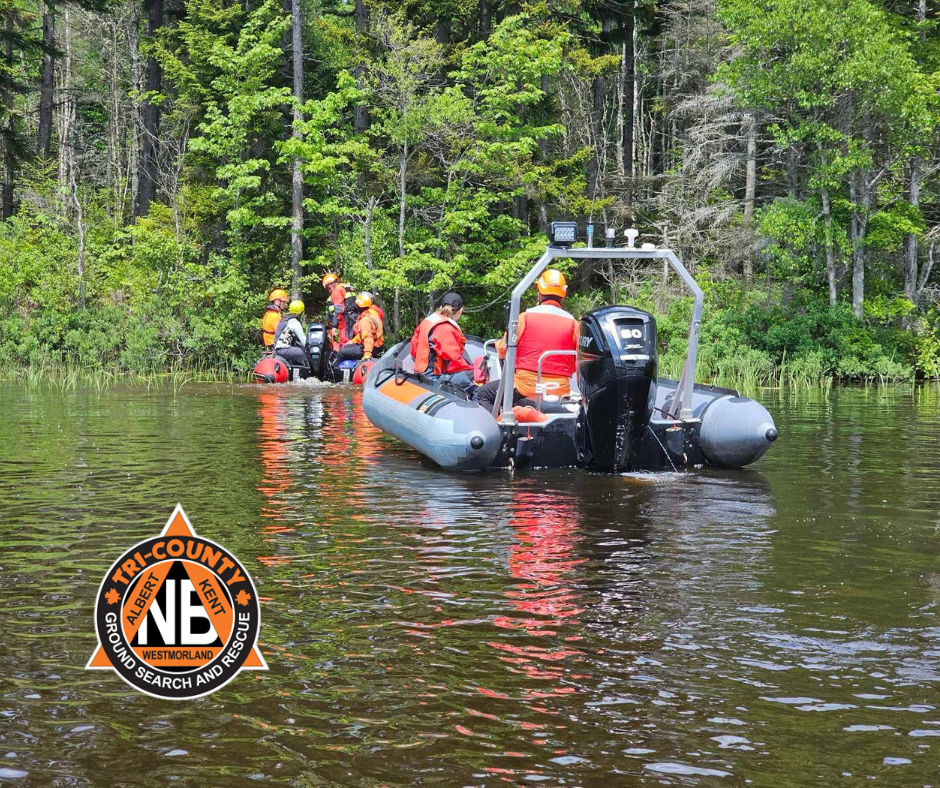
Members of TCGSAR during a search. (Submitted: Nick Kennedy, VP External Affairs)
The budget for TCGSAR is funded by EMO through the Government of New Brunswick. The New Brunswick Ground Search and Rescue Association (NBGSARA) receives the funding and distributes amounts to all 9 teams in the province. TCGSAR receives anywhere from $3,000 to $11,000.
Just to keep two vehicles and a trailer running, Tri-County’s operating budget can exceed $25,000 a year.
“If our members aren’t out actively volunteering, being reimbursed for mileage by the RCMP, who we have a great relationship with, obviously, we’re going to come up short in that. So, we have multiple fundraisers a year and a lot of members who donate their mileage checks back to the team to ensure that we’re able to keep running.”
Tri-County’s budget goes towards vehicle maintenance, gear upkeep, training, and insurance.
“Tires expire, trailers require replacement, and GPSs require upgrades. Recently, we acquired, through a very generous donation, a $16,000 thermal drone. Just being able to keep that insured and our members qualified costs a lot of money,” said Kennedy.
TCGSAR’s end-state goal is to get a home for their equipment. Unlike volunteer or paid fire departments, which people predominantly think of as having a primary station, Tri-County does not.
Their equipment, regardless of conditions, is in the elements constantly. TCGSAR has a compound where they can park and lock their vehicles and trailers, but their response times are delayed because they have to gather their equipment from several locations.
For example, they keep a majority of their equipment locked up in an office that is generously donated by the Air Force Vets club.
“The end state goal would be all equipment in a heated building, able to respond at a moment’s notice, without delay,” said the vice president, “we can handle the recruiting, we can handle the training, but right now, we need a place to store our vehicles and call home.”
One misconception that Kennedy sees at TCGSAR is that a lot of people think they must wait a certain amount of time before reporting someone missing.
“That is simply not the case. You can report someone missing to your local law enforcement at any time, and then, depending on the scenario, they will reach out to us, and we might make the decision to activate. You do not contact us directly; you contact your local law enforcement, and they will get the ball rolling as soon as possible to activate us.”
For more information about Tri-County Ground Search and Rescue, visit their website.
By Carl Clutchey, Local Journalism Initiative Reporter
Source: The Chronicle-Journal
Citizens groups opposed to a proposed underground storage site for spent nuclear-fuel rods near Ignace say they’re heartened by the level of push-back against the project.
A federal agency reviewing the Nuclear Waste Management Organization’s proposal received more than 600 comments when the project’s initial project description was put out for feedback over a 30-day period that ended on Feb. 4.
“The public stepped up and did their job and did it very well,” Northwatch co-ordinator Brennain Lloyd commented in a news release this week.
Most of the comments to the Impact Assessment Agency of Canada were negative, but a few were supportive, including a letter from Ontario Power Generation, which operates nuclear power plants in the province.
A spokesman for the Nuclear Waste Management Organization (NWMO) said “the number of submissions and comments shows that the (review) process is working as intended.”
“We look forward to receiving and responding to the summary of issues when we receive it later this month.”
Lloyd said the assessment agency has “a mountain of work to do” ensuring its summary of issues “actually reflects what they have heard.”
Nishnawbe Aski Nation and Treaty 3 were among the Indigenous groups expressing concerns about the underground storage site project.
A long-standing sticking point has been how the nuclear fuel rods — which remain radioactive after use — will be transported to the proposed storage site, formally called a deep geological repository (DGR).
Used fuel rods are currently stored at nuclear power plants; environmental groups say that practice should continue.
Opponents of the deep geological repository project were dismayed when the transportation issue wasn’t included in the NWMO’s initial project description, but the impact assessment agency later said transportation could still be part of the review process at some point.
The Nuclear Waste Management Organization has said fuel rods could be railed or trucked in specialized containers designed to withstand hard impacts and fiery crashes.
Some Indigenous and municipal leaders in the Thunder Bay district have also expressed concerns over how the rods may be transported, given the high number of serious road crashes in the region involving heavy trucks.
By Sandi Krasowski, Local Journalism Initiative Reporter
Source: The Chronicle-Journal
Thunder Bay Chamber of Commerce president Charla Robinson says there are several steps the Ontario government can take in its 2026 budget to help the city achieve its growth potential.
The chamber forwarded its priorities to the government last month during the province’s pre-consultation process for a budget document that is expected to be released before the end of March. With 800 member companies under its wing, the Thunder Bay Chamber of Commerce represents nearly 20,000 employees in the community.
“It’s about our workforce and supporting our post-secondary institutions to make sure we have appropriate training programs for it,” said Robinson.
Immigration has been an ongoing matter for which the chamber has advocated. The immigration programs must meet the needs of Northern Ontario, and Robinson said some specifics are set aside from the provincial program that are required in the North.
“We included that we need to make sure we have the workers that we need and that they’re trained for the jobs that we have,” she said.
Another priority is about economic opportunity, and Robinson pointed out the need for support for the forest sector as they transition out of products that are in declining demand, such as newsprint, and pivot to new types of wood products such as biomass.
“We are asking for the government to keep those in mind to support the advanced wood construction and biomass action plans to ensure that they have the support they need to go through this transition in the middle of all of these trade threats,” she said.
The other opportunity is around mining. The Ontario Chamber of Commerce recently released a report called Mining 2030, and How to Unearth Ontario’s Potential.
“They identified several steps that they think the province should take to make it better for us to capitalize on the mining opportunities that we have,” she said.
“We identified a few around an exploration tax credit, and the Northern Energy Advantage program, which is an energy pricing program for large industry.”
Robinson added that they want to make sure they have the infrastructure strategy in place to ensure the housing, health care and highways support the growth that the mining sector can bring.
“Our final pieces were really about local community issues and the need for healthy, sustainable communities to ensure that we can grow our economy,” she said.
“We’re encouraging the government to keep working with municipalities to address things like substance use, homelessness and some of those social issues that are really impacting our community and our ability to grow.”
The chamber is also voicing its opposition to the proposal to merge the Lakehead Region Conservation Authority with a conservation authority in southern Ontario.
“We are urging the government to keep that a standalone. We put it in the budget document because it was originally rolled out as part of the financial update last fall by the minister of finance,” Robinson said, adding they hope that this will be reversed as part of the upcoming budget, based on the fact that it was aligned with other budgetary measures.
Canada plans to invest hundreds of billions of dollars over the next decade into a new plan to build and buy Canadian-made military products wherever possible.
In an announcement on Tuesday in Montreal, Prime Minister Mark Carney touted the new Defence Industrial Strategy.
It calls for $180 billion in defence procurement and $290 billion in capital investment into defence-related industries over the next decade.
The federal government anticipates $125 billion in downstream economic benefits from the plan by 2035, and promises 125,000 new careers in the industry.
Speaking in Montreal, Carney highlighted that Canada’s political situation is rapidly changing, and veering into the unknown: “The various assumptions which have defined Canadian policies in terms of defence and foreign affairs, these assumptions have been completely upended.”
Canada’s new defence industry plan will focus on building up self-reliance and reducing dependency on a small number of military suppliers.
The plan aims to up defence exports by 50 per cent, and award 70 per cent of defence acquisitions to Canadian firms.
“The truth is, over the last few decades, Canada has neither spent enough on our defence nor invested enough in our defence industries. We’ve relied too heavily on our geography and others to protect us,” Carney explained. “This has created vulnerabilities that we can no longer afford, and dependencies that we can no longer sustain.”
A larger breakdown of the new plan can be found on the federal government’s website.