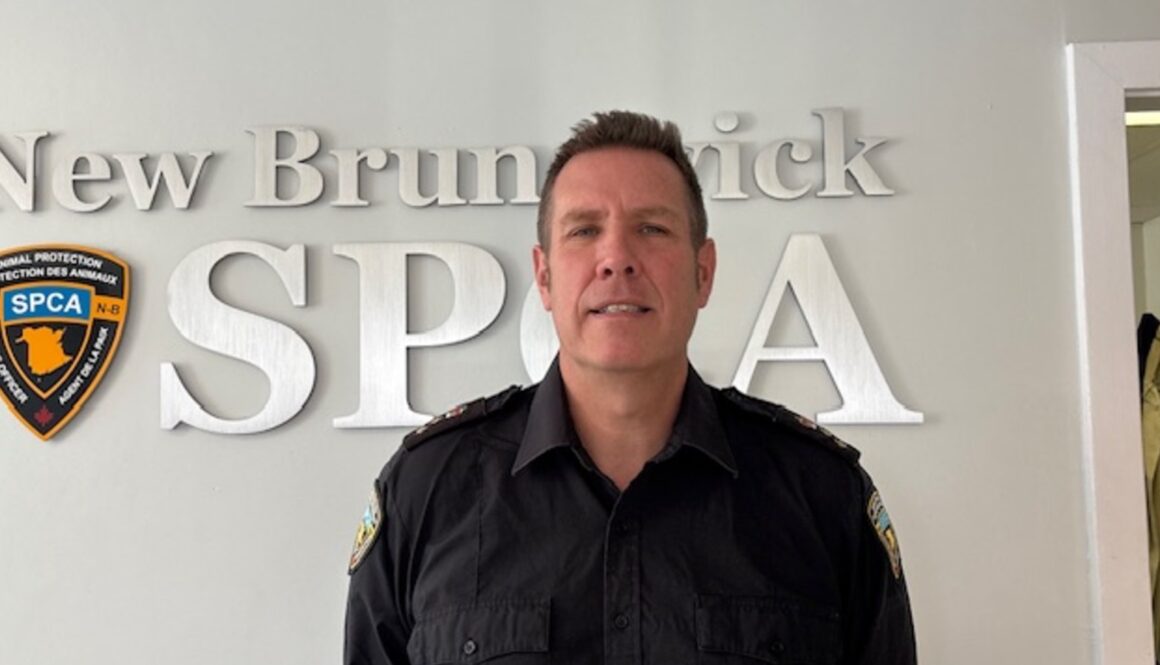
The New Brunswick SPCA has a new chief animal protection officer.
Don Metcalfe says he wants to put more focus on prevention and community outreach as the organization responds to rising call volumes.
Metcalfe moved into the role after the retirement of longtime chief Tony Porter, who served eight years in the position.
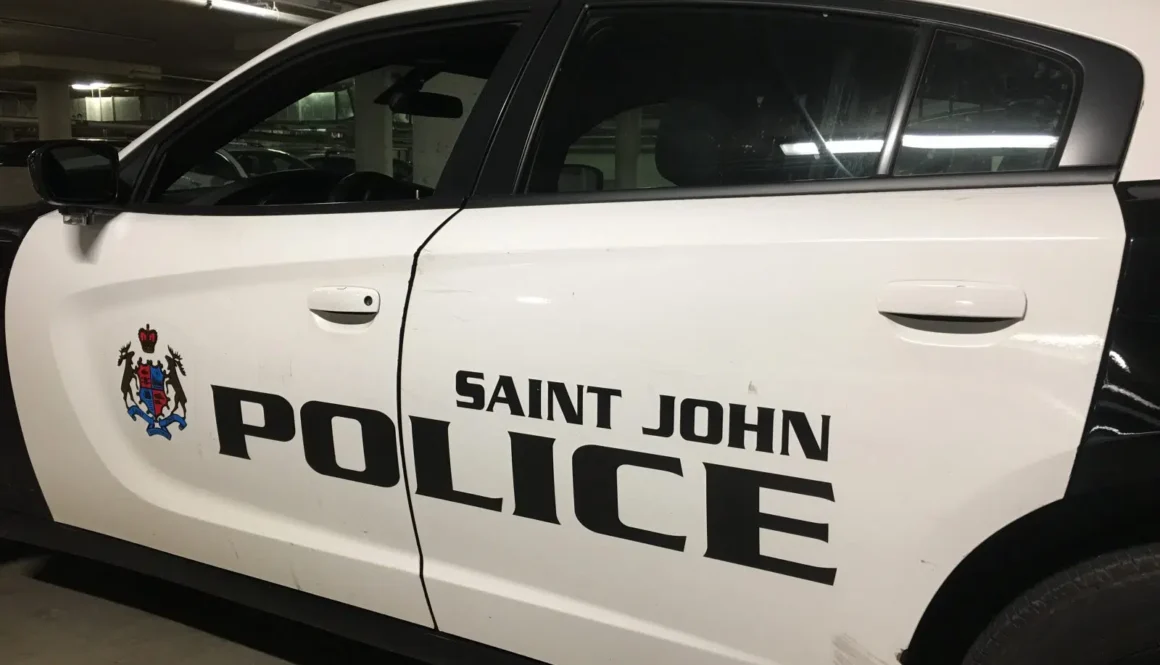
He spent more than three decades in policing, including 29 years with the Saint John Police Force.
Metcalfe said the position lets him combine his enforcement background with his commitment to animal welfare.
“I’ve been an animal lover my whole life. We’ve been dog people since I was young, and I am truly all about the protection of animals and their welfare. It’s really important to me,” he said.
He also spoke about the role pets have played in his own life, including his Airedale terrier, Baxter, and his late pug, Bella.
Don Metcalfe with his Airedale terrier, Baxter. Image: Submitted by Don
Metcalfe said animals have always been a source of comfort during stressful days and a reminder of why the work matters.
Metcalfe said his years in community policing shaped how he approaches the job.
He said he wants to build stronger partnerships with residents, schools and local organizations to help prevent neglect before it occurs.
He pointed to the NBSPCA’s Happy Tails program as an example of early support that can keep pets in their homes.
The program offers financial help to owners who are struggling with basic veterinary costs.
Metcalfe said call volumes have increased in recent years, especially in Moncton, Fredericton and Saint John.
He said officers often cover large areas and manage heavy workloads, which can limit the amount of proactive education they can provide.
Shelters across the province also play a key role in the NBSPCA’s work.
“They go above and beyond to help us. I truly don’t know what we would do without them,” Metcalfe said.
He said he hopes a stronger focus on education and community engagement will help reduce calls over time while supporting officers in their day‑to‑day work.
The Premier insists the province’s small communities are being recognized by his government.
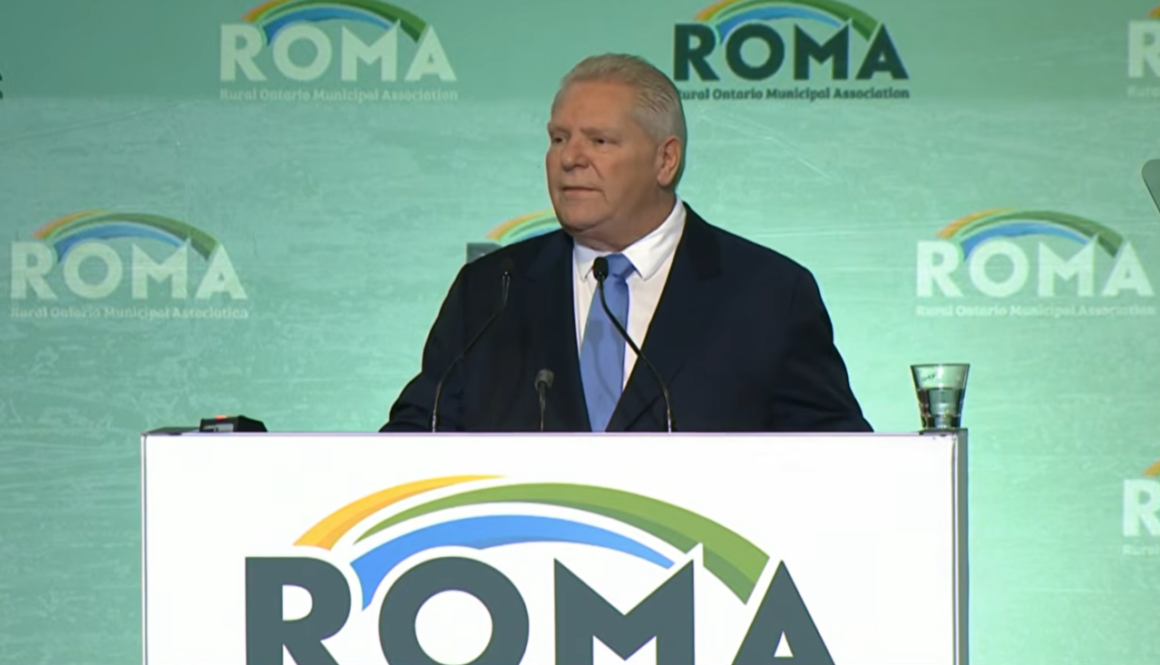
Doug Ford addressed municipal leaders attending the Rural Ontario Municipal Association conference in Toronto on Monday, outlining funding and programs that benefit small, rural and northern communities.
Ford adds that no government has invested more in the north than his.
“We think it’s the greatest area to prosper and thrive and grow and attract businesses, no matter if it’s the lumber, no matter if it’s our energy that we’re building or the Ring of Fire and everything else in between,” says Ford.
Ford noted specific investments in roads, housing, and transit.
This includes spending $30 billion over the next 10 years to repair and expand roads, highways and bridges, especially in rural areas.
He says it is necessary to improve safety.
“It’s been very disturbing to hear all the accidents up north,” says Ford.
“I get the calls right to my cell phone, and we’re doing everything we can to twin roads, to put two in one roads, to make it safer, making sure that the roads get plowed and salted as quickly as possible because there’ve been tragedies over the holidays and no one wants that.”
Ford also noted the $70 billion to improve transit services, with $25 million earmarked for small communities.
The province is also making $400 million available to small, rural and northern communities to develop or upgrade infrastructure to add to new housing projects.
The town of Fort Frances is lobbying for tax changes affecting microbreweries.
Ontario’s tax laws classify them as industrial due to the presence of brewing equipment on site.
Mayor Andrew Hallikas says they do not justify a higher tax rate.
“What’s not fair to me is that classification applies to the entire premises. Although the part that’s actually doing the brewing could be a very, very small part of the footprint of the business,” says Hallikas.
Hallikas says the entire building, including the restaurant, bar and other public seating areas, falls under the industrial classification, using the same tax rate that would be applied to a sawmill, auto plant or other manufacturing facility.
He says brew pubs are primarily hospitality venues.
Hallikas pressed the idea of a mixed tax rate to officials with the Ministry of Finance while attending the Rural Ontario Municipal Association conference in Toronto.
“We get a lot of people coming to town because of the good name of our local brew pub,” says Hallikas.
“They’re a really essential part of revitalizing downtown cores of small communities. So we want to make sure that they’re treated fairly under the current tax framework.”
Microbreweries received a tax cut last year when the province introduced lower alcohol tax rates.
The annual Voyageur Winter Carnival is returning to Thunder Bay in February with a slate of winter activities in its lineup.
On the weekend of February 14 and 15, from 11 a.m. to 5 p.m., the carnival will offer attendees the chance to go skating or curling on the Kaministiqua River, try snow sports such as snowshoeing, and learn about winter survival skills.
The carnival will also feature live music and farm animals.
The fort is also hosting Indigenous Night Sky Storytelling events on February 5, 19, and 26 at the David Thompson Astronomical Observatory from 7 p.m. to 9 p.m.
As well as stories, the Night Sky events will feature the observatory’s meteorite collection and space exhibits, and those in attendance will be able to learn about the Anishinaabe star chart.
Details on upcoming events can be found on the historical park’s website.
The Thunder Bay Public Library is encouraging locals to pop by for free events and community gatherings throughout the month of February.
From babies to retirees, the library has something for everybody in their newly released schedule.
Programming includes weekly beading, knitting, gardening and hip-hop classes. There’s a chess club, spice club and travel club as well.
Parents of small children can enjoy programs like play days and family storytime sessions. They can also drop in for daily Discovery Club sessions, a self-guided exploration of STEAM (science, technology, engineering, arts, math) concepts for children 4 and up.
Elderly locals can meet and socialize at weekly Retirement Explorers gatherings and a Seniors Coffee Chat.
On February 12, the library will offer free counselling for adults completing applications such as housing assistance. Downsizing With Care is an interactive, informative session on life skills for young adults planned for February 2.
For a full schedule of events and programming, visit the library website.
Most New Brunswick property owners won’t see a change in their tax value this year.
The province has mailed out its 2026 assessment notices with a one‑year freeze in place.
The provincial government said the freeze will keep 2026 taxation values at 2025 levels for about 430,000 properties.
The measure applies to residential and non‑residential properties, including heavy industrial sites.
Local Government Minister Aaron Kennedy, who is also responsible for Service New Brunswick, said the freeze is meant to give people stability while the province works on a broader overhaul of the property tax system.
He said the goal is to create a system that is more predictable, transparent and fair.
The freeze does not apply in cases where a property has changed, such as new construction, major improvements, sales or transfers, error corrections, or changes in use or classification.
In those situations, the value for taxation will be updated for 2026.
The province’s real and true market value assessment base for 2026 is $112.8 billion, an increase of 8.6 per cent from last year.
The value for taxation base — the figure used to calculate property taxes — is $99.8 billion, up 2.7 per cent.
Government figures show residential properties account for $2.5 billion of that increase, while non‑residential properties account for $0.2 billion.
Service New Brunswick said assessors continued to calculate real and true market values for 2026 and carried out reinspections to update property data.
The government said the annual assessment base helps provincial and local governments collect revenue to deliver services.
Property owners who disagree with their real and true market value can request a free review online or by calling 1‑888‑762‑8600.
The deadline to file a request for the 2026 taxation year is February 18.
Final recommendations from an NB Power review are expected by the end of March.
Surveys were issued last April, and looked at financial sustainability, governance and utility structure, customer expectations, investor attractiveness and strategic partnerships.
Engagement came from the public, rights-holders and stakeholders. Responses were received in person and by email.
Anne Bertrand, Michael Bernstein and Duncan Hawthorne lead the review.
Six themes were revealed in the results: concerns about rising rates, a need for better governance within the company, better and clearer communications from the utility, the need for an integrated and long-term provincial energy strategy, better governance within the company and from politicians and the importance of transitioning to a cleaner future.