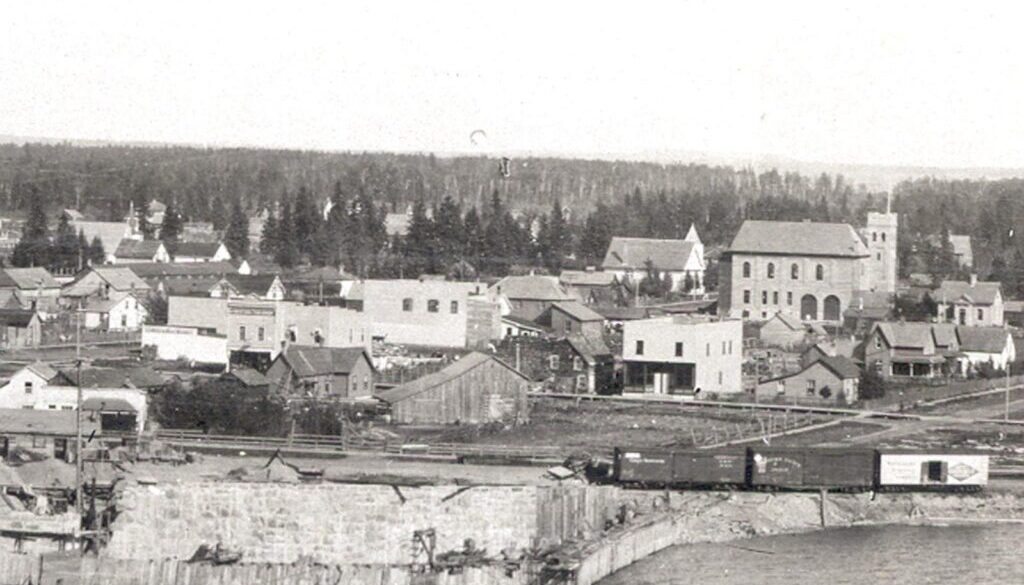
Fort Frances landscape changed by business district fire
The night sky was clear, and all was quiet in Fort Frances in the early morning hours of June 16, 1905.
A CN Train had just arrived with travellers, preparing to settle in for the night.
The still of the night was interrupted by a fire that would lead to the destruction of a large section of the town’s business community.
The flames broke out in the rear of Nelson’s Clothing Store, located at the corner of Church and Front Streets.
The travellers, who earlier departed from the train and were making their way to the town’s hotels on Front, were the first to report the fire.
Before anyone could react, the fire spread to nearby Wells Hardware.
The dry wood structures fueled the flames that quickly extended toward the Williams Block on Church St., which housed the Canadian Imperial Bank of Commerce and Fraleigh’s Drug Store.
By then, the blaze attracted several townspeople who attempted to put it out, while others removed stock from buildings in the fire’s path.
A lack of adequate firefighting equipment hindered their efforts.
Fort Frances was still in the process of setting up a fire department and had recently purchased a new steam-powered fire engine.
However, the equipment was still sitting on a railcar waiting to be unloaded.
The Koochiching fire department was prepared to lend a hand and have its steam-powered engine floated across the Rainy River on a barge.
International Falls Mayor Loel Slocum insisted that Fort Frances assume the risk should the engine fall into the river.
Fort Frances Mayor James Osbourne declined the offer, saying the risk and cost were too great.
Within a few hours after the fire started, more than a block and a half of businesses were razed before the fire could be brought under control.
Losses were estimated at $200,000, with half attributed to the H. Williams Company.
Owner W.A. Preston hinted that his losses could reach in excess of $300,000.
“The fire undoubtedly is a most serious and crushing blow to the town, coming as it does just as the opening of an era of prosperity from which great things had been hoped,” said Preston in a newspaper interview.
The initial losses and insurance coverage were outlined in the area’s newspapers.
H. Williamson Company, stock of general merchandise and buildings, $75,000 ($25,000 in insurance coverage)
Wells Hardware, $14,000 ($7,000 insurance)
Fort Frances Hotel, James Paul, $15,000
Couchiching Hotel, Thomas Wilson, $15,000 ($12,000 insurance)
Alberton Hotel, W. Bishop, $10,000 ($5,500 insurance)
W.C. Nelson, clothing, $9,000 ($6,000 insurance)
F.S. Fraleigh, drug and stationery, $4,500 ($2,700 insurance)
J.C. Scott, jewellery, $3,000 ($1,000 insurance)
D.C. McKenzie, drugs, $2,500 ($1,000 insurance)
W.A. Baker, tailor, $1,500 ($300 insurance)
Bank of Commerce, $2,500
W.G. Breckon, bakery and confectionery, $2,500 ($500 insurance)
L. Christie, meats, $2,000
Arcade Restaurant, $500
Telephone Company, $500
Holbeck Sisters, $500
F. J. Strain, barber, $200
The loss of the three hotels also left Fort Frances without a licensed establishment.
The cause of the fire was identified as incendiary, but exactly how it started was not determined.
Some suggested it was someone from the International Falls area who was interested in slowing down the progress in Fort Frances, though the allegations could not be proven.
Mayor James Osbourne promised a thorough investigation, but the damage caused made any probe difficult.
Business owners soon had to deal with looters seeking items that were still salvageable.
This forced the town to appoint special constables to watch over the area as owners moved their saved goods into barns and warehouses.
As fast as the flames had spread through the town’s business community, owners were already making plans to rebuild.
At the time of the fire, Wells Hardware was in the process of constructing a new building on what was then known as the new section of Fort Frances.
The Williams Company and the proprietors of the Fort Frances and Couchiching Hotels revealed their plans to rebuild immediately.
Within a month, the new Fort Frances Hotel had 30 rooms constructed, while the new Alberton Hotel had 15 in place.
Fraleigh, Christie, Scott and the Bank of Commerce acquired temporary buildings to resume their operations until more permanent locations could be decided.
The town council took steps to improve fire safety.
A new by-law was approved that required the use of brick construction in new commercial buildings instead of wood framing.
The new steam fire engine was removed from the rail yard and tested, with scores of residents on hand to give their nod of approval.
A new downtown centre would soon take shape, with the new main street becoming Scott Street.