Nuclear plant breaks down again just as a big chill envelopes New Brunswick
By: John Chilibeck, Local Journalism Initiative Reporter Source: The Daily Gleaner
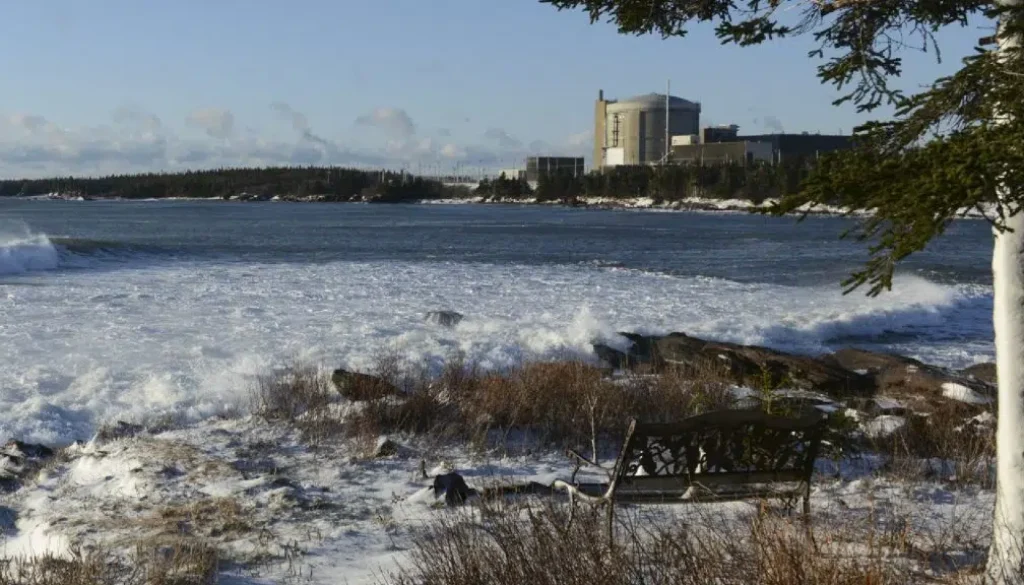
One of New Brunswick’s biggest electrical generators, the Point Lepreau nuclear plant, has suffered a breakdown just as a deep freeze grips a big part of the province.
The breakdown happened late in November, according to NB Power, when the plant was being fired up after a prolonged maintenance outage, which was supposed to end Dec. 1 in time for the cold weather.
A restart will happen sometime “later in December,” NB Power spokeswoman Elizabeth Fraser told Brunswick News last week.
Most New Brunswick households primarily use electricity to heat their homes.
Wind chills made it feel as cold as -30C last Friday in parts of the province, and since then temperatures have remained subzero.
The temperature plunge raised questions about how close NB Power was to a system shutdown, when too many people draw electricity all at once.
Fraser said that NB Power was “well-prepared with the availability of hydro generation and other baseload units.”
She wrote in an email that the Coleson Cove Generating Station near Saint John was also fired up last Friday. In addition, the public utility had to buy surplus electricity from Quebec and Maine.
It was reminiscent of what happened nearly three years ago.
On Feb. 3 and 4, 2023, a huge temperature plunge, combined with extreme wind chills, made it feel colder than -40 C in much of the province. NB Power asked industry to stop using electricity and was forced to turn on all its generators to ensure there weren’t blackouts.
It could not count on buying electricity from Quebec or Maine because they were suffering from the same cold spell and needed to use all their power.
Point Lepreau was running at the time, and no blackouts occurred.
NB Power executive Brad Coady told people months later he had been worried the province could have run out of electricity on that frigid day.
The latest breakdown at Point Lepreau didn’t please Energy Minister René Legacy.
“I’m very concerned,” Legacy told reporters at the legislature, when asked about the situation at NB Power. “They are short of generation capacity. If this is a very regional cold snap, then our neighbours might be in the same situation. And this is the regular conversation that we’re having around energy security.”
Legacy has been adamant that NB Power must build a controversial gas-powered plant in Tantramar in the southeast of the province by 2028 – or even sooner – to ensure there are no electrical shortages.
Earlier this month, neighbouring Prince Edward Island’s main electrical provider, Maritime Electric, said it was planning to avoid blackouts this winter by putting in place rolling outages.
Too many people in the tiny province are drawing on the grid all at once.
Also called rotating outages or load shedding, the practice is unheard of in the region in recent times. The same kind of preventative measures taken in California or Ukraine could come to the Maritimes next.
Rolling outages protect the power grid from a full shutdown when people use a lot of electricity all at once, especially in the harsh winter months. It would require communities and neighbourhoods to take turns temporarily losing power for a few hours at a time, to avoid a widespread blackout that would leave people trembling in the cold and dark.
Still, Legacy didn’t fear a blackout hitting New Brunswick, despite huge population growth over the last few years causing much bigger demand on the system.
“Usually, they give some kind of notification to the public. NB Power will come up with the protocol to say, ‘We need people to slow down at peak periods’,” he said. “I haven’t been advised of that.”
NB Power’s spokeswoman said the utility maintains its entire fleet of generators to ensure there’s enough electricity always being produced.
“Fuel inventories have also been reviewed and topped up to ensure availability if and when temperatures drop,” she wrote. “NB Power also has contracts in place with neighbouring utilities to ensure we have enough energy capacity in the colder months.”
The latest failure at Point Lepreau, which NB Power says was detected the evening of Nov. 29, happened only 15 days after Brunswick News had asked the public utility if there was a problem at the plant that would delay its return to service from a planned maintenance outage that started in July.
On the date that Brunswick News asked the question, Nov. 14, Fraser said the planned outage continued to “progress safely and on schedule.” She added that Point Lepreau was expected to return to service Dec. 1 as planned.
But in an update, Fraser said the plan was disrupted when workers at the plant just west of Saint John tried firing it back up. A bearing failed and needed to be replaced.
The public utility is now saying Point Lepreau should be in service later in December.
“During an early return to service and synchronization to the electrical grid, we ran into challenges on the non-nuclear side of the station with a bearing that is being replaced now,” Fraser wrote in an email.
“We are progressing with the preparation work for the installation of the bearing. This will be followed by start up activities and the connection to the electrical grid. Once the bearing is installed, we will provide an updated return-to-service date.”
The spokeswoman said getting a nuclear generating station running after an outage is complex.
“We follow rigorous safety and testing protocols to make sure all systems are operating safely,” she said. “While our team is working around-the-clock to return the station to service, this is not a process that can be rushed. Every step must be completed with the upmost focus on safety and quality.”
This is the third time in the last two years that Point Lepreau has had a breakdown, over and above planned shutdowns for regular maintenance and repairs.
The nuclear plant produces cheap power when it is running smoothly, but when it’s out of service, NB Power is forced to turn on expensive and highly polluting backup generators, such as Coleson Cove near Saint John, which burns heavy oil.
Executives at the utility have said each day Point Lepreau doesn’t run costs about $1 million on average to buy replacement power or burn fuel. But that’s an average only. During the coldest winter months, the costs can easily triple.
Fraser said it was too early to say how much the repairs or replacement power would cost.
The minister, meanwhile, said he could understand why the plant had another breakdown. Point Lepreau began running 42 years ago and underwent a major refurbishment 14 years ago.
“I mean, it’s a nuclear plant. We know that when they restart, it’s a very, very very detailed technical process. They will start at a certain percentage. If an alarm goes off, they have to go check to see what happens. For you and me, it sounds like ‘go check what happened.’ They’re not lifting a hood on a Ford F-150. These things are huge to get into and see exactly what happened and what’s caused the problem.”
The minister wasn’t aware that Maritime Electric had warned customers it might have to introduce rolling outages.
“Well, that’s one of the solutions. If there’s no power, you’re better to plan it than just have it happen. I haven’t been made aware of what Maritime Electric is doing and how long or when they’re gonna do it. But it’s happening across the world. So, to pretend it I may not happen here, I think would be imprudent.”