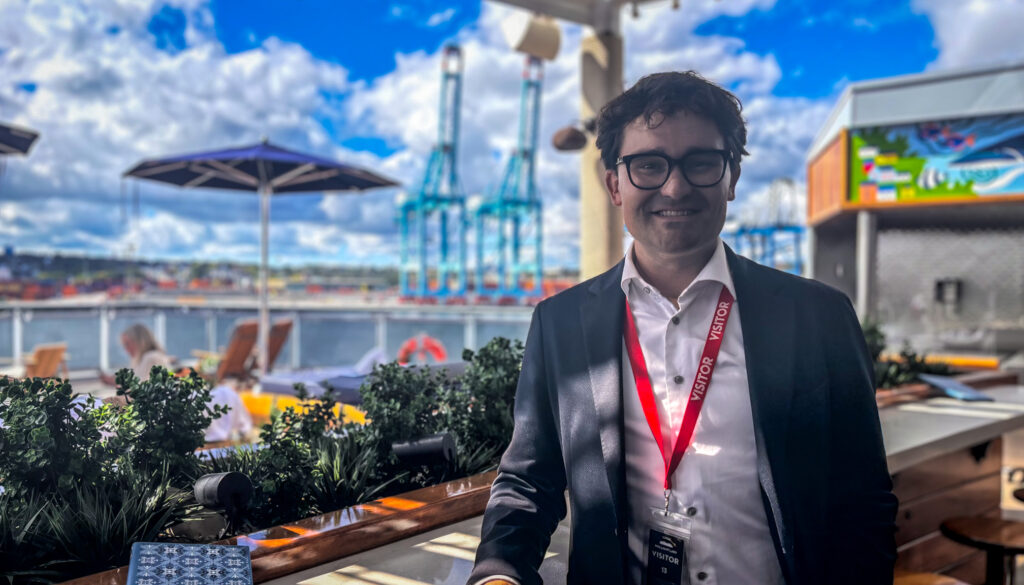
Port Saint John CEO reflects on growth and future plans
Port Saint John is closing out one of its strongest years, with strong gains in container traffic and a busy cruise season.
CEO Craig Bell Estabrooks said the year unfolded during a period of uncertainty in global trade, including new tariffs in the United States and a federal election in Canada that focused heavily on supply chains.
Even with those pressures, he said the port expects to finish between 230,000 and 240,000 20-foot equivalent units (TEUs), well above last year’s total of 180,000.
Estabrooks said the growth reflects a decade of planning tied to the port’s modernization program.
“You know, 10 years ago when we dreamed of the modernization and got the funding in place and started building, we knew it was going to take some time to achieve the volumes that we’re getting today,” he said.
“It’s happened a little sooner than we anticipated, but we’re still very, very early in that story.”
The port also completed its $247‑million modernization project, funded largely by the provincial and federal governments.
Estabrooks said the upgrades give Saint John a deeper harbour, modern berths and the ability to handle larger vessels. A ribbon cutting is planned for January.
Cruise traffic also reached a high point this year. Estabrooks said the port welcomed just under 200,000 passengers, including several ships diverted to Saint John due to storms.
He said the port reached its maximum capacity during five days in the fall when three ships arrived each day, and the focus was on maintaining safety and a strong passenger experience.
Looking ahead, Estabrooks said the next phase of growth will focus on land‑side improvements.
That includes better use of four underused warehouses, continued rail investment and preparing for even larger ships arriving in 2026.
He said DP World, the port’s terminal operator, has publicly described Saint John as a potential “million‑TEU play,” though the port is currently at about a quarter of that level.
“While we’re really proud of our growth, we’ve got a lot more work to do,” he said.
Estabrooks also pointed to the Americold cold‑storage facility now under construction as an important addition to the port’s future.
He said the temperature‑controlled warehouse will support food‑grade products and strengthen the port’s role in the cold chain once it opens.
He said the port’s progress has been years in the making, but the focus is already shifting to what comes next.
“You can be reflective, it’s important to be reflective,” he said. “But then you park it and move on and keep going.”