Stanley Cup history nearly sunk in Lake of the Woods
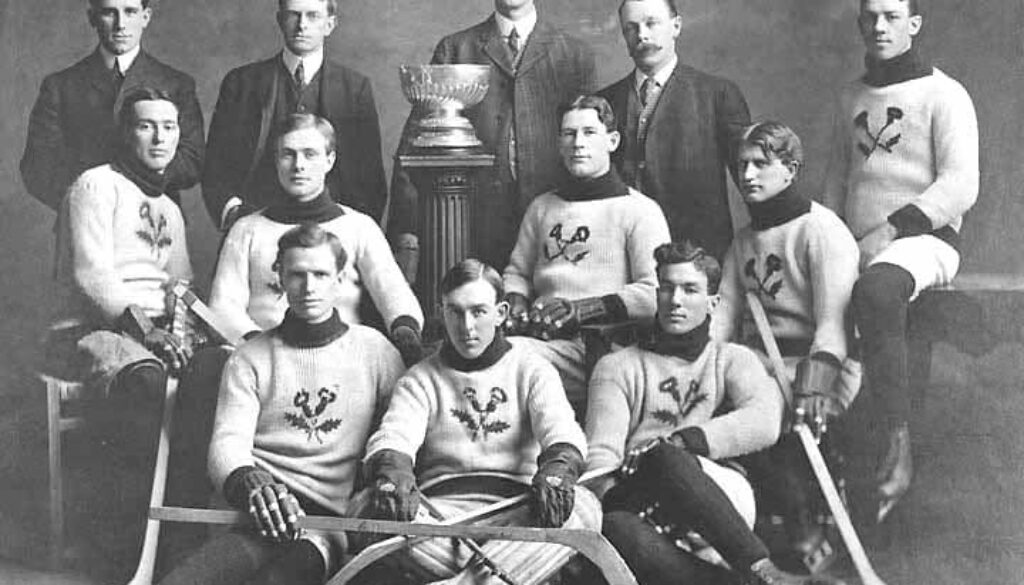
The Kenora Thistles’ Stanley Cup victory in 1907 is much heralded.
Their defence of the silver bowl, however, was overshadowed by controversy, politics and squabbles, and a threat to toss the Cup in the lake, all leading to the Thistles falling in the rematch with the Montreal Wanderers in March 1907.
The troubles began in the days after Kenora stunned Montreal for the Cup that January.
Kenora played a pair of exhibition games following the series, losing Billy McGimsie to what was initially thought to be a career-ending shoulder injury in a non-Cup challenge exhibition game with Ottawa.
The team returned home having to take two trains. Tommy Hooper, Russell Phillips, manager F. Hudson and trainer Jimmy Links boarded one train home while the rest of the squad caught a second.
That train took nearly a week to reach Winnipeg after a storm halted it in Detroit, stranding passengers for two days.
The players’ late return forced the Manitoba League to play an abbreviated six-game schedule for its teams to be eligible for Stanley Cup competition.
The Thistles limped into the season with McGimsie and Tommy Hopper, who was ill during the Stanley Cup games and later diagnosed with a broken collarbone.
Si Griffis and playing-coach Roxy Beaudro also expressed a desire to retire but decided to hold off their decision until the end of the year.
In a search for replacements, the team landed Fred Whitecroft from Peterborough, who agreed to a contract worth $700 (est. $24,000 in 2025 dollars).
As the Thistles prepared to play their first league game, they landed in the middle of a dispute between the Portage La Prairie and Brandon Hockey Clubs over a cancelled game due to Brandon loaning Art Ross and Joe Hall, two of its star players, to the Thistles for their cup run.
The dispute split the teams, with the Strathconas agreeing that Portage earn the win by default and Kenora siding with Brandon.
Kenora and Brandon threatened to quit and form their own league before the Thistles issued an ultimatum that Portage replay the game or face cancellation of a game with them.
As Stanley Cup champions, the Thistles were seen as a strong draw, and the prospect of losing out on a strong gate persuaded the Portage team to drop its protest.
The Thistles open the season with three straight wins before suffering back-to-back losses to Portage and Brandon that threaten defence of the Cup.
A win over the Strathconas in their final game secured a tie for first with Brandon, and the need for a playoff series to decide a champion.
Hooper’s absence at point was evident during the team’s two losses, and forced the Thistles again to seek out talent to strengthen the club.
Kenora’s recruitment efforts raised the ire of the Wanderers, who repeated as Eastern Canada Amateur Hockey Association champions.
The Wanderers voiced opposition to playing any team for the Cup that did not have “bona fide” members.
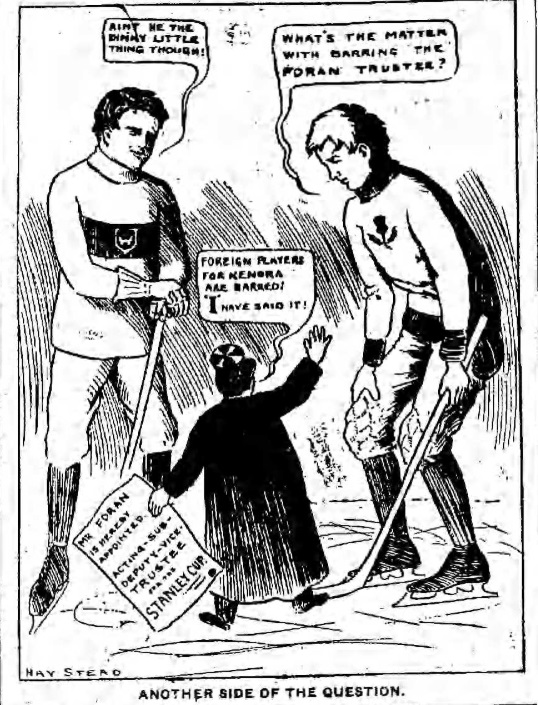
William Foran, the Cup’s acting trustee, agreed and ruled that a competing team would be prohibited from adding any player who came from the league it played in.
In the days following the ruling, Kenora secured the rights to Alf Smith and Harry Westwick from the Ottawa Hockey Club, which lost to the Wanderers in the ECAHA final. An offer was also made Harry Smith, Ottawa’s leading goal scorer, who declined.
The team also made a move to acquire Roy Brown from the Michigan Soo Indians of the International Professional Hockey League (IPHL).
The three players played in Kenora’s final league game, but Foran denied their use in any Cup challenge game.
“It is the infringement on the first principles of sport, and I will not permit it. I am irreconcilably opposed to such measures,” Foran stated.
Foran also confirmed that should the Thistles be successful in defending their league title, they would earn the right to host Cup challenge series games.
Montreal had objected to playing in Kenora, suggesting the city’s rink was too small.
“The people of Kenora have backed their team loyally for years and several times assisted in defraying the heavy expenses of sending them east after the Stanley Cup,” said Foran.
“In this fact alone, I think it would be a very unsportsmanlike to compel Kenora, if they be the cup contenders, to defend it on neutral ice, and unless the Wanderers can prove conclusively to me that the ice is altogether too small for a Stanley Cup series,”
Kenora did appeal the ruling impacting Smith, Westwick and Brown, but Foran warned they would forfeit the chances to defend the cup if the players suited up.
Kenora reacted by filing a protest against the Wanderers for having Riley Hern and Hod Stuart on the roster, claiming the players were imported at the start of the season from the professional IPHL for the sole purpose of helping Montreal defend its championship.
Foran, however, ruled Hern and Stuart had been with the team all season, satisfying his definition of “bona fide” players.
While Foran sifted through the eligibility arguments, the Wanderers arrived in Winnipeg in mid-March, claiming they were told to be in the city for the start of the Cup series on the same day that the Manitoba league championship series began.
Following the Thistles’ decisive victory in the opening game of the Manitoba final, a meeting was convened in Winnipeg to discuss dates for the Cup challenge series.
Montreal wanted the games played the day after the Manitoba title was decided, while Kenora demanded additional time to prepare.
Kenora wrote Foran to uphold its request, and returned home to secure the league title with a second win over Brandon.
Foran instead responded by ordering the Cup series to start a day after the Thistles-Brandon series.
In a show of defiance, the Thistles held firm to their plans to play Smith and Westwick.
The Manitoba Hockey League showed support for the Kenora team by passing a resolution to show its disappointment with Foran’s decisions.
“That this league, having received no notification to the effect that power to institute new rules governing cup contests has been delegated by Mr. Ross to Mr. Foran, refuses to recognize Mr. Foran’s authority to make such a ruling, and declines to be governed by the same,” read a part of the resolution.
The league also rejected Foran’s suggestion that another Manitoba club would take Kenora’s place if it did not comply.
“The team winning between the Brandon and Kenora Thistle clubs for the championship of the present season shall have the exclusive right to defend the cup, and that under no circumstance will the cup be defended this season by any other team in the league,” stated the league.
Kenora offered to move the schedule up one day, but Foran first wanted assurances that the Thistles would not use its recent imports and again threatened that the Wanderers would be awarded the cup if Kenora did not comply.
When the date arrived to play the game, the Thistles announced that they would forfeit the game.
“It is utterly impossible for us to play tonight,” said Tommy Phillips, the Thistles captain, to the Manitoba Tribune.
“If the Wanderers claim the game by default tonight, they will have to win either Friday or Monday to take the cup.”
Lester Patrick of the Wanderers retorted, “We are going to Kenora to get the cup.”
That elicited a response from a Kenora official who threatened to throw the cup into Lake of the Woods, suggesting that if the Wanderers wanted it, they would have to fish it out.
Fortunately, the threat was not carried out, but when the Wanderers arrived at the arena, they found public skating taking place and were not permitted entry unless they paid the admission fee.
Kenora’s team officials were on site, ready to discuss the series schedule.
Montreal insisted on playing the two-game series in Winnipeg.
The Thistles eased back on their demands to have the games on home ice, offering to split the series between Kenora and Winnipeg.
When they proposed that the first game happen immediately following their meeting, the Wanderers balked at the suggestion, saying it was too late in the night for the teams or spectators.
Smith and Westwick’s eligibility was raised, but Thistles’ President J. Johnson refused to discuss personnel, leading to the meeting’s abrupt end.
The Wanderers returned to Winnipeg, where they expressed disappointment in the failure to reach an agreement with their opponents.
“The Kenora team does not seem disposed to meet us on anything like fair grounds, and the negotiations are off,” said the Wanderers Secretary Jennings in an interview with the Manitoba Tribune.
Jennings also indicated Montreal was laying claim by default to the first game of the series.
Days later, James Bell of the Winnipeg Arena successfully brought the clubs back together once again and convinced them of the expectation of large crowds and financial returns for the teams in playing there.
In agreeing so, Montreal withdrew its objections to Smith and Westwick suiting up for the Thistles, upsetting Foran.
“If the two clubs ignore the instructions of the cup trustee, mutually agreeing to play against Westwick and Smith, when both were positively informed these men were ineligible to participate in the present cup match, the series will be treated as void, and the cup will be taken in charge by the trustees,” stated Foran.
Despite Foran’s threat, the games went ahead with Montreal winning the opener 7-2.
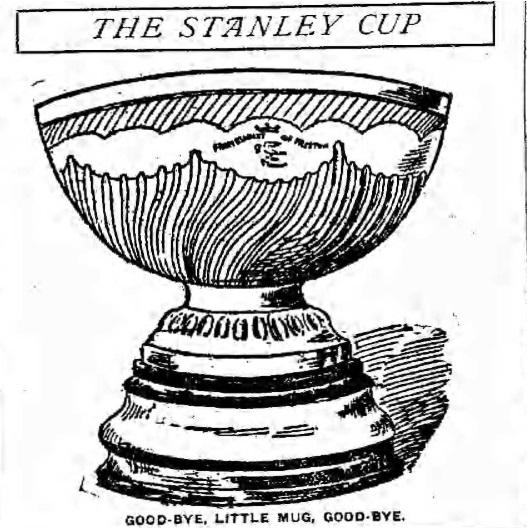
Kenora won the second 6-5 but fell short in their bid to hold onto the Cup, losing the two-game total goal series 12-8.
Beaudro, Eddie Geroux, and McGimsie retired at the end of the season.
Griffis also stepped away from the game, later joining the Vancouver Millionaires that would play for the Stanley Cup in 1918, losing to the Toronto Arenas of the newly-formed National Hockey League.
Westwick and Smith returned to Ottawa, while Whitcroft joined the Edmonton Eskimos of the Alberta Professional Hockey League.
Smith was elected to the Hockey Hall of Fame in 1962. Griffis was inducted in 1950.