A Lakehead University research project studying how climate change-induced drought affects conifer pine trees will receive $60,000 over the next four years from the Ontario government’s Ministry of Natural Resources (MNR).
The project is headed by Dr. Qing-Lai Dang, a Lakehead Professor in the Faculty of Natural Resources Management.
As climate change makes droughts more frequent and severe, Dang hopes understand the stress mechanisms which cause Ontario’s conifer pines to die.
“What we do not know is how dry is too dry for the trees, and how much the drought actually reduces their growth and productivity,” Dang explains.
The research project will also provide information to the MNR to help the body update its forestry management guidelines, with future-proofed policies that account for climate change.
Through studying how pine trees die from drought, Dang also hopes to make forests more resilient.
In drought, trees tend to die either from “carbon starvation” or “hydraulic failure”.
Dang hopes to determine which tree species are dying from which mechanism.
“That mechanism of identification can be used by tree breeders to breed trees for the future that will be more drought resilient,” he says.
The professor believes his research has environmental and economic implications.
Drought will hurt forestry industries and the communities which rely on them, and diminish the biodiversity of forest ecosystems.
In addition to the provincial grant, the project is also receiving $120,000 from the Natural Sciences and Engineering Research Council of Canada.
The grant money will help the project pay for graduate and postdoctoral students to assist with research.
Dang says the focus of his research for more than two decades has been to understand how boreal forests will respond to climate change, to see “what kind of forests we will have by the end of the century.”
The Federation of Canadian Municipalities and the federal government are investing in climate adaptation.
Last week, they invested $7.1 million to support 80 climate adaptation projects across the country, including three in New Brunswick.
The funding allows municipalities to develop climate-focused asset management strategies, comprehensive risk assessments and adaptation plans that protect communities and infrastructure from increased climate threats.
“Climate change is already impacting Canadian communities, threatening homes, disrupting critical infrastructure and putting lives at risk,” FCM president Rebecca Bligh said in a statement. “Every dollar invested in adaptation today saves communities many more in recovery costs tomorrow.”
The investment was made through the Green Municipal Fund’s Local Leadership for Climate Adaptation initiative.
The initiative helps municipalities plan, test and implement tailored climate adaptation solutions that protect their residents and assets.
The Green Municipal Fund allows FCM to provide funds and education to municipalities to help them reach net-zero emissions and build resilient communities, as well as deliver economic and social benefits. It has helped greenhouse gas emissions by 2.98 million tonnes since its inception in 2000.
In New Brunswick, the City of Edmundston, Town of Quispamsis and the Town of Cap-Acadie each received $70,000 from the fund.
Cap-Acadie and Edmundston will use the money to create climate change adaptation plans in their respective communities.
Quispamsis will conduct a comprehensive asset management plan evaluation and climate change readiness assessment.
“Communities across Canada are on the front lines of climate change and they need the tools to adapt,” said Environment, Climate Change and Nature Minister Julie Dabrusin. “The Government of Canada, in partnership with the Federation of Canadian Municipalities, is working to help municipalities turn plans into action.”
It’s going to be another hot one this year, according to Environment and Climate Change Canada.
The federal government released its annual global mean temperature forecast, giving Canadians a sense of what they can expect from temperatures around the world this year.
And the expectation is more of the same.
After record-breaking global heat in 2023 and 2024 and a comparably warm 2025, temperatures are expected to remain at historically high levels in 2026.
The forecast said there’s a greater than 99 per cent chance that 2026 will be hotter than every year on record prior to 2023.
The latest forecast shows the global mean temperature in 2026 is predicted to be between 1.35 and 1.53 C above pre-industrial levels. That means global temperatures will remain at least 1 C above pre-industrial levels for the 13th consecutive year.
It also predicted a 12 per cent chance that 2026 will exceed the 1.5 C Paris Agreement threshold. While exceeding that in a single year isn’t a failure to meet the Paris Agreement’s goal, which is defined by long-term average temperature over multiple decades.
Canada’s long-term forecasts show the period from 2026 to 2030 are likely to be the hottest five-year period on record.
The federal government is taking steps to address the rise in carbon emissions, including measures introduced in last year’s budget and the Climate Competitiveness Strategy.
“Canadians are already experiencing the impacts of a changing climate, from extreme heat to increased risks to communities and infrastructure,” said Environment Minister Julie Dabrusin. “This latest global temperature forecast provides important, science-based information to help governments, decision-makers, and communities better understand what lies ahead and plan accordingly.”
The Federal Economic Development Agency for Northern Ontario (FedNor) is delivering a new green initiative to northern Ontario’s Indigenous communities.
Funded by the Strategic Partnerships Initiative, the Northern Ontario Indigenous Clean Energy Initiative (NOICE) will help Indigenous-led clean energy developments come to fruition.
The program will assist communities with planning, skill development, and assistance in securing investments for green energy projects.
NOICE is framed as a reconciliation effort that will help Indigenous communities in the north determine their own pathways towards greater economic resilience and self-sufficiency.
The new program was announced by Minister for FedNor Patty Hajdu, who described its purpose as a way to “empower increased capacity for Indigenous communities to pursue economic and business opportunities in clean energy development.”
The minister says clean energy is one of Canada’s strongest selling points in international markets.
First Nations and Metis communities, Indigenous-owned businesses and organizations can apply to the program.
The clean energy announcement comes two weeks after the former Environment and Climate Change minister Steven Guilbeault resigned from Prime Minister Mark Carney’s cabinet in response to the federal government’s memorandum of understanding (MOU) agreement with the province of Alberta, which opens up the possibility of a new pipeline.
In an interview last week, Guilbeault expressed skepticism that Canada could still reach its 2030 emissions targets.
When asked about former minister Guilbeault’s resignation, Minister Hajdu argued that Canada needed to be pragmatic in its approach to climate change.
“It’s important to have targets that we can reach, rather than targets where we have provinces, in some cases, not agreeing at all to do that work,” she said.
Hajdu pointed out that the MOU includes commitments from Alberta to reduce emissions and comply with a higher industrial carbon tax.
“Although I appreciate that there may not be unanimity of opinion in this space, I do feel that it is important to work in the art of the possible,” she continued.
The project was set to cost $50-80 million to construct.
As a “peaking” plant, the facility would have only operated when the electrical grid was experiencing high usage.
Thunder Bay’s City Council was set to vote on the proposed plant at their final meeting of the year on December 2.
In a note to council, Versorium stated that they have been modifying their plant proposal to “fit within a smaller footprint,” which may impact the plant’s ability to sell its waste heat to Canada Malting.
The sale of waste heat for use in Canada Malting’s production process was initially advertised as a way to offset about one-sixth of the plant’s greenhouse gas emissions.
Emissions were a major concern at a Growth Standing Committee meeting in late October, where climate advocates criticized the plant as a violation of the city’s commitment to achieving a net-zero carbon footprint.
Versorium Energy Ltd. states that it still intends to produce a proposal for a peaker plant next year.
City Council’s Growth Standing Committee has recommended that a proposed natural gas “peaker” plant come before a full council vote.
The proposal, put forward by Alberta-based Versorium Energy Ltd., calls for council to approve the construction of a $50-$80 million facility at Maureen Street and Central Avenue.
Should council decide to approve the project, Versorium will still need to bid for a contract with Ontario’s Independent Electricity System Operator (IESO).
At Tuesday’s committee meeting, critics of the proposal had an opportunity to speak out against the plant.
“Pretending that we’ll somehow need to buy dirty energy from the 20th century just totally defies logic,” said Paul Berger at the meeting.
Berger teaches climate change education at Lakehead’s Faculty of Education and is the lead organizer of Citizens United for a Sustainable Planet.
Berger emphasized that Canada, Ontario, and the city of Thunder Bay have all produced their own 2030 climate change targets, and none of them are on track to meet those targets.
“Canada is a climate laggard. That’s radically unfair to those living and dying with our failings,” Berger said. “In this context, it would be madness to build a gas-fired generating station that will emit greenhouse gases, making the problem worse.”
Berger’s presentation focused on the extent of the climate crisis, which worsens by the year and shows no signs of slowing down.
He stressed that the Earth is at a tipping point, which can be understood as a point from which there is no turning back, and from which the planet will be irreversibly changed for the foreseeable future.
Berger pointed to raging wildfires, dying coral reefs, increasingly unstable hurricanes, and the impending collapse of the Antarctic Ice Sheet.
Berger’s presentation was followed by Keira Essex, who is the curriculum coordinator for Indigenous Clean Energy.
Essex told council that Canada’s per capita emissions are among the highest in the world. Though China and India have become leading polluters, individual Canadians emit greenhouse gases at more than double the rate of individuals in China.
Like Berger, Essex reminded council that the city has a net-zero plan and argued that a natural gas plant would violate that commitment.
“Investing in already outdated infrastructure, which opposes our municipal plans and has minimal and vague economic benefits for our community, may not be the wisest approach in governance,” Essex said.
“Creative accounting”
Berger and Essex were not solely focused on the big picture of global climate change: they had criticisms for Versorium Energy as well.
Essex questioned the financials of a natural gas peaker plant.
A peaking plant is not designed to run at all times, but simply at times when an electrical grid’s demand is at its highest. Because a peaker plant’s role is simply to “top up” the grid’s missing capacity, it is not as efficient as other forms of electrical generation.
“They’re the most costly and least efficient natural gas approach,” Essex said. “Gas peaking is also the most expensive form of energy, falling well behind renewables and shortly behind nuclear.”
Versorium has claimed its gas plant, though a greenhouse gas emitter, could actually offset more emissions than it produces. Berger aggressively opposed the suggestion.
“That’s an egregious claim. It’s creative accounting,” Berger said.
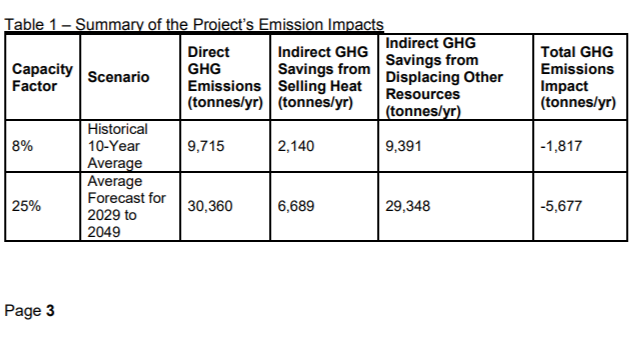
Versorium Energy Ltd. predicts that by indirect means, its gas plant could reduce Ontario’s greenhouse gas emissions by 5,677 tonnes each year. (Screen capture via the City of Thunder Bay)
Versorium says that about one-fifth of its emissions can be offset through selling excess heat to Canada Malting, which has a facility next to the proposed gas plant site. Canada Malting could use that heat in their boiling process, saving them from producing or acquiring the heat by other means.
Berger questioned the feasibility of the idea, arguing that it would require an expensive retrofit of the malting company’s facility.
Representatives from Versorium responded to inquiries by this reporter, stating that they are in discussions with Canada Malting, and, should the plant be constructed, Versorium will sell the excess heat to their potential partner at a discount, which will offset the capital costs of a retrofit.
In an interview with this reporter, Berger acknowledged that if Canada Malting did go forward with a retrofit, Versorium’s predictions of offsetting greater than 6,600 tonnes of greenhouse gases could be possible.
Berger expressed greater skepticism of Versorium’s other claim: that it could offset more than 29,000 of its 30,000 tonnes of emissions through “displacing other sources.”
“The most appropriate response to this chart is to laugh,” Berger said at the meeting.
Representatives from Versorium explained that their predictions stem from the idea that a peaker plant in Thunder Bay could replace the need to rely on a peaker plant in another part of the province – likely in Southern Ontario, more than 1,000 kilometres away.
They argue that energy losses from transmitting energy across great distances mean a peaker plant in Southern Ontario would essentially have to work harder to provide the same amount of energy to Thunder Bay as a local plant, resulting in greater emissions.
While this is true, Versorium’s predicted numbers demand scrutiny.
Versorium is suggesting that building a plant in Thunder Bay can offset almost 97 percent of its total emissions through this theory.
The IESO estimates transmission losses of about two percent system-wide on the Ontario grid, and for comparison, Alberta’s AESO estimates losses of about four percent. To square Versorium’s numbers, Ontario’s transmission losses would need to be closer to 50 percent, meaning half of the electricity produced would need to be lost in transit.
Meeting Ontario’s capacity needs
The criticisms by Berger and Essex gave some councillors pause at the committee meeting.
Despite this, the city government’s recommendation was that council greenlight the proposal.
City Manager John Collin explained that the city’s recommendation to approve the proposal was in service of the IESO’s needs.
“They have categorically said – and they are the experts, not administration – that Ontario needs 75 percent more power than it already has in the next 25 years,” Collin said, referring to the IESO.
The IESO is currently accepting bids for a wide range of electricity-producing projects, including green energy and nuclear projects for the grid’s base supply, and a broader range of “dirty” producers for filling in the gaps during periods of excess demand.
At the meeting, Councillor At Large Kasey Etreni asked how the proposal aligned with the city’s net-zero strategy.
City administrators answered by explaining that the city “point-blank” needs more power, meaning even dirty energy could serve the city’s overall climate goals.
City councillors went along with the city’s recommendation and approved the proposal. Now that Versorium’s proposal has been approved in a standing committee, it will come before a full City Council discussion and vote in a future meeting.