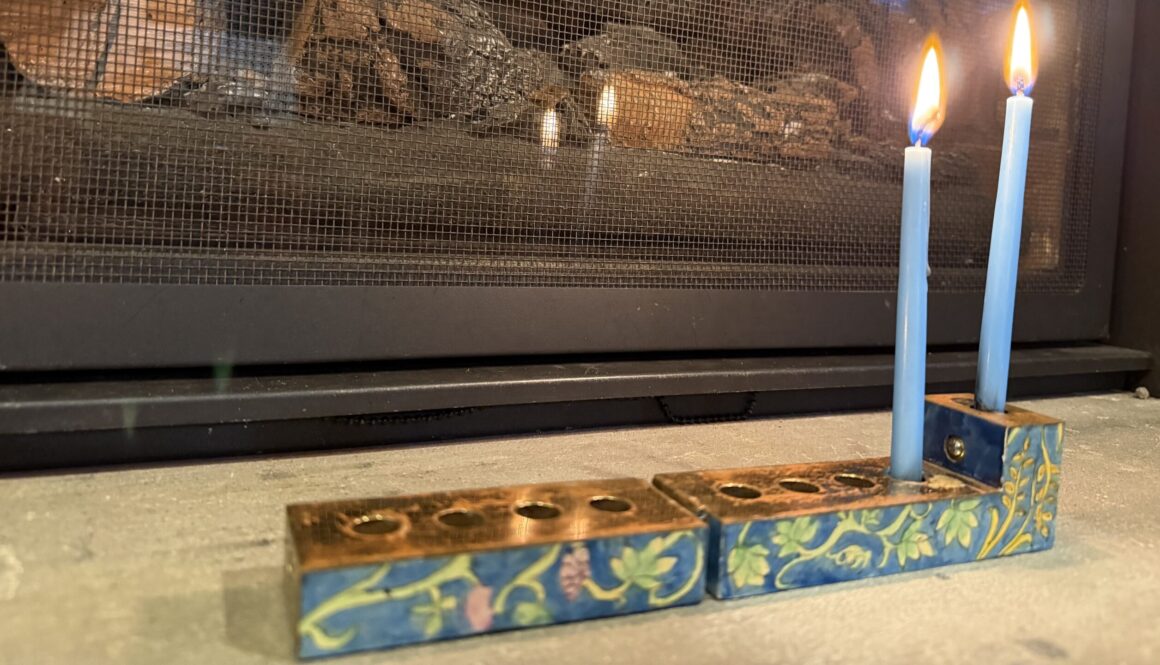
A sombre wish for a Happy Hanukkah from your friendly neighbourhood reporter
For those of you who haven’t been introduced, I’m Sam, 99.9’s first-ever Jewish journalist.
I moved to Thunder Bay this year from Toronto, a city with a long-standing and historic Jewish community nearly as large as our entire city.
Last week, I decided it might be fun to write something about a Jewish holiday taking place in the lead-up to Christmas.
But earlier today, in Australia, a Jewish event celebrating the holiday was attacked in a brutal and horrifying mass shooting.
At least 11 people have been killed, and 29 wounded in the attack.
In the days and weeks to come, great debates will be had about the motivations of the two individuals who carried out the shooting, but until more information comes to light, there is no use in speculating.
When events like this happen, I am reminded that the spectre of antisemitism, which has haunted Jewish people for two millennia, is alive and well despite the progress we have made since the Second World War.
A constant lesson of our history is the need to carry on no matter the tragedy, immortalized in the phrase this too shall pass.
Through expulsions, pogroms, and mass killings, Judaism has persisted, and its people have continued to proudly bear our label despite the risks.
When I woke up this morning to the news, I considered deleting this piece, feeling the light-hearted tone was no longer appropriate.
I changed my mind: I suspect that the men who attacked the Australian event earlier today would love nothing more than for Jewish folk around the world to spend their Hanukkah in quiet fear, afraid to attend public gatherings or publicly identify with Judaism.
At times like these, it is more important than ever to joyfully share our heritage and traditions, in public and without apology.
So read on if you wish to learn about the holiday of Hanukkah, which has always been my favourite Jewish holiday, and which was being peacefully celebrated on a beach in Sydney when 11 lives were taken this morning.
Hanukkah, our festival of lights, begins tonight and ends on Monday, December 22.
A brief Jewish history lesson
I’ve always loved Hanukkah as a history buff, because the holiday celebrates a well-documented and inspiring historical event that took place a full 1,500 years after the Torah (what you likely know as the Old Testament) was written.
Unlike the biblical events that define most Jewish holiday celebrations, there is no historical ambiguity to Hanukkah. We know, in fairly certain terms, what happened, when, and by whom.
If you hadn’t heard, the Jewish faith traces its roots to the modern-day lands of Israel and Palestine – specifically, in what today makes up the occupied territory of the West Bank in Palestine, which Israel refers to as Judea and Samaria after the ancient Jewish kingdoms that used to exist there.
Judea, the southern kingdom with its capital in Jerusalem, was the centre of Jewish life in the age of antiquity.
Despite centuries of occupation by foreign conquerors, Jews in Judea had been allowed to practice their religion and culture by their occupiers.
But in the 100s BCE, the Seleucid king Antiochus IV, who ruled the Levantine portion of Alexander the Great’s fractured empire, decreed that the Jews would be Hellenized, outlawing the Jewish faith and forcing my ancient ancestors to worship the Greek pantheon.
Alas, Zeus and co. were not really our cup of tea.
The event sparked a great rebellion led by a Jewish family known as the Maccabees.
The rebellion was very much in the vein of a David fights Goliath story, as the small Jewish kingdom of Judea challenged a great empire and emerged victorious against all odds.
Festival of Lights
If you’ve ever heard of the Western Wall in Jerusalem, you may know that in the age of antiquity, that wall used to be one piece of the outer ring of a great Jewish temple that was central to the ancient Jewish faith.
The temple would eventually be destroyed by the Romans, but at this time it still existed and was of great importance to the ancient Jews.
When the Maccabean rebellion broke out, their adversaries, the Seleucid Greeks, sacked the holy temple.
After driving out their occupiers, the Maccabees returned to Jerusalem only to discover the temple in a state of disrepair.
A large menorah, or seven-stemmed candelabra, stood tall in the temple.
It was traditionally meant to illuminate the holy temple 24/7 by burning olive oil.
The menorah had not been allowed to burn its seven flames while under Seleucid occupation.
This is where history becomes legend: upon liberating Jerusalem, the Maccabees could find only one small jar of lamp oil in the temple for the menorah – enough to last for just one day.
Miraculously, the lamp oil from that tiny jar burned for eight days, giving the temple’s caretakers enough time to restock their oil supply.
The story of the burning menorah is central to the holiday tradition: we celebrate Hanukkah for eight days to represent the eight days that the little jar of oil burned.
Over the holiday, Jewish families light a modified menorah called a Hanukkiah, which has nine stems, in our homes.
Today, we light candles rather than burning olive oil.
Eight stems on the Hanukkiah represent the eight days of burning, and a ninth stem, the Shamash, or helper in Hebrew, is used to light the other eight.
Each night of the holiday, we light another candle. On the first night, we light one candle, on the second two, and on the final day, we light all eight candles with the Shamash.
But what about the food?
As we all know, a holiday is only as good as its traditional foods.
For Hanukkah, we serve deep-fried Latkes (potato pancakes) as the star dish.
We usually top them with sour cream or apple sauce, though in my family, we sometimes top them with smoked salmon.
Other traditional foods are Sufganiyot, or jelly donuts, and gelt, or chocolate coins.
One of Hanukkah’s traditions is to play dreidel: the four-sided spinning top functions similarly to a dice.
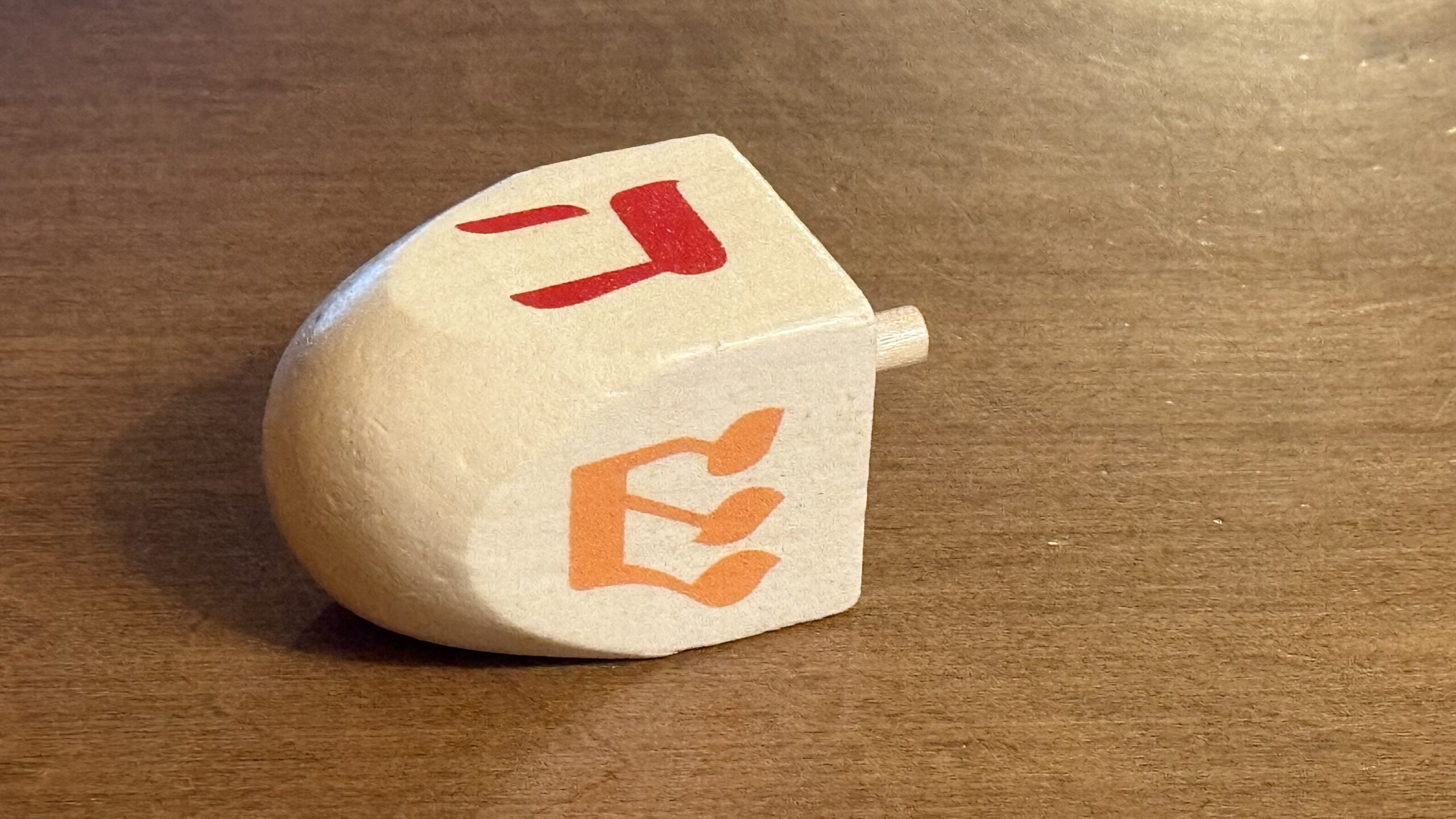
We teach our children the horrors of gambling at a young age by allowing them to gamble their chocolate gelt, so they can feel the pain of losing all their sweet chocolate money when the dreidel lands on the wrong side.
Hanukkah is also a time to bring out other classic Jewish foods: Challah, or Jewish egg bread, Kugel, or egg noodle casserole, apple cake, and, god willing, juicy beef brisket.
If, like me, you’re away from your family this holiday season, I hope it comforts you to think of the traditions, the comfort foods, the stories, and the heritage that you’ve left behind.
But of course, you haven’t really left it all behind. These things live within you everywhere you go, as they do in me.
Happy Hanukkah, or Hanukkah Sameach,
Sam