The City of Thunder Bay has announced that it no longer expects to open its temporary shelter village at the Hillyard site by the end of the year.
The city now anticipates an opening in the spring.
Despite the delay, work on the site is officially underway.
Two contracts have been awarded to third parties: one for building the site, and the other for operating the village once it is complete.
The city says detailed design work on the site has begun, including grading and drainage plans.
Sewage and water services are currently being extended to the new location, and soon, the city pledges it will begin clearing trees, replacing soil, and fencing the area.
The temporary shelter village is a crucial piece of the city’s ten-part plan for addressing encampments.
The shelter village will include 80 locked habitats, designed to help homeless individuals transition between living on the street and planting roots in permanent homes.
Following an Ontario Supreme Court decision, the city has no legal authority to clear out encampments unless it has a space it can offer to individuals.
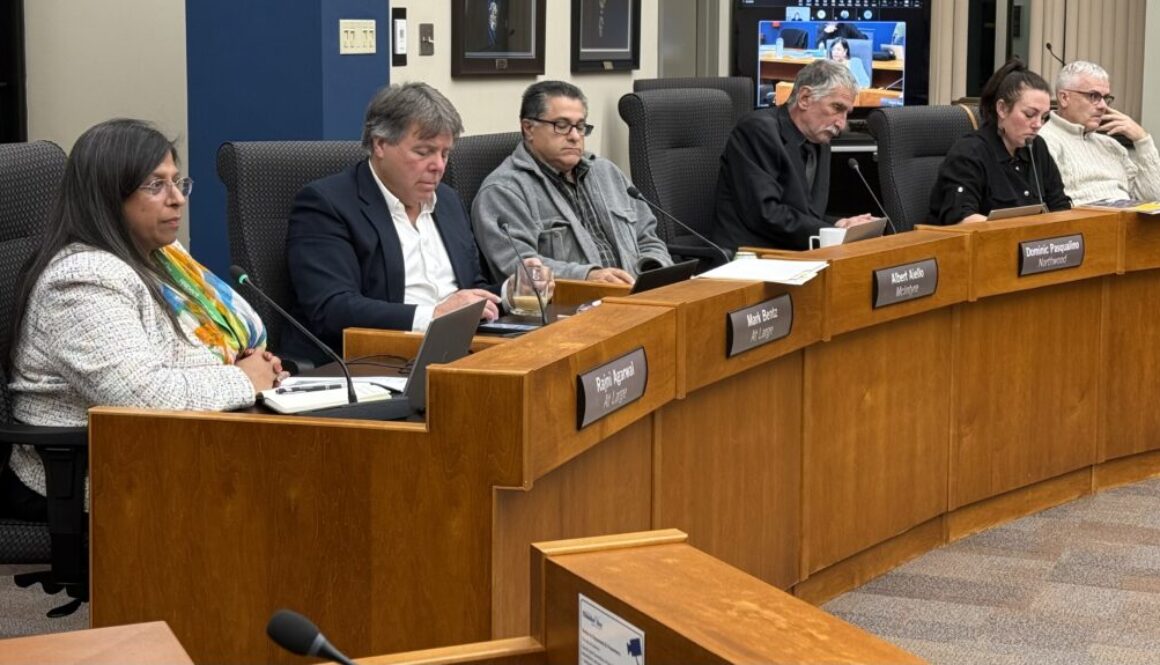
Councillor At Large Rajni Agarwal introduced the motion, suggesting the city should build more permanent housing rather than a temporary shelter village.
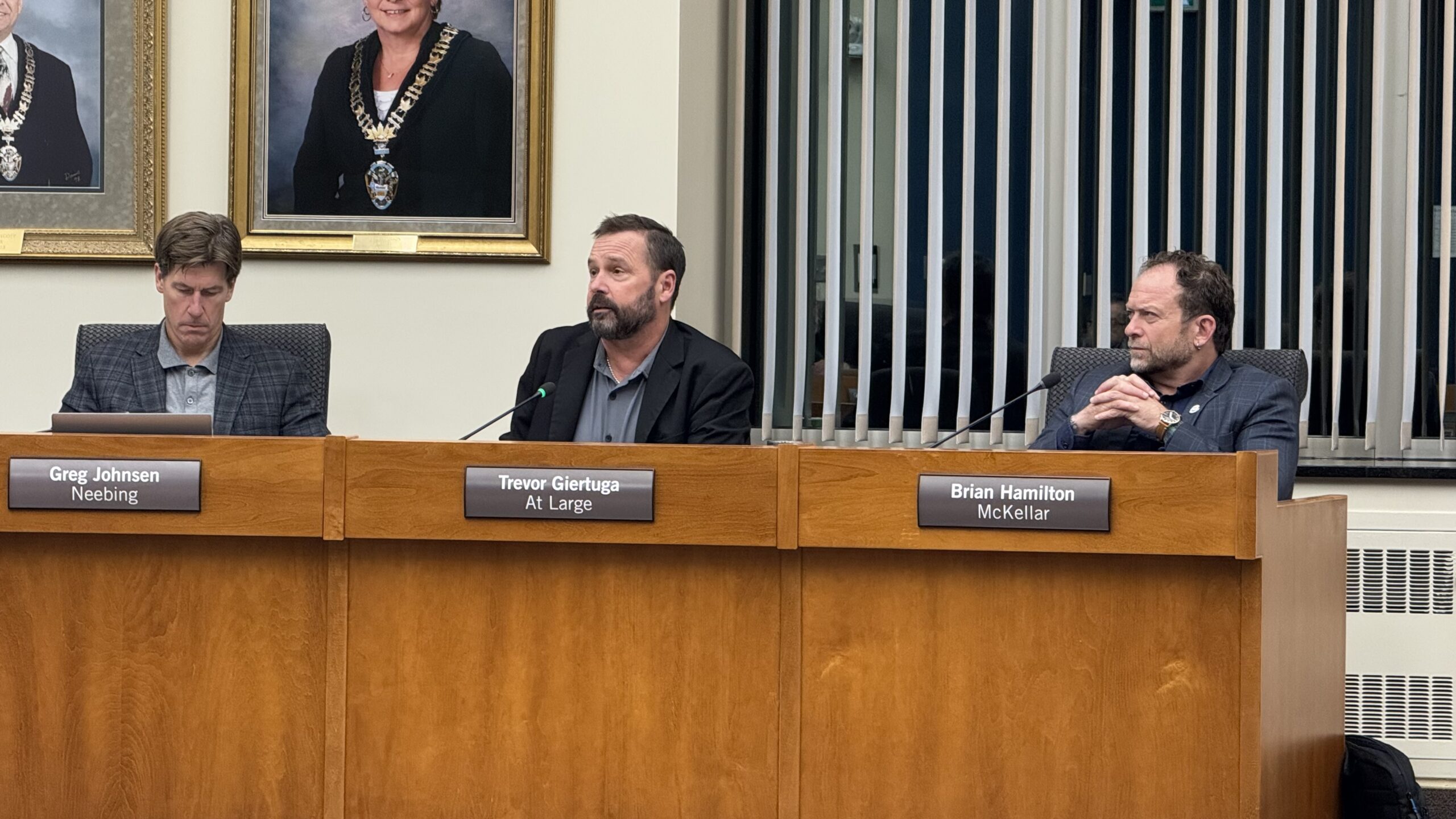
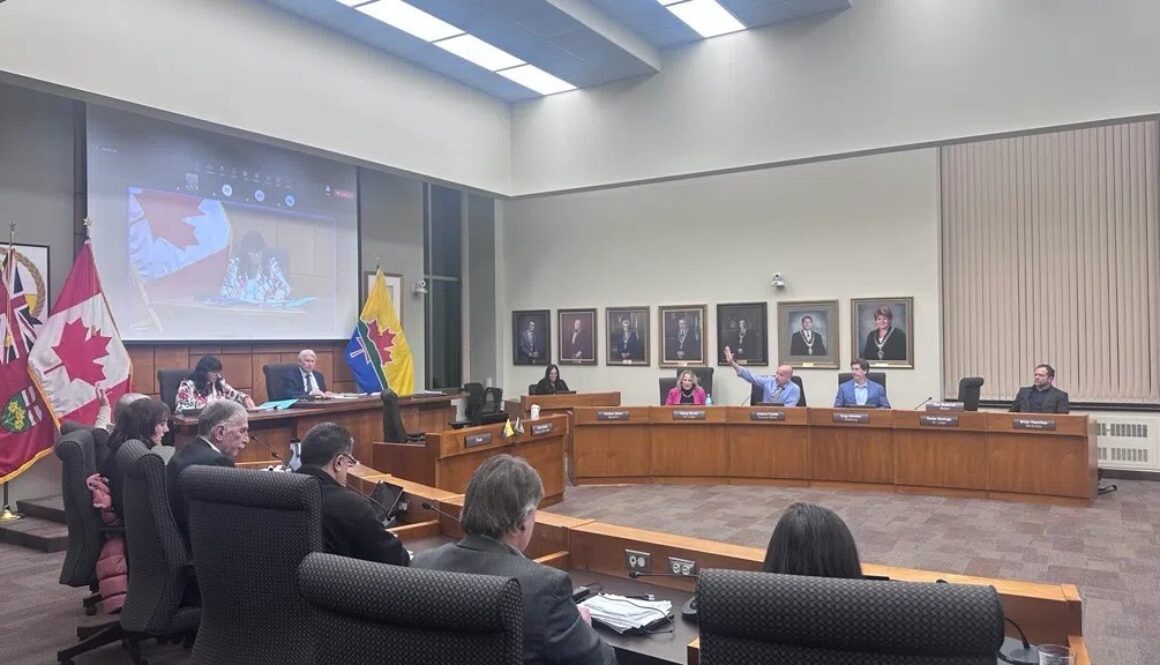
Councillor At Large Trevor Giertuga seconded Agarwal’s motion. In the end, Giertuga was the only councillor to vote with Agarwal.
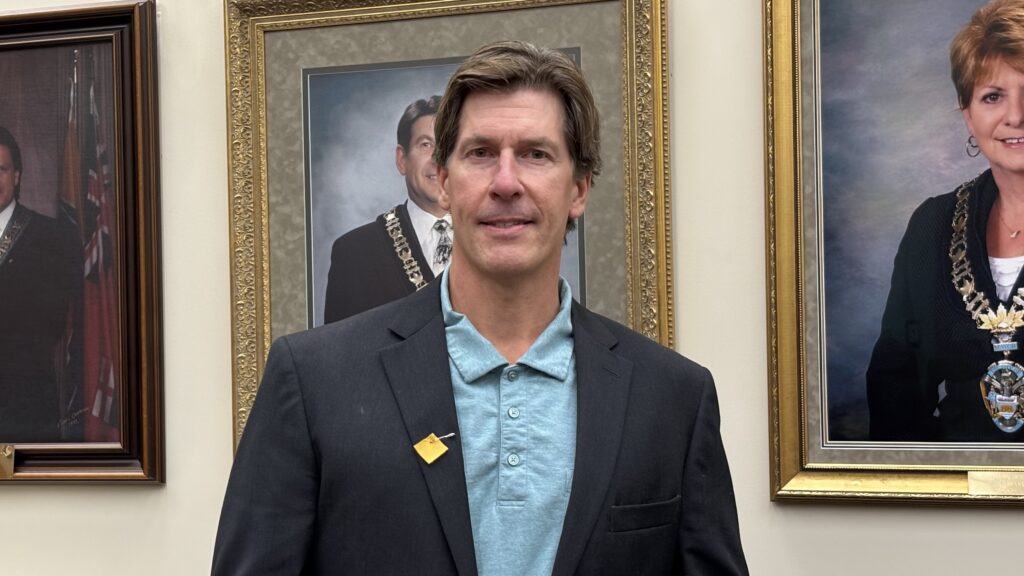
Councillor At Large Trevor Giertuga speaking at the City Council meeting. (Sam Goldstein/October 21, 2025)
“We cannot be changing paths at the eleventh hour,” said Councillor At Large Mark Bentz.
City Manager John Collin revealed at the meeting that Thunder Bay has already signed two contracts with third parties for the construction and operation of the temporary shelter village.
“We’ve made commitments – legal commitments – and we have to stand by those,” Bentz responded.
Responding to a question from Neebing Ward Councillor Greg Johnsen, the city manager also confirmed that the ten-part plan for addressing encampments would dissolve without the temporary shelter village.
Councillor Andrew Foulds of Current River Ward pointed out that the city will have no legal ability to clear out encampments without the temporary shelter village.
In the end, even councillors who were highly critical of the ten-part plan, such as Councillors Albert Aiello of McIntyre Ward and Michael Zussino of Red River Ward, ultimately voted to keep the temporary shelter village.
Agarwal’s motion required a two-thirds majority of nine votes to succeed.
The final tally was 11-2 in opposition to Agarwal’s motion.
Councillors Rajni Agarwal and Trevor Giertuga voted YES to deleting the temporary shelter village from the ten-part plan.
Mayor Ken Boshcoff and Councillors Michael Zussino, Dominic Pasqualino, Kristen Oliver, Greg Johnsen, Brian Hamilton, Andrew Foulds, Kasey Etreni, Shelby Ch’ng, Mark Bentz, and Albert Aiello voted NO to deleting the temporary shelter village from the plan.
“It’s a difficult issue that we’re dealing with,” said Dominic Pasqualino after the meeting. “But I believe that we’re too far along to back out of it now.”
Councillor at-large Rajni Agarwal’s motion to amend was introduced at Tuesday’s City Council meeting.
The motion calls to delete the fourth point of the city’s Ten-Part Human Rights-Based Community Action Plan, which outlines a need to develop a temporary shelter village as a transition space for unhoused individuals.
Agarwal has argued that the construction of new affordable and supportive housing units over the last few years, combined with the federal government’s new Build Canada Homes plan, together negate the need for a temporary shelter village.
Not everyone on City Council agrees with Agarwal’s assessment.
“To me, it’s similar to seeing people in the water cancelling the lifeboats because we have a ship on order five years from now. I think we could do both things,” says councillor at-large Shelby Ch’ng. “I think we could have a temporary solution and also work towards a permanent solution.”
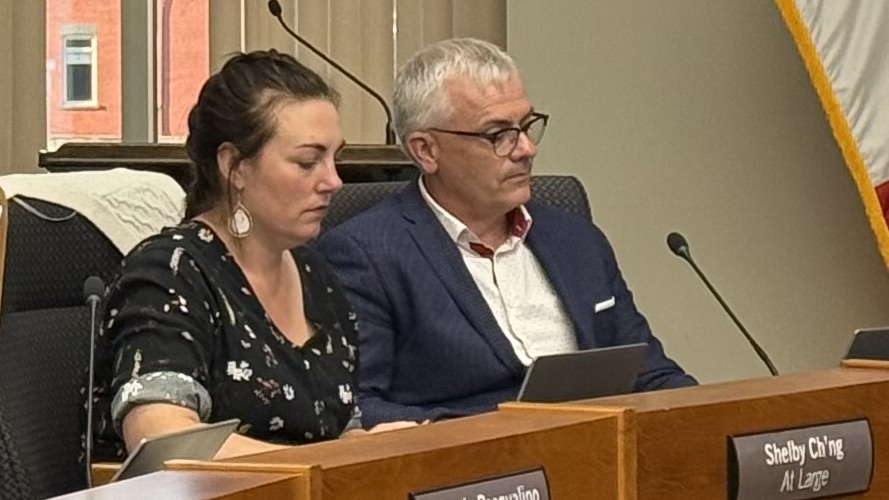
Councillor Shelby Ch’ng, left, at a City Council meeting. (Sam Goldstein/September 16, 2025)
Ch’ng points out that the temporary shelter village serves a different purpose than affordable and supportive housing units. She suggests that if the city hopes to earn federal grant money, it ought to have transition spaces.
“I would be looking at places that have a transition program so that when you do put people into permanent housing, that they’re successful, and not going from sleeping in a sleeping bag in the middle of winter… to now having to operate their own apartment,” she says. “There’s a transition period that is absolutely needed.”
Unlike Councillor Ch’ng, McKellar Ward Councillor Brian Hamilton opposed the Hillyard site that Council ultimately voted for. Yet Hamilton still believes the city ought to proceed with a temporary shelter village at Hillyard, now that the plan is in motion.
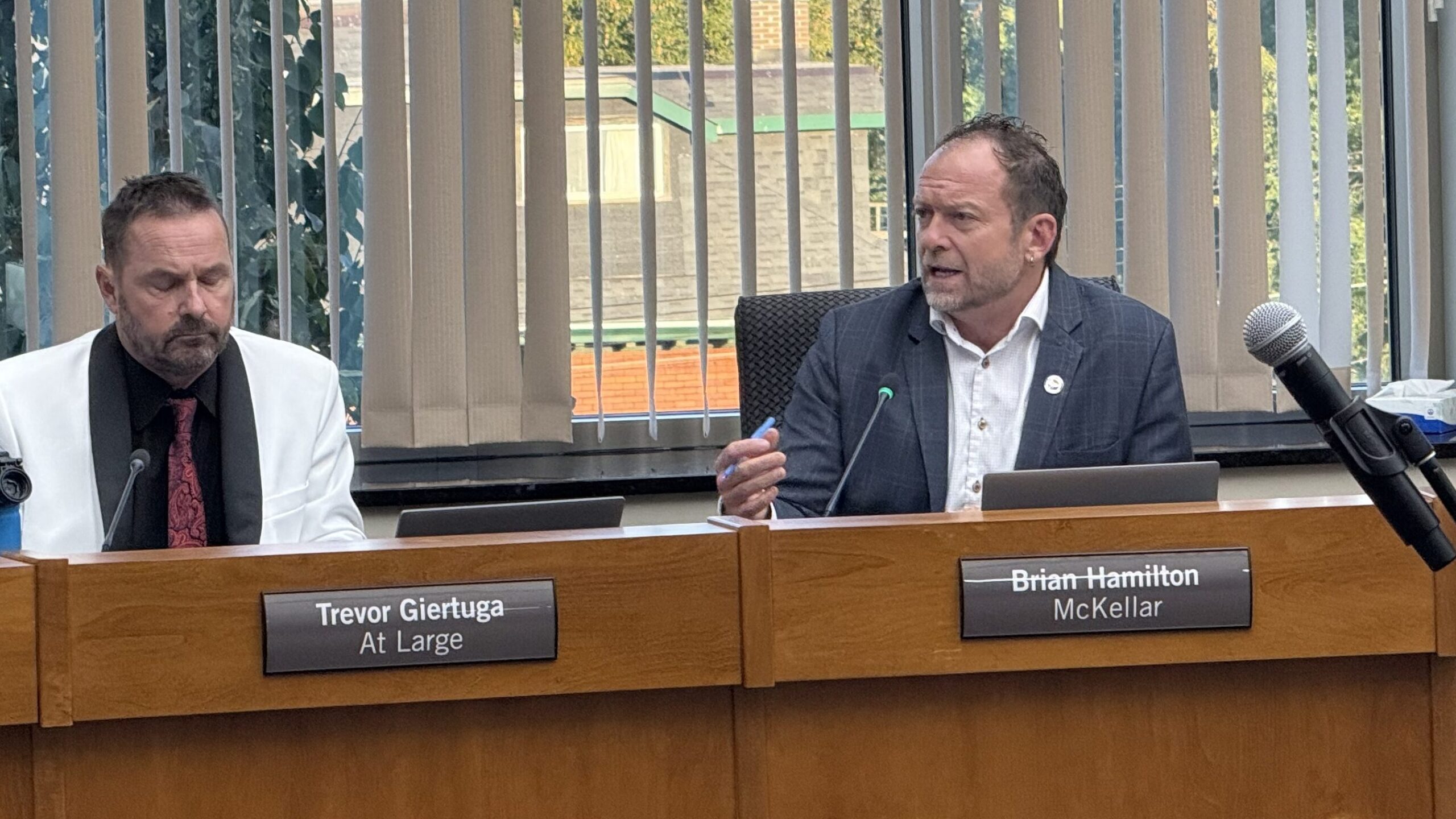
Councillor Brian Hamilton, right, at a city council meeting. (Sam Goldstein/September 16, 2025)
“I do see a need in utility for this type of facility in the community in the interim and at least for the midterm to get through this economic and housing crisis that we find ourselves in,” Hamilton says.
Hamilton is also skeptical of Agarwal’s pitch to get federal funding from the Build Canada Homes plan.
“There’s so many unknowns to that. That’s not a guarantee… It’s not even on the table. What is on the table right now is the crisis on our doorstep,” he explains. “It’s going to be years in the making before we actually bring new units online.”
Neebing Ward Councillor Greg Johnsen welcomes further debate on the temporary shelter village.
“It’s the democratic process… It’s good for the community in the sense that some people are aggressively against this, and some people are aggressively for it,” Johnsen says. “So here’s another opportunity for residents to weigh in.”
City Councillor Greg Johnsen. (Sam Goldstein/October 7, 2025)
Johnsen opposed the Hillyard site in part because he feels the public didn’t have sufficient time to engage on the issue.
“It was a last-minute resolution that found favour and I voted against it,” he states.
If Agarwal’s motion passes, the big question will be whether the city’s ten-point plan for addressing homeless encampments can succeed without a temporary shelter village.
“I was told that the temporary village is the crux of the ten-point plan. It is the linchpin,” Johnsen says.
“So one of my questions will be… if we remove the temporary village, well, where is the ten-point plan? Does it dismantle altogether, or does it remain afloat… I’ll be very much paying attention to that answer as well,” he adds.
Ch’ng believes there is no ten-point plan without the temporary shelter village. Legally, the city cannot dismantle homeless encampments without having a temporary space where unhoused individuals can be taken.
“If we do not have a temporary solution, we cannot move the tents, bottom line,” she says. “It opens us up to huge legal and liability risk and quite frankly, I don’t want to spend our tax dollars on liability when the cheaper option is to put up a temporary solution until permanent housing is built.”
Agarwal’s motion will come before City Council to be debated and voted on at the next meeting on October 21.
Thunder Bay Councillor at-large Rajni Agarwal has filed a motion to amend the city’s ten-part Human Rights-Based Community Action plan.
The plan was created as a strategy for dealing with homeless encampments with humanity and dignity.
Point #4 of the city’s plan called for building a temporary shelter village. Three weeks ago, City Council settled on the Hillyard site as the location of that village.
Now, Councillor Agarwal is motioning to delete that piece of the plan. In her motion, Agarwal argues that the federal government’s new $13 billion Build Canada Homes plan offers a better solution for Thunder Bay’s homeless crisis.
“The request to remove the temporary village is in order to get the full robust housing required with proper partnerships for permanent structures in lieu of the temporary sheds. With the government funding allocation of $1 billion dollars towards homelessness we should be able to get a much larger grant to properly serve the population,” the motion states.
Agarwal points out that three years ago, the city secured $20.7 million from Canada’s housing accelerator fund, which was a $4 billion program. “If we looked at the same sort of proportion, we should receive close to $60 million,” Agarwal says.
The Councillor is also focused on the fact that the temporary shelter village is just that – temporary. The shelter village was always intended to be a transitional solution for the city, to eventually be replaced with a more long-term solution. Agarwal believes the city should focus on a permanent solution instead.
City Council initially voted for the Hillyard site back in July. In mid-September, a new vote challenged the site, but Hillyard survived. A nine-vote, two-thirds majority was required to scrap Hillyard, and only eight votes were secured.
Similarly, Councillor Agarwal’s motion will require a two-thirds majority vote to delete the temporary shelter village from the human rights plan.
“How confident? I don’t know,” responds Agarwal on being asked if the vote can succeed. “I hope we all work together for a good permanent solution because I know that as Council, we do want that. We want legacy, we want permanent, we want people to be in a better place, and everyone on Council feels the same.”
During Tuesday night’s council meeting, City Manager John Collin highlighted that the city has more time than they previously thought before shovels have to be in the ground.
To meet the current deadlines to receive the grant, at least 40 units must be ready to start accepting occupants by December 15, 2025, and the remaining units must be fully operational by February 27, 2026.
“We have been pursuing or exploring whether or not another extension on the funding of the $2.8 million would be possible from the province because just the act of pressing pause on all this has put that timeline very much at risk,” said Collin.
“I have received confirmation through our Member of Provincial Parliament, the Honourable Kevin Holland, that he and the minister of municipal affairs and housing believe that if we put forward a reasonable request for an extension to our timelines, the minister of municipal affairs and housing has confirmed that it will be granted.”
At the next city council meeting, a final decision should be made on the host location.
If city council votes against the motion, the status quo will remain and the Hillyard Site will host the village.
If council votes yes, the Hillyard Site would be scrapped as the host location, and city council would be tasked with deciding whether to refer the matter back to city administration to explore additional sites.
The decision to move on from the Hillyard Site would also eliminate additional sites previously looked at, including Cumberland, Miles St. and Kam River Park, from being rebated at a later point.
“One thing I know as a business owner or any stakeholder is that there is high levels of anxiety with this file,” McKellar Ward Councillor Brian Hamilton. “The community wants to see black or white where we are, and I think two weeks more is just two weeks more of anxiety.”
“We are really failing a community here that we’re not really talking about, and we’re failing the community at large as well by not, you know, quote unquote putting this to bed. I’d really like to come to a conclusion. Homeowners and businesses certainly need that certainty to be able to thrive and survive in this climate.”
More than 100 of Thunder Bay’s Intercity businesses and healthcare facilities, known as the Intercity Business Collective (IBC), are asking the city to reassess the Hillyard Site.
The group backs Councillor Zussino’s motion to rescind approval of the location.
The Hillyard Site has been selected to host Thunder Bay’s temporary shelter village initiative, but a member of city council would like to see other options investigated.
The site located next to 8th Avenue, near Central Avenue, was selected in July.
Red River Ward Councillor Michael Zussino is proposing a new direction at Tuesday’s city council meeting.
He is looking for city council to rescind the decision to confirm the location, and would like to see other host sites investigated.
“So anytime a member of council has the option to bring forward a notice of motion to change direction, to change course, they can bring a notice of motion to rescind or to amend a decision,” explained the Director of Legislative Services and City Clerk, Krista Power.
“He’s bringing it forward in three parts. The first part is to suspend the rules.”
Normally, a notice of motion requires a presentation at a meeting, followed by no debate or discussion until a later council meeting.
“He’s asking to essentially override that provision to wait the two weeks and make the decision the same night, which is in the same vein of what counsellor Etreni did on a previous notice of motion on this file. So that’s the first piece, is that they will vote and need 9 votes to suspend the rules. If that passes, they will then go to the notice of motion to rescind.”
If councillors opt not to suspend the rules, then the notice of motion to rescind will simply move forward to be debated at the September 16th meeting.
“If it passes and they debate it and they decide to rescind, then they would go to decision point three, which is to refer the matter back to administration, to look for an additional site,” added Power. “If they rescind as per Councillor Zussino’s motion, they are rescinding Hilliard.”
The decision would also eliminate additional sites previously looked at, including Cumberland, Miles St. and Kam River Park from being rebated at a later point.
“I am bringing forward this Notice of Motion to Rescind to allow City Council an opportunity to consider a change in course as it relates to our response to supporting people who are currently unhoused in our city and those that are impacted,” said Red River Ward Councillor Michael Zussino. “While a temporary village may be the best path forward, it is my position that Hillyard may not be the best location for this project.”
If council passes debating the item on Tuesday, but chooses not to pursue a new location, then the status quo will remain and the city will move forward with the Hillyard Site.
More than 100 of Thunder Bay’s Intercity businesses and healthcare facilities, known as the Intercity Business Collective (IBC), are asking the city to reassess the Hillyard Site.
The group backs Councillor Zussino’s motion to rescind approval of the location.
“Placing vulnerable individuals in a facility without integrated medical, mental health, and addiction support is concerning,” says an IBC spokesperson. “This approach could lead to worsening health outcomes, increased strain on emergency services, and unsafe conditions for both residents and the surrounding community.
“A coordinated healthcare model is essential to ensure this project truly helps the people it’s meant to serve.”