Student union leaders say they “were met with excuses” instead of real solutions when discussing strike repercussions during their latest meeting with the Department of Education.
In a statement online, Alexina St. Pierre-Farrow, chairperson of the Canadian Federation of Students–Nova Scotia (CFS-NS), says the response received from government officials has only added fuel to student anger as they gear up for what organizers call Nova Scotia’s first province-wide university strike March 15 – 21 over deep budget cuts.
Specifically addressing Advanced Education Minister Brendan Maguire in her letter, stating “no more excuses”, St. Pierre-Farrow condemns post-secondary funding reductions and demands answers on supports for Indigenous learners and grant-reliant students. It follows a student-led press conference with other Halifax university representatives held on February 26.
They say the walkout next week will involve campuses like Dalhousie, Saint Mary’s, NSCAD, King’s, and Acadia.
Students are reviving Quebec’s iconic red square strike symbolism. PHOTO BY NATALIE CHIASSON /Acadia Broadcasting
Students say they’re already “squarely in the red” from high tuition, rents, and job scarcity, plus cuts to key financial aids. Representatives are calling for a 20 per cent tuition cut, equal fees for international and domestic students, and protection for programs serving marginalized groups.
Organizers say the goal of their protests are to tell the Houston government that students “need tangible, meaningful action, and they need it now.” They plan to join the thousands taking part in ongoing arts and culture rallies across the province tomorrow outside Province House, while their strike remains scheduled to begin on Sunday.
Premier Susan Holt in her recent State of the Province Address hinted her government would be looking at some ‘difficult but necessary’ budget decisions, as the province is currently in a deficit.
Following the circulation of a leaked government document containing ideas that target a post-secondary budget reduction of $35 to $50 million, New Brunswick universities and their communities have been faced with the possibility of cuts to post-secondary funding.
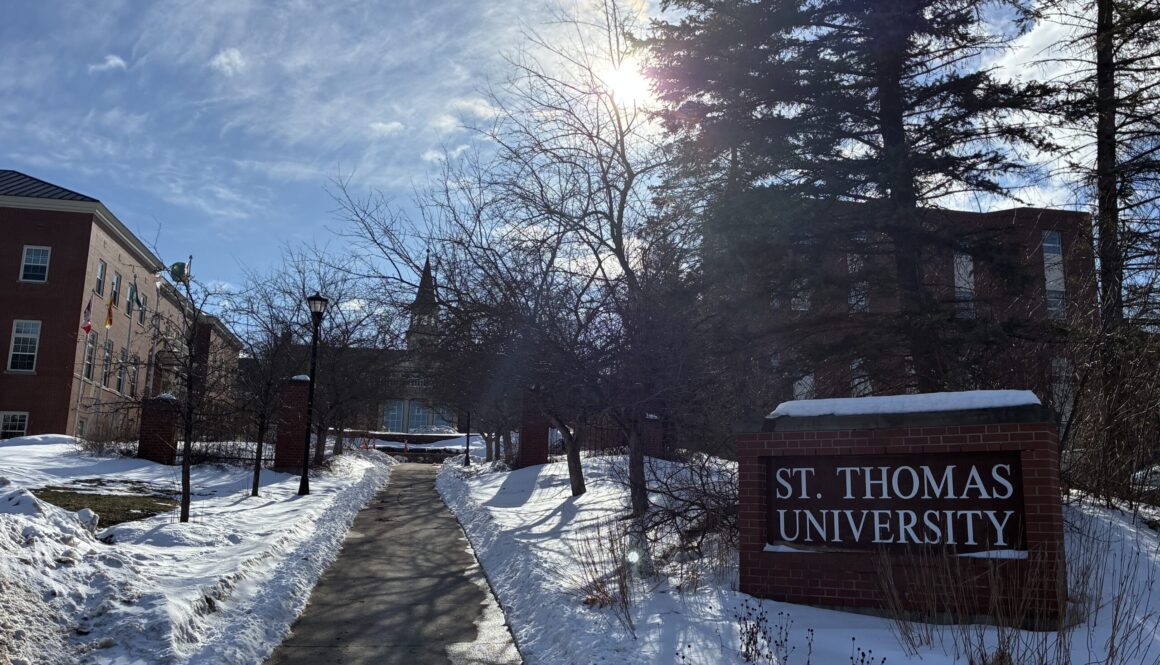
President and Vice-Chancellor of St. Thomas University Dr. Nauman Farooqi addressed STU faculty, students, and alumni in an email sent on the evening of Feb. 25.
The email explained that Premier Holt called Farooqi regarding ideas from the Department of Post-Secondary Education, Training, and Labour on the future of the province’s post-secondary sector.
Premier Holt assured Dr. Farooqi that the provincial government has no plans to close or merge St. Thomas University – despite suggestions of such in the leaked document – but Farooqi says the impending fiscal challenges for post-secondary institutions remain.
“Developments over (the last) two weeks have been concerning and led to great uncertainty. I trust that you find the Premier’s message to our community reassuring,” Farooqi wrote.
Professor Shaun Narine (Submitted: Shaun Narine)
Shaun Narine has been a political science professor at St. Thomas University for 24 years. He says the potential cuts were brought to the whole post-secondary sector very suddenly.
“One thing that the province keeps emphasizing is that ‘no decisions have been made’ and they are putting out these ideas, they want to see how universities react, they want to see what kind of feedback they get, what kind of counterproposals they get,” said Narine. “On the other hand, the [provincial] budget is coming in on March 17, and this whole thing was dropped on universities – the whole post-secondary sector – at the most a couple of weeks ago, which suggests that maybe a lot of decisions have been made.”
Narine says cutting 10 to 15 percent out of the budgets for the post-secondary sector would be shortsighted and devastating to universities like St. Thomas.
“It would destroy us in all likelihood or make it very difficult to run a credible university with credible programs.”
Creating this kind of uncertainty for the entire post-secondary sector would make it difficult for students to commit to higher education in New Brunswick, according to Narine.
Narine first arrived to New Brunswick in 2002. At the time, he noticed the province’s issue with outmigration due to people leaving for better job opportunities in other parts of Canada. Over the years he has been in New Brunswick, Narine has begun to notice a reversal in outmigration thanks to opportunities the province offers, one of which is the post-secondary sector.
Posters found on campus put out by St. Thomas University’s Student Union (Submitted: Wilfred Fraser)
“As it is, the entire post-secondary sector across Canada was being heavily hit by the federal government’s decision to make it much more difficult for international students to come in. Now, in New Brunswick, to be hit by this possibility of having the sector gutted by the Holt government, would be extremely harmful.”
“If you are going to hack out the post-secondary sector, you are actually doubling down on a situation where your population is not nearly as educated as it needs to be to be competitive in an international environment,” said Professor Narine. “People power, the knowledge base of your society, is what makes your economy function. You don’t build for the future by gutting your post-secondary institutions.”
The issue of a lack transparency is also a concern for many, including Narine, who thinks it displays a lack of confidence in the government’s plan.
“You are left with the suspicion that the reason the government is doing this with what appears to be extreme speed is because they want to do something that is going to be very unpopular as quickly as possible – a kind of fait accompli (accomplished fact) – and push it through before opposition can organize,” said Narine.
He says none of the recent occurrences between post-secondary institutions and the provincial government inspire faith and trust in what might be occurring.
“There are not a lot of examples of other industries in New Brunswick that have a pipeline to new people. This is something that I think the provincial government is at risk of fundamentally undermining,” concluded Narine.
Lakehead University’s hockey squad aims to build on a five-game win streak this weekend.
The Thunderwolves will be heading to Southern Ontario to tackle the Toronto Metropolitan Bold on Friday night before going to Waterloo on Saturday to face off against the Laurier Golden Hawks.
Coming off a two-week break, the Thunderwolves head coach says the team is well-rested and will be ready for the ice heading into the weekend.
“I thought the timing of the buy was okay,” admits Andrew Wilkins about the two weeks off. “At the end of the day, we’ve been working hard and I think our mindset is, come out of the break being faster and stronger and we’ll try and do our best to pick up where we left off.”
The last game the Wolves played was on November 8 that saw the Lakehead squad edge out the Windsor Lancers in overtime by a tight score of 2-1.
While Friday’s game against Toronto is sure to shake the rust of the skates, it is Saturday’s match-up versus Laurier that the Wolves might be focused on.
After all, the Wolves currently sit two points behind the OUA Western Conference-leading Golden Hawks.
“Laurier’s a good team,” says Wilkins. “I think we have to worry about what we do, play our style and get to that as quickly as possible (but) we feel if we play our game and execute what we are trying to do, we give ourselves a chance to win.”
Following this weekend, the Wolves continue on the road with two more games in 2025 against the Toronto Varsity Blues (November 29) and the Brock Badgers (November 30).
The team’s next home game will be Friday, January 2 against the SIJHL All-Stars.
Maclean’s Magazine has released its top university rankings for 2026 and Lakehead University is again, leading the way.
Named Ontario’s top primarily undergraduate university, the school ranked first in student awards and student-to-faculty ratio and second in scholarships and bursaries.
“Lakehead has always been a place where students achieve their full potential through transformative, world-class education,” said Dr. Gillian Siddall, the university’s president and vice-chancellor in a release.
“This recognition in Maclean’s celebrates the dedication of our faculty, staff, and partners in creating an environment where excellence and inclusion go hand in hand.”
Maclean’s annual university rankings highlight the top Canadian post-secondary schools across three categories: primarily undergraduate, comprehensive, and medical/doctoral.
Lakehead’s growing reputation continues to gain international attention as well.
Last week in the Times Higher Education World University Rankings 2026, Lakehead placed second in Ontario and second in Canada among primarily undergraduate universities.