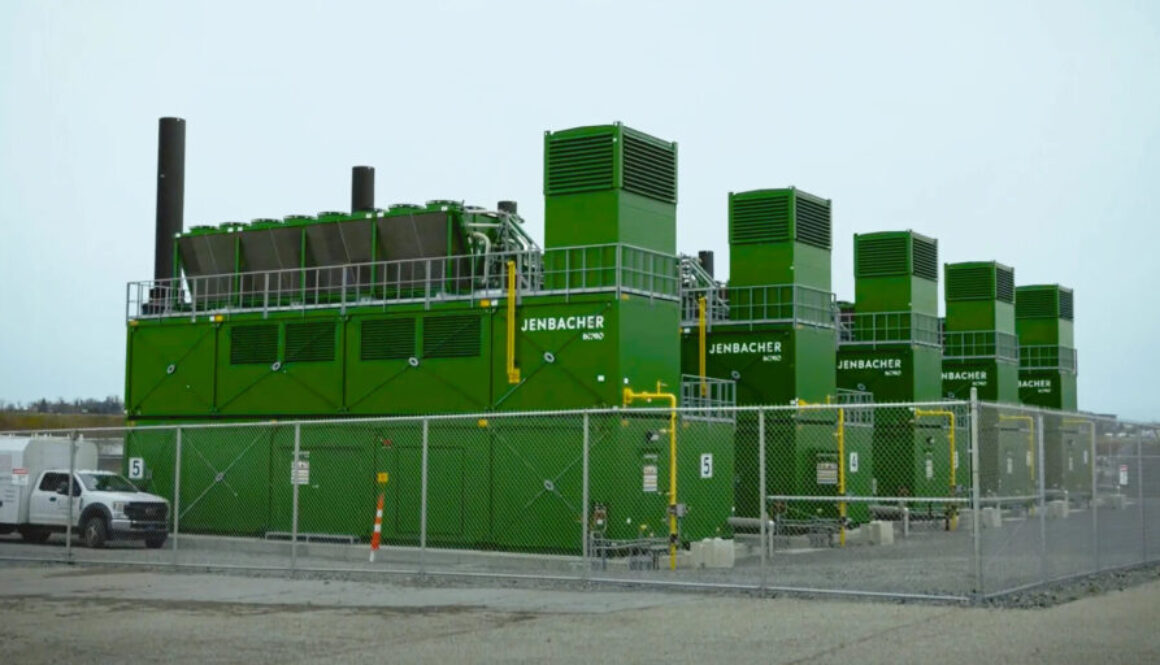
Growth committee approves gas plant despite climate concerns
City Council’s Growth Standing Committee has recommended that a proposed natural gas “peaker” plant come before a full council vote.
The proposal, put forward by Alberta-based Versorium Energy Ltd., calls for council to approve the construction of a $50-$80 million facility at Maureen Street and Central Avenue.
Should council decide to approve the project, Versorium will still need to bid for a contract with Ontario’s Independent Electricity System Operator (IESO).
At Tuesday’s committee meeting, critics of the proposal had an opportunity to speak out against the plant.
“Pretending that we’ll somehow need to buy dirty energy from the 20th century just totally defies logic,” said Paul Berger at the meeting.
Berger teaches climate change education at Lakehead’s Faculty of Education and is the lead organizer of Citizens United for a Sustainable Planet.
Berger emphasized that Canada, Ontario, and the city of Thunder Bay have all produced their own 2030 climate change targets, and none of them are on track to meet those targets.
“Canada is a climate laggard. That’s radically unfair to those living and dying with our failings,” Berger said. “In this context, it would be madness to build a gas-fired generating station that will emit greenhouse gases, making the problem worse.”
Berger’s presentation focused on the extent of the climate crisis, which worsens by the year and shows no signs of slowing down.
He stressed that the Earth is at a tipping point, which can be understood as a point from which there is no turning back, and from which the planet will be irreversibly changed for the foreseeable future.
Berger pointed to raging wildfires, dying coral reefs, increasingly unstable hurricanes, and the impending collapse of the Antarctic Ice Sheet.
Berger’s presentation was followed by Keira Essex, who is the curriculum coordinator for Indigenous Clean Energy.
Essex told council that Canada’s per capita emissions are among the highest in the world. Though China and India have become leading polluters, individual Canadians emit greenhouse gases at more than double the rate of individuals in China.
Like Berger, Essex reminded council that the city has a net-zero plan and argued that a natural gas plant would violate that commitment.
“Investing in already outdated infrastructure, which opposes our municipal plans and has minimal and vague economic benefits for our community, may not be the wisest approach in governance,” Essex said.
“Creative accounting”
Berger and Essex were not solely focused on the big picture of global climate change: they had criticisms for Versorium Energy as well.
Essex questioned the financials of a natural gas peaker plant.
A peaking plant is not designed to run at all times, but simply at times when an electrical grid’s demand is at its highest. Because a peaker plant’s role is simply to “top up” the grid’s missing capacity, it is not as efficient as other forms of electrical generation.
“They’re the most costly and least efficient natural gas approach,” Essex said. “Gas peaking is also the most expensive form of energy, falling well behind renewables and shortly behind nuclear.”
Versorium has claimed its gas plant, though a greenhouse gas emitter, could actually offset more emissions than it produces. Berger aggressively opposed the suggestion.
“That’s an egregious claim. It’s creative accounting,” Berger said.
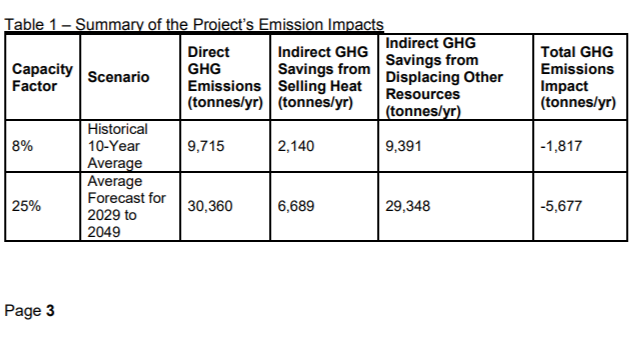
Versorium says that about one-fifth of its emissions can be offset through selling excess heat to Canada Malting, which has a facility next to the proposed gas plant site. Canada Malting could use that heat in their boiling process, saving them from producing or acquiring the heat by other means.
Berger questioned the feasibility of the idea, arguing that it would require an expensive retrofit of the malting company’s facility.
Representatives from Versorium responded to inquiries by this reporter, stating that they are in discussions with Canada Malting, and, should the plant be constructed, Versorium will sell the excess heat to their potential partner at a discount, which will offset the capital costs of a retrofit.
In an interview with this reporter, Berger acknowledged that if Canada Malting did go forward with a retrofit, Versorium’s predictions of offsetting greater than 6,600 tonnes of greenhouse gases could be possible.
Berger expressed greater skepticism of Versorium’s other claim: that it could offset more than 29,000 of its 30,000 tonnes of emissions through “displacing other sources.”
“The most appropriate response to this chart is to laugh,” Berger said at the meeting.
Representatives from Versorium explained that their predictions stem from the idea that a peaker plant in Thunder Bay could replace the need to rely on a peaker plant in another part of the province – likely in Southern Ontario, more than 1,000 kilometres away.
They argue that energy losses from transmitting energy across great distances mean a peaker plant in Southern Ontario would essentially have to work harder to provide the same amount of energy to Thunder Bay as a local plant, resulting in greater emissions.
While this is true, Versorium’s predicted numbers demand scrutiny.
Versorium is suggesting that building a plant in Thunder Bay can offset almost 97 percent of its total emissions through this theory.
The IESO estimates transmission losses of about two percent system-wide on the Ontario grid, and for comparison, Alberta’s AESO estimates losses of about four percent. To square Versorium’s numbers, Ontario’s transmission losses would need to be closer to 50 percent, meaning half of the electricity produced would need to be lost in transit.
Meeting Ontario’s capacity needs
The criticisms by Berger and Essex gave some councillors pause at the committee meeting.
Despite this, the city government’s recommendation was that council greenlight the proposal.
City Manager John Collin explained that the city’s recommendation to approve the proposal was in service of the IESO’s needs.
“They have categorically said – and they are the experts, not administration – that Ontario needs 75 percent more power than it already has in the next 25 years,” Collin said, referring to the IESO.
The IESO is currently accepting bids for a wide range of electricity-producing projects, including green energy and nuclear projects for the grid’s base supply, and a broader range of “dirty” producers for filling in the gaps during periods of excess demand.
At the meeting, Councillor At Large Kasey Etreni asked how the proposal aligned with the city’s net-zero strategy.
City administrators answered by explaining that the city “point-blank” needs more power, meaning even dirty energy could serve the city’s overall climate goals.
City councillors went along with the city’s recommendation and approved the proposal. Now that Versorium’s proposal has been approved in a standing committee, it will come before a full City Council discussion and vote in a future meeting.