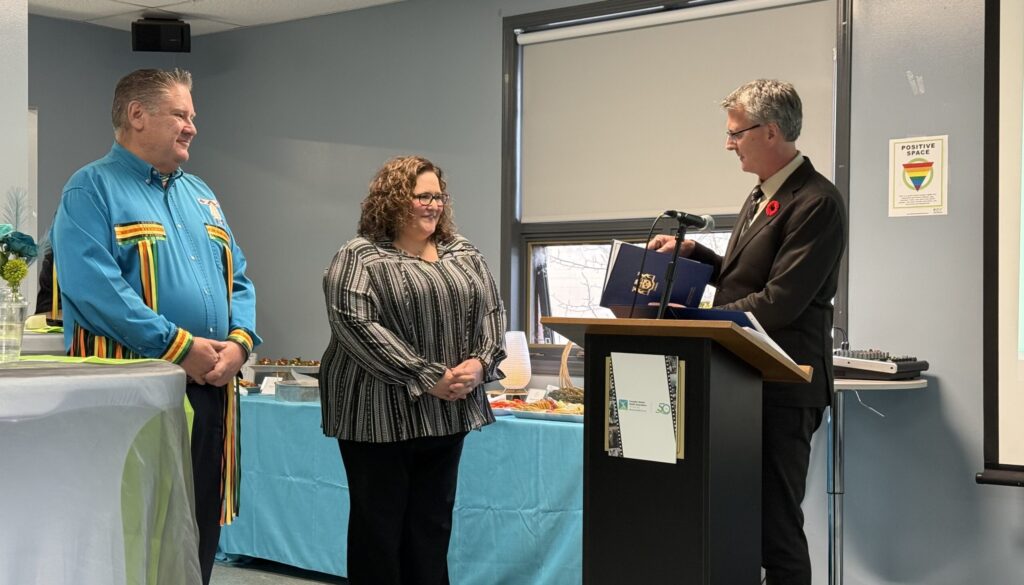
CMHA Thunder Bay celebrates 50 years
The Thunder Bay branch of the Canadian Mental Health Association celebrated 50 years as a chartered branch on Monday.
The city’s local CMHA began in the 1950s as a group of concerned citizens raising community awareness of mental illness. In 1975, the group officially joined the national CMHA organization.
CMHA Thunder Bay CEO Tiffany Stubbings says back then, the group had four employees and two programs. Today, the organization has almost 100 employees devoted to a wide range of programs.
“To see what we started as and where we’ve come is really incredible,” says Stubbings.
In five decades, the public conversation around mental health has changed dramatically. Stubbings says people are more willing to be open and vulnerable about their mental health struggles than they were in the past, but stigmas persist.
“There’s a perception that if you have a mental illness, you’re weak, and that couldn’t be further from the truth,” she says. “It takes a lot of courage and a lot of vulnerability to share that you’re struggling. And I think the more people can do that, the more we realize that we’re not alone in this.”
Stubbings says the way forward is to continue having conversations about mental health, to normalize the experience.
“We should talk about our mental health just like we talk about our physical health. Just like someone talks about having diabetes, we need to talk about people’s struggles with depression or anxiety. We should be treating it the same as we treat physical health,” she suggests.
Long-time CMHA member William Campbell describes CMHA employees as “the most compassionate, understanding, non-judgmental people that were willing to listen to me and provide me direction.”
Campbell is a survivor of the Sixties Scoop: in the 1960s, tens of thousands of Indigenous children in Canada were forcibly separated from their families to be adopted by non-Indigenous families.
Campbell was separated from his family when he was four.
By the time he was 18, he had been through three adoptive homes, experiencing abuse from supposed guardians. Battling the trauma of his experience, he wound up living on the streets of Barrie.
Campbell’s experiences connected him with the CMHA, putting him on a path to recovery.
Decades later, Campbell came to Thunder Bay after reconnecting with his biological family.
He became involved with CMHA again – this time as a member of Thunder Bay’s Client Member Advisory Council.
In addition to meeting with other CMHA clients who share similar challenges, as a member of the advisory council, he offers input on CMHA programming.
Today, Campbell makes an effort to help other CMHA clients whose situations he may recognize: “It feels amazing to be that role model for other clients here, members, and knowing that there’s a future ahead for them.”