N.B. releases long‑term plans to improve education
New Brunswick is laying out a 12‑year roadmap for its schools.
The provincial government has released new education plans for the anglophone and francophone sectors.
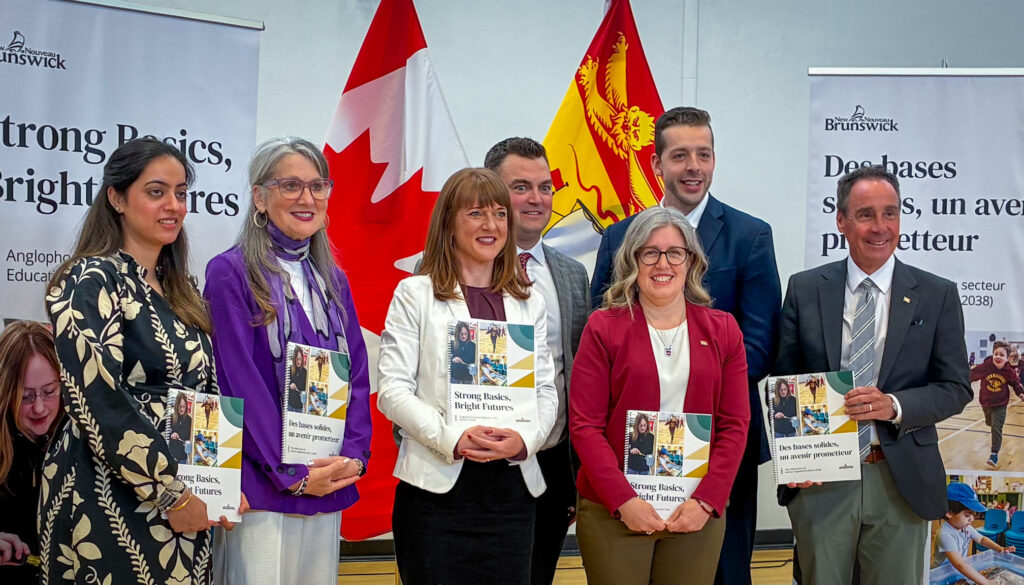
The anglophone plan, ‘Strong Basics, Bright Futures‘, focuses on literacy, numeracy, student well‑being and stronger collaboration.
It includes a three‑year action cycle with annual targets and 25 indicators the province will track publicly.
Premier Susan Holt said the goal is to strengthen foundational skills and give students the support they need to succeed.
“We’re measuring at every step that we’ve committed to publicly, that we report on publicly,” she said, adding that the results will show whether the system is improving.
Education Minister Claire Johnson said the anglophone plan was shaped through extensive consultation.
She added that roughly 14,000 people took part in the engagement process, including educators, families and community members.
Johnson said the academic standards themselves are not changing, but expectations for how many students should meet them will rise over time.
“We want those goals to be incremental, and we want them to improve with time so that year after year there are more people succeeding in our system,” she said.
Anglophone plan outlines targets and classroom support
The plan identifies three priority areas:
- strengthening foundational skills
- promoting well‑being and belonging
- improving collaboration across the system
It also sets three conditions for success:
- a stable workforce
- continuous improvement
- greater accountability
Johnson said the plan combines a long‑term vision with shorter‑term action cycles to ensure progress is monitored and adjusted as needed.
“We’ve combined the road map, the long‑term vision with shorter‑term action plans,” she said.
The plan builds on $2.2 billion in education spending this year, according to a government release.
That includes money for more educational assistants, resource teachers, school counsellors and early childhood supports.
The province is also funding a lunch program for every school and providing healthy breakfast foods with support from the federal National School Food Program.
The 2026‑27 capital budget includes $242.7 million for school infrastructure, including new schools and upgrades.
The plan’s 25 indicators include early intervention timelines, student well‑being, French‑language proficiency and the number of schools reaching at least 70 per cent success on provincial assessments.
Heidi Ryder, president of the New Brunswick Teachers’ Association, said the plan is a positive step but added that its success will depend on transparent implementation and adequate resources in classrooms.
Francophone plan focuses on identity, early learning and long‑term stability
The provincial government also released a separate plan for the francophone sector, ‘Ensemble pour la réussite!‘ (Together for Success).
It sets progressive objectives for the next 12 years and includes three‑year action plans with specific metrics and annual targets.
Holt said the francophone plan was developed through extensive consultation and reflects the needs of Acadian and francophone communities.
Johnson said the plan emphasizes literacy, numeracy and identity‑building from early childhood through Grade 12.
The francophone plan highlights three priority areas:
- building stronger foundations for learning
- developing skills for success
- strengthening unity in a changing world.
It also outlines conditions for success, including a proactive response to diverse needs, ongoing training for educators, and recruitment and retention efforts.
The plan builds on government spending already underway, including school food programs, major infrastructure projects and staffing increases across both sectors.
Eric Godin, president of the Association des enseignantes et des enseignants francophones du Nouveau‑Brunswick, said he welcomes the plan and is encouraged that universal pre‑kindergarten for four‑year‑olds is included.