Sam Goldstein is a 2025 graduate of the Seneca Polytechnic journalism program. Sam’s great passions are for history, politics, and food. Born and raised in Toronto, he works as a multimedia journalist in Thunder Bay. You can reach him at goldsteins@radioabl.ca.
The program aims to help small and medium-sized Canadian businesses enter industries relating to defence and military procurement.
The Federal Economic Development Agency for Northern Ontario (FedNor) will be spending almost $16 million over the next three years to assist businesses in northern Ontario with transitioning or adapting into the industries.
Businesses can apply for investments from the initiative to enter fields including research and innovation, and domestic supply chain development.
This announcement comes as the Canadian government looks to increase its military spending to meet NATO targets.
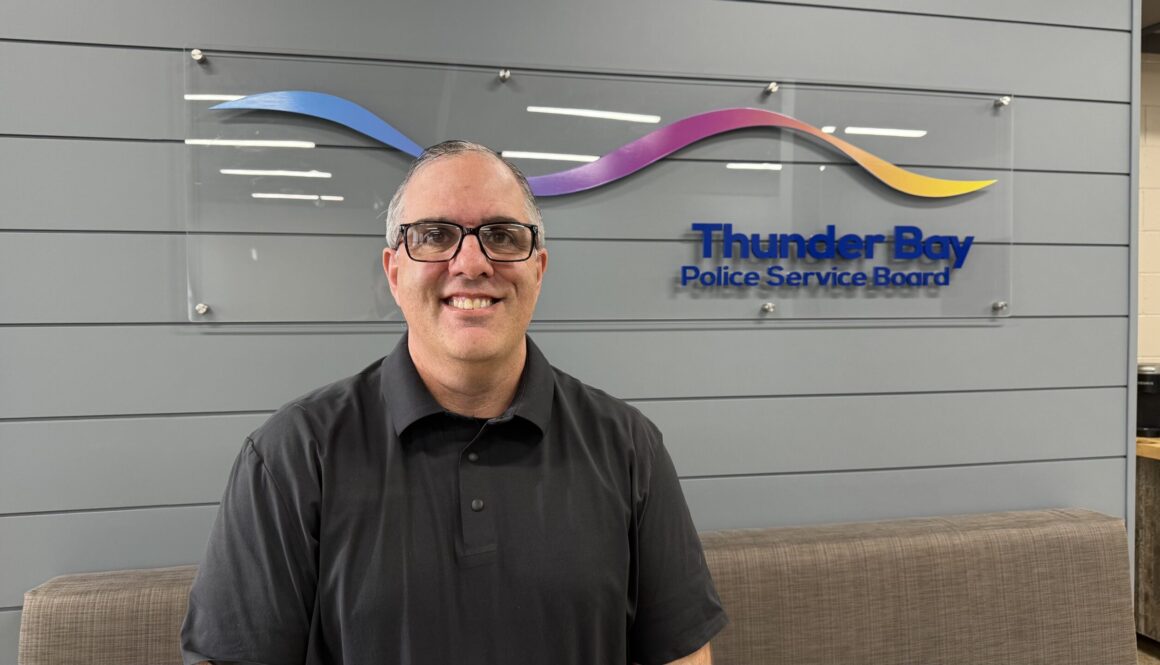
The Thunder Bay Police Service (TBPS) Board has appointed Mark Figliomeni as its first-ever full-time Executive Director.
Figliomeni has previously worked in municipal politics as a councillor and mayor of Schreiber, as a board member and vice-chair of the District of Thunder Bay Social Services Administration Board, and most recently as the Chief Administrative Officer of Red Rock Township.
But the director’s new role in leading the police board comes with historic baggage that will demand a deft touch.
In late 2018, the city of Thunder Bay was rocked by two reports that both characterized the TBPS as an institution wracked by systemic racism from top to bottom.
The Sinclair Report, published by Senator Murray Sinclair (who also chaired the Truth and Reconciliation Commission), observed a failure by the TBPS to investigate Indigenous-related crimes in the city and a general lack of faith in police by Indigenous residents of Thunder Bay and the surrounding district.
The Broken Trust report, published by Gerry McNeilly, Director of The Office of the Independent Police Review, came to similar conclusions one month later, specifically criticizing the manner of investigations into Indigenous deaths by the TBPS.
Both reports laid out a series of recommendations to improve police transparency and accountability, and ultimately repair the fractured trust that marginalized members of the city had lost in their public institutions.
The police board initially conveyed a reluctance to address the recommendations under then-Chief Sylvie Hauth, who is currently facing criminal charges and is set to face the courts in April.
But in the years since, progress has been made: the TBPS appointed Darcy Fleury of the Red River Métis as Chief, appointed two Indigenous women to the board, and last year released a public tracker to improve transparency in the service’s efforts to meet the many recommendations to transform the institution.
The appointment of a full-time Executive Director to lead the board was one of the recommendations of the Sinclair report.
Figliomeni describes his orientation into the new role as overwhelming but intriguing.
Though he is still familiarizing himself with the position’s nuances, the new director feels the new full-time position “enables us to evolve with the times.”
“Generally speaking, it’s the vision of the board to continue to get better, to adopt those recommendations from that report, and move forward,” he says.
Figliomeni is undaunted by the controversial history of the city police.
Despite entering uncharted territory as the first in his role, he feels that his own career history has prepared him for the task.
“When it’s an inaugural role, it’s one framework that you’re there to develop. So we have a kind of vision as to where it’ll go, but certainly it’s a vision that still needs to be developed.”
Figliomeni says his career history demanded “wearing many hats,” taking on wide-ranging responsibilities and relying on the establishment and maintenance of key relationships to achieve success.
The new director recognizes that the police board has a grave responsibility to make positive changes, but feels the progress is clear and visible.
“I think this board has a clear focus of being better, and I think you’ve seen that over the last year or more… I’m seeing a very engaged board, and a board very interested in being successful with a brand new strategic plan,” he adds.
Figliomeni sees the role he is taking on as intriguing, challenging, and one that will allow him to make a difference.
“I wanted to be able to contribute back to the city of Thunder Bay, a city that I call home.”
For those of you who haven’t been introduced, I’m Sam, 99.9’s first-ever Jewish journalist.
I moved to Thunder Bay this year from Toronto, a city with a long-standing and historic Jewish community nearly as large as our entire city.
Last week, I decided it might be fun to write something about a Jewish holiday taking place in the lead-up to Christmas.
But earlier today, in Australia, a Jewish event celebrating the holiday was attacked in a brutal and horrifying mass shooting.
At least 11 people have been killed, and 29 wounded in the attack.
In the days and weeks to come, great debates will be had about the motivations of the two individuals who carried out the shooting, but until more information comes to light, there is no use in speculating.
When events like this happen, I am reminded that the spectre of antisemitism, which has haunted Jewish people for two millennia, is alive and well despite the progress we have made since the Second World War.
A constant lesson of our history is the need to carry on no matter the tragedy, immortalized in the phrase this too shall pass.
Through expulsions, pogroms, and mass killings, Judaism has persisted, and its people have continued to proudly bear our label despite the risks.
When I woke up this morning to the news, I considered deleting this piece, feeling the light-hearted tone was no longer appropriate.
I changed my mind: I suspect that the men who attacked the Australian event earlier today would love nothing more than for Jewish folk around the world to spend their Hanukkah in quiet fear, afraid to attend public gatherings or publicly identify with Judaism.
At times like these, it is more important than ever to joyfully share our heritage and traditions, in public and without apology.
So read on if you wish to learn about the holiday of Hanukkah, which has always been my favourite Jewish holiday, and which was being peacefully celebrated on a beach in Sydney when 11 lives were taken this morning.
Hanukkah, our festival of lights, begins tonight and ends on Monday, December 22.
A brief Jewish history lesson
I’ve always loved Hanukkah as a history buff, because the holiday celebrates a well-documented and inspiring historical event that took place a full 1,500 years after the Torah (what you likely know as the Old Testament) was written.
Unlike the biblical events that define most Jewish holiday celebrations, there is no historical ambiguity to Hanukkah. We know, in fairly certain terms, what happened, when, and by whom.
If you hadn’t heard, the Jewish faith traces its roots to the modern-day lands of Israel and Palestine – specifically, in what today makes up the occupied territory of the West Bank in Palestine, which Israel refers to as Judea and Samaria after the ancient Jewish kingdoms that used to exist there.
Judea, the southern kingdom with its capital in Jerusalem, was the centre of Jewish life in the age of antiquity.
Despite centuries of occupation by foreign conquerors, Jews in Judea had been allowed to practice their religion and culture by their occupiers.
But in the 100s BCE, the Seleucid king Antiochus IV, who ruled the Levantine portion of Alexander the Great’s fractured empire, decreed that the Jews would be Hellenized, outlawing the Jewish faith and forcing my ancient ancestors to worship the Greek pantheon.
Alas, Zeus and co. were not really our cup of tea.
The event sparked a great rebellion led by a Jewish family known as the Maccabees.
The rebellion was very much in the vein of a David fights Goliath story, as the small Jewish kingdom of Judea challenged a great empire and emerged victorious against all odds.
Festival of Lights
If you’ve ever heard of the Western Wall in Jerusalem, you may know that in the age of antiquity, that wall used to be one piece of the outer ring of a great Jewish temple that was central to the ancient Jewish faith.
The temple would eventually be destroyed by the Romans, but at this time it still existed and was of great importance to the ancient Jews.
When the Maccabean rebellion broke out, their adversaries, the Seleucid Greeks, sacked the holy temple.
After driving out their occupiers, the Maccabees returned to Jerusalem only to discover the temple in a state of disrepair.
A large menorah, or seven-stemmed candelabra, stood tall in the temple.
It was traditionally meant to illuminate the holy temple 24/7 by burning olive oil.
The menorah had not been allowed to burn its seven flames while under Seleucid occupation.
This is where history becomes legend: upon liberating Jerusalem, the Maccabees could find only one small jar of lamp oil in the temple for the menorah – enough to last for just one day.
Miraculously, the lamp oil from that tiny jar burned for eight days, giving the temple’s caretakers enough time to restock their oil supply.
The story of the burning menorah is central to the holiday tradition: we celebrate Hanukkah for eight days to represent the eight days that the little jar of oil burned.
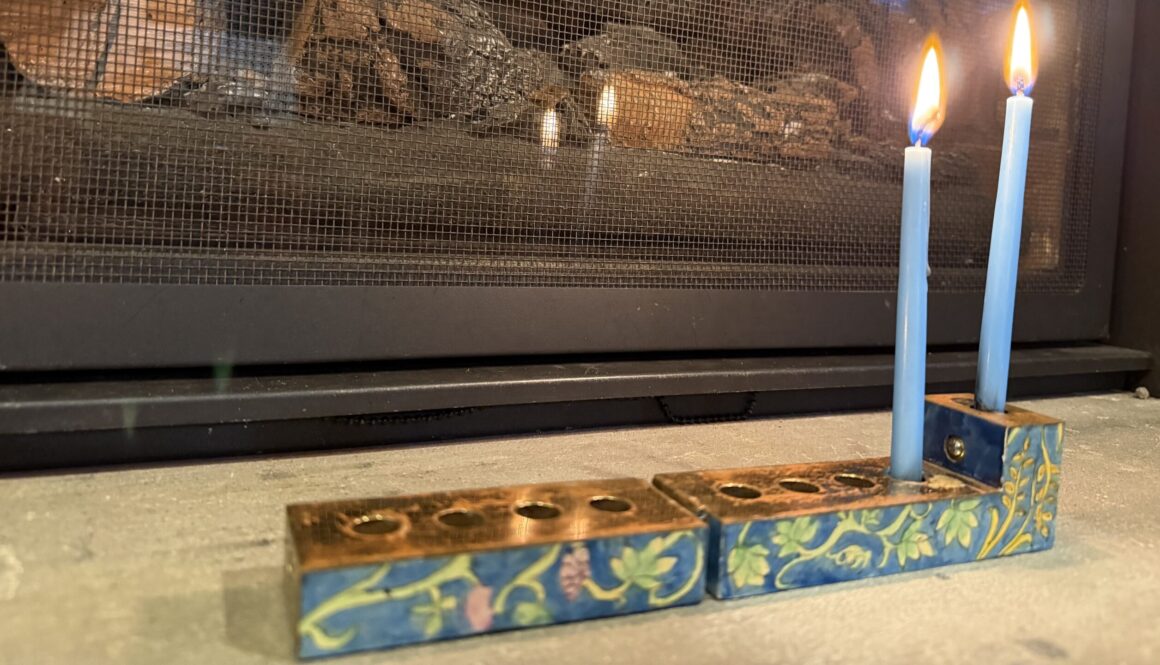
Over the holiday, Jewish families light a modified menorah called a Hanukkiah, which has nine stems, in our homes.
Today, we light candles rather than burning olive oil.
Eight stems on the Hanukkiah represent the eight days of burning, and a ninth stem, the Shamash, or helper in Hebrew, is used to light the other eight.
Each night of the holiday, we light another candle. On the first night, we light one candle, on the second two, and on the final day, we light all eight candles with the Shamash.
But what about the food?
As we all know, a holiday is only as good as its traditional foods.
For Hanukkah, we serve deep-fried Latkes (potato pancakes) as the star dish.
We usually top them with sour cream or apple sauce, though in my family, we sometimes top them with smoked salmon.
Other traditional foods are Sufganiyot, or jelly donuts, and gelt, or chocolate coins.
One of Hanukkah’s traditions is to play dreidel: the four-sided spinning top functions similarly to a dice.
A dreidel, or Jewish spinning top. The four Hebrew letters on the four sides represent an acronym translating to “a great miracle happened there.” (Sam Goldstein/December 10, 2025)
We teach our children the horrors of gambling at a young age by allowing them to gamble their chocolate gelt, so they can feel the pain of losing all their sweet chocolate money when the dreidel lands on the wrong side.
Hanukkah is also a time to bring out other classic Jewish foods: Challah, or Jewish egg bread, Kugel, or egg noodle casserole, apple cake, and, god willing, juicy beef brisket.
If, like me, you’re away from your family this holiday season, I hope it comforts you to think of the traditions, the comfort foods, the stories, and the heritage that you’ve left behind.
But of course, you haven’t really left it all behind. These things live within you everywhere you go, as they do in me.
The Federal Court of Canada has ruled in favour of the Sandy Lake First Nation and St. Theresa Point First Nation in a class-action lawsuit against the Canadian government.
The lawsuit, St. Theresa Point First Nation v. His Majesty the King, argued that the Canadian government has a responsibility to provide or support adequate housing on reserves.
The $5 billion lawsuit has two stages: the first stage, which is now complete, was focused on determining if the Canadian government was legally responsible for on-reserve housing.
The second stage will figure out to what extent the government is liable and how a resolution can be reached.
The Nishnawbe Aski Nation (NAN) reacted positively to the court decision.
“For far too long, First Nations have suffered with chronic housing shortages, overcrowding, and unsafe, deteriorating homes while Canada fails to meet its obligations,” said NAN Grand Chief Alvin Fiddler. “Safe and suitable housing is fundamental to the health and prosperity of our communities.”
The provincial government is investing $500 million into a Critical Minerals Processing Fund (CMPF).
The new fund is meant to speed up the process of constructing and expanding processing facilities for critical minerals by helping finance projects.
The Ontario government is looking to develop a more circular economy around critical minerals, which will require processing facilities to keep up with the growing demand to open new critical mineral mines.
The CMPF is intended to complement any attempt to open up the Ring of Fire to new mines.
Demand for critical minerals like graphite, lithium, cobalt, nickel, and copper has increased substantially in the last few years due to their necessity in modern technologies like computers, as well as green energy technologies like solar panels, electric vehicles, and battery storage.
Any businesses hoping to receive funding under the CMPF should consult Invest Ontario.
Ontario’s electrical utilities, including Hydro One, are advising the public to be vigilant of fraud this holiday season.
The utility companies have come up with three Ps for fraud prevention: pause, prove, and protect.
They advise pausing when discovering a notification that could be remotely suspicious, rather than rushing into a payment scheme that may not be legitimate.
The utilities recommend proving the veracity of any potential scam by directly contacting utility companies, rather than being contacted (use the phone number on a utility bill.)
Finally, they recommend protecting all personal information, which should not be given out on a whim.
The public should be wary of any demands for immediate payment, which are meant to put pressure on individuals to take quick action before thinking through the possibility of fraud.
Any promises of refunds or updating account information should always demand scrutiny.
Utility companies will never ask a customer to pay their bill using gift cards, prepaid debit cards, or cryptocurrency (this advice can be used for scams far beyond just utilities).
Those who are concerned they may have been defrauded can contact the Canadian Anti-Fraud Centre at 1-888-495-8501
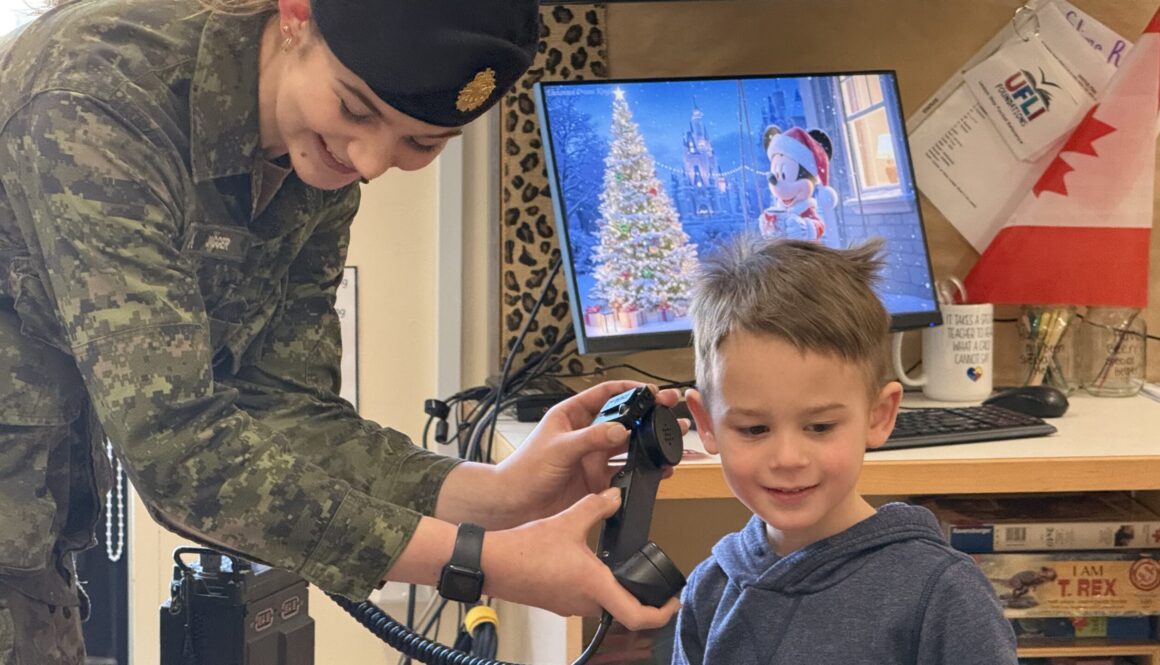
Members of the Canadian Armed Forces’ 38 Signal Regiment visited St. Margaret Elementary School on Thursday as part of their annual Radio Santa program.
Kindergarteners at the school were given the chance to ask questions to Santa Claus through a two-way radio.
The children were mainly concerned with logistical questions, such as how reindeer fly and why Santa chooses to fly during the night.
While some students asked for unattainable gifts such as a unicorn and a dinosaur, most were content with tangible items, such as a dollhouse or a Nintendo Switch.
Some students were more interested in sharing with Santa than asking questions: “My mom lost her phone in the water a long time ago,” one informed the radio operators.
The signalers came prepared with the names of the schoolchildren and the gifts they hoped to receive for Christmas, so Santa could convincingly project his knowledge of the children’s holiday desires.