Randy Thoms is a veteran news broadcaster with over 40 years' experience. He is based in Fort Frances and covers stories across northwestern Ontario. Contact Randy at thoms.randy@radioabl.ca.
An Alberta-based mining company is expanding its interests in northwestern Ontario.
Golden Rapture Mining says it is acquiring the mineral rights to seven mining claims located near Swell Bay, about 40 kilometres northeast of Fort Frances.
Gold was first discovered in the area in the 1890s, with a shaft, trenches and pits put in place.
There has been further exploration by geologists since, with the latest conducted by King’s Bay Gold, which revealed in 2001 signs of high-grade gold.
The company says it plans to conduct exploration work in the near future.
Golden Rapture also owns property in the Dryden area and north of the Rainy River Mine.
Thunder Bay-Rainy River MP Marcus Powlowski is looking for changes to a program that grants special access to physicians, medications that have not been fully approved by Health Canada.
The program allows doctors access to the drugs only when conventional therapies have failed, are unsuitable or are unavailable.
Powlowski, an emergency physician, wants to reduce the time it takes to receive approval.
He cites an incident involving a doctor at Sick Kids Hospital as a reason for the change.
“A pediatric ICU doctor recently told me about spending six hours trying to resuscitate a child, the first four hours of which were spent trying to access a drug which is available only through this program, even though that drug is considered first-line therapy in the United States,” Powlowski told the House of Commons.
Powlowski says approval of his Private Member’s Bill would reduce the red tape that is associated with the program.
“And also leave the decision in life-threatening situations as to whether to use a drug not yet approved by Health Canada to the clinicians, not to bureaucrats in Ottawa.”
Powlowski introduced the bill last week, with a second reading expected when MPPs return from their March break.
Premier Doug Ford feels a national oil pipeline would help keep gasoline prices down in Ontario.
Prices have skyrocketed in recent days due to the war in Iran.
In northwestern Ontario, they have spiked to as high as $1.75 a litre.
Ford says that having Canadian oil refined in the country reduces the need for outside supplies.
“Let’s start getting a pipeline built across our country,” says Ford.
“Let’s bring it down to Sarnia. Let’s get the pipeline over to the Irving refinery in New Brunswick. That would relieve it,” says Ford.
Last summer, Alberta, Saskatchewan and Ontario signed agreements to study the potential of a pipeline to flow oil and gas to a new port at James Bay and southern Ontario.
A feasibility study was started last fall.
To be completed later this year, the study is expected to provide potential routes and costs.
Minnesota faces an uphill climb in boosting its population to maintain a strong labour force and meet other needs.
Formal census counts happen every 10 years, but in between the reports, experts monitor trends and compare them with past population swings.
Susan Brower, state demographer for Minnesota, says after decades of steady growth, the state’s population is levelling off.
Slowdowns are happening across the U.S., but she notes it is especially felt in the Midwest and Northeast regions.
Brower attributes the shift to what is known as “natural change.”
“We have a higher share of deaths, more mortality in those higher age groups, and we have falling birth rates at the same time,” explains Brower.
Unlike some of its Midwestern neighbours, Brower points out Minnesota is not quite at the point where there are more deaths than births, but the state is projected to cross the threshold by the end of the 2030s.
Demographers warn the pressure from the shift is beginning to show, with more strain on health care systems and government budgets.
There is an effect on the labour force, too, and Brower argues boosting international migration could ease that pressure.
It is unknown how much the Trump administration’s immigration crackdown will stall progress in aiding Minnesota’s workforce needs with foreign-born workers.
Brower adds Minnesota has seen a recent boost in people moving here from other states, but reiterates looking toward other countries holds more promise than anything else.
“In terms of growth of the workforce, international migration is the most plausible mechanism to start to see more growth in the near future,” underscores Brower.
She notes even with some exceptions, the pattern of people leaving Midwestern states is too much to overcome in the short term.
When speaking at an event hosted by the University of Minnesota Alumni Association, Brower contended the latest numbers should compel policymakers to support educational opportunities for working adults and parents.
The research indicated there should be an emphasis on essential industries like health care.
It has been a decade since the Fort Frances Lakers last finished first in the standings in the Superior International Junior Hockey League.
That drought ended last week when they clinched the 2025-26 regular season title with a pair of wins over Ironwood.
Local hockey fans cheered the town’s first hockey championship nearly 100 years ago.
It happened in March 1927, when the Fort Frances Maple Leafs swept the Eveleth Miners in three straight games to win the inaugural Arrowhead Amateur Hockey League crown.
The six-team league came together in the fall of 1926 with the Virginia Hawks, Hibbing Falcons, Duluth West Ends and International Falls Insulites joining the Leafs and Miners.
Before then, Fort Frances hockey teams played mostly exhibition contests.
The first league in the Rainy River District was established in 1905, with teams from Emo, Rainy River and Fort Frances playing a six-game schedule in January and February.
The league received little local press coverage, though it was reported that Emo won the championship.
The genesis for the Arrowhead league goes back to the winter of 1925, while Fort Frances, then classified as an intermediate team, was playing exhibition games in Minnesota.
The team was suspended by the Thunder Bay Amateur Hockey Association in December for travelling to Minnesota, violating an edict issued by Canadian Amateur Hockey that forbade Canadian amateur clubs from playing in the U.S.
The Central Amateur Hockey League formed that season, with teams from Duluth, Winnipeg, Minneapolis, St. Paul, Eveleth-Hibbing and Sault Ste. Marie.
Upon completion of the season, team officials opted to transition into a professional league, satisfying the interests of the Minneapolis and St. Paul clubs.
Eveleth and Hibbing considered staying but decided the cost would be too great.
This led to the discussions of a new amateur league, with interest coming from Duluth, Marquette, Michigan; Virginia, Superior, Hibbing and Eveleth.
Fort Frances and International Falls also sent delegates to a meeting in Hibbing in November to discuss its structure, rules and schedule.
Harry Marr, assistant treasurer of the Fort Frances Hockey Club and town clerk, was selected vice-president, while O.E. Olson would represent the International Falls on the board of directors.
Each club was required to remit a membership fee, though the amount of money was not disclosed.
A balanced 20-game schedule was drawn up, with each team playing 10 home games.
International Falls did not have its own arena and was forced to play its home games out of the Fort Frances Curling Club, which also doubled as the home rink for the Maple Leafs, a name selected by the Fort Frances club’s board of directors.
The clubs agreed to play according to rules established by the Canadian Amateur Hockey Association and issue fines of $100 for failing to play a scheduled game.
A provision was included that if International Falls was unsuccessful in establishing a team before the start of the season, a second team sponsored by the Fort Frances Hockey Association would be permitted but play as International Falls.
The Insulites were able to assemble a team, securing several Canadians, but found themselves shorthanded for a few games early in the season, prompting some Maple Leafs to suit up.
Fort Frances was led by Horton Scott in net, Jimmy Angus and Art Torseth on defence, and Bert Gillon, Maurice Godin and Warren Menthe up front.
The Leafs opened their season in Eveleth on December 10, 1926, dropping a 2-0 game to the Miners.
They found their footing three days later, defeating Duluth 3-1, and proceeded to win 12 of their next 13 games to keep pace with the Miners for first place overall.
Fort Frances ended its schedule with a 10-0 pasting of Virginia to finish with a record of 16 wins and 4 losses, six points back of Eveleth, which lost just once, a 2-0 defeat at the hands of the Leafs.
This set up a best-of-five final series for the championship that opened in Fort Frances on March 8, 1927.
The Leafs controlled much of the play in the first 20 minutes, firing 18 shots at the Miners’ Pat Bryne, but failed to sneak a puck past the Ottawa-born netminder.
The Miners scored twice in the opening period and held the 2-goal margin until the third, when the Leafs scored goals three minutes apart to tie the game.
Both teams had equal chances to pull ahead, but neither found the back of the net, forcing overtime.
Just minutes into the extra frame, Jim Kelly fired a hard drive that whizzed past Bryne, sending the hometown fans happy.
Game 2 was played the next night at the Fort Frances Rink, where the Miners carried a 4-1 lead early in the third period.
A goal by Buck Hanson narrowed the Miners’ lead and gave the Leafs momentum.
Godin scored a pair of unassisted markers midway through the period to even the score before Kelly and Ross Creasy scored in succession to give the home team a 6-4 victory and a 2-game series lead.
The series resumed in Eveleth on March 11th, with more than 300 Fort Frances fans catching a train for the game at the Eveleth Hippodrome.
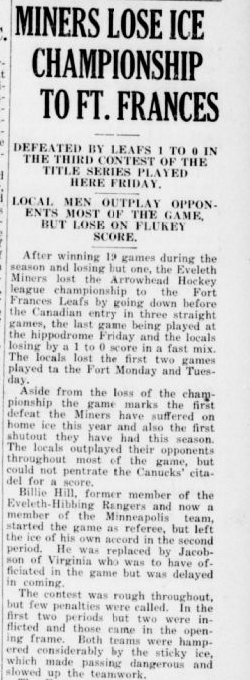
Eveleth News article of final game in 1927 Arrowhead Amateur Hockey league, Eveleth News, March 17, 1927
The Miners outplayed their visitors from the drop of the puck, but no results showed from their effort.
Eveleth had three goals nullified by referee Billie Hill, who once played hockey in the Minnesota city.
The Leafs broke the scoreless game in the second period.
While a scramble for the puck ensued in Eveleth’s end, Angus skated around the net, picked up the loose disk with his hand and threw it into a clear spot where Godin snapped it past a startled Bryne.
The Miners’ argued, but Hill claimed he did not see the illegal manoeuvre and allowed the goal to stand.
Shortly after the play, Hill left the game and was replaced by another official from Virginia.
It would be the game’s only goal. Fort Frances held off a determined Eveleth squad for the rest of the game to capture the championship.
The team was recognized at an event at the town hall auditorium at the end of March.
Each player received a sweater coat adorned with their monogram and other gifts.
Team secretary, H.A. Tibbetts, recited a poem that recognized each player’s achievements.
As quoted by the Fort Frances Times, April 7, 1927;
Jimmy Angus;
Our team has a captain named “Jim,” who supplies it nerve, pep and vim; When we’re down on our luck, and he gets the old puck; For a goal we can count upon him.
Horton Scott;
Horton Scott picks ’em off with his chin, his eyebrows, an elbow or chin; In spite of their boasts, when Scott twists the posts; Their chances of scoring are thin.
Tommy Mathieu;
To’ Mathieu, they all look the same, no matter their “rep” or their fame; Big or small, short or tall, when they hit this stone wall; They retire for the rest of the game.
Art Torseth;
Now Torchy is there with the stuff, and it don’t pay to start something rough; He can block, he can check, and rush, too, by heck; And they find when they bump him, he’s tough.
Maurice Godin;
A speedy red demon is Morris, who sent Eveleth home sick and sorry; For his work with his stick was so clever and slick; That he covered Fort Frances with glory.
Bert Gillon;
There’s not much the matter with Bert, down the wing he proceeds with a spurt; When they try to check Gillon, they think he’s a villain; And frequently someone gets hurt.
Ross ‘Bo’ Creasy
They may think our centre is slow, but that’s only because they don’t know; For a lightning streak greasy, no faster than Creasy; And a black eye don’t bother our ‘Bo.’
Buck Hanson;
We were licked – down and out – out of luck, but that didn’t bother our Buck; For, not once, but twice, he sailed down the ice; And in Eveleth’s net placed the puck.
Warren Menthe;
Then Menthe came on with a shout, and the foemen were soon put to rout; For when Menthe got thru the whole Eveleth crew; They wound themselves all “Warren” out.
Jim Kelly
There’s also a wee fellow called Jim, in stature, there’s not much of him; But when playing the game, Kelly was there just the same; He made Eveleth’s chances look dim.
Ads promoting the Ford government’s investments in healthcare could be airing on television, radio and social media sites.
The Premier raves about it as being historic, but admits the province needs to do more to promote the message.
Last spring’s budget committed over $91 billion.
“I hear it from healthcare workers and CEOs of hospitals, ‘get out there and start telling people what we’re doing for healthcare,’ because we’re doing so much,” says Ford.
“We always seem to focus on the economy, which drives everything. I get it. But I think we have to put some information out there, whether it be social media or commercials, whatever it might be, because people deserve to know what we’re doing. People deserve to know how we’re spending their tax dollars.”
Health Minister Sylvia Jones agrees.
She cites an example of HealthCare Connect, and some people not being aware that it can help connect them to a primary care provider.
“I think there really are opportunities for us to communicate that on a more regular basis, that as we change and as we move forward in all of the initiatives that we’ve done, that people need to know where the opportunities are in their own communities,” says Jones.
The Ford government will reveal healthcare spending for the next fiscal year on March 26th when Finance Minister Peter Bethlenfalvy tables the budget.
Fort Frances and the District of Rainy River Services Board (DRRSB) are offering their support to the establishing of a rural immigration program within the Kenora-Rainy River region.
Confederation College and the Northwestern Ontario Municipal Association are leading the effort to have a second Rural Community Immigration Pilot (RCIP).
The program is designed to attract skilled workers from outside Canada to rural and remote communities and offer them an opportunity to obtain permanent residency in the country.
A pilot program was permitted for the Thunder Bay area, but it eliminates other communities in northwestern Ontario from participating.
Fort Frances Mayor Andrew Hallikas says it would help many businesses in his community.
“I’m in contact on a regular basis with local businesses such as Canadian Tire, La Place Rendezvous, Dairy Queen, McDonald’s, Boston Pizza and others who desperately need these workers,” says Hallikas.
“If you’ve gone to these establishments, you know how much the workers add to the whole dining experience.
Support is being sought from municipalities, organizations, and others.
In a letter, Charene Gilles, Chief Administrative Officer for the DRRSB, states that an additional RCIP site would help stabilize the region’s workforce.
“We continue to experience an aging population and limited local labour pool,” writes Gilles.
“For DRRSB, it would strengthen our ability to recruit and retain critical employees, particularly in child care, and support continuity of services that are essential to district families, employers, and community sustainability.”
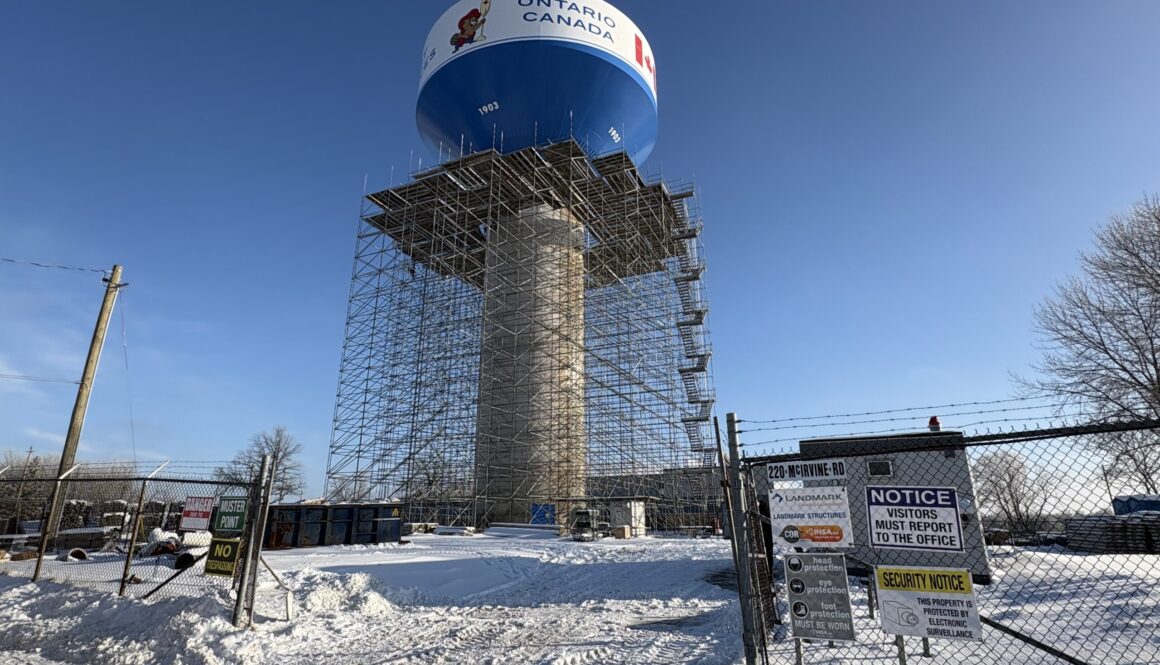
Additional repairs are being made to the water tower in Fort Frances.
Piping used to flow warm water to the top has shown signs of cracking and is being replaced.
Initially, the town has to replace a faulty heat trace line, which caused the water to freeze.
An inspection revealed numerous holes and cracks.
When a new heat trace line was installed, additional cracks were spotted and repaired.
When water was allowed to flow back through the pipe, more leaks were noted.
As scaffolding was still in place from the previous tower upgrades and the high cost to install it afterward, it was decided to replace the piping.
“The risk is very high, given the leaks keep surfacing, that small cracks may be missed until after the tower is completely filled or worse, once the cladding is complete and scaffolding removed,” a report from Administration to council reads.
It will cost the town an additional $106,468.23, above the $175,000 estimated cost to replace the heat trace line.
Operations and Facilities Manager Travis Rob says the new heat trace line has been installed, along with a secondary one, should the initial one fail.
He says there is also a mechanism that will let staff know if the line fails to function.
“On the heat trace controls, there’s actually an indication of a fault. So we have some indication that it’s not working,” says Rob.
“The old heat trace line didn’t have any of that. The only way we found out that there was a problem was (the) signs of a leak.”
The water tower had been shut down for several months last year for crews to make several improvements.
The water was turned back on in early January, around the same time the faulty heat trace line was discovered.
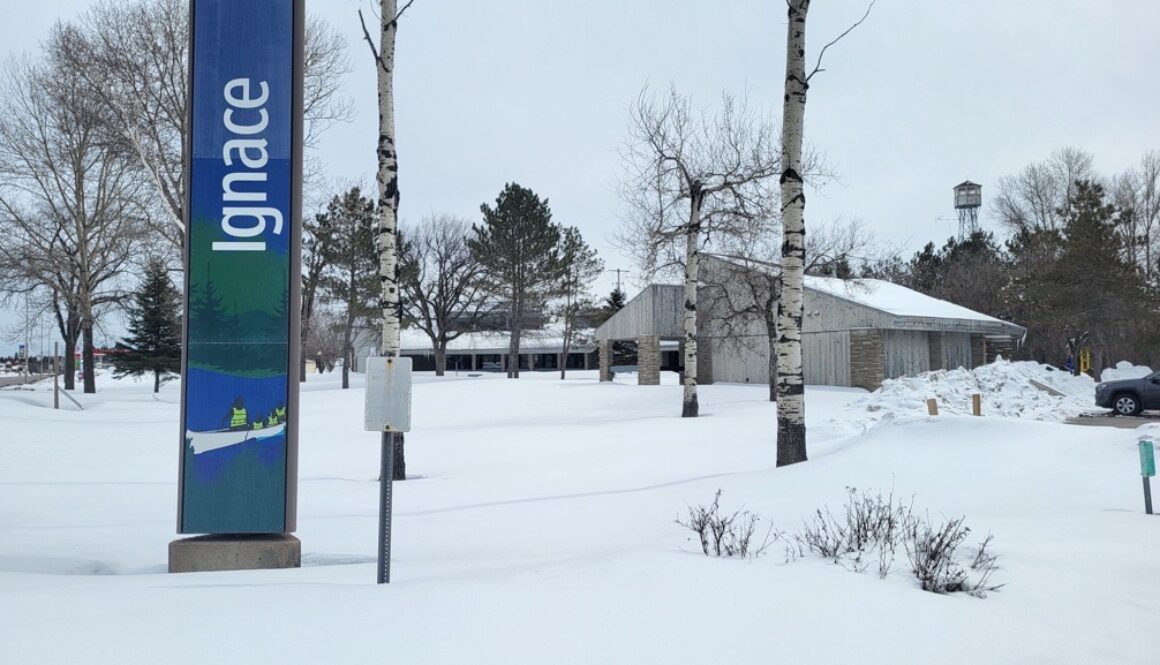
A lack of qualified staff has led Ignace to sign an agreement with a southern Ontario firm to handle chief building official services.
The deal with RMS Building Consultants is viewed as a temporary measure to ensure the town meets legislative requirements.
The agreement with the Cambridge, Ontario, firm was necessary because Ignace lacks sufficient qualified staff to handle building matters such as building permit reviews, inspections and enforcement.
The town also has a number of large projects in the works.
Chief Administrative Officer Aaron Gullins says recruitment for an in-house building official is underway.
“If we can’t find one who already is a CBO, we could hire somebody who potentially wants to be a CBO,” says Gullins.
“This company also does mentorship, and they provided a cost to mentor this person to a point at which they would be able to conduct those inspections for themselves.”
In the meantime, building matters will be left to RMS to handle for now.
Gullins says in many cases, it will handle communication with builders virtually.
“Normally, they don’t come up. Normally, they have an agreement with the person applying, and they’ve worked out a way where they’ll have a virtual interface, and they’ll say point to this, look at this,” says Gullins.
A set of fees has been established for the work that will be provided.