We have a crop of incredibly talented musicians, singers, songwriters and artists from right here in northwestern Ontario.
One of the things that we do very well is cheer on those around us who are committed to their artform and who are honing their craft, all while finding success.
On Oct. 9 the PI in Dryden (aka Patricia Inn Family Restaurant) will showcase a pair of live music acts that are connected to our area.
It’s a concert you won’t want to miss.
On the bill…
The Opera Blue
Kori Kameda, one half of this talented duo talks about the act…
Here’s a song sample to entice you to come out to the show…
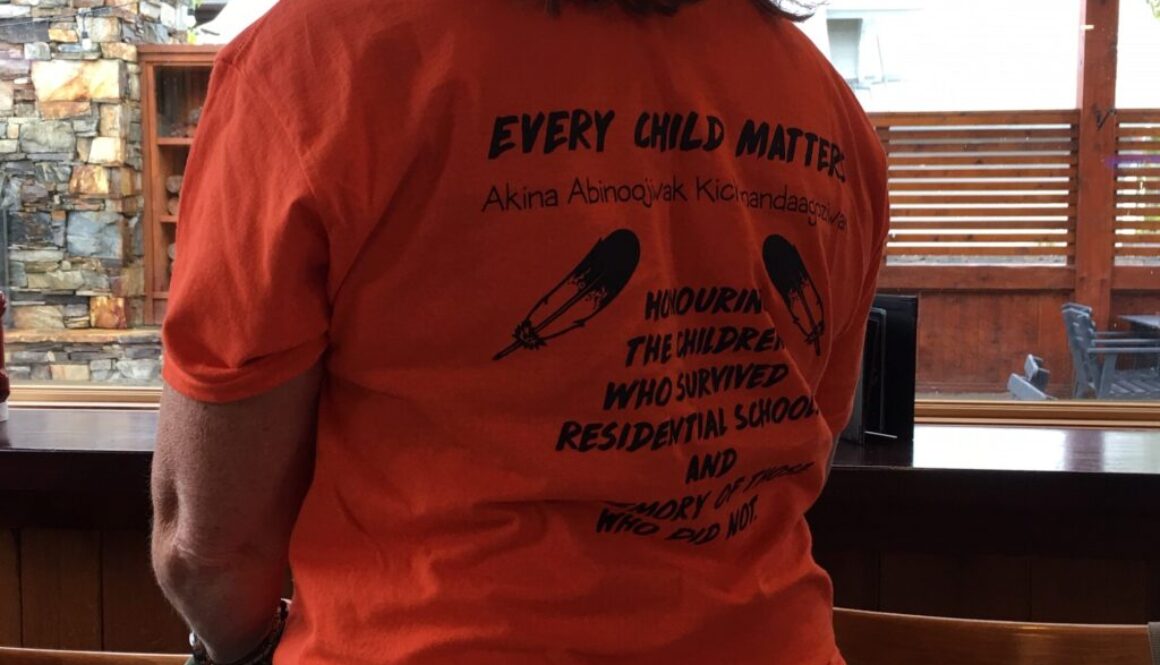
As conversations about unmarked graves continue, with some demanding proof and others choosing to deny or minimize what happened, I feel called to share my truth as an Anishinaabekwe in Treaty #3. I want to acknowledge that what follows speaks about residential schools, loss, and intergenerational trauma, which may be difficult for some to read.
My truth is in the sound of the drum and the voices of the singers at powwows. It is in watching the grace and beauty of the dancers as they move across the arbour. It is in the smell of our sacred medicines as they rise in smoke during a smudge. It is in listening to the wisdom of knowledge keepers as they share their stories, teachings, and memories.
My truth, as I know it, was once put in jeopardy because of systemic atrocities that took place here in my own homeland. Ceremonies were outlawed. Anishinaabemowin, our language, was prohibited. Practices were disrupted, all in the name of “removing the Indian in the child.”
My truth is also the death of loved ones in unmarked graves. It is family connections broken and scattered. It is the loss of language that should have been passed down with ease, with normalcy, but instead was silenced or shared with apprehension. My truth is intergenerational trauma spilling into streets, jail cells, and cemeteries. Trauma that we did not ask for but inherited.
And yet, my truth is also survival.
Like so many others, I continue to navigate the impact of these realities while working hard to build a beautiful life for my family. I have been able to do this because of the strength of my mom, whose own parents were forced into Indian Residential Schools. I think of my dad too, whose grandmother endured the injustice of the Indian Act, which stripped First Nations women of their status if they married non-status men. These policies were designed to erase us, yet here I am. Each morning, I send my son to school knowing that no one is beating the “Indian” out of him. That is both a relief and a reminder of how far we still have to go.
I am grateful that survivors and community leaders worked tirelessly to pass on teachings, protect our lands, and share the beauty of what it means to be Anishinaabe. Without them, I might never have witnessed the vibrant energy of the 6th Annual Healing Your Spirit Powwow hosted by Kenora Chiefs Advisory at Wauzhushk Onigum. I might not have joined the Agency One Lands Celebration at Point Park, honouring the return of land, the protection of sacred spaces, and the renewal of cultural and economic opportunities for our people. I might not have stood at Kay-Nah-Chi-Wah-Nung, listening to Art Hunter speak about the Manitou Mounds, sacred sites that remind us we have always been here, and we are still here.
These events are not simply cultural showcases. They are living proof of survival. They are acts of reclamation, joy, and defiance. They are reconciliation in motion, whether or not governments are ready to recognize them as such.
Yet, non-Indigenous detractors often make headlines. They claim that reconciliation has lost its way. They point to orange shirts, ceremonies, or acknowledgments as though these are gimmicks, as though our grief, survival, and resurgence are merely marketing campaigns.
From where I stand, nothing could be further from the truth.
Yes, I see how some institutions reduce reconciliation to an annual gesture or a photo opportunity. I understand how corporate Orange Shirt Day slogans can ring hollow without deeper commitments. But that should not be a reason to dismiss reconciliation itself. It should be a reason to push harder, to dig deeper, to hold institutions accountable.
Reconciliation is not a brand, and it should never be reduced to commercialization. It is not seasonal. It is not a checkbox. It is a process that belongs to all of us, Indigenous and non-Indigenous alike. It requires honesty about the past, accountability in the present, and shared responsibility for the future.
For me, reconciliation is found in community moments: in the songs sung late into the evening at powwows, in children running freely at a celebration on lands once taken from us, in Elders who continue to share truths even when it costs them to speak.
Reconciliation is also in the everyday: when non-Indigenous neighbours show up to listen and learn, when schools make space for our languages, when governments finally begin to honour treaties not only in word but in action. These are not glamorous gestures. They are the quiet, steady steps toward mino-bimaadiziwin, the good life, that our ancestors envisioned.
So when I hear that reconciliation has lost its way, I think of those young dancers stepping proudly into the powwow arena. I think of families gathering at Agency One Lands to celebrate renewal. I think of my son going to school without fear And I think of Phyllis Webstad, whose story about her orange shirt as a little girl reminds us all why truth and reconciliation matter. And I know reconciliation has not lost its way. It is alive in every step we take to carry our truth forward.
For those who feel tired of hearing about reconciliation, I ask you to consider what tiredness really means. For Indigenous people, tiredness has never been an option. We did not choose the trauma, but we choose every day to keep walking, teaching, and healing. The least others can do is walk beside us with respect, humility, and commitment. That may mean being uncomfortable with the truth.
My truth is not something that can be denied by an editorial, a headline, or a talking point. My truth lives in community, in culture, in the strength of our people. And my truth is also an invitation: to see reconciliation not as a burden, but as an opportunity to build relationships rooted in honesty, justice, and care.
Because when we gather, in song, in story, in ceremony, reconciliation is not lost. It is found.
Monday, Sept. 22, marked the first day of autumn, and you know what that means: fall-time movies!
Every season brings different movies to mind. In the springtime, maybe you’re reminded of La La Land, Notting Hill or Enchanted. In the summer, you might think of The Notebook, Dirty Dancing and The Parent Trap. Now that it’s fall, what are some movies that come to mind?
Here’s a list of some fall-time favourites you might want to put on your watchlist for the season:
The Goonies
The Goonies is a classic 1985 film, and it actually takes place during October, making it perfect for a fall-time movie!
This film revolves around a group of kids who discover an ancient map and set out on an adventure to find hidden treasure to save their homes from being demolished. It’s not until they bump into pirate One-Eyed Willy that they realize what they’re getting themselves into…
I grew up watching movies with my dad, and this is one of the memorable ones that bring out child-like wonder, adventure, and the importance of friendship and family.
The Intern
If you love Anne Hathaway movies like I do, The Intern is a great one.
In this 2015 film, Ben Whittaker (Robert De Niro) is finding new things to do after retirement. He finds a senior intern position at an online fashion retailer and works alongside Jules Ostin (Anne Hathaway). At first, Jules thinks he’s wasting his time and doesn’t have much to contribute, especially since she’s juggling a busy schedule. But they soon get along and she learns something much more valuable — friendship.
So if you’re looking for a feel-good movie, find some time this weekend to watch it!
Coraline
This 2009 film was, and still is, a classic fall-time animated movie contender.
Coraline, voiced by Dakota Fanning, is the main character who lives in a house where both parents are too busy to give her attention and love. One night, she follows a mouse that leads her to a secret passageway behind an abnormally small door. In that alternate world, her button-eyed parents treat her the way she always dreamed of. But that’s when she realizes things are too good to be true….
I remember watching this film for the first time as a kid, as terrifying as it is, it’s incredibly well-written, with twists and turns that take you by surprise. I felt in tune with the characters’ emotions, which brought out a lot of empathy in me as a kid.
It has a Rotten Tomatoes score of 91 per cent and an audience rating of 74 per cent. I usually trust Google reviews more, which rate it a 4.7 out of 5.
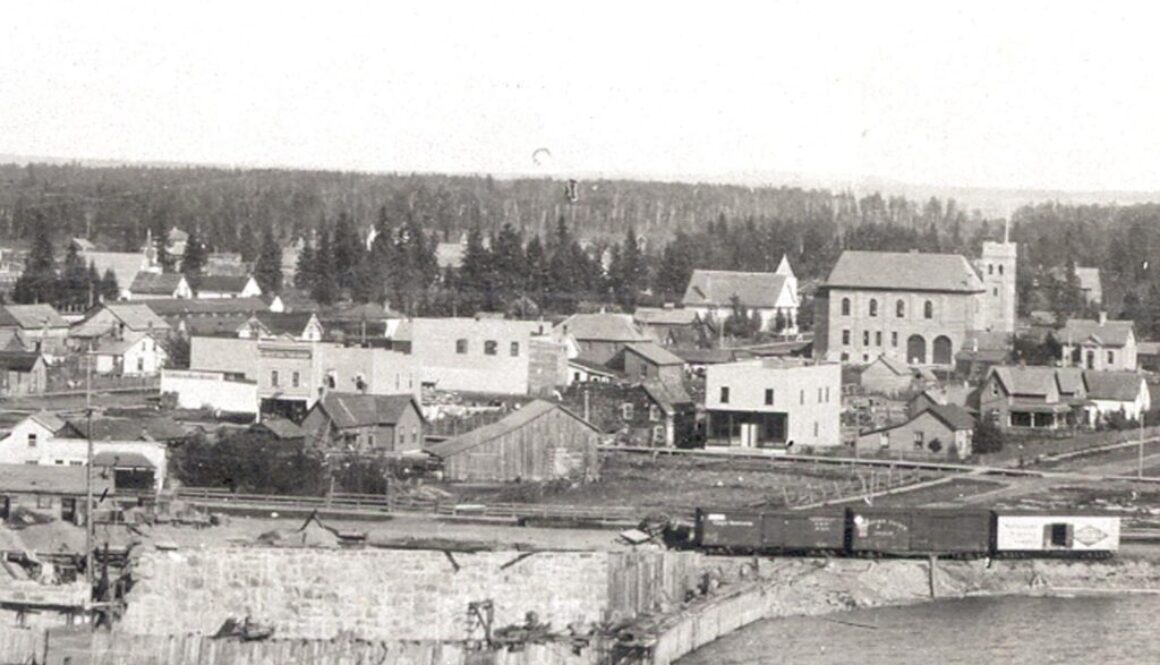
The night sky was clear, and all was quiet in Fort Frances in the early morning hours of June 16, 1905.
A CN Train had just arrived with travellers, preparing to settle in for the night.
The still of the night was interrupted by a fire that would lead to the destruction of a large section of the town’s business community.
The flames broke out in the rear of Nelson’s Clothing Store, located at the corner of Church and Front Streets.
The travellers, who earlier departed from the train and were making their way to the town’s hotels on Front, were the first to report the fire.
Before anyone could react, the fire spread to nearby Wells Hardware.
The dry wood structures fueled the flames that quickly extended toward the Williams Block on Church St., which housed the Canadian Imperial Bank of Commerce and Fraleigh’s Drug Store.
By then, the blaze attracted several townspeople who attempted to put it out, while others removed stock from buildings in the fire’s path.
A lack of adequate firefighting equipment hindered their efforts.
Fort Frances was still in the process of setting up a fire department and had recently purchased a new steam-powered fire engine.
However, the equipment was still sitting on a railcar waiting to be unloaded.
The Koochiching fire department was prepared to lend a hand and have its steam-powered engine floated across the Rainy River on a barge.
International Falls Mayor Loel Slocum insisted that Fort Frances assume the risk should the engine fall into the river.
Fort Frances Mayor James Osbourne declined the offer, saying the risk and cost were too great.
Within a few hours after the fire started, more than a block and a half of businesses were razed before the fire could be brought under control.
Losses were estimated at $200,000, with half attributed to the H. Williams Company.
Owner W.A. Preston hinted that his losses could reach in excess of $300,000.
“The fire undoubtedly is a most serious and crushing blow to the town, coming as it does just as the opening of an era of prosperity from which great things had been hoped,” said Preston in a newspaper interview.
The initial losses and insurance coverage were outlined in the area’s newspapers.
H. Williamson Company, stock of general merchandise and buildings, $75,000 ($25,000 in insurance coverage) Wells Hardware, $14,000 ($7,000 insurance) Fort Frances Hotel, James Paul, $15,000 Couchiching Hotel, Thomas Wilson, $15,000 ($12,000 insurance) Alberton Hotel, W. Bishop, $10,000 ($5,500 insurance) W.C. Nelson, clothing, $9,000 ($6,000 insurance) F.S. Fraleigh, drug and stationery, $4,500 ($2,700 insurance) J.C. Scott, jewellery, $3,000 ($1,000 insurance) D.C. McKenzie, drugs, $2,500 ($1,000 insurance) W.A. Baker, tailor, $1,500 ($300 insurance) Bank of Commerce, $2,500 W.G. Breckon, bakery and confectionery, $2,500 ($500 insurance) L. Christie, meats, $2,000 Arcade Restaurant, $500 Telephone Company, $500 Holbeck Sisters, $500 F. J. Strain, barber, $200
The loss of the three hotels also left Fort Frances without a licensed establishment.
The cause of the fire was identified as incendiary, but exactly how it started was not determined.
Some suggested it was someone from the International Falls area who was interested in slowing down the progress in Fort Frances, though the allegations could not be proven.
Mayor James Osbourne promised a thorough investigation, but the damage caused made any probe difficult.
Business owners soon had to deal with looters seeking items that were still salvageable.
This forced the town to appoint special constables to watch over the area as owners moved their saved goods into barns and warehouses.
As fast as the flames had spread through the town’s business community, owners were already making plans to rebuild.
At the time of the fire, Wells Hardware was in the process of constructing a new building on what was then known as the new section of Fort Frances.
The Williams Company and the proprietors of the Fort Frances and Couchiching Hotels revealed their plans to rebuild immediately.
Within a month, the new Fort Frances Hotel had 30 rooms constructed, while the new Alberton Hotel had 15 in place.
Fraleigh, Christie, Scott and the Bank of Commerce acquired temporary buildings to resume their operations until more permanent locations could be decided.
The town council took steps to improve fire safety.
A new by-law was approved that required the use of brick construction in new commercial buildings instead of wood framing.
The new steam fire engine was removed from the rail yard and tested, with scores of residents on hand to give their nod of approval.
A new downtown centre would soon take shape, with the new main street becoming Scott Street.
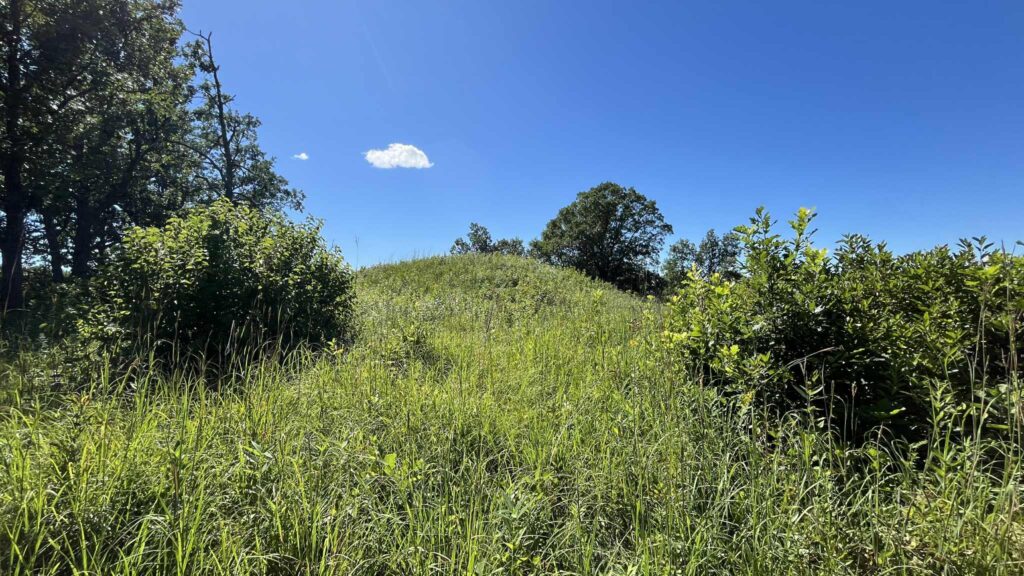
If you’ve ever stood somewhere and felt the ground hum with history and stories, you’ll understand what it’s like to visit Kay‑Nah‑Chi‑Wah‑Nung, also known as the Manitou Mounds. This sacred site on the Rainy River in Northwestern Ontario is a National Historic Site; a place where time folds, and where you can feel thousands of years in the wind, in the long grass, in the river’s roar. You will be welcomed, learn, walk, eat, reflect, all in one day. Welcome to the “paddle” portion of Paddle & Plate; an exploration of Northwestern Ontario and all the experiences and adventures that await you across the region.
A Place of Long Rapids and Long Stories
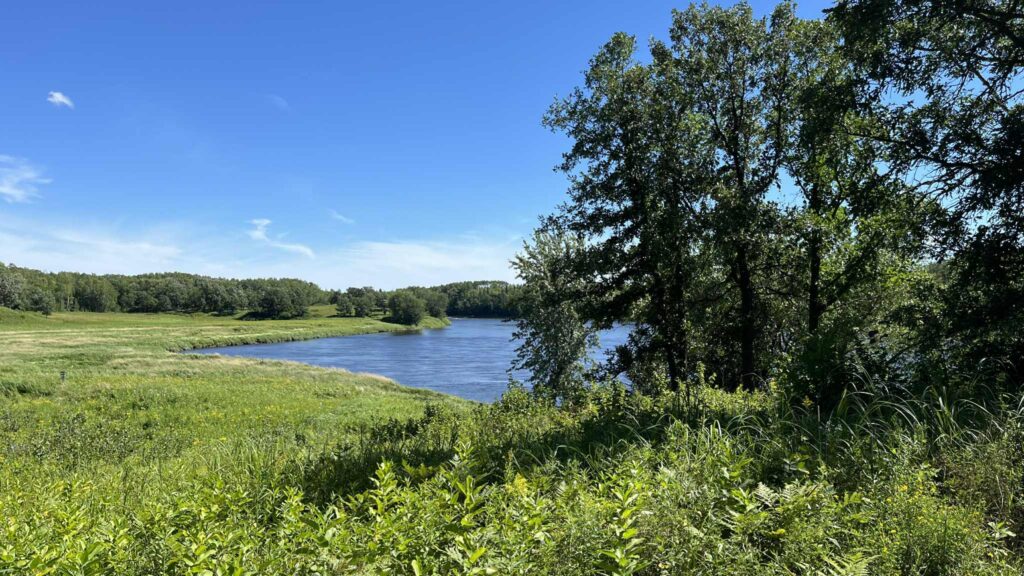
The name Kay‑Nah‑Chi‑Wah‑Nung means “the Place of the Long Rapids.” The moment you arrive at the banks of the Rainy River, you see, and hear, why: the water rushing, the rapids pulsing, the presence of the river as an old, living thing. For the Anishinaabe and many Indigenous peoples, this river (Manidoo Ziibi, Spirit River) has been a source of life: food, travel, connection, ceremony.
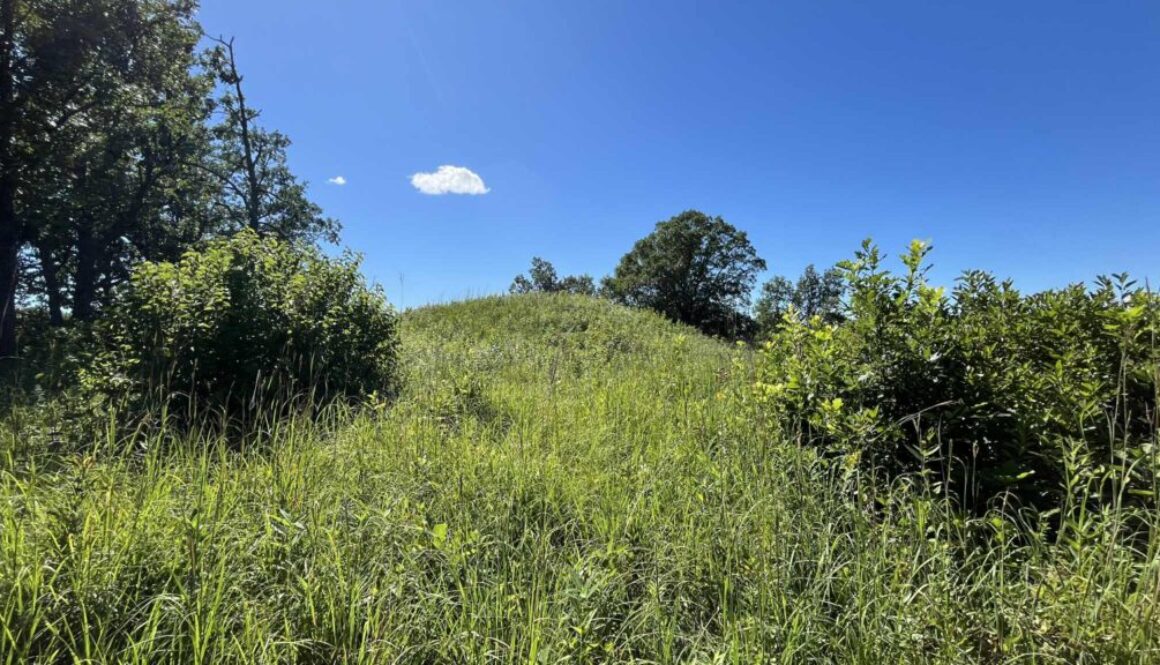
The mounds themselves are ancient burial sites, built by Indigenous Peoples who called this region home for over 8,000 years. The first mound builders here were from the Laurel Complex (about 2,300 years ago), and later the Blackduck and Selkirk groups continued the tradition of building mounds, each culture contributing its style, its pottery and artifacts, and its stories. These mounds are impressive, some rising as high a two‑storey building (7m), standing alongside the river, visible still today as monuments to people whose names we may never know.
Arriving at Kay‑Nah‑Chi‑Wah‑Nung
I visited with a group of five: my partner, her son, our two granddaughters, and me. From the moment we pulled in, the staff greeted us with warmth and genuine enthusiasm. They carried pride, respect, and a desire for others to understand. Right away, it was clear this was not just another “tourist stop.”
We opted for a guided tour, and honestly, I can’t emphasize enough how much richer that choice made the experience. The trails are beautiful on their own, but having someone who knows the land, its stories, its heartbreaks and triumphs, changes everything. It also made things more accessible: with kids, with someone who tires, or with mobility limits, the guide helps pace things, choose where to stop, what to focus on.
What We Saw: Tour Highlights & Sacred Moments
Our journey began inside the Visitor Centre, where the first thing that caught my eye was a basket for tobacco, or asemaa. In Anishinaabe culture, offering tobacco is a sacred practice, used to communicate with Elders or Knowledge Keepers, to show gratitude, or to ask for guidance. Starting the visit with this gesture set the tone: this was not just a place to look at, but a place to enter with respect.
Walking further in, we descended a long hallway of stairs that led us deeper into the land and toward the front desk. To the left was something unexpected: a massive 4,000-gallon aquarium, home to native fish of the Rainy River. During our visit, it held a lively bass and nearly three foot long sturgeon, the first I had ever seen up close! The staff explained that this sturgeon, which can live for decades and hold immense cultural and ecological significance, are housed here temporarily before being released back into the river. Rainy River First Nations is deeply committed to protecting and reintroducing sturgeon populations, not just locally but in many places, as far away as Alabama. It was a reminder that the care of this land extends to the water and all life within it.
This is where we met our incredible guide, Shy-Leigh. Her family lineage is deeply entwined with the history of this place, and you can feel that connection in everything she says. She cares. She listens. She answers questions with a rich knowledge of the history of the site. She holds space between what is known, what is learned, and what is felt. She also recently began working in the site’s Archives & Collections, helping to protect artifacts, oral histories, and materials that carry memory. Knowing she isn’t just giving tours but helping preserve what’s sacred made her stories land differently. It turned the visit into a shared act of respect.
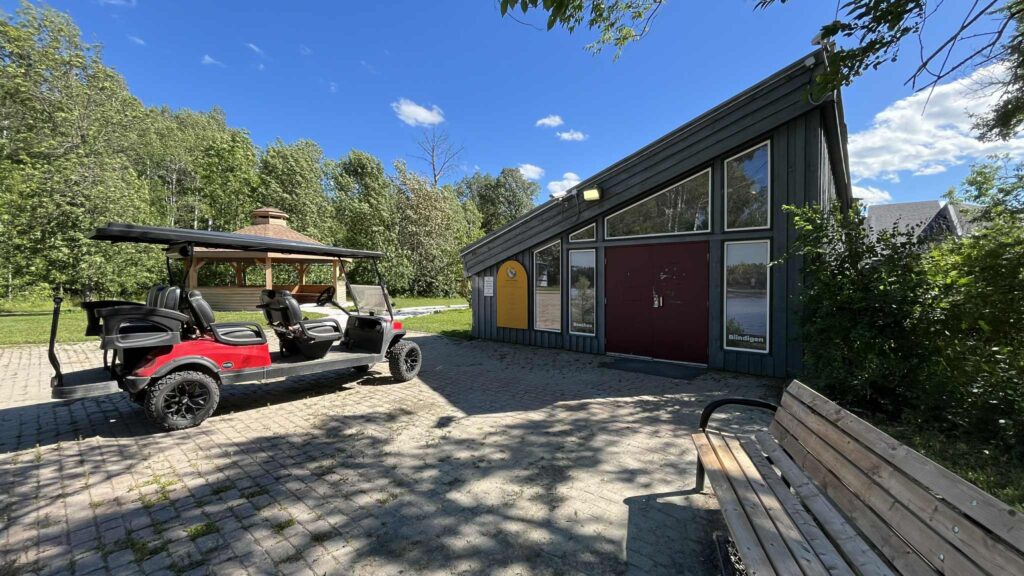
Inside the Visitor’s Centre you will find incredible exhibits that will provide you with a wealth of knowledge about the site and the history of the Anishinaabeg Peoples of the Treaty 3 Territory, a cute gift shop, and a restaurant called The Hungry Hall, which features a menu full of delectable offerings that have roots in Indigenous culture from the area, like wild rice burgers, fresh fish, and more! We had dinner after our tour and the meal was so incredible it warrants it’s own article – watch for that, coming soon!
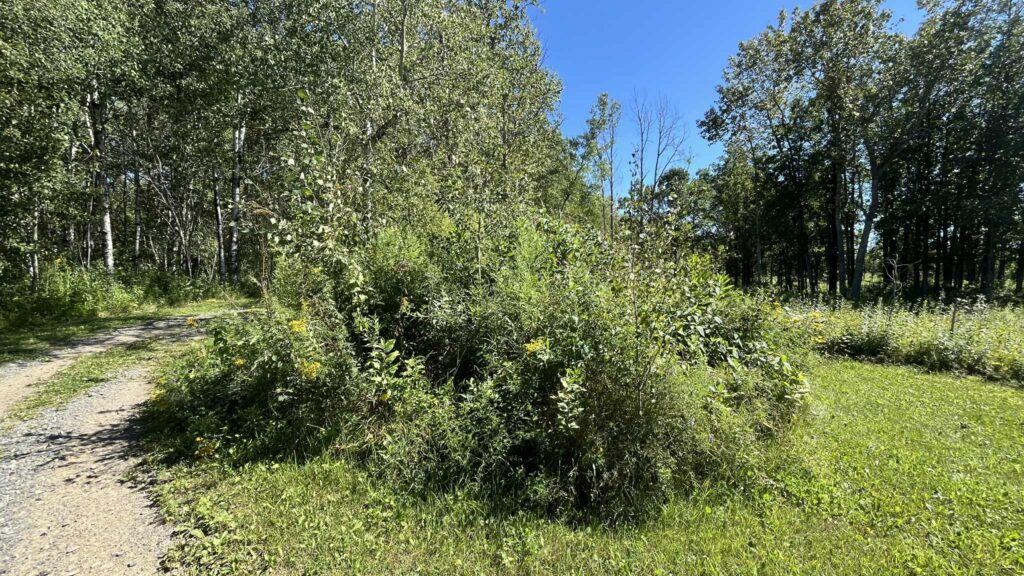
Shy-Leigh led us back outside, where we climbed onto a large golf cart that would carry us along the trail. Our first stop was a burial site that had once held a church. Though the building is gone, grave markers remain, some belonging to settlers, others to Anishinaabe people who had converted to Christianity during the beginning of colonization in the area. Shy-Leigh pointed out a few markers, including that of a young girl, and as we stood there, it struck me how layered this land is with histories: faith, colonization, grief, and resilience.
From there, we continued to one of the 17 burial mounds on site, this one from the Blackduck era. It was here that Shy-Leigh began to explain how the mounds were constructed, how the remains of loved ones were carefully prepared and placed inside, and how the mounds themselves grew over time as generations were added. This was the first moment I felt overwhelming emotion: the weight of knowing many people rest here, ancestors whose lives and deaths were meaningful, whose stories are still being uncovered and honoured. It was impossible not to feel both sorrow and reverence.
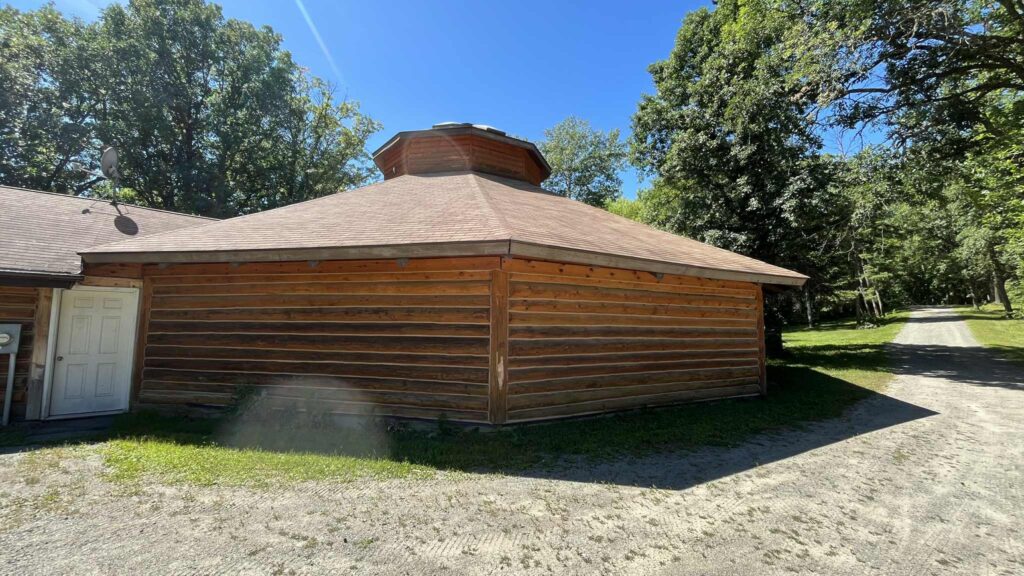
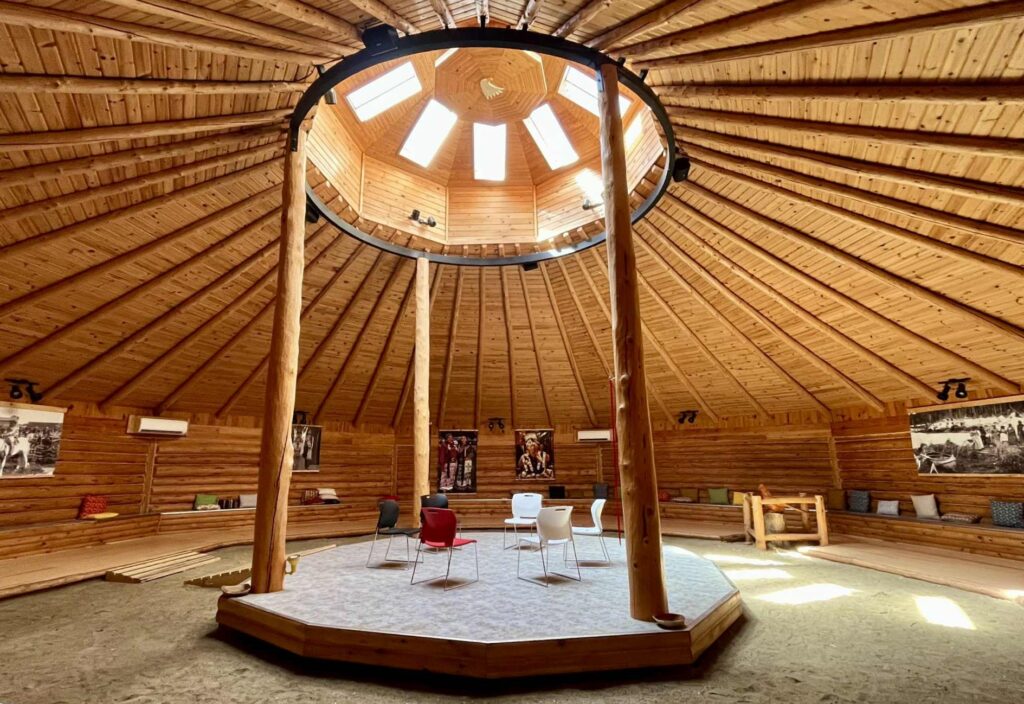
Our next stop was the roundhouse, a striking circular building made of beautiful cedar. While it is fairly new, it is built in keeping with cultural traditions and spiritual teachings. The round design reflects the Anishinaabe belief that circles represent balance and continuity.
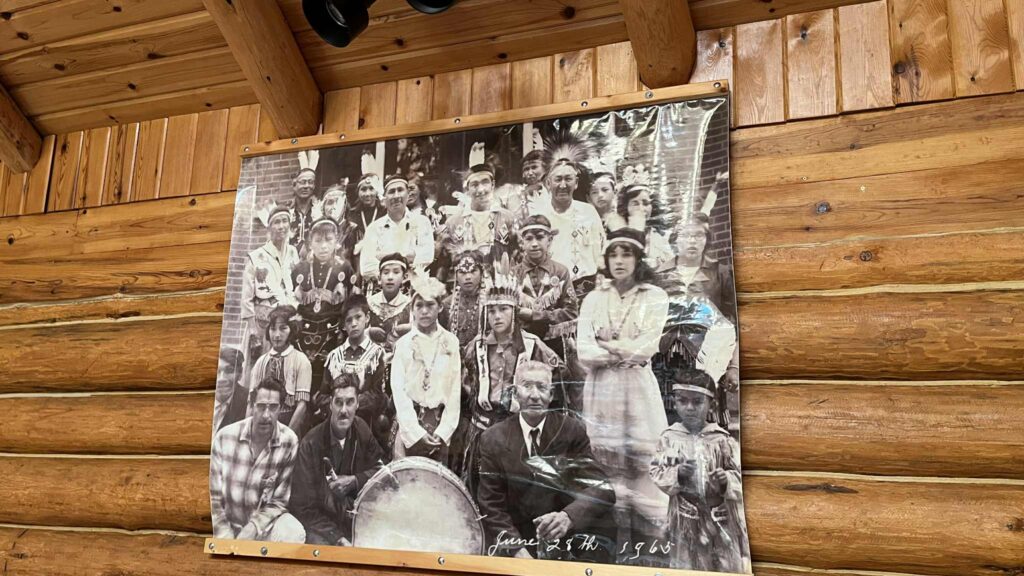
Inside, cedar poles mark the four directions, and the earthen floor in the middle circle ensures visitors remain connected to the land itself. Photographs of the community’s history line the walls, and Shy-Leigh shared stories of Elders and community members who had visions in their dreams guiding parts of the interior design. Walking inside, I felt both grounded and uplifted, as though the space held the wisdom of many voices.
As we travelled further down the trail, we paused at several more mounds, both Blackduck and Laurel. Each carried its own history, from the artifacts found inside – pottery, pipes, ceremonial items – to the painful reality that some were desecrated by academics in the past in the name of “research”. Hearing these stories was difficult, but it was also powerful to see how the Rainy River First Nations have reclaimed stewardship, restoring dignity and respect to these sacred places.
Our final stop was high on a hill overlooking the rapids of the Rainy River. The view was breathtaking: grasses swaying in the wind, the river rushing below, sunlight spilling across the landscape. Here, Shy-Leigh spoke about the cultural significance of the land, the wildlife, and the plants that grow here, many of which are still used as traditional medicines. It was the perfect place to pause and take in the enormity of everything we had seen. For me, it was a moment that tied everything together. The ancient and the present, the grief and the beauty, the land and its people.
Context & Cultural Facts For Deeper Understanding
The Laurel Complex people built large, round burial mounds along the river’s edge; these date from about 2,300 years ago.
The Blackduck and Selkirk cultures existed roughly 300‑800 years ago. Their pottery, artifact styles, and mound forms are distinct but show continuity and interaction with Laurel practices.
Kay‑Nah‑Chi‑Wah‑Nung mounds are burial monuments. It is the largest burial mound site in Canada and the second largest in the world.
Why You Should Visit
You don’t have to be a historian (or archaeologist) to appreciate Kay‑Nah‑Chi‑Wah‑Nung. You might come just for the trails, to watch birds, for the beauty of the land, or a quiet moment by the river, but you’ll leave with something bigger: a deeper understanding of this land and the people who have honoured it for generations. It’s rare to find a place where education and emotion are so tightly interwoven. Here, you’ll learn, yes. But more importantly, you’ll feel.
Practical Tips for Your Trip
Where: 340 Ross Road, Stratton, Ontario
Hours: Visitor Centre operates seasonally (spring‑through‑fall), with some operations year‑round.
Tours: Guided tours are highly recommended; they make the history come alive and are more accessible for young children or for folks who can’t walk long distances.
Respectful Practices: Be aware of cultural practices, for example, tobacco offering; respecting graves or markers; listening openly; following trail etiquette.
Check the Events Calendar: Workshops, cultural programming, and special tours often take place.
Final Thoughts
Kay‑Nah‑Chi‑Wah‑Nung isn’t just a museum or a set of mounds. It’s a sacred space. It’s history and hope intertwined. It’s a place that reminds you of the roots of land, people, and the stories they hold. Walking there, learning from people like Shy‑Leigh, sharing moments with my family, standing above the rapids I left feeling both humbled and uplifted. The sorrow of what’s been lost, the scars, are real, but so is the resilience, the beauty, the commitment to care and remember.
If you ever find yourself in the Borderland, more specifically in the area of Rainy River, do not miss this place. Trust me: you’ll stand on ancient ground, and your heart will walk out changed.
For more information or to begin planning your visit to Kay-Nah-Chi-Wah-Nung Historical Centre, visit their website here: manitoumounds.com.
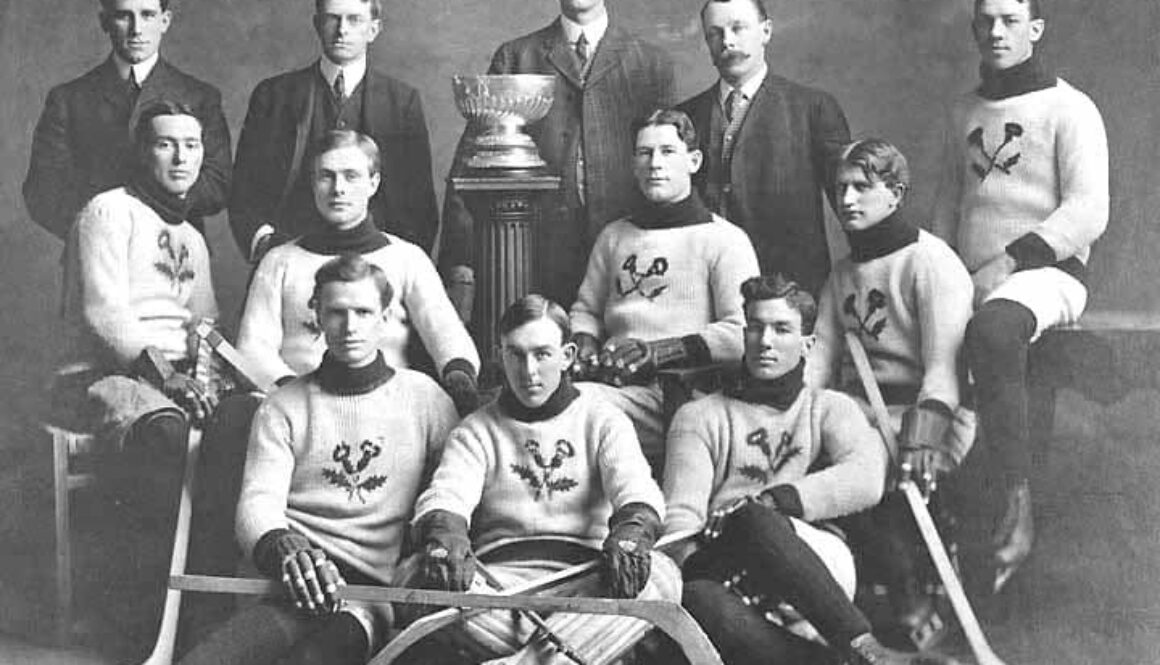
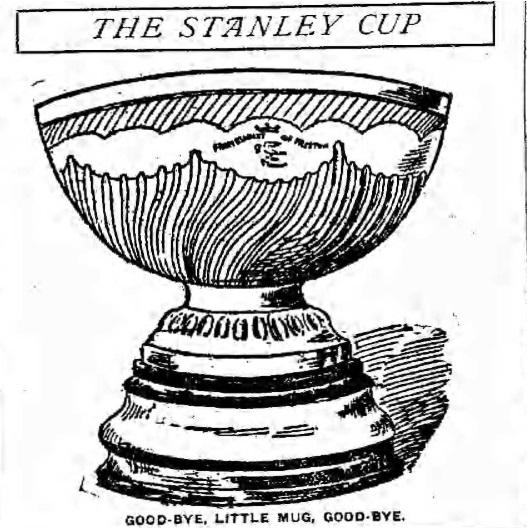
The Kenora Thistles’ Stanley Cup victory in 1907 is much heralded.
Their defence of the silver bowl, however, was overshadowed by controversy, politics and squabbles, and a threat to toss the Cup in the lake, all leading to the Thistles falling in the rematch with the Montreal Wanderers in March 1907.
The troubles began in the days after Kenora stunned Montreal for the Cup that January.
Kenora played a pair of exhibition games following the series, losing Billy McGimsie to what was initially thought to be a career-ending shoulder injury in a non-Cup challenge exhibition game with Ottawa.
The team returned home having to take two trains. Tommy Hooper, Russell Phillips, manager F. Hudson and trainer Jimmy Links boarded one train home while the rest of the squad caught a second.
That train took nearly a week to reach Winnipeg after a storm halted it in Detroit, stranding passengers for two days.
The players’ late return forced the Manitoba League to play an abbreviated six-game schedule for its teams to be eligible for Stanley Cup competition.
The Thistles limped into the season with McGimsie and Tommy Hopper, who was ill during the Stanley Cup games and later diagnosed with a broken collarbone.
Si Griffis and playing-coach Roxy Beaudro also expressed a desire to retire but decided to hold off their decision until the end of the year.
In a search for replacements, the team landed Fred Whitecroft from Peterborough, who agreed to a contract worth $700 (est. $24,000 in 2025 dollars).
As the Thistles prepared to play their first league game, they landed in the middle of a dispute between the Portage La Prairie and Brandon Hockey Clubs over a cancelled game due to Brandon loaning Art Ross and Joe Hall, two of its star players, to the Thistles for their cup run.
The dispute split the teams, with the Strathconas agreeing that Portage earn the win by default and Kenora siding with Brandon.
Kenora and Brandon threatened to quit and form their own league before the Thistles issued an ultimatum that Portage replay the game or face cancellation of a game with them.
As Stanley Cup champions, the Thistles were seen as a strong draw, and the prospect of losing out on a strong gate persuaded the Portage team to drop its protest.
The Thistles open the season with three straight wins before suffering back-to-back losses to Portage and Brandon that threaten defence of the Cup.
A win over the Strathconas in their final game secured a tie for first with Brandon, and the need for a playoff series to decide a champion.
Hooper’s absence at point was evident during the team’s two losses, and forced the Thistles again to seek out talent to strengthen the club.
Kenora’s recruitment efforts raised the ire of the Wanderers, who repeated as Eastern Canada Amateur Hockey Association champions.
The Wanderers voiced opposition to playing any team for the Cup that did not have “bona fide” members.
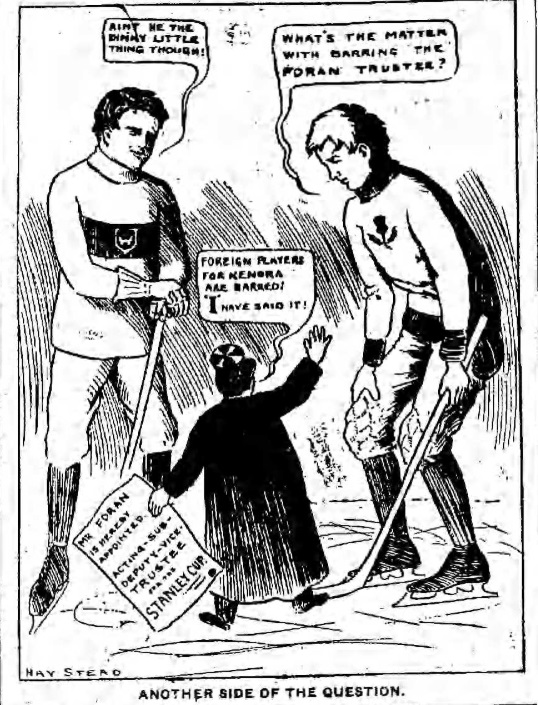
William Foran, the Cup’s acting trustee, agreed and ruled that a competing team would be prohibited from adding any player who came from the league it played in.
In the days following the ruling, Kenora secured the rights to Alf Smith and Harry Westwick from the Ottawa Hockey Club, which lost to the Wanderers in the ECAHA final. An offer was also made Harry Smith, Ottawa’s leading goal scorer, who declined.
The team also made a move to acquire Roy Brown from the Michigan Soo Indians of the International Professional Hockey League (IPHL).
The three players played in Kenora’s final league game, but Foran denied their use in any Cup challenge game.
“It is the infringement on the first principles of sport, and I will not permit it. I am irreconcilably opposed to such measures,” Foran stated.
Foran also confirmed that should the Thistles be successful in defending their league title, they would earn the right to host Cup challenge series games.
Montreal had objected to playing in Kenora, suggesting the city’s rink was too small.
“The people of Kenora have backed their team loyally for years and several times assisted in defraying the heavy expenses of sending them east after the Stanley Cup,” said Foran.
“In this fact alone, I think it would be a very unsportsmanlike to compel Kenora, if they be the cup contenders, to defend it on neutral ice, and unless the Wanderers can prove conclusively to me that the ice is altogether too small for a Stanley Cup series,”
Kenora did appeal the ruling impacting Smith, Westwick and Brown, but Foran warned they would forfeit the chances to defend the cup if the players suited up.
Kenora reacted by filing a protest against the Wanderers for having Riley Hern and Hod Stuart on the roster, claiming the players were imported at the start of the season from the professional IPHL for the sole purpose of helping Montreal defend its championship.
Foran, however, ruled Hern and Stuart had been with the team all season, satisfying his definition of “bona fide” players.
While Foran sifted through the eligibility arguments, the Wanderers arrived in Winnipeg in mid-March, claiming they were told to be in the city for the start of the Cup series on the same day that the Manitoba league championship series began.
Following the Thistles’ decisive victory in the opening game of the Manitoba final, a meeting was convened in Winnipeg to discuss dates for the Cup challenge series.
Montreal wanted the games played the day after the Manitoba title was decided, while Kenora demanded additional time to prepare.
Kenora wrote Foran to uphold its request, and returned home to secure the league title with a second win over Brandon.
Foran instead responded by ordering the Cup series to start a day after the Thistles-Brandon series.
In a show of defiance, the Thistles held firm to their plans to play Smith and Westwick.
The Manitoba Hockey League showed support for the Kenora team by passing a resolution to show its disappointment with Foran’s decisions.
“That this league, having received no notification to the effect that power to institute new rules governing cup contests has been delegated by Mr. Ross to Mr. Foran, refuses to recognize Mr. Foran’s authority to make such a ruling, and declines to be governed by the same,” read a part of the resolution.
The league also rejected Foran’s suggestion that another Manitoba club would take Kenora’s place if it did not comply.
“The team winning between the Brandon and Kenora Thistle clubs for the championship of the present season shall have the exclusive right to defend the cup, and that under no circumstance will the cup be defended this season by any other team in the league,” stated the league.
Kenora offered to move the schedule up one day, but Foran first wanted assurances that the Thistles would not use its recent imports and again threatened that the Wanderers would be awarded the cup if Kenora did not comply.
When the date arrived to play the game, the Thistles announced that they would forfeit the game.
“It is utterly impossible for us to play tonight,” said Tommy Phillips, the Thistles captain, to the Manitoba Tribune.
“If the Wanderers claim the game by default tonight, they will have to win either Friday or Monday to take the cup.”
Lester Patrick of the Wanderers retorted, “We are going to Kenora to get the cup.”
That elicited a response from a Kenora official who threatened to throw the cup into Lake of the Woods, suggesting that if the Wanderers wanted it, they would have to fish it out.
Fortunately, the threat was not carried out, but when the Wanderers arrived at the arena, they found public skating taking place and were not permitted entry unless they paid the admission fee.
Kenora’s team officials were on site, ready to discuss the series schedule.
Montreal insisted on playing the two-game series in Winnipeg.
The Thistles eased back on their demands to have the games on home ice, offering to split the series between Kenora and Winnipeg.
When they proposed that the first game happen immediately following their meeting, the Wanderers balked at the suggestion, saying it was too late in the night for the teams or spectators.
Smith and Westwick’s eligibility was raised, but Thistles’ President J. Johnson refused to discuss personnel, leading to the meeting’s abrupt end.
The Wanderers returned to Winnipeg, where they expressed disappointment in the failure to reach an agreement with their opponents.
“The Kenora team does not seem disposed to meet us on anything like fair grounds, and the negotiations are off,” said the Wanderers Secretary Jennings in an interview with the Manitoba Tribune.
Jennings also indicated Montreal was laying claim by default to the first game of the series.
An illustration in the Manitoba Free Press, March 19, 1907.
Days later, James Bell of the Winnipeg Arena successfully brought the clubs back together once again and convinced them of the expectation of large crowds and financial returns for the teams in playing there.
In agreeing so, Montreal withdrew its objections to Smith and Westwick suiting up for the Thistles, upsetting Foran.
“If the two clubs ignore the instructions of the cup trustee, mutually agreeing to play against Westwick and Smith, when both were positively informed these men were ineligible to participate in the present cup match, the series will be treated as void, and the cup will be taken in charge by the trustees,” stated Foran.
Despite Foran’s threat, the games went ahead with Montreal winning the opener 7-2.
Kenora won the second 6-5 but fell short in their bid to hold onto the Cup, losing the two-game total goal series 12-8.
Manitoba Free Press, March 19, 1907
Beaudro, Eddie Geroux, and McGimsie retired at the end of the season.
Griffis also stepped away from the game, later joining the Vancouver Millionaires that would play for the Stanley Cup in 1918, losing to the Toronto Arenas of the newly-formed National Hockey League.
Westwick and Smith returned to Ottawa, while Whitcroft joined the Edmonton Eskimos of the Alberta Professional Hockey League.
Smith was elected to the Hockey Hall of Fame in 1962. Griffis was inducted in 1950.
Image courtesy of Shred Kelly – www.shredkelly.com
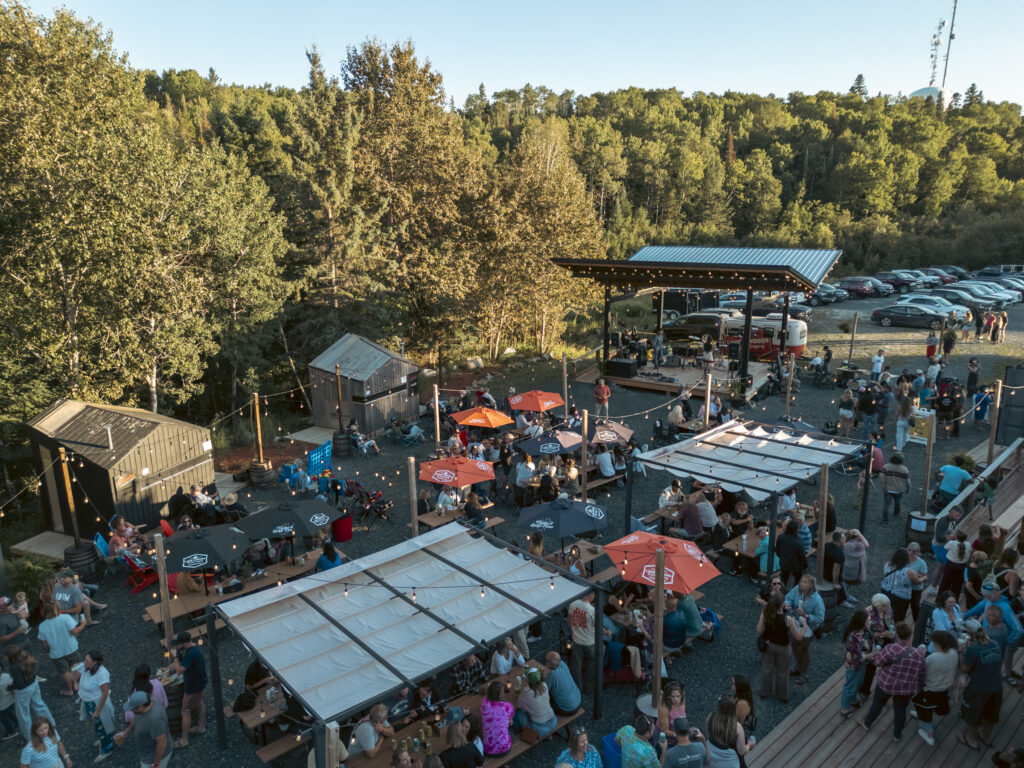
IT WAS A SOLD-OUT SHOW! — On August 16, 2025, Shred Kelly, Fernie, BC’s folk-rock dynamos, brought their electrifying “stoke folk” energy to The Brewers Village in Kenora, Ontario, Canada and absolutely set the outdoor venue ablaze! The night was a high-octane celebration of music and good vibes, with the band Tim Newton, Kenora’s very own — Sage McBride, Ty West and Ryan Mildenberger unleashing a torrent of foot-stomping anthems and heartfelt ballads that had the crowd jumping and dancing under the sunset. Joined by special guests Missy Jacobson and local talent Jackson Klippenstein, Shred Kelly turned the Brewers Village into a pulsating party hub, their infectious riffs and soaring vocals echoing through the Kenora night. Fans went wild for tracks like “For What It’s Worth”, “I Hate Work” and “Blissfully Unaware”. The band’s raw passion and mountain-born spirit transformed the evening into an unforgettable summer spectacle. With banjo-strumming, craft brews flowing and the crowd roaring, it was a night that proved why Shred Kelly is a must-see live act in Kenora!
Hailing from Fernie, British Columbia, Shred Kelly is a vibrant four-piece band that has been crafting their unique “stoke folk” sound since 2009. Based in the heart of the Canadian Rockies, they fuse elements of alternative, folk, and rock, delivering high-spirited performances and authentic, mountain-inspired storytelling. Comprising Tim Newton (vocals, banjo, guitar), Sage McBride (vocals, keyboard — originally from Minaki, Ontario), Ty West (guitar), Ryan Mildenberger (drums), and Jordan Vlasschaert (bass), the band has built a loyal following through their dynamic live shows and thoughtful songwriting. With their 2023 album Blurry Vision and tours across Canada, the US, and beyond, Shred Kelly continues to captivate listeners with their infectious energy and heartfelt melodies. Thanks to The Brewers Village for creating a memorable evening in Kenora!
For Thunder Bay singer-songwriter Katherine Nemec, the heart of music has always lived between four walls: the living room. It’s where she first strummed a badminton racket and called it a guitar, where friends gathered for late-night jam sessions, and where triumphs and heartbreaks echoed in equal measure.
“I realized the only common denominator in the songs I wanted to perform was that they were all songs I loved to sing in my living room,” Nemec says. “And because I love hosting my friends, I loved the idea of just a bunch of people sitting around in a living room, sharing their favourite songs.”
Those walls, she reflects, have seen it all. “They’ve seen me receive amazing opportunities, and unfortunate rejections, and it’s all just a part of the journey,” she says. “Being an artist and musician is something I wouldn’t trade for the world, but it doesn’t come without its trials and tribulations.” Still, it’s those ups and downs that have shaped her sound — one that has grown from playful, makeshift lyrics on a badminton racket to polished storytelling on stages across Thunder Bay.
Her journey has been stitched together by collaborations and friendships. From writing songs in high school bands with longtime friend Shayla Rozic to recording her first EP with Jean-Paul De Roover, Nemec says her music “music always takes little pieces of people along the way, so I guess as I form new connections and as I grow into a different person each season, my sound inevitably changes a little bit. ” Lately, she’s leaned into the rockier side of her influences. “I’m a pretty quiet person and I like to keep to myself, so doing anything that felt loud or intense felt counterintuitive,” she says. “But it really is where I have the most fun musically.”
That spirit of collaboration carries into Live from the Living Room. For this concert, Nemec won’t be alone. She’ll be joined by Jacob Goodman on guitar, Nathan Pakka on bass, Shayla Rozic on keys, and Taylor Nicholl on drums. “I’ve played with each of them in some capacity throughout life but never all together like this,” she says. “It’s been really fun to have each of us put our own touches on the songs.”
The setlist will mix originals and covers, including one that brings her full circle: Get Back by Demi Lovato. “This song was from the ‘Disney rock’ era where everyone at Disney was releasing albums that were basically just full of rock songs — Jonas Brothers, Miley Cyrus,” she says. “So getting to do this song that I grew up hearing, that felt really rock ’n’ roll for an eight-year-old, feels really cool.” Alongside that nostalgia comes the excitement of something brand new. “There is one new original I’ve been workshopping that I’ll be playing — I’m really excited about that one.”
The concert is part of Magnus Theatre’s Unseen, Unheard, and Uncurated series, staged outdoors under the summer sky. Nemec is no stranger to Magnus, having recently appeared in Lies & Legends: The Musical Stories of Harry Chapin. That show, she says, “forced me to reconnect with myself as a musician, not just a performer. I got to bounce between keys and guitar, and teach myself to play bass, so it was a lot of mental work in that regard but so worth it.” This time, though, she’s aiming for something more relaxed and familiar. “I’m really hoping the outdoor stage allows for some ambient noise. I love the sound of the rain on the tent, so, as weird as it may be, I’m kind of hoping for a bit of a drizzle the night of. But I’m really just hoping it feels like a mix between sitting in someone’s living room and enjoying a summer evening sitting in someone’s backyard.”
Nemec’s story is rooted deeply in Thunder Bay. From talent shows to her first paid gig at Black Pirates Pub in 2015, to community theatre and performances with the TBSO, she has grown up on local stages. “I think in everything I do there’s a connection to the local music scene,” she says. “My hope is that the theatre-goers get a taste of the local musicians in town, and the music lovers get a taste of the theatre scene.”
And even as this concert approaches, she’s already thinking about what’s next. “There’s always a new chapter on the horizon,” she says. “I’ve been so blessed with so many big opportunities in the last year I could probably stop now and be content, but I have some new originals I’d like to record eventually. Otherwise, I just work hard at things as they come up and hope that with each new opportunity ending, another one pops up down the road.”
But for now, her own songs — and the songs that shaped her — are more than enough to fill the space. When the lights go up on Live from the Living Room, audiences can expect an evening that feels equal parts intimate jam session and backyard summer concert. The show takes place on Friday, August 22 at 7:30 p.m. on the Magnus Theatre Outdoor Stage, with tickets available for $40. It’s a chance to hear Katherine Nemec share the songs that shaped her journey — and maybe discover a few new favourites along the way.
It started with a box of old photographs. No one was quite sure when the last Harbourfest had taken place — sometime in the early ’90s, judging by the photo albums — but there it was: kids clutching balloon animals, a runway stretching down Red River Road, crowds swaying to live music as the sun set over the harbour. The snapshots told the story of a festival that once brought the whole city downtown.
This year, with the grand re-opening of Red River Road, the Waterfront District BIA decided it was time to bring that story back to life. “While brainstorming, we came across photo albums from past Harbourfests, which inspired us to revive this beloved community tradition,” the BIA said. “With the beautification of the North Core, we wanted to not only showcase the new and vibrant streetscape, but also to use it as it was intended — by hosting events right on the road. The wider sidewalks, expanded patio spaces, and fresh design make it the perfect setting for community gatherings.”
And so, Harbourfest 2025 was born — not as a replica of the past, but as a way to blend nostalgia with something new.
On Thursday, August 21, Red River Road will become a pedestrian-only playground. Music will spill from the stage, vendors will line the sidewalks, kids will dart between carnival games, friends will share plates of food, and the whole scene will unfold against the backdrop of the harbour. That, the BIA says, is what makes Harbourfest stand apart. It’s not just an event happening in the North Core — it is the North Core, in full celebration mode.
The evening begins at 5:00 p.m. with opening remarks and a ribbon cutting at 5:30 p.m., followed by performances from Arabella Dance and World Cultural Dance. At 6:30 p.m., the fashion show returns — a crowd favourite from the original Harbourfest — and at 7:00 p.m., the ever-popular dog contest takes the stage. More than 40 vendors and BIA businesses will be open along the street, offering everything from handmade goods to patio cocktails. Then, at 8:00 p.m., the live music lineup kicks off with Blood Red Moon, Small Town Bad, and Throwback, carrying the night through with rock, indie, and retro sounds.
“We looked back through old newspaper articles and photo albums from the festival’s early days, and what we found was a lot of creative community activities. The photo albums of the original Harbourfest had a lot of fun activities, events and performances, all of which drew great crowds, making it hard to choose what to bring back,” the BIA said. “This year, we picked what we felt were the favourites, including the fashion show, the very popular dog contest, and at the request of the public a strong lineup of live bands. Harbourfest had everything but we revived what we could tackle with a couple of months of planning all while paying homage to the festival’s roots and bringing that same energy and charm to a new generation of attendees.”
In the weeks leading up to the event, the entire neighbourhood has been buzzing. Local businesses have planned late-night hours, Harbourfest-only specials, and storefront displays to capture the energy of the evening. For many, it’s more than a festival — it’s a chance to welcome new faces and reconnect with familiar ones. To make it easier for out-of-town guests to stay, organizers also partnered with the Prince Arthur Hotel to offer a Harbourfest rate.
Most of today’s planners weren’t old enough to remember the original Harbourfest, but the community hasn’t let them forget it. Social media quickly filled with stories — vendors reminiscing about their first booth, parents recalling their kids’ excitement, and teenagers sharing how the event became the highlight of their summer.
“Many said it was their favourite festival as a child,” the BIA noted. “An affordable, amazing event that created wonderful memories and brought the community closer. Those stories have inspired us as we work to bring that same spirit and joy back to Harbourfest today.”
When asked to capture Harbourfest in just three words, organizers didn’t hesitate: nostalgic, community, connection. They’ve even imagined a mascot — Harvey the Heart — a cheerful symbol of the Waterfront District’s energy, optimism, and future. And if the festival had a soundtrack, they say it would be Queen’s Don’t Stop Me Now, with its jubilant refrain, “You can’t stop me now, ’cause I’m having such a good time…” — the perfect anthem for a night meant to celebrate joy, togetherness, and good times in the heart of the city.
Because at its core, Harbourfest isn’t only about music, markets, or contests. It’s about standing shoulder-to-shoulder with your neighbours, soaking in a summer evening, and remembering why this city is such a good place to call home.
Harbourfest 2025 takes place Thursday, August 21, on Red River Road in Thunder Bay’s Waterfront District. Admission is free. For more information and to see what’s planned, follow them on social media and come help write the next chapter in a festival story that has always belonged to the community.
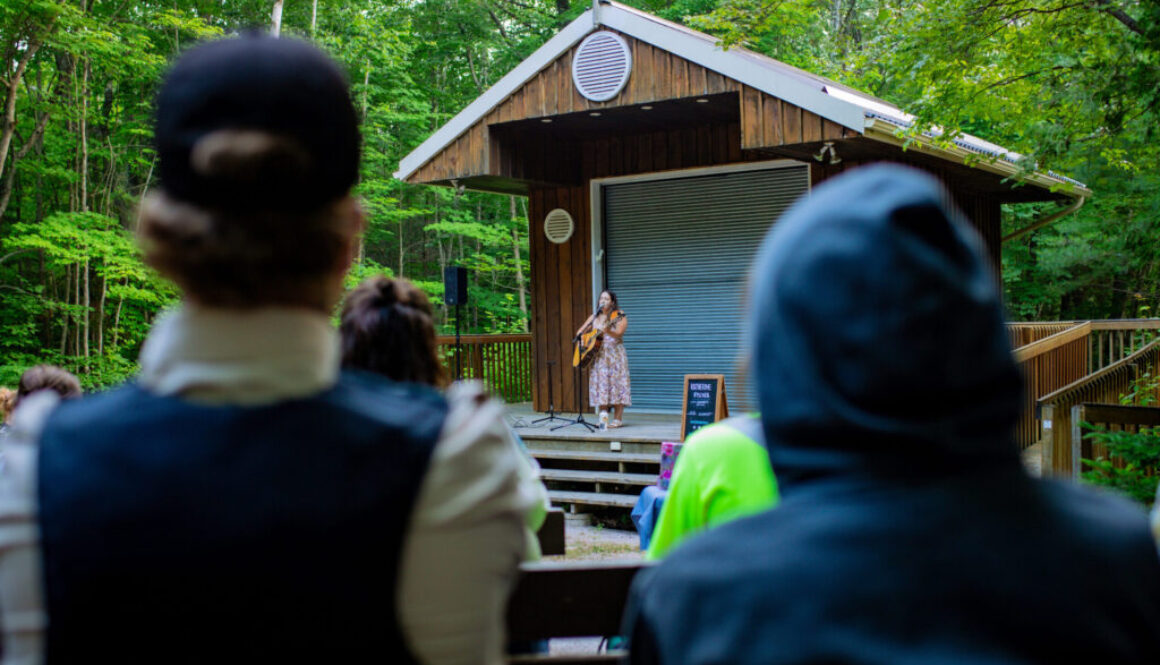
For London, Ontario singer-songwriter Katherine Fischer, the best stage in the world isn’t under a spotlight—it’s under the open sky, framed by trees, waves, and a warm summer breeze. This summer, Fischer is bringing her folk confessionals to nine provincial parks across Ontario, including two local gems: Sleeping Giant and Kakabeka Falls. It’s the second year of her Ontario Parks Tour, a grassroots concert series that blends live music with the magic of the outdoors.
“I truly believe that connecting to music in a natural setting is really special,” Fischer says. “Nature grounds us, and I think there is something really wonderful about singing songs that talk about nature while being immersed in it.”
The idea for the tour was sparked by an unforgettable 2022 performance at Killarney Provincial Park’s long-running summer concert series. “I saw how special it was,” Fischer says. “I love camping at parks and saw the opportunity for concerts to happen there.” With support from the Ontario Arts Council, she launched the 2024 pilot tour, visiting six parks and drawing as many as 180 people to a single show. The response was so strong that this summer she’s expanded to nine parks, some in places that rarely see live music, making the experience even more rewarding.
Fischer’s songs blend heartfelt storytelling with vivid natural imagery, drawing influence from artists like Sara Bareilles, Joni Mitchell, Kacey Musgraves, and Phoebe Bridgers. “I truly think the heart of the songs I write is combining the rawness of the human experience with nature imagery,” she says. “I explore intimate feelings such as love and grief while using references to rivers and forests, and my experiences learning to care for and reconnect with the land.” Her connection to music began early—her father was a songwriter who was always playing the family piano, and her mother loved listening to great writers like Bruce Springsteen. Once she was old enough for school, she was always in choirs and plays. “It feels like music has always been a part of me,” she says.
Touring Ontario’s parks has been as much an adventure as it has been a performance schedule. “Ontario is so vast and has so many ecosystems – it’s an absolute pleasure to get to spend the summer travelling and exploring,” she says. Performing in these spaces is unlike any other entertainment venue. Audiences are often made up of campers, hikers, and families who may have stumbled upon the music by chance. Some moments have been deeply personal, like after singing The Current, a song about grief and loss. “I’ve had a few folks come up to me after shows and share their experiences with deep loss and grief,” Fischer says. “Those moments stand out to me because they are such vulnerable moments of human connection. There is a beauty in the vulnerability of getting on stage sharing these deeply personal experiences I have had, and knowing that that is helping someone feel less alone.”
Fischer has also been documenting the tour through short, joyful videos that capture the parks, the drives, and the music. “I have always loved making videos and sharing them on YouTube of my adventures,” she says. “It’s a really fun, different form of artistic expression. The feedback is always lovely on my videos. I try to share the joy and the vulnerability of being an artist, and I think that translates.” The response from her audience has been warm, and the videos have become a way to both invite people into her world and preserve the memories for herself.
When asked what she’s most looking forward to about her northwestern Ontario stops, Fischer can’t choose between Sleeping Giant and Kakabeka Falls. “It is so wonderful to come to northern Ontario – I love the landscapes. They are my favourite places in the world,” she says. “But there is something also really warm and welcoming about northern Ontario audiences that is really special. So it’s a tie between both.”
“Nature and human beings are so deeply connected,” she says, “there is something magical about gathering together to enjoy the vulnerability that is artistic expression surrounded by the landscapes of this beautiful country.”
After the tour wraps, Fischer will head into the studio to work on new songs, with plans already forming for Parks Tour #3 next summer. For her, the “why” behind it all comes down to something Martha Graham once wrote about artistic expression—a “blessed unrest” that lives inside and must be shared:
There is a vitality, a life force, a quickening that is translated through you into action, and because there is only one of you in all time, this expression is unique. If you block it, it will never exist through any other medium and be lost. The world will not have it. –Martha Graham
“Music is as much a part of me as any other human function—it will and has always been,” she says.
Katherine Fischer’s latest album, Great Loves, is available on all streaming platforms. You can follow her adventures at katherinefmusic.com or @katherinefmusic on social media. She performs at Sleeping Giant Provincial Park on August 15 and Kakabeka Falls Provincial Park on August 16, 2025. Concerts are free with park day-use admission.