Voting across the Rainy River District takes place on Monday in this year’s municipal elections.
Voting is already underway in Fort Frances and Atikokan, where Internet and telephone voting methods are being used.
Fort Frances will elect a new mayor for the third time in three elections.
Andrew Hallikas announced at the beginning of the year that he would not seek a second term, opening the door for Councillor John McTaggart and Brent Calder to seek the position.
Both are retired businessmen, though McTaggart has eight years of municipal experience serving on town council.
Atikokan Mayor Rob Ferguson is seeking a second term in office, but faces a challenge from Councillor Liz Shine for the job.
In Rainy River, Mayor Deb Ewald is vying for a sixth consecutive term, with businessman and former town councillor Andrew Hartnell as her challenger this election.
Rainy River is one of five communities in the district using paper ballots.
The others are La Vallee, Dawson, Morley and Chapple Townships.
All of the incumbents for mayor or reeve are seeking another term in office.
In La Vallee, voters will decide between incumbent Lucille MacDonald and Jim Belluz for the position of reeve.
MacDonald has been on council for the past decade. Belluz has served on council for a combined 27 years.
Voters in Dawson Township will choose between incumbent Doug Hartnell and David Haner for mayor.
Chapple Mayor James Gibson saw no challengers step forward and has been acclaimed.
Incumbent Telford Advent and Ashley Morrison are seeking the mayor’s chair in Township of Morley.
There will be no elections in Emo, Lake of the Woods or Alberton Township as all candidates have been acclaimed.
Mike Ford returns as mayor of Alberton.
Harold McQuaker continues as Emo’s Mayor for a second term, while Colleen Fadden returns for a third term as Mayor of Lake of the Woods.
She has been acclaimed in each of the last three municipal elections.
According to the Association of Municipalities of Ontario, 32% of all candidates registered for the October 26th municipal election are women.
The number is slightly lower in northwestern Ontario, with 115 of the 364 candidates being women, including 20 seeking to be head of council.
PoliticsNow has been working since 2017 to offer support to women interested in municipal office.
It includes help in developing leadership skills, mentoring, and assistance in campaigning.
In its first year, twenty women were supported, with eleven winning election in 2018.
For the 2022 election, 40 of the 60 women who turned to PoliticsNow found a seat on council.
Founder Amanda Kingsley Malo says many of the women she sees express an interest in wanting to contribute further to their community, especially in northern Ontario.
“Women who are running for office in places like that are the women who are president of the PTA, maybe are very involved with their church groups, have demonstrated leadership qualities that really show in a small town,” says Kingsley Malo.
“When you’re going out anywhere like that, you see those women front and center. And it’s really easy to see them giving, not only giving back to their community. So they feel uniquely qualified to do that where they live because municipal council just becomes another way of doing that.”
However, the rise in abuse toward elected officials is hindering many women from running.
Kingsley Malo says much of the abuse is coming from online comments.
“I’ve never seen any comments on a male politician’s page that insult the fundamentals of who he is as his gender. I do see it all the time on women,” says Kingsley Malo.
“They just don’t always think it’s worth it. And they’re worried about the impact that that’ll have on their families. Men are as well; they’re just facing a little bit less of it.”
She says her group has also been a target.
In northwestern Ontario, all but one municipality has female representation on Monday’s ballot.
Shuniah Mayor Wendy Landry, undated. Acadia Staff photo
Shuniah has five of six female candidates, including Mayor Wendy Landry, who was acclaimed as mayor for a fourth consecutive term.
Greenstone, Marathon, Rainy River, Red Lake, Gilles and O’Connor also have a strong number of women seeking office. Conmee Township has three candidates vying to be mayor, including incumbent Sheila Maxwell.
Four women already have a seat as the head of council, including Landry in Shuniah, Gale Black in Sioux Narrows-Nestor Falls, Colleen Fadden in Lake of the Woods Township and Darquise Robinson in Red Rock.
School board elections coincide with this year’s municipal election, but interest this year is lower than it has been.
Only a handful of races are taking place across northwestern Ontario, including in Kenora, Dryden and Thunder Bay.
Most other positions were filled by acclamation.
Some communities, including Kenora and Atikokan, needed extended nomination periods to secure candidates.
In Kenora, no one filed for the three positions available on the Keewatin-Patricia District School Board by the original deadline.
The extended nomination period brought in five candidates, forcing the need for an election.
Vacancies still remain in Ear Falls and Rainy River and will be left to the respective school boards to decide how they will be filled.
The situation in northwestern Ontario is not unusual.
The Ontario Public School Boards Association (OPSBA) counts 84 trustee positions across the province as being acclaimed.
It acknowledges that it is a modest increase over previous election years.
Changes impacting the role of school board trustees are seen as the main reason for the lack of interest in some areas.
Earlier this year, Education Minister Paul Calandra mused about doing away with elected school board trustees.
Legislation was later introduced that dismissed trustees’ powers and reduced honorariums.
Several school boards in southern Ontario remain under provincial supervision.
OPSBA still views trustees as providing an essential connection between the education system and the public.
“School board trustees have served Ontario communities since before Confederation because public education is simply too important to be governed at a distance,” states OPSBA President Kathleen Woodcock in a release.
“In some respects, recent legislative changes have brought the trustee role closer to that of a board director in other organizations. But trustees retain something fundamentally different: direct democratic accountability to the students, families and communities they serve.”
Woodbeck is pleased to see many people still wanting to be a school board trustee, suggesting to her that local education governance still matters deeply to Ontarians.
Here is a list of all candidates running in school boards in northwestern Ontario.
Kenora-Keewatin Patricia District School Board
Dryden (one to be elected)
Jason Owen
Barbara Gauthier
Judi Green
Ear Falls – Vacant
Ignace – Steve Poling (acclaimed)
Kenora/Sioux Narrows/Nestor Falls (3 to be elected)
Dave Cornish
Anita Cameron
Grant Erickson
Malcolm (Rory) McMillan
Pickle Lake – Norine Van Breda (acclaimed)
Red Lake – Dave McLeod (acclaimed)
Sioux Lookout – Sylvia Davis (acclaimed)
Machin – Roger Griffiths (acclaimed)
Kenora Catholic District School Board
Kenora (5 to be elected)
Derek Favreau (acclaimed)
Teresa Gallik (acclaimed)
Paul Landry (acclaimed)
Marie Lundin (acclaimed)
Irene Richards (acclaimed)
Red Lake – Angela Bishop (acclaimed)
Northwest Catholic District School Board
Dryden/Machin (2 to be elected)
Peter Marshall
Kathy Bryck
Michael Cortens
Fort Frances/Alberton/La Vallee (2 to be elected)
Lisa Cousineau (acclaimed)
Kenny Desjardins (acclaimed)
Morley/Stratton/Emo/Chapple/Dawson/Rainy River/Lake of the Woods/Sioux Narrows-Nestor Falls – David Sharp (acclaimed)
Atikokan – Teresa Larson (acclaimed)
Sioux Lookout and Ignace (2 to be elected)
Jim Kulchyski (acclaimed)
Cathy Bowen (acclaimed)
Rainy River District School Board
Fort Frances (2 to be elected)
Heather Latter (acclaimed)
Mike Walchuk (acclaimed)
La Vallee/Alberton – Kathryn Pierroz (acclaimed)
Atikokan – Kristi Langer (acclaimed)
Emo/Chapple/Nestor Falls – Barbara Kyro (acclaimed)
Rainy River/Morley/Lake of the Woods/Dawson – Vacant
Lakehead District School Board (8 to be elected)
Susan Frattaroli
CJ Goater
Kathleen Heikkinen
Patricia Johansen
Scotia-Leigh Kauppi
Lex MacArthur
Deborah Massaro
Ian Morgan
Vish Nayyar
George Saarinen
Ryan Sitch
Trudy Tuchenhagen
Thunder Bay Catholic District School Board (6 to be elected)
This is the sixth in a series of articles looking back at Fort Frances’ municipal elections.
From the town’s early beginnings until 1961, municipal elections in Fort Frances were held annually.
That changed when a special election in September 1958 saw voters support the election of a mayor every two years.
The change would take effect in the December 1959 election, with Joseph Livingstone becoming the first two-year mayor.
A year later, voters supported two-year terms for councillors, with the change coming into play for the December 1961 election.
That election would be a historic one as voters selected John McVey as their next mayor.
John McVey. Photo courtesy Fort Frances Museum and Cultural Centre
He was the first Fort Frances-born mayor, and at the age of 38, he was the youngest ever to be selected to the head council position.
McVey served in World War II, returning home to take over a garage business created by his father and sold in the spring of 1961.
Campaigning on the phrase, ‘It’s Time for Change,’ McVey beat out Livingstone, who finished third in voting, Councillor Ted Gladu and Steven Melynchuk.
The only woman to run for office also earned election. Mrytle Williams, who opposed property assessment, topped all candidates in voting.
Voters also approved the showing of Sunday afternoon movies and theatrical productions, giving the arts and entertainment the same treatment provided to sporting events several years earlier.
McVey remained as mayor through the 1963 and 1965 elections, each time defeating Livingstone.
McVey was also a staunch supporter of the Progressive Conservative Party and served as president of the local riding associations.
In 1967, as his term as mayor was winding down, McVey decided to run in the October provincial election as the PC candidate, losing a bid for the seat in the Rainy River Riding to the Liberal’s Thomas Reid by a mere 40 votes.
Not long after, McVey accepted a position in Winnipeg with the Dominion Bureau of Statistics, later to be known as Statistics Canada.
Aimo Marshall. Photo courtesy Fort Frances Museum and Cultural Centre
Four candidates stepped forward in an effort to replace McVey in the December 1967 election.
They included Livingstone, Aimo Marshall, Len Connor and Myrtle Williams, the first woman in Fort Frances to run for the office of mayor. Marshall won the seat, taking over 40% of the votes cast.
The native of Finland immigrated to Canada in 1924, initially settling in Thunder Bay before moving to Fort Frances a year later.
He first entered municipal politics in 1948, winning a seat on town council and remaining through to the end of 1951.
In his re-election bid in 1969, Marshall would face three challengers: Councillor E.E. Doman, C.D. ‘Buster’ Saunders, and Williams, who was making her second run for mayor.
The race would come down to a two-way race between Marshall and Doman, with the incumbent winning a second term by a mere 114 votes.
The only question on the ballot earned 63% support, with voters accepting the town issuing a $160,000 debenture to assist with renovations of La Verendrye Hospital.
Marshall sought a third term as mayor in December 1971 with Councillor Allan Avis as his only challenger.
Avis garnered 66% of the vote to become the town’s 20th mayor in its history.
Allan Avis. Photo courtesy Fort Frances Museum and Cultural Centre
Avis was originally born in Brandon, Manitoba, moving to Fort Frances with his parents in 1922.
He established West End Motors in 1946, where he continued to serve as its president until his death in 1990.
Prior to the 1971 vote, town council had discussed the construction of a new town hall.
The issue was placed on the ballot, but voters rejected the idea 1,254 to 921.
Avis was returned to office in December 1973, defeating challenger Jim Herkes.
The election garnered one of the lowest turnouts in town history, with just 34.6% of eligible voters taking part.
Turnout for advance polls was just as disappointing, with just 22 people making an effort to cast their ballot early.
One of the candidates for councillor was Doris Gustafson. She was last in voting among the four candidates for councillor-at-large, but picked up a respectable 1,182 votes in her first and only election bid.
Members of council would only serve one year before another election was required. This was due to the passing of the Municipal Election Act that standardized election rules and legislated to take effect in 1974.
Avis was returned to office by acclamation that year, and earned another two-year term in the December 1976 vote, also by acclamation.
The lack of a race for mayor and poor weather contributed to the turnout at the polls reaching an all-time low of 29.8%.
Lois Cadieux, who first won a seat at the council table in 1973, was returned to office, becoming the first woman to serve on council for two consecutive terms.
She won a third term when she finished second in the vote for councillor-at-large in the November 1978 election.
For a third straight election, Avis was returned to office by acclamation, leading to another poor turnout at the polls with 32.3% of eligible voters casting ballots.
Avis made the term his last and opted not to seek re-election in 1980.
Housing, affordability, economic development, and infrastructure have dominated candidate debates across northwestern Ontario over the past month.
Housing has long been an issue for the region.
The lack of affordable housing is seen as a barrier to economic development, employment, and retaining a declining, aging population.
Some mayoral and councillor candidates seeking election in this month’s municipal elections are offering their support to help with projects such as large apartment or housing subdivisions.
Others want to see derelict or empty lots made available sooner for new homes.
There are projects planned for many communities, including Fort Frances, Dryden, Sioux Lookout and Ignace.
Some have also put in place Community Improvement Plans that offer incentives and tax breaks to encourage development.
Taxes are another issue that remains high on the candidates’ minds.
Faced with rising costs of their own, municipalities have struggled to keep taxes as low as possible while maintaining services.
Some have indicated that those efforts are becoming increasingly challenging with higher policing costs.
Many candidates have stated their desire to keep municipal budgets in check and avoid unnecessary or major projects unless required.
Some of those projects are related to infrastructure.
Many communities in northwestern Ontario face aging infrastructure and peg replacement costs in the 10s of millions of dollars as roads, sewer and water lines, and buildings continue to deteriorate.
Some candidates say addressing the deficit is necessary to spur economic development.
The dependence on the forest industry has diminished for many communities who are now looking at other ventures to bolster their tax base.
Green energy projects, such as solar farms and battery storage units, have become vogue for some.
There is also increased mining activity that, if successful in developing into mineral production, could help create new jobs and attract families to the region.
Two candidates for mayor are seeking voter support in the municipal election in Fort Frances.
John McTaggart and Brent Calder outlined their platforms at a recent candidates’ forum.
John McTaggart, October 2026. Image: Johnathan Price/Acadia Broadcasting
McTaggart is a two-term councillor looking to take over from Andrew Hallikas, who opted not to seek another term in office.
“My decades of business experience and my two terms of council, I believe, will provide you with the best choice for the next mayor of our great town,” says McTaggart.
McTaggart sees several priorities for the next council, including a need to grow its industrial base that will help increase the tax base and create new jobs.
He sees the development of new energy projects as helping achieve that goal.
“We are quickly being recognized for our move to be a green energy producer,” says McTaggart.
“And that will open doors to businesses that require that green power. We will look to piggyback on those initiatives to grow industry right here in Fort Frances.
McTaggart says council and administration have to have the attitude that Fort Frances is open to business, and be ready for development without red tape and delays.
“I will commit to you that I will work every day to source and promote new business opportunities in industry to help us grow Fort Frances,” says McTaggart.
The two-term councillor sees the need for more housing, noting his involvement in the development of a new apartment complex scheduled for the former Shevlin woodyard in the near future.
He sees room for more developers with similar projects.
“I drive through small communities in the outskirts of Winnipeg, I see many new apartment buildings, and we need to source who those developers are and attract them to Fort Francis to help meet our needs,” says McTaggart.
Brent Calder, October 2026. Image: Johnathan Price/Acadia Broadcasting
His opponent Brent Calder also places housing high on his agenda as he seeks to become the town’s newest mayor.
He says it is necessary for the local economy to thrive and prosper.
“If we don’t have the houses, we can’t do economic development,” says Calder.
“We’ve got all kinds of properties, and I’ve talked to some of the contractors, and they’re willing to build houses, so we’ve got to start with some of our properties because right now they’re not getting any tax dollars from them.”
Calder operated businesses in Fort Frances, relocated to Alberta after the mill closed to run several large companies before returning.
While a newcomer to the municipal political scene, he feels he has gained the experience necessary.
“I’ve been in the leadership role all my life,” says Calder.
“I managed to build roads and industrial construction. I’m hoping these projects have given me extensive experience in leadership, financial management, project planning, budgeting and team building. I believe these skills will help me guide workplaces into the future.”
He feels the town needs to be more transparent and supports the return of council committees.
“I think when Fort Frances started cutting back the (council) committees, it lost an avenue where the councillors weren’t getting a lot of information. And the result is that we had some pretty hot items come up,” says Calder.
Calder is also not sold on the development of a roundabout at the Central Avenue/2nd/3rd/4th Street intersection, saying it is a priority right now.
He cites other issues, such as addressing the community’s homeless as more important.
“We have let that problem get into a major problem here. We should have done something five or six years ago. Don’t get me wrong, we have to protect the homeless, but it shouldn’t be at the expense of individuals.”
Voting in the Fort Frances municipal election starts Saturday.
Eligible voters should have received a special PIN by mail to cast ballots online or by phone.
Voting opens at 10 a.m. Saturday.
Town Clerk Chelsea Greig says voters will have 10 days to vote.
“It will run until October 26th at 8 p.m.,” says Greig.
“We’re going to have voters vote online or by telephone during that time, 24/7, but we’ll also have in-person assistance throughout those 10 days..
Greig is planning some outreach at local seniors’ homes and apartment complexes, the library and the United Native Friendship Centre, for those without access to the Internet or a device, or who need assistance to vote.
There will also be an area set up in the council chambers at the Fort Frances Civic Centre during voting hours on October 26th, the official date of the municipal election.
Residents who failed to register to vote can do so right up to election day.
“We’ll have forms for people so that they can demonstrate that they are an eligible voter. If they’re not on the list, we can still make sure that they can vote,” says Greig.
There are 6,751 eligible voters already registered.
Anyone who did not receive their special PIN to vote is encouraged to contact the clerk’s office before election day.
This is the fifth in a series of articles looking back at the municipal elections in Fort Frances.
As Fort Frances entered the 1950s, residents mourned one of the town’s more popular civic leaders.
Bert Holmes died in August 1951 while in office, having been elected to the top seat for 11 consecutive years.
Under municipal law at the time, elections to fill vacancies on council were to take place within 15 days of the town clerk issuing the writ, with a meeting to nominate candidates held within five days.
It was the first time that a special election would be required to fill the mayor’s chair.
Three men were nominated: CNR telegraph manager Joseph Livingstone, businessman R.V. ‘Rusty’ Green and John Herrem.
Herrem was immediately declared invalid as he was serving as a trustee on the board of education.
Green failed to approve of his nomination, allowing Livingstone to take over as mayor in October.
Livingstone had come to Fort Frances five years early, transferring from Winnipeg to become CN’s head telegraphist.
Joseph Livingstone. Photo courtesy Fort Frances Museum and Cultural Centre
He was originally born in Georgia, moving to Canada in 1924.
Livingstone enlisted in the U.S. Navy in 1917, and became a squadron leader in the Canadian Air Force during World War II, helping to construct radar stations across Britain and Europe.
Even though he won by acclamation, elections still proceeded with two questions placed on the ballot.
Just over 60% supported a $475,000 addition to the Fort Frances High School, while 56% of voters rejected the idea of council holding two-year terms instead of one.
A few short months later, elections for all council seats were held, with 75% of the electorate turning out to the polls.
Livingstone remained as mayor, defeating challenger Bert Forsberg by 261 votes.
Incumbents George Lockhart, Allan Avis and Matt Grynol were also returned to office, joining Green, J.H. Parker and John Renberg around the council table.
Livingstone won a second straight full-time in office in December 1952, again defeating Forsberg, this time by a margin of almost 500 votes.
Despite the need only for election in just two of three wards, voter turnout was still strong at nearly 70%.
Emil Shine won the councillor seat in Ward One, with John Midgley upsetting long-time councillor Matt Grynol in Ward Two.
Lockhart, Parker, Green and Renberg were returned by acclamation for the other seats.
Livingstone was unopposed in seeking a third term in office, while the elections for councillor returned the same members who served over the past year.
The issue of Daylight Saving Time was also put to a vote for a third time in five years, and for a third time was rejected, this time by 56% of voters.
In December 1954, Livingstone faced challenges for the mayor’s seat from Lockhart and Matt Grnol.
Feeling that change was necessary, Lockhart was elected mayor, defeating the incumbent by almost 450 votes.
Lockhart was the first mayor to be born in the Rainy River District, hailing from Stratton.
George Lockhart. Photo courtesy Fort Frances Museum and Cultural Centre
He later moved to Chicago, but returned to help with the family farm in the 1930s.
His political career started in 1943, when he was elected to Ontario’s Queen’s Park, holding the Riding of Rainy River for the Co-operative Commonwealth Federation (CCF) for two years.
He later served on Fort Frances council from 1950 until he decided to seek the mayoral position.
Lockhart won a second term in December 1955, defeating Livingstone by nearly 550 votes.
James Melvin ‘Mel’ Newman served as Lockhart’s opponent in the December 1956 vote and defeated the incumbent by more than 1,000 votes.
Newman was a prominent businessman, having served as a two-term member of the provincial legislature, representing the Riding of Rainy River for the Liberal-Labour Party from 1945 until 1951.
Voters were also asked to cast ballots on four questions, including another on Daylight Saving Time.
The issue was again defeated by more than 250 votes.
Voters also narrowly supported fluoridation of the town’s water system.
James Melvin ‘Mel’ Newman. Photo courtesy Fort Frances Museum and Cultural Centre
Newman won a second term in December 1957, defeating Lockhart by 400 votes, with a turnout of 51% of eligible voters.
Voters also supported the town with its plans to develop an industrial area in the north end by acquiring 180 acres of land not to exceed $180,000.
Newman opted not to seek re-election in December 1958, resulting in the return of Livingstone and Lockhart to battle for the mayor’s chair.
Livingstone won out by more than 300 votes.
A special election was required to fill the councillor seat representing Ward Two as no candidates had stepped forward in time for the original election date.
J.H. Parker, who had previously decided not to seek reelection, would later return to fill the post.
The vote in December 1959 would be the first time voters elected mayor for a two-year term. Councillor positions remained one-year terms.
Livingstone would defeat Councillor Dan Foran for the mayor’s spot by more than 230 votes.
The town experienced one of its lowest turnouts in several years, with just 48% of the 4,443 eligible voters taking part.
This dropped further to 30% for the December 1960 vote.
Rainy weather that later turned into a blizzard was partly to blame, as was the fact that voters were not required to cast a ballot for mayor owing to the new two-year terms introduced the year before.
Of those who did cast a ballot, a majority supported sporting events being scheduled on Sundays, even though many activities such as hockey, baseball and bowling were already taking place on the day.
In 1961, the question of two-year terms for other members of council was placed on the ballot and passed by a large majority, establishing a new era in municipal politics.
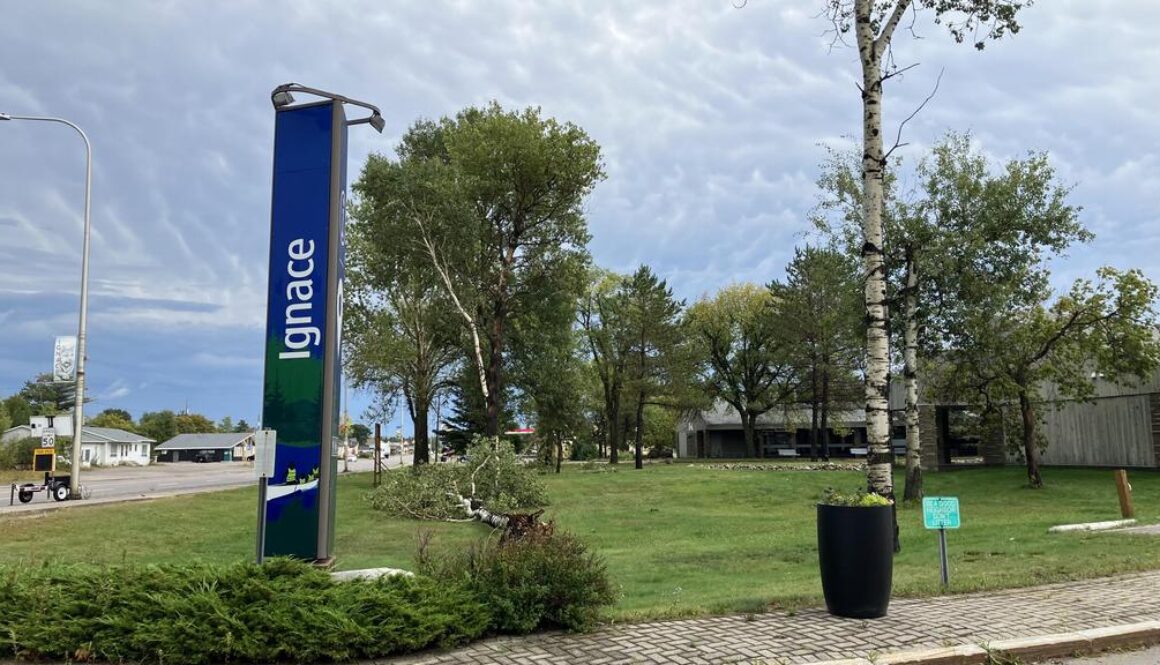
Preparations continue in Ignace for this year’s municipal elections.
Residents will be voting online.
The voting period will run from October 13th at 10 a.m. until October 26th at 8 p.m.
Clerk-Treasurer Lesley Sterling says they will send voting information to eligible voters soon.
“All of those kind of unique access PIN codes and voter information letters will be mailed out to the eligible voters at the end of September,” says Sterling.
“We are still missing mailing addresses for about 100 people, though, generally tenants who don’t have utility bills with the township.”
Sterling says they hope Canada Post or other residents can provide the township with the missing information.
The preliminary voters list with 1168 names has been updated and provided to the electronic polling company.
Any newcomer to the community who is 18 before October 26th can still register to vote by contacting the clerk.
Those without access to a device will also have the opportunity to cast ballots.
There are plans to have devices available at the township office for people to use during the voting period.
Two candidates are running for mayor.
Nine are seeking one of four councillor seats.
There is no election for public school board trustee.
Stephen Poling was the only candidate to file to represent the community on the Keewatin Patricia District School Board.
He is currently serving as trustee for Sioux Lookout but has been declared eligible to represent Ignace.
A candidate running for mayor in Thunder Bay has withdrawn from the race.
Shane Judge announced his decision Monday morning in an online post.
“It only became apparent after the filing of my nomination papers that, if elected, I would not be able to devote the time and energy needed to make the changes I hoped to make at city hall and in the community. The reasons are personal,” Judge states.
“I wish to apologize to my supporters who will be disappointed by this decision. The concerns we share about the future of our city remain.”
Judge’s decision to withdraw comes just over two weeks after receiving backlash for a separate post that singled out women voters.
He later took the post down and apologized, stating his “effort to insert gender into an appeal was just dumb.”
Judge also ran mayor in the 2014 and 2018 elections and for councillor at-large in the 2022 election.