New Brunswick government projects $1.39B budget deficit
The Liberal government is calling it a day for difficult decisions in the province.
For the second year in a row the budget is predicting over a billion dollar shortfall so cuts are being made.
Premier Susan Holt made a campaign promise to balance the budget every year of her term, but this is the second consecutive year where there is a gap.
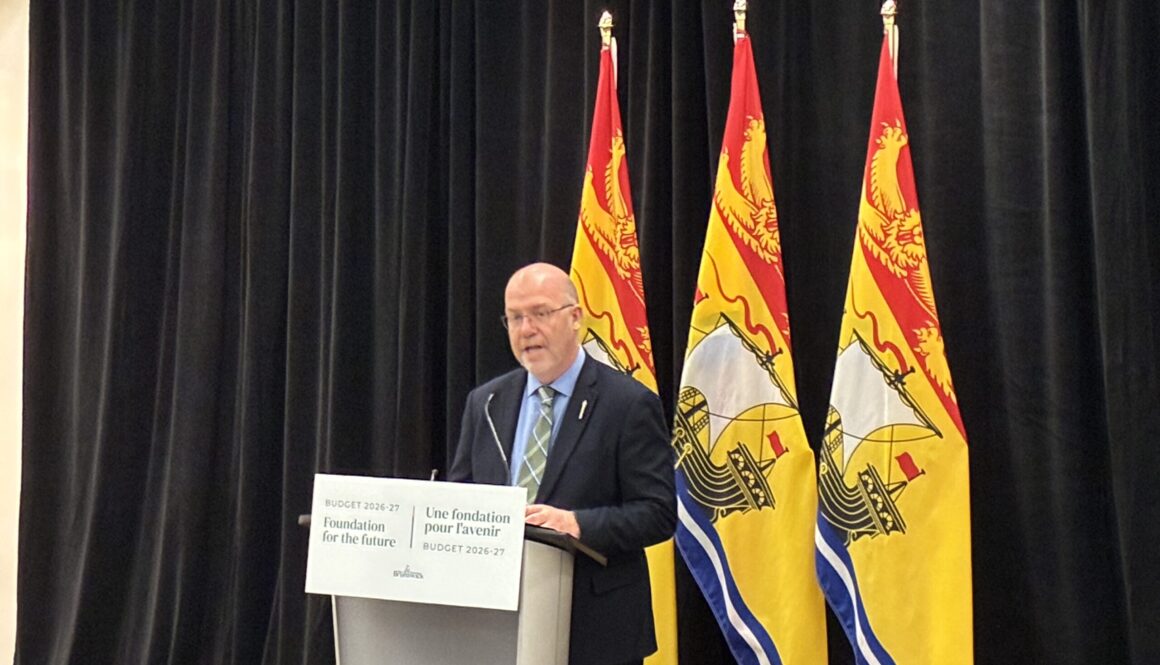
Finance Minister René Legacy said today’s budget reflects an economic and fiscal reality that has evolved significantly in a short period of time.
“However, our mission stays the same: invest in New Brunswickers by growing our economy and delivering essential public services efficiently.”
Legacy said the challenge of making significant investments in healthcare, affordability, and the economy while working to curb the province’s upward trend in expenses and increase revenues remains.
Right sizing civil service
The province is planning to save up to $100 million by reducing the size of the civil service. Over the next three years the government is looking to reduce the number of employees working for the province by 12 per cent. The plan is to look for voluntary departures and eliminating non-critical unfilled vacancies.
This year’s budget includes $15.6 billion in spending including nearly $800 million more than the year prior, but the revenue is only projected at $14.2 billion.
Legacy says this budget is transformative for the province. “These are not easy decisions, but they are necessary ones,” said Legacy.
Investment in health care but freezing post-secondary funding levels
The Holt government plans to spend roughly $4.8 billion on health care, an increased investment of $710 million from last year, a total increase of a billion dollars from the 2024-25 budget.
The budget includes an investment of $170.4 million as part of the Physician Services Agreement signed earlier in the month. Other larger investments in health are $50 million dedicated to modernizing and digitizing the health-care system, moving from a collection of stand-alone hospital information systems to a standardized system consistent across the province.
$30 million will go towards expanding collaborative care clinics throughout the province. This investment will allow New Brunswick to open and expand 12 more clinics. In combination with the 11 announced last year, the Holt government’s commitment to 30 collaborative care clinics is in sight.
At the same time the province notes enrollment in post-secondary institutions peaked in 2004 and has been in a steady decline. The budget is calling for a freeze of post-secondary operating grants at 2025-2026 levels and asks the leadership of New Brunswick institutions to address the challenges facing the sector.
New ways to make profit
Tolls on non-New Brunswick vehicles will be introduced and operational by 2028 in Aulac. Annual revenue of $10.4 million will be directed to road and bridge maintenance.
$1.2 million will be invested to tackle the issue of contraband tobacco in the province via a dedicated contraband tobacco enforcement team. A $3-million annual increase in revenue is expected from decreasing contraband tobacco purchases by five percent.
The province also plans to invest $667,000 to crack down on unreported lobster sales. Fisheries and Oceans Canada has estimated between 10 and 30 per cent of lobster sales in Atlantic Canada are unreported, which suggests between $29 million to $87 million in unreported sales, which represents $5 million to $8 million in missing tax revenues for the province.
Provincially operated veterinary services will be phased out by 2029. This creates an opportunity for the 72 qualified veterinary clinics across New Brunswick to expand and serve clients provincially.
Investments in affordability, housing, and social supports
To meet housing needs of lower income residents in the province, $17 million is being invested in a new Community Housing Retention and Expansion Program, which is being developed with the non-profit housing sector.
$10.2 million in wrap-around services for supportive housing is also being invested.
An additional $5 million set aside for the Energy Efficiency Fund will total $25 million provided to support energy conservation for non-electric fuel types like oil and gas, and to support low-income individuals and families.
$98.1 million in relief for New Brunswickers’ power bills are provided through a 10 percent rebate on monthly residential electricity usage first introduced last year.
For the first time, $1 million will be provided in funding for the Indigenous Domestic Outreach Program, for gender-based violence programming in transition houses in First Nation communities, and to support the implementation of support programs.
Investments in teachers, EAs, students
Following last year’s implementation of the free breakfast program for all New Brunswick schools, an additional $7 million will be provided to deliver a school lunch program province wide. It will be accessible to all students starting in September, according to Legacy.
To further support students and teachers, $19.3 million will help add educational assistants and address the gap between available resources and student needs in both the anglophone and francophone sectors.
$5.8 million will be invested in additional academic support teachers, resource teachers, and guidance counsellors.
An additional $1.4 million will be invested in recruiting and keeping employed teachers, bus drivers, custodians, and educational assistants.
New Brunswick’s economy
“New Brunswick has what the world needs, and this budget makes investments to prove it,” said Legacy. “The world is looking for critical minerals to power next-gen technology and the energy transition. We have them.”
Legacy said the bottom line cannot be managed without expanding upwards.
As the Sisson mine was recognized as a top nation-building project last November, the recognition demonstrates that New Brunswick can play a bigger role in Canada’s economy, according to Legacy.
$9.9 million will be invested to prepare for additional nuclear development at Point Lepreau.
The budget will also invest $2 million in the Agriculture Growth Action Plan and $750 thousand in the Local Food and Beverages Program to accelerate food production in New Brunswick.
$22 million will be invested ONB’s Competitiveness and Growth Pilot, turning it into a full program.
There will also be $1 million for the New Brunswick Innovation Foundation and $1 million for Research N.B.
Tourism and Arts in N.B.
Visitors to the province spend $2.7 billion annually. The Holt government’s new tourism strategy sets an ambitious target of $3.7 billion. To help reach these goals, an investment of $2 million will be made.
“Our government believes that dollars invested in arts and culture have huge impacts both to the economy and for community participation and well-being,” said Legacy.
To help stabilize the sector, $2.8 million will be invested as part of a five-year action plan that will be presented later in the spring.
Strengthening New Brunswick
$141.1 million is being provided to support local governments, an increase of $47.5 million over last year.
$4.2 million will be invested to facilitate foreign credential recognition for priority occupations in healthcare, education, and skilled trades.
In response to New Brunswick surviving the 2025 wildfire season, one of the most severe in the province’s history, $6.7 million will be invested to strengthen wildfire preparedness and response.
The funding will provide the budget to make 74 seasonal forest ranger positions year-round roles.