Prime Minister Mark Carney says the latest round of tariffs against the U.S. will hurt, but we will come out stronger on the other side.
In a video posted online Tuesday morning, Mark Carney says turning away from the Americans will come at a cost.
“With the resilient economy in the strongest fiscal position in the G7, we have everything we need to pivot and prosper. That pivot will come at a cost. There’s always a cost to action. But it doesn’t come close to the cost of standing still,” says Carney.
The new tariff covers about $27 billion worth of goods entering Canada from the states and matches tariffs imposed by the U.S. government.
Carney adds that the Americans tried 50 per cent tariffs in the 1890s. Will McKinley, congressman, championed the Tariff Act of 1890.
But it ended up strengthening the Canadian economy as our country diverted trade to other places, Carney says, and the U.S. ended up with four years of economic depression.
He went on to highlight how, when Canada became its own country, Prime Minister Sir John A. MacDonald built a rail line from the Atlantic to the Pacific and how, a century later, the Trans-Canada Highway would do the same.
“Canada is a nation forged in adversity, a country that prides itself on doing what’s right, not what’s easy, a nation that knows we’re always stronger together. Canada came to life in many ways in response to American aggression,” he says.
The federal government has announced tariff relief measures for hard-hit businesses and people.
Carney says that is because some are being deliberately targeted by the tariffs by the Americans and will feel it worse than others.
They have set aside $7.5 billion for relief measures.
Carney says we are better prepared now than we were a year and a half ago.
“This is about who we are as Canadians,” he says.
“It’s about making Canada strong, and it’s about the compassion that makes us who we really are. The truth is, adversity only makes us stronger. It always has.”
Prime Minister Mark Carney has announced that 313 VIA passenger rail cars will be built in Thunder Bay.
The deal is worth $4.7 billion and is the first time in four decades these rail cars have been produced in Canada.
Minister of Transport Steven McKinnon calls it “the single largest procurement in VIA history.”
“When Canadians need things built – they come to Thunder Bay,” says Carney. “For too long, we bought from abroad what we are more than capable of building right at home. “
VIA’s fleet of passenger rail cars is more than 70 years old — “They were built when the NHL had six teams, goalies wouldn’t wear masks, the Leafs would win the cup,” the Prime Minister jokes.
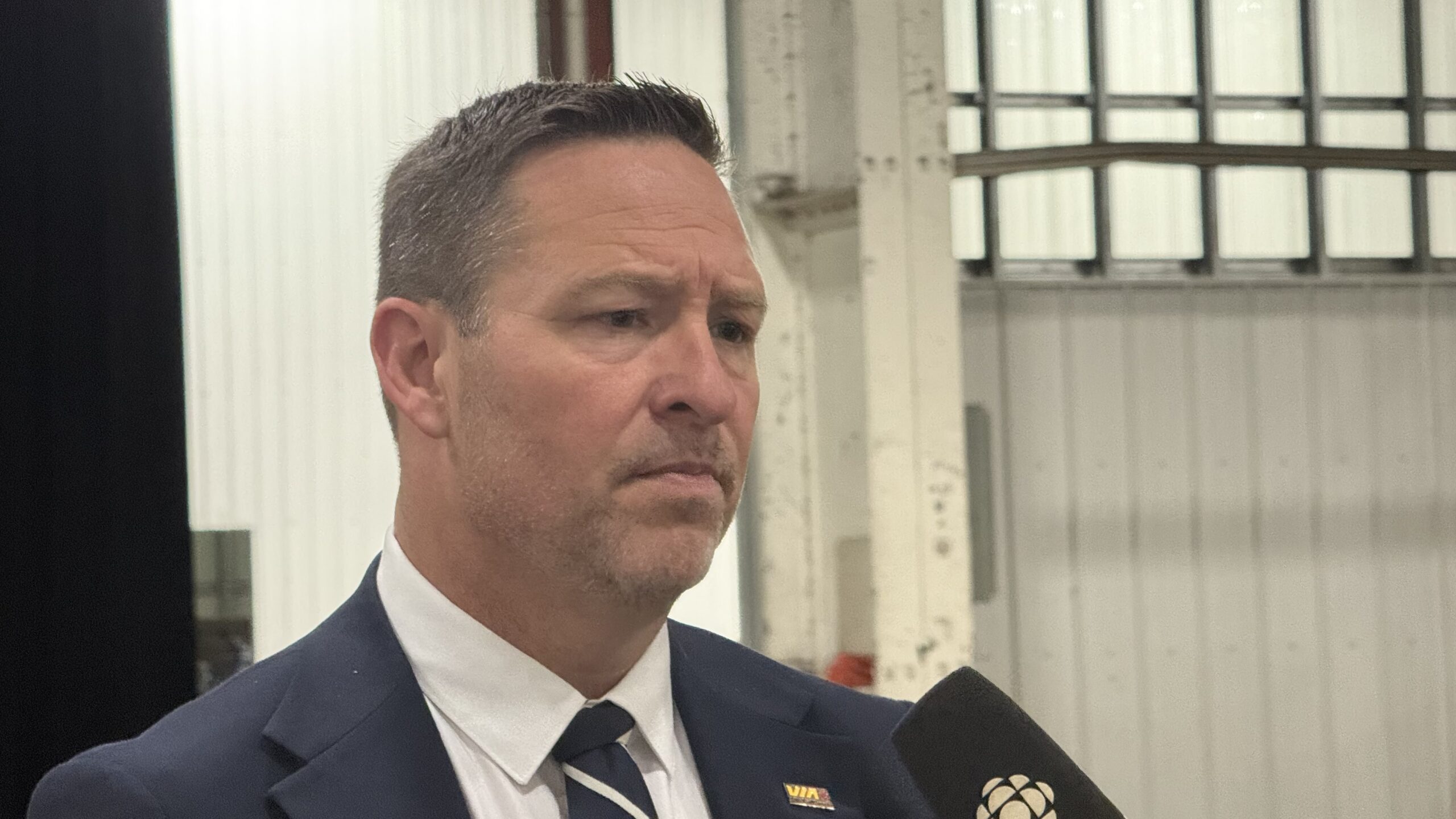
Mathieu Paquette, interim CEO of VIA, says the age of the fleet “brings a lot of challenges in terms of reliability, especially on route reliability. So with new equipment, you can expect less breakdowns, and that reliability will go up, and therefore on-time performance as well.”
Interim VIA CEO Mathieu Paquette takes questions from reporters at an announcement at Thunder Bay’s Alstom Plant. PHOTO: SAM GOLDSTEIN/ACADIA BROADCASTING/SEPT 3, 2026
Alstom will use the Buy Canadian policy to procure materials from more than 900 Canadian suppliers.
“It will be Canadian electricians that install the wiring, Canadian machinists that will make the precision parts, Canadian welders that will build the steel frames from Canadian carbon steel,” says Carney.
The Prime Minister says the investment will create almost 700 jobs for workers in Ontario and Quebec.
It is not yet clear exactly how many jobs will be created at Thunder Bay’s Alstom plant, but Unifor Local 1075 President Justin Roberts expects to see about 200 in the near future.
Roberts says the announcement is “great news for all of us here at Alstom Thunder Bay. It’s even better news for my members that have felt insecure about their jobs. Now this brings some security to them and their families.”
According to Paquette, the contract will bring the passenger trains into service in phases, with the first cars in service by 2031, and the final batch by 2035.
“This is a guaranteed 10 years of solid security for our members,” adds Roberts.
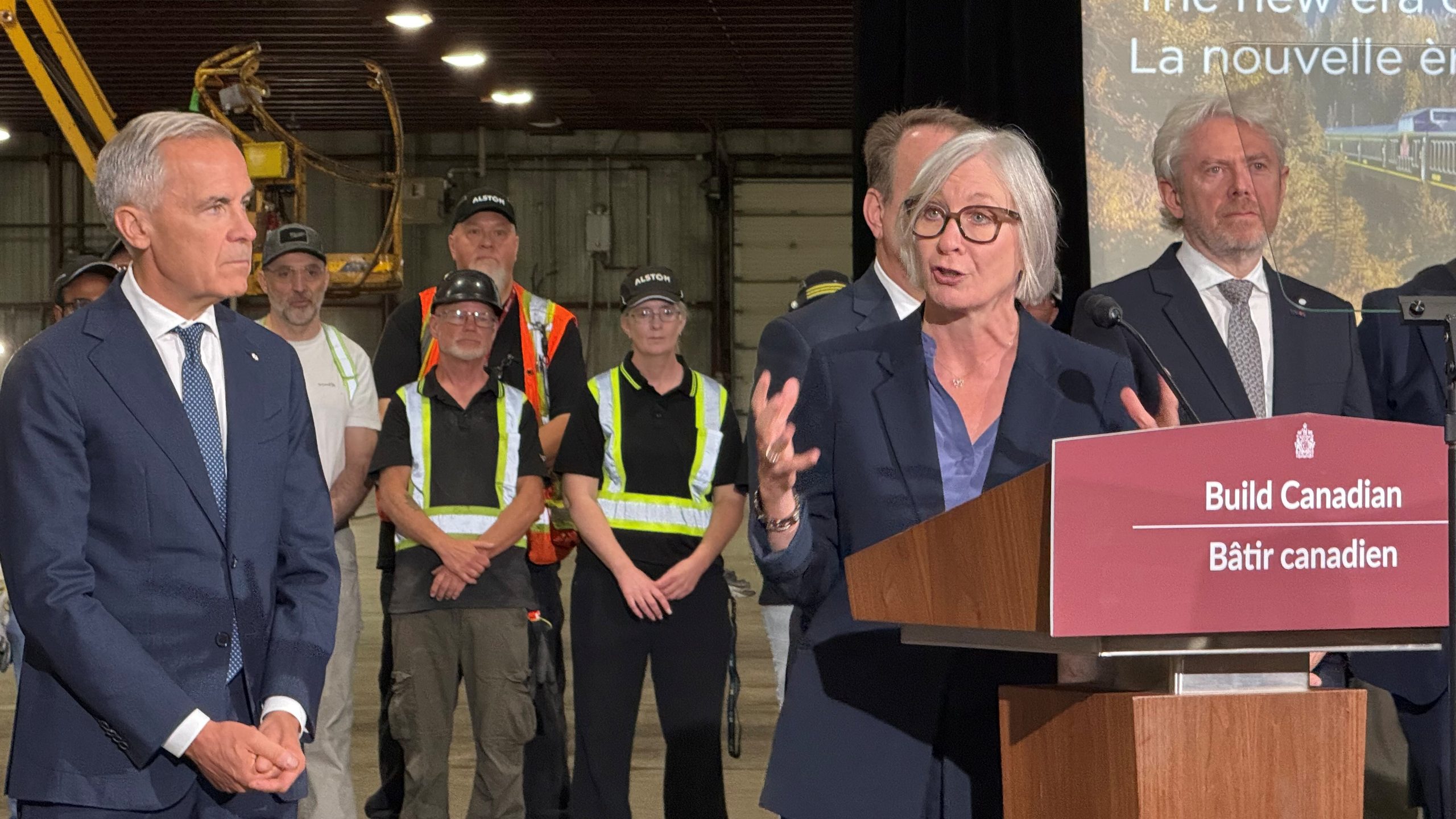
Thunder Bay—Superior North MP Patty Hajdu introduces Prime Minister Mark Carney at an announcement at Thunder Bay’s Alstom plant. PHOTO: SAM GOLDSTEIN/ACADIA BROADCASTING/SEPTEMBER 3, 2026
The announcement is already sending ripples through the city thanks to the possible downstream economic effects of such a significant investment.
Already Thunder Bay’s Community Economic Development Commission (CEDC) and Chamber of Commerce have weighed in to praise the contract, which both parties lobbied the federal government to grant to the Thunder Bay plant.
“For Thunder Bay, an investment of this scale will strengthen our manufacturing sector, generate significant economic activity, and drive long-term growth across our community and region,” says CEO Jamie Taylor of the CEDC.
The VIA contract also has important long-term implications for the Alstom plant: part of the investment will go into refurbishing the plant to ensure it’s capable of working on the new VIA cars, particularly while it is working in parallel on subway cars for Toronto.
“When they announce millions of dollars that they’re going to invest into the site, that’s terrific news. That’ll prepare us for a future of building cars beyond these contracts,” explains Roberts.
Unifor union leader Justin Roberts speaks at an announcement at Thunder Bay’s Alstom Plant. PHOTO: SAM GOLDSTEIN/ACADIA BROADCASTING/JANUARY 15, 2026
Though Thunder Bay will now construct the next generation of passenger rail cars for VIA, the nation’s coast-to-coast passenger rail line hasn’t stopped in Thunder Bay for decades, with the route now travelling through Armstrong.
While Paquette is unwilling to offer a commitment from VIA on bringing rail service back to Thunder Bay, saying only that “it’s probably a bit too soon to tell… but we’re definitely looking at adding services,” Prime Minister Carney says that “for this government, it’s a priority, yes.”
A New Brunswick doctor is among the four newest members of the Canadian Senate.
Dr. Rodney Ouellette was appointed to the upper chamber July 7.
Ouellette is a doctor who has spent his career advancing cancer research.
The founder of the Atlantic Cancer Research Institute, his research and leadership has helped improve cancer research capacity in the region while contributing to advances in precision medicine.
Ouellette’s work bridges clinical medicine and scientific research, focusing on understanding the molecular basis of cancer and translating scientific discoveries into more precise approaches to cancer diagnosis, treatment and patient care.
The appointment was made the same day Prime Minister Mark Carney announced changes to the Senate appointment process.
In a release from the PMO, Carney said the government is expanding the criteria for new applicants to the Senate in order to attract the expertise needed to deal with challenges that will shape Canada’s future.
“Since Confederation, the Senate has been an independent pillar of our Parliament – a vital means through which Canadians from all regions of the country scrutinise, debate, and pass legislation with the goal of bettering our nation,” the prime minister said.
“Today, we are protecting the Senate and its critical role by ensuring it is comprised of the talent, expertise, and perspectives required to meet the challenges of a new era.”
With the changes, recruitment of potential senators will look more closely at candidates with enhanced focus and expertise in key Canadian strategic industries, regulatory frameworks and emerging social and economic affairs.
The government also removed the non-partisanship criterion for appointments.
According to the PMO release, this decision recognizes “the valuable contributions made by Canadians who have chosen to serve in elected office or in other partisan roles.”
To that end, two new senators for Quebec have been appointed from partisan positions.
Richard Martel served as a Conservative MP from 2018 until this appointment.
Carney also appointed Thomas Pitfield, who had been serving as the PM’s principal secretary.
Pitfield previously served as senior policy adviser to the leader of the government in the Senate.
The final appointee is Geeta Tucker, who will represent Manitoba.
Tucker is a chartered professional accountant, currently an executive consultant with the CPA Western School of Business.
She was recently the president and CEO of CPA Manitoba.
Prime Minister Mark Carney has picked Germany TKMS to build the navy’s new fleet of a dozen submarines.
Carney made the announcement in Halifax, Monday, at the Canadian Armed Forces Base.
The other choice in the process for the multibillion-dollar contract was South Korea’s Hanwha Ocean.
“In a more dangerous and divided world, Canada must be prepared to defend our interests, protect our citizens, build our economy, and secure our future,” said Carney in a statement.
“To that end, we are making the largest defence procurement in our nation’s history with speed, ambition and discipline.”
It means six new submarines will be maintained and serviced in Nova Scotia, according to Premier Tim Houston.
“This is a game changer for our province,” said Houston in a statement.
He said it will pump billions of dollars of investment into our region and create career paths.
Mayor of Halifax, Andy Fillmore said, Monday’s announcement is “one of the most consequential defence procurement decisions Canada has made in generations.”
The current fleet of submarines will remain operational until the mid to late 2030’s.
Carney will departed Halifax at 5:50 p.m. for Turkiye for the NATO Summit.
Canada and Ireland are moving to deepen their relationship after Prime Minister Mark Carney met with Irish Taoiseach Micheál Martin in Dublin.
The two leaders met on Sunday, with discussions focused on trade and strengthening economic resilience as global uncertainty continues to grow.
Carney said bilateral trade has increased nearly 150 per cent over the past decade, with Ireland a key partner in investment, agriculture, clean growth and economic security.
“In Canada, we believe that this moment of rupture can only be answered by positive, purposeful action,” Carney said. “By building what comes next. So, we look first to our closest allies.”
Efforts will centre on expanding trade, investment and economic stability, building on business ties that support tens of thousands of jobs in both countries.
Carney said the partnership is evolving in response to global instability.
“Canada and Ireland face a rapidly changing world,” he said. “One which, unfortunately, is more dangerous and divided — a world that must feel as uncertain as the future must have to my grandparents when they immigrated.”
He also announced up to $2 million in support for ‘Canada-Ireland 180’, a 2027 cultural initiative marking 180 years since more than 100,000 Irish people migrated to Canada. The program will highlight shared heritage, support Irish-Canadian artists and expand cultural exchange.
Carney said the initiative will celebrate the shared heritage between Canada and Ireland, empower Irish-Canadian artists, and deepen cultural exchanges between our two countries.
Beyond economic cooperation, both countries are planning deeper collaboration in health, clean energy, and artificial intelligence. They also reaffirmed shared commitments on global security, climate action, and continued support for Ukraine.
A move by the federal government will provide some temporary relief for Canadians using fuel.
“Canada’s new government will temporarily suspend the federal fuel excise tax from next Monday until Labour Day. We will also remove the excise tax on aviation fuels,” Prime Minister Mark Carney announced earlier today.
This comes after byelections in Ontario and Quebec helped to secure three more seats for the Liberals, giving them a majority government.
Carney says this temporary suspension of the excise tax will remove up to 10 cents per litre on gasoline and four cents per litre of diesel fuel.
“Today’s cut to the fuel excise tax is a responsible, temporary measure consistent with what it takes to build a stronger, more affordable economy, combined with sound fiscal management,” Carney added.
Prime Minister Mark Carney has secured a majority for his Liberal government after three byelection victories in Ontario and Quebec, with results announced just after midnight Eastern time.
The Liberal Party celebrated the wins, welcoming three new MPs — Tatiana Auguste, Danielle Martin, and Doly Begum — whose elections expand representation and strengthen the largest women’s caucus in Canadian history.
In Terrebonne, Tatiana Auguste captured her seat by 731 votes, following a dramatic one-vote margin in last year’s result. Party officials say the outcome reinforces confidence in Carney’s leadership and his focus on a strong economic plan.
The results cap a record-breaking 2026 Liberal Convention and a historic year of growth in membership and fundraising, with nearly 300,000 new registered Liberals joining across the country in one year. United under Carney, the Liberals say they remain committed to delivering the “leadership needed to build a stronger, safer, and more prosperous future.”
Three by-elections set for Monday night election will decide whether Mark Carney will finally get that majority government.
After five MPs crossed the floor to join the Liberals, they just need one for the required 172-seat majority. And if they can win two seats, that will let them pass legislation without the help of the speaker’s vote or any other parties.
In the spring, the Liberals flipped the riding of Terrebonne, Quebec, from the Bloc by a single vote.
But the supreme court nullified the vote, which forced a by-election, after a Bloc voter complained their mail-in ballot was not counted due to an error.
The other two ridings were held by former Liberal cabinet ministers.
Bill Blair stepped down as MP to become our country’s high commissioner to the U.K. He was elected in 2015 as a Liberal and served under several different cabinet titles, including Minister of Emergency Preparedness and Minister of Public Safety. From July 2023 to May 2025 he was the Minister of National Defence.
The other MP who stepped down is Chrystia Freeland.
She moved on to become an economic advisor for Ukraine’s President Volodymyr Zelenskyy.
Freeland was elected in 2013 and also served several key ministerial roles, including minister of Foreign Affairs, Minister of International Trade, Minister of Intergovernmental Affairs, Minister of Finance, Minister of Transport and Internal Trade.
From November 2019 to December 2024, she was also the Deputy Prime Minister.
Voting closes in all three by-elections on Monday night.
With gas prices going up, you may be wondering if it is time for an oil pipeline from New Brunswick to Western Canada.
Since war broke out in Iran and the middle east late February, gas prices have jumped, with many oil tankers getting disrupted as they try to travel through the Strait of Hormuz.
Prime Minister Mark Carney visited Halifax on March 26. When our newsroom asked if a pipeline was on the table and what else his government was doing to combat the rising oil prices, he said they have several affordability measures in place, including tax cuts.
“We will look at this as the conflict evolves, and most importantly as the impact on Canadians is there, not saying necessarily that’s the final word,” Carney said.
Later, he added, “We also have opportunities on the east coast in conventional energy, which we’ll be exploring to build that out, and across this country.”
Although he did not rule out the possibility of an oil pipeline in the future, he said Nova Scotia has tremendous energy potential with offshore wind.
He met with Nova Scotia Premier Tim Houston the next day, on March 27, and signed an agreement to cut red tape for major infrastructure projects. That would include Wind West, an offshore wind initiative that would require new transmission infrastructure to move energy beyond Nova Scotia. The project has the potential to supply a significant portion of Canada’s electricity needs.
A Nova Scotia MP says China dropping tariffs on lobsters and crabs is a win for the seafood industry.
On Friday, Prime Minister Mark Carney announced a ‘landmark’ agreement with China that will see the ‘anti-discrimination’ tariffs eliminated on March 1.
Acadie-Annapolis’ Chris d’Entremont says the 25 percent tariff caused pricing problems for buyers.
“It’s a very positive development. The fishing industry has been asking for a while to try and get those tariffs changed or removed. It’s a good step forward, and gives us a year to continue discussions,” said d’Entremont.
The tariff changes are expected to last until the end of 2026, as of now.
D’Entremont says further discussions are needed on the world stage to make sure the tariff removal becomes permanent.
“There has been some talk from the minister of Export development, so he’ll continue discussions with his Chinese counterpart to make sure we can get those tariffs permanently removed.”
The changes will unlock nearly $3 billion in export orders, according to Prime Minister Mark Carney.