Ontario’s Transportation Minister says his Ministry continues to look at how to improve road safety in northern Ontario.
A three-lane highway, known as the 2-plus-1 concept, is being piloted in the North Bay area.
Prabmeet Sarkaria says work on the project is underway.
He says they are also looking at other areas where it might be suitable.
“On Highway 17, we’re looking at concepts of passing lanes, truck climbing lanes where we have specifically been told there are challenges and issues to make that road safer,” says Sarkaria.
“That work is ongoing, and we’ll be having more to say on that very shortly in the coming weeks.”
The Ministry is also studying the four-laning of Highway 17 west of Thunder Bay to Kakabeka Falls.
Drivers in Halifax’s Quinpool South neighbourhood will soon need to slow down.
The Halifax Regional Municipality (HRM) says speed limits on residential streets in the area will be reduced from 50 km/h to 40 km/h as part of its ongoing road safety efforts.
The change applies to local residential streets bounded by Quinpool Road, Coburg Road, Robie Street, and Oxford Street. Jubilee Road will remain unchanged because of its road classification.
Municipal crews are scheduled to begin installing new speed limit signs on Tuesday, July 14, following provincial approval of the reduction through the Nova Scotia Motor Vehicle Act.
According to HRM, studies show that reducing vehicle speeds from 50 km/h to 40 km/h can increase pedestrian survival rates by 40 per cent in the event of a collision.
The municipality says the speed limit reduction is one of several initiatives aimed at improving road safety and supporting its goal of reducing transportation-related fatalities and injuries. Officials say the changes are intended to create safer, more accessible communities for people of all ages and abilities.
The provincial government is committing to a number of measures to improve road safety in northern Ontario.
The action follows several lengthy closures and fatal collisions on Highways 11 and 17 this winter.
NDP MPPs from northern Ontario also recently travelled by vehicle across northern Ontario, documenting safety concerns they and others from the region have long expressed.
The province says it plans to increase the number of transportation enforcement officers in the region and conduct more enforcement blitzes, focusing on large commercial vehicles.
It also plans to deploy two mobile inspection units this spring as part of that enforcement.
The province is also looking to improve and upgrade highway signage to make it more visible to motorists.
New portable electronic messaging signs that provide motorists with safety information, weather conditions and road closures will also be installed.
“Our government is keenly aware how important safe roads, bridges and highways are to the residents, visitors and businesses in the north who rely on them daily,” states George Pirie, Minister of Northern Economic Development and Growth, in a release.
“That is why we are taking action to improve safety, increase enforcement and make targeted investments that will keep people safe and goods moving, while strengthening connections between northern and remote communities.”
The province also intends to advance the preliminary design work on a four-lane highway between Thunder Bay and Shabaqua.
Public meetings will be held this spring.
Work is also proposed on upgrading the provincial rest areas in northern Ontario to provide more year-round truck parking.
“Highways 11 and 17 are lifelines for northern Ontario, and we’re making them safer and more reliable by cracking down on dangerous driving, strengthening enforcement and investing in new safety measures that keep people and goods moving,” states Prabmeet Sarkaria, Minister of Transportation.
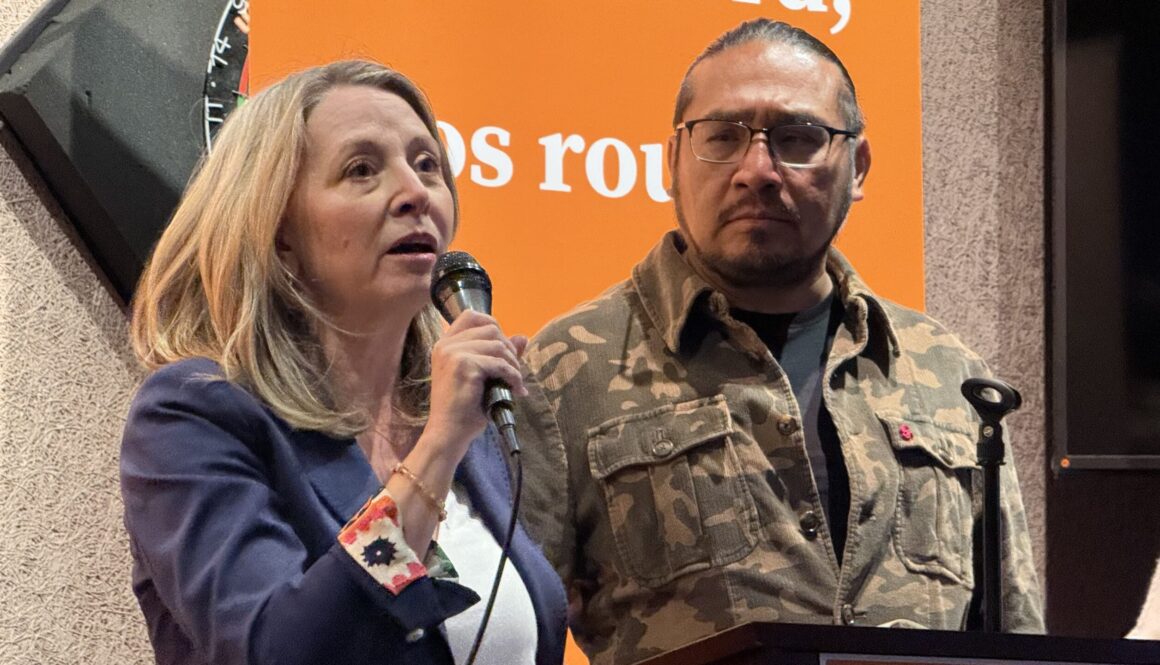
Following the conclusion of the Ontario New Democratic Party’s (ONDP) northern Ontario road tour, ONDP MPP’s Sol Mamakwa, John Vanthof, Guy Bourgoin, and Lise Vaugeois were joined on Monday by their leader Marit Stiles to host a town hall at Thunder Bay’s Slovak Legion Hall.
The town hall comes as deaths on northern highways are repeatedly casting safety into the spotlight.
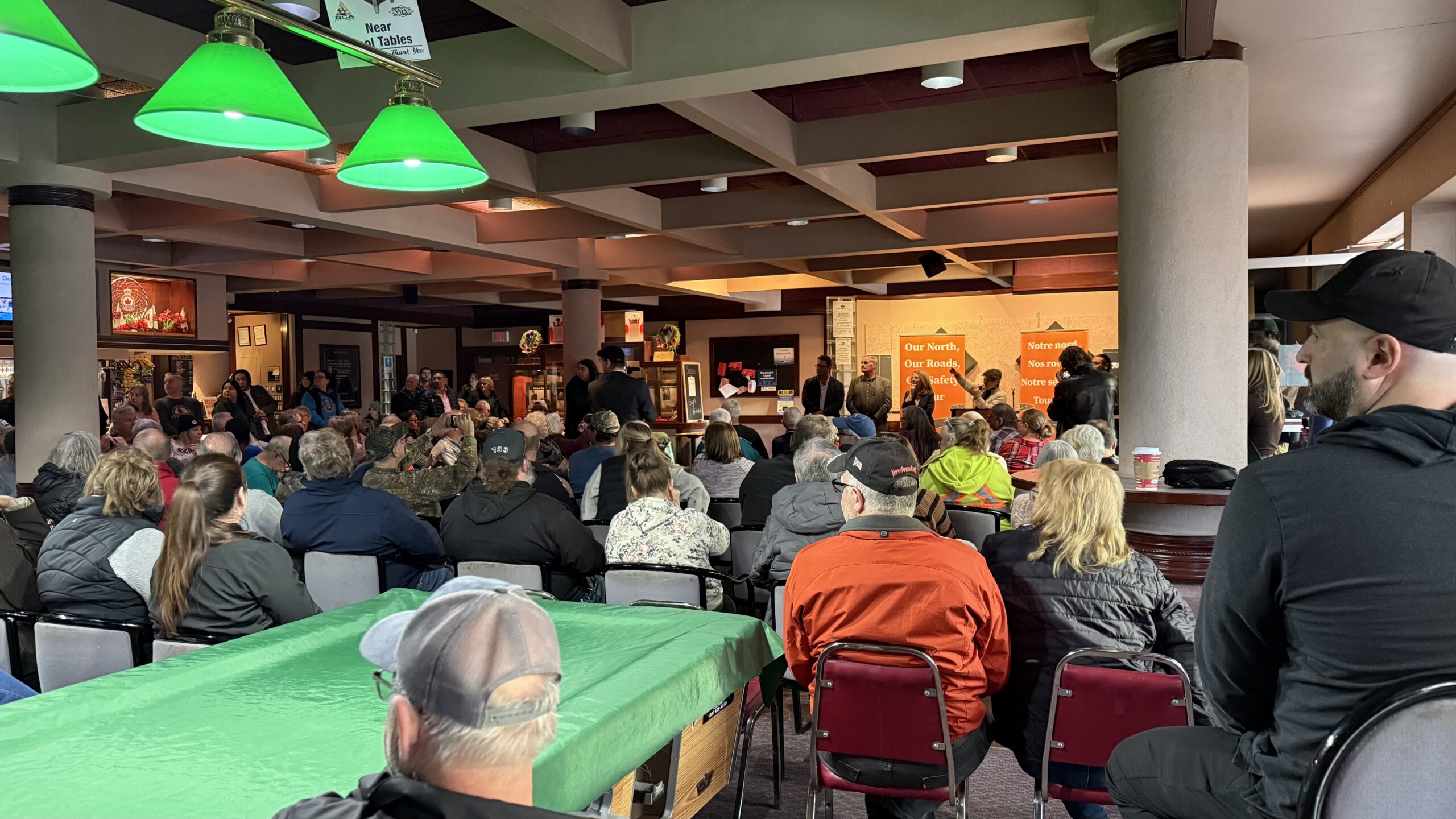
Attendees packed the Legion hall to share stories of lost loved ones, fears of driving on unsafe roads, and frustration at the glacial pace of highway twinning.
Survivors of accidents described lifelong physical and mental trauma, while those forced to say goodbye to friends or family prematurely explained the difficulty of moving on.
Family members of long-haul truckers voiced the terminal anxiety they feel when their spouses, siblings, or parents are on the job.
At one point, ONDP leader Marit Stiles asked the attendees to raise their hands if they had ever experienced a close call on a northern highway.
In response, the packed room erupted with raised hands.
Locals pack the Slovak Legion Hall to voice road safety concerns. (Sam Goldstein/March 9, 2026)
Stiles expressed surprise at the large turnout, but not at the feelings shared.
“I think it’s an indication that people are really desperate to have change and to be safe,” she remarked.
Many solutions were discussed: beyond twinning or building “2+1” highways, locals also called for a deeper licensing process for truckers, with suggestions such as graduated licensing, apprenticeships, or even treating the profession as a skilled trade.
Some called for empathy for new truckers pressured or exploited by a degenerating system, asking for better worker protections; others pointed out that dangerous driving manifests in cars as well as trucks, and argued safer roads — the more systemic approach — could better account for human error.
Stiles had her own suggestion: treat the upgrades to Highway 11/17 as a nation-building project of national importance and urgency, due to the economic impacts of frequent highway closures.
“If [premier Doug Ford] can’t see that it’s bad enough that people are losing their lives and families are torn apart, then maybe he’ll see the logic in the fact that our economy is being ground to a halt multiple times a day with the shutdown of those highways,” she said. “That there’s no way the road through the Ring of Fire is going to be a reality if we have road safety issues like we have right now in Northern Ontario.”
Lise Vaugeois, MPP for Thunder Bay—Superior North, has been an outspoken critic of highway safety in the north. She agrees with those who call for a “system-wide” approach to highway safety.
Beyond simple infrastructure upgrades like more medians, shoulders, and passing lanes, Vaugeois points to a lack of oversight in the trucking industry.
“The Ontario Trucking Association says that 90 per cent of trucking fleets have not been audited. There is no control, there is no supervision happening in the trucking industry,” she explains.
A recurring theme at the town hall was that everyone more or less agrees on what is needed to make highways safer, but that there is a lack of political will to force the issue.
Some of the attendees suggested blocking highways, or threatening strikes.
While ONDP members refrained from outright endorsing civil disobedience, they encouraged disgruntled highway travellers to organize, build movements, and place steady, long-term pressure on provincial leaders to keep their promises.
Stiles promised her party would do the same at the provincial legislature.
“We’re going to keep going back at them with more motions, more bills to continue to raise the pressure on the government,” she assured. “I don’t think they’re going to want to say no this time after so many people are losing their lives. I think it’s going to look very badly for the government, so I hope they will agree.”
The NDP is making a road trip through northern Ontario.
Their northern Ontario members intend to raise awareness of the need to improve highway safety.
Kiiwetinoong’s MPP Sol Mamakwa says the tour will shed light on what northerners experience daily.
“It’s also a chance for us to listen to first responders, people across the north who have been affected by collisions on these highways,” says Mamakwa.
“And it is our hope that the government hears them too.”
The NDP have put forward several requests, only to have Private Member’s Bills rejected in the Legislature.
The wish lists have included commitments to twin sections of Highway 11 and 17, transferring the responsibility of winter road maintenance from private contractors back to the Ministry of Transportation, better training of transport drivers and stronger enforcement of the commercial vehicle regulations.
NDP leader Marit Stiles intends to participate in part of the tour.
“Safety issues on northern highways are a day-to-day issue,” says Stiles.
“This is an issue that we in the Ontario NDP and my colleagues standing with me and others who are not here with us today have been raising for years. But the situation has become more than critical.”
Using figures obtained from the MTO, the NDP members say that the risk of getting into a collision in northern Ontario is as much as 10 times greater than in southern Ontario.
Mushkegowuk – James Bay MPP Guy Bourgouin says northern Ontario should not have to suffer through what he calls second-class conditions.
“We have the right to have secure roads like the rest of the province,” says Bourgouin.
“That’s why we are going to listen to people and take that testimony to prove to the people in the south of what they don’t understand, because it looks like the government is not understanding. We want to bring the North’s perspective so that the government understands what we’re living with daily.”
The MPPs plan to make several stops along the way, including in the communities of Kapuskasing, Timmins, Thunder Bay, Kenora, Sudbury and Sault Ste. Marie.
They plan to document their tour on social media and on video for presentation to the government at a later day.