The long journey west: The Anishinaabe migration from Waabanakiing to the Rainy River (and Beyond)
History is an amazing thing.
It can explain, enlighten, and inspire.
In our region of Rainy Lake and Rainy River, there are amazing stories that remain to be widely known about how our Ojibwe-Anishinaabeg families once arrived in our area, how our families made their way here, and legacies begun and continued upon arrival and establishing a new home.
For many generations, the Anishinaabeg (the people later known as the Ojibwe, Potawatomi, and Odawa) lived far to the east in Waabanakiing, the land along the Atlantic coast. Communities and villages were concentrated near the Mouth of the St. Lawrence River.
From this eastern homeland began one of the most important migrations in Anishinaabe history.
Following direction from spiritual leaders (as well as in response to expanding population, strain on various local resource, and conflict with other Indigenous Nations), Anishinaabe families began moving westward from Gaa-biidaajiwang (the mouth of the St. Lawrence River), travelling along Ginooziibiing, the St. Lawrence itself.
Cultural leaders have shared this migration (beginning in roughly 450 AD) unfolded through a series of stopping places remembered in Anishinaabe history.
The first stopping place is Mooniyaang (the island now known as Montreal) which resembled the shell of a turtle.
From there, the travellers continued to another stopping place at Gichi-gikaabikaang (today’s Niagara Falls) which some described later as Wayaanag-gakaabikaang.
The next stopping place is remembered at Gichi-gami-ziibiing (the Detroit River).
The fourth stopping place was Manidoowaaning (known today as Manitoulin Island).
As the migration continued westward, the Anishinaabeg gathered at Michi-mikinaak (the Straits of Michilimackinac). Here an important political division and cultural alliance developed. The Anishinaabeg would separate into distinct roles and responsibilities. These are the Odawa (the keepers of trade and commerce), the Potawatomi (the keepers of the unity fire), and Ojibwe (the keepers of spirituality) made up the Three Fires Confederacy – a relationship of mutual support among three closely connected nations which still exists today.
From this region the travellers continued toward Baawiting (now known as Sault Ste. Marie) where the powerful rapids dominate the landscape. When European explorers and missionaries later arrived, they referred to the Ojibwe living there as Saulteurs or Saulteaux (prompted from the French observations of the people living along the rapids). A Slovenian missionary and grammarian (Frederic Baraga) wrote about the Ojibwe using the word Ochipwe – a misnomer that has been used by some as Chippewa since the publication of his book.
At Baawitigong the migration took a new turn.
The Ojibwe divided into two major travelling groups. One group followed the south shore of Gaa-babakiteyaashkaamagak (Lake Superior, with the name Gichi-gamiing some generations later). Another group travelled along the north shore. Both groups moved westward with the intention of eventually reuniting. Our rock paintings are just some evidence of this historical movement.
As communities travelled and settled along these routes, regional differences gradually developed, contributing over time to variations in dialects spoken in different areas, including regions that today include northwestern Ontario and Minnesota.
The group travelling along the north shore reached the next stopping place first. This place was Manidoominising, known as Spirit Island, located near Onigamiinsing (present-day Duluth, Minnesota).
Spirit Island lies within the Spirit Lake estuary of the St. Louis River. In this region the travellers encountered wild rice, a plant that would become a central food source and cultural foundation for many Anishinaabe communities. In Anishinaabe teachings, the people had been instructed to travel until they reached the place where “food grows on the water.”
When the southern travellers later arrived at Spirit Island. Rather than travelling farther west, a majority moved southeast toward another stopping place. Some members of the northern group, however, continued travelling westward along their own path (due to conflicts with neighbouring nations), but in limited numbers.
Meanwhile, the larger travelling group moving southeast arrived at another stopping place known as Mooningwanekaaning, today called Madeline Island on Lake Superior. A major settlement developed there at La Pointe.
Over time, however, tensions and pressures developed in the region surrounding Madeline Island. The influx of military, missionaries, and new trade were important factors. In response, leaders made important decisions to protect sacred ceremonial items.
Those items and lodges were eventually moved from Mooningwanekaaning across Gaa-zhaagawaamikaag (Chequamegon Bay) to Mashkiiziibiing (Bad River, Wisconsin) where they were protected and kept safe.
Meanwhile, Ojibwe groups travelling along the north shore of Lake Superior continued moving north and northwest through interconnected waterways.
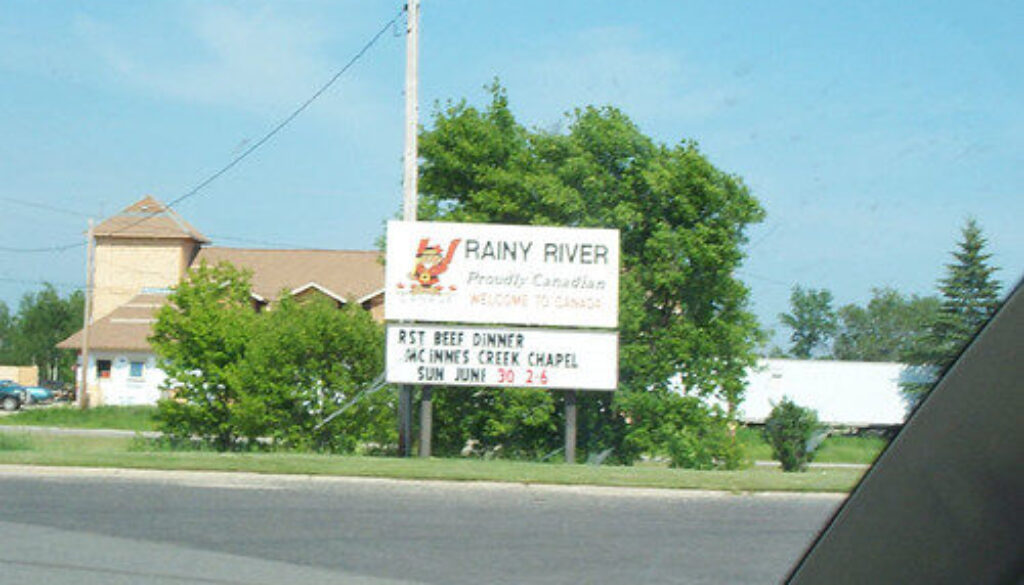
Their travels carried them through places such as the Pigeon River, Gichi-onigamiing (Grand Portage), and Animikii Wiikwedong (Thunder Bay). From there, river and lake systems carried them deeper into the interior, reaching places including Gaa-biitoowegamaag zaaga’iganing (Lake Kabetogama), Gojijiwi-zaaga’iganing (Rainy Lake), Manidoo-ziibiing (Rainy River), Miskwaagamiiwi-zaaga’iganing (Red Lake), and Kaa-babiikotaawangaang (Lake of the Woods). From these waters, Ojibwe travellers eventually continued westward onto the prairies.
At the same time, the Ojibwe who had travelled along the southern route around Lake Superior moved inland toward the west. Communities developed in places such as Nagaajiwanaang (Fond du Lac which was a major access point to settlement) and later Misi-zaaga’iganing (Mille Lacs), among other locations.
European records first begin to document Ojibwe communities in the Rainy Lake and Rainy River region during the mid-1600s, although oral histories indicate the people had been travelling through and living in the area earlier – but in limited numbers. The mid-1600s saw the arrival of countless families.
During that period, relationships between Dakota communities and French explorers and traders became increasingly strained. As fur trade networks expanded, the Ojibwe often served as middlepersons in trade between different nations and European traders.
For periods in the late 1600s and early 1700s, Ojibwe, Dakota, and French groups maintained complex relationships that included trade, diplomacy, and occasional conflict. However, in the early 1700s, disease, competition in the fur trade, and shifting alliances contributed to growing tensions across the region. Major conflict flash-points during the mid-1700s at locations such as Sioux Narrows, Sioux Lookout, Bear’s Pass, and Warroad. These struggles formed part of a longer period of warfare between Ojibwe and Dakota communities (and are reflected in their names).
Because starvation was among the most significant (and frightening) hazards to all, harsh winters occasionally led to ceasefires, hunting together, marriages, as well as cultural and ceremonial exchange (Biindikoodaadiwin) before spring arrived and conflicts continued.
Over time, Ojibwe communities became firmly established throughout much of northern Minnesota and the Rainy River region, while Dakota communities increasingly lived further to the south and west. A flash point and success at Battle River in 1760 helped the Ojibwe establish a foothold in the region while scouts pushed out in all directions.
In the mid-1800s, another important cultural exchange took place. The Bwaani-dewe’igan (or Big Drum) was shared by the Dakota to the Ojibwe as a gesture of peace during a difficult period of conflict. These drums are still cared for in our region to this day.
In 1873, Treaty #3 (known in Anishinaabemowin as Manidoo Mazina’igan) was concluded between the Crown and the Ojibwe-Anishinaabe Nation. The treaty would become highly influential in the development of later numbered treaties, particularly in matters concerning land, governance, and education.
Another story of significance emerged in the early twentieth century.
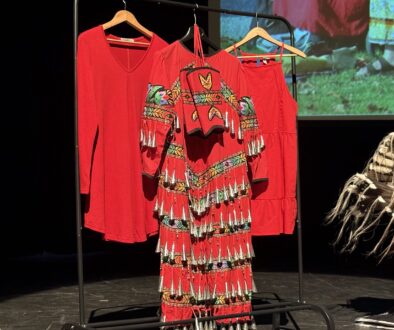
During a time when many men from the Rainy River region were giving their lives overseas fighting in World War One, a vision received by Maggie Wilson at Manidoo Baawitigong to protect the troops overseas. A number of dresses with special jingles were created and a dance that came through a dream – The Union Star Dance – was done to protect the solders overseas during the end of the war who called the region home.
Following the end of first World War and soldiers returning home from the battlefields overseas, sickness was brought home. During this influenza pandemic, another special chord was played in the on-going song of Anishinaabe history at beautiful Whitefish Bay. A vision received by a community member inspired the creation of a healing ceremony now known as the Jingle Dress Dance and several dresses were made to help a young Maggie White and used for healing and protection. As the story and ceremony spread, it became closely associated with healing across many Anishinaabe communities. Different regions such as Barren’s River and in northern Minnesota tell similar stories of dreams and visions that led to the creation of the jingle dress and the continuation of this important tradition.
These are but a few points of our history and there will always be more to know, but a bit of insight (and profound understandings) goes a long way as we retrace our footsteps and chart the direction of our future together.