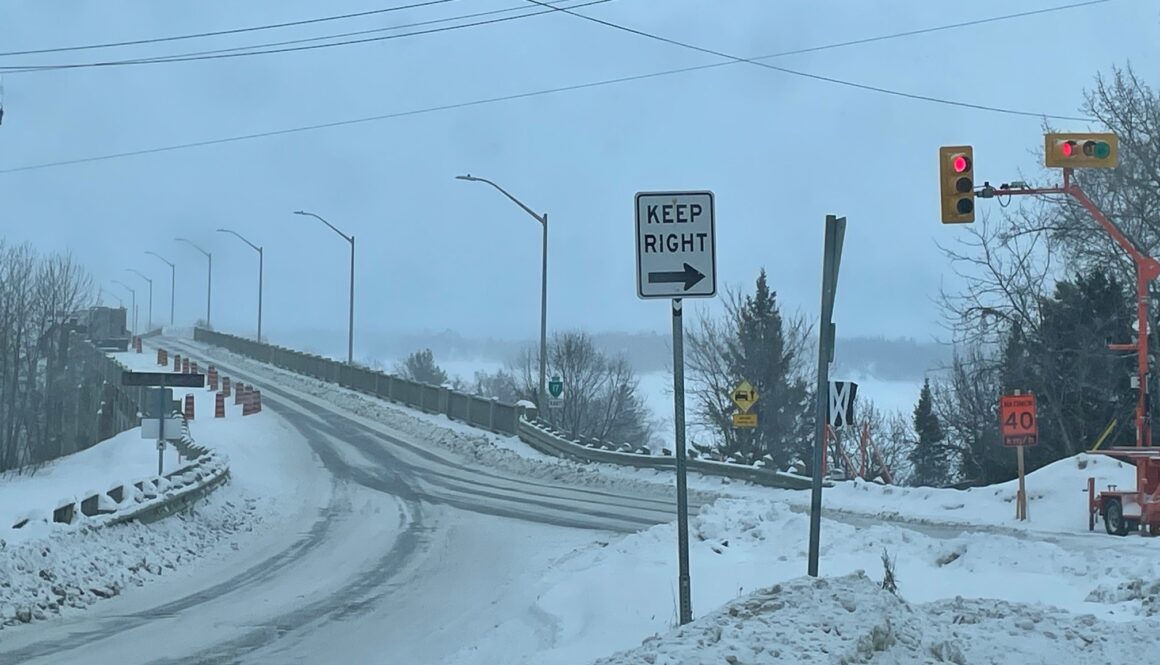
Load restrictions should be coming off the Keewatin Channel Bridge in the next couple of weeks.
Director of Engineering and Infrastructure Greg Breen says work on the bridge is nearing completion.
“They are about 2/3rds through the scaffold removal on Keewatin Channel Bridge,” Breen told Kenora city council at Tuesday’s Committee of the Whole meeting.
“There are still a few repairs that need to be done on the tail ends of either side. We can’t fully remove the weight restrictions on the bridge until every last piece of scaffolding is off that bridge. That’s the code requirement.”
Breen says as soon as the contractor is able, both lanes of the bridge will be open again.
“People will continue to see the (load restriction) signage up but as soon as the contractor is able, they are going to be taking the lane closure that’s there now, and re-opening traffic in both directions. So, could be as early as a couple of weeks from now, or slightly later than that. They are trying to get through it as fast as they can.”
The Keewatin Channel Bridge been down to one lane for most of the winter as crews work to repair and replace steel beams, and re-coat the bridge.
A total of $102,500 has been awarded to organizations in the City of Dryden from the Moffat Family Fund.
Kim Junko is the city’s treasurer and says seven of eight applications were approved.
“Confederation College Dryden for their youth summer camps, Dryden Community Services programming, Dryden Food Bank, Public Library Board, Making Connections for Children and Youth, and the Northwestern Health Unit for two programs equaling $102,500.”
The biggest grant went to the Dryden Food Bank ‘s Milk and Calcium-Rich Food Purchase Program for over $26,000.
Other grants were:
Confederation College Dryden – Youth Summer Camps $4,732 Dryden Community Services – Programming Expansion $12,500 Dryden Public Library Board – Children’s Programming $10,020 Making Connections for Children & Youth – Universal Recreation $20,000 Northwestern Health Unit – Community Pathways Partnership Program $11,000 Northwestern Health Unit – Nutrition on Weekends Program $17,760
Following the conclusion of the Ontario New Democratic Party’s (ONDP) northern Ontario road tour, ONDP MPP’s Sol Mamakwa, John Vanthof, Guy Bourgoin, and Lise Vaugeois were joined on Monday by their leader Marit Stiles to host a town hall at Thunder Bay’s Slovak Legion Hall.
The town hall comes as deaths on northern highways are repeatedly casting safety into the spotlight.
Attendees packed the Legion hall to share stories of lost loved ones, fears of driving on unsafe roads, and frustration at the glacial pace of highway twinning.
Survivors of accidents described lifelong physical and mental trauma, while those forced to say goodbye to friends or family prematurely explained the difficulty of moving on.
Family members of long-haul truckers voiced the terminal anxiety they feel when their spouses, siblings, or parents are on the job.
At one point, ONDP leader Marit Stiles asked the attendees to raise their hands if they had ever experienced a close call on a northern highway.
In response, the packed room erupted with raised hands.
Locals pack the Slovak Legion Hall to voice road safety concerns. (Sam Goldstein/March 9, 2026)
Stiles expressed surprise at the large turnout, but not at the feelings shared.
“I think it’s an indication that people are really desperate to have change and to be safe,” she remarked.
Many solutions were discussed: beyond twinning or building “2+1” highways, locals also called for a deeper licensing process for truckers, with suggestions such as graduated licensing, apprenticeships, or even treating the profession as a skilled trade.
Some called for empathy for new truckers pressured or exploited by a degenerating system, asking for better worker protections; others pointed out that dangerous driving manifests in cars as well as trucks, and argued safer roads — the more systemic approach — could better account for human error.
Stiles had her own suggestion: treat the upgrades to Highway 11/17 as a nation-building project of national importance and urgency, due to the economic impacts of frequent highway closures.
“If [premier Doug Ford] can’t see that it’s bad enough that people are losing their lives and families are torn apart, then maybe he’ll see the logic in the fact that our economy is being ground to a halt multiple times a day with the shutdown of those highways,” she said. “That there’s no way the road through the Ring of Fire is going to be a reality if we have road safety issues like we have right now in Northern Ontario.”
Lise Vaugeois, MPP for Thunder Bay—Superior North, has been an outspoken critic of highway safety in the north. She agrees with those who call for a “system-wide” approach to highway safety.
Beyond simple infrastructure upgrades like more medians, shoulders, and passing lanes, Vaugeois points to a lack of oversight in the trucking industry.
“The Ontario Trucking Association says that 90 per cent of trucking fleets have not been audited. There is no control, there is no supervision happening in the trucking industry,” she explains.
A recurring theme at the town hall was that everyone more or less agrees on what is needed to make highways safer, but that there is a lack of political will to force the issue.
Some of the attendees suggested blocking highways, or threatening strikes.
While ONDP members refrained from outright endorsing civil disobedience, they encouraged disgruntled highway travellers to organize, build movements, and place steady, long-term pressure on provincial leaders to keep their promises.
Stiles promised her party would do the same at the provincial legislature.
“We’re going to keep going back at them with more motions, more bills to continue to raise the pressure on the government,” she assured. “I don’t think they’re going to want to say no this time after so many people are losing their lives. I think it’s going to look very badly for the government, so I hope they will agree.”
A chef at a long-term care facility in Arichat, Cape Breton says the residents are like family, living in such a small community, but the work they do is not understood by the province.
St. Anne Community and Nursing Care Centre is one of 32 homes that have voted to strike across Nova Scotia over the last several months, fighting for better wages.
Mike Sampson tells Acadia News he is part five or six staff members who take great care in what they do, making home cooked meals for the 30 residents who live there.
“You don’t just cook. You’ve got to make sure that everybody has the right textures and the right type of food because a lot these people are compromised,” says Sampson.
“Some have celiac disease. Some have had strokes, so they can’t eat solid foods. There’s a lot to the work that we do.”
At times they will get a chance to chat with the residence, get to know them personally and their preferences.
“Sometimes they’ll tell you, ‘Oh you haven’t made bread pudding in a long time. Could you make some for me?'” explains Sampson.
However, now that staff have voted to strike it may not be long before they walk off the job.
Sampson says it’s not something that they want to do but feel they should be paid fairly.
“I mean, we haven’t had a contract signed in over two years,” says Sampson. “A lot of people in the kitchens and environmental are only making a little over $18 an hour.”
He says there are some who are struggling and just starting families, so it’s not easy for them to make a living.
“We do work that’s important. I mean, we’re feeding some of the most vulnerable people in our communities. They’ve always taken care of us, so it’s our turn to take care of them,” says Sampson.
Negotiations
CUPE Local 5032 have been without a collective agreement since October 2023, according to President Annette Boudreau.
She says as bargaining continues, they will not be accepting anything less than a “decent living wage for all LTC employees”.
“The government offering cents as an increase for the last few years is a slap in the face for the hard-working employees that go above and beyond to secure, dignity, respect and safety for the most vulnerable Nova Scotians that need assistance with their activities of daily living.”
She says she voted for Premier Tim Houston because she thought he was doing a good job with healthcare.
“But he has made it clear that WE don’t have his respect. He once called us health care heroes. Where did that change,” asks Boudreau.
Long term care homes, she says, are not just buildings but homes for parents, grandparents and loved ones.
“The people who care for them every day deserve to be valued, respected, and paid a wage that reflects the important work they do.”
A variety of weather alerts in the province this morning.
To the north, areas including Grand Falls, Edmundston and Bathurst are under winter storm warnings.
Central and western New Brunswick, including Fredericton and Woodstock, are under freezing rain warnings, with the possibility of four to eight hours of freezing rain.
For areas including Moncton and Southeast New Brunswick, Sussex, Kennebecasis Valley, Kings County, St. Stephen and Northern Charlotte County, a special weather statement. Environment Canada is calling for a combination of snow, ice pellets, freezing rain, and rain today and tomorrow. There is the potential for two to four hours of freezing rain.
Environment Canada Meteorologist Jim Prime says there’s always variation with these systems, “Because when we get mixed precipitation, a little bit of a change of temperature at the surface or the upper atmosphere can change the precip for freezing rain to ice pellets or rain or snow, there’s so much variability in it.”
Alerts have been lifted for the Saint John region and areas in the south. They can expect a wet couple of days with rain and just a risk of freezing rain.
“For the most part, the snow is going to be over the north of the province. So we’re looking at 15 to 25 centimetres of snow and ice pellets there. More ice pellets for the central and then for the southern parts, probably just a risk of ice pellets and freezing rain. It’s mostly just going to be a rain event,” Prime added.
If you have plans to travel on Wednesday afternoon or Thursday morning, you’re probably going to face delays on icy, slippery roads. Give yourself some extra time to scrape your windshield or clear the snow and ice from around your vehicle.
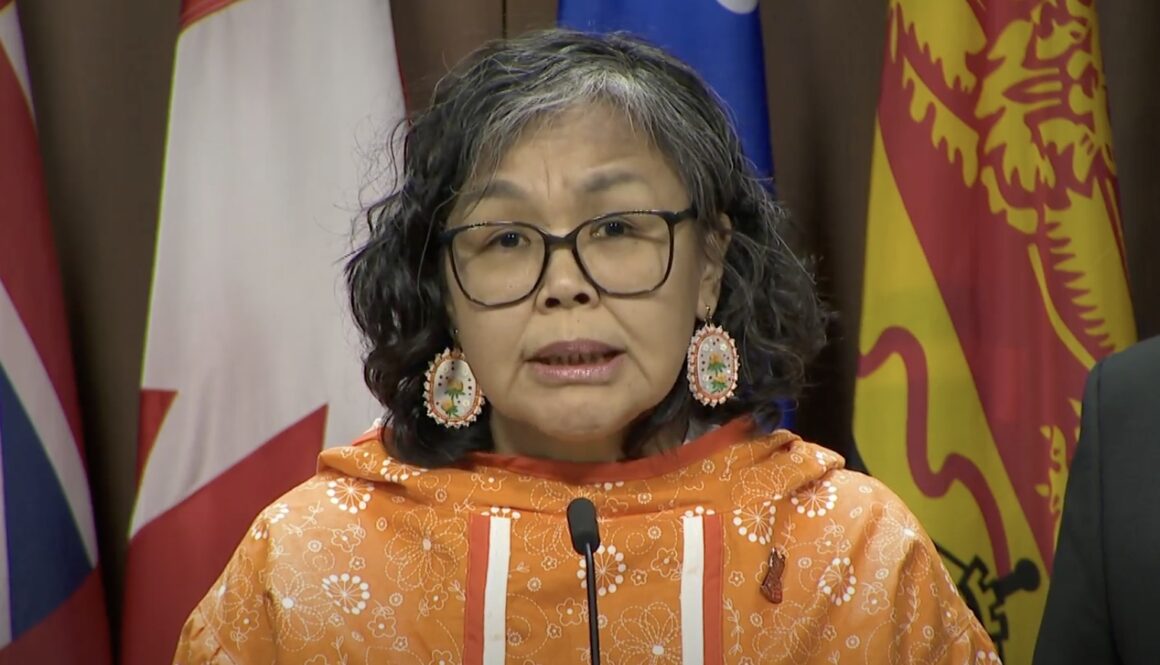
Nunavut MP Lori Idlout has left the New Democratic Party and joined the Liberal caucus, a move that brings Prime Minister Mark Carney’s government closer to a majority in the House of Commons.
Idlout confirmed the decision in a statement released early Wednesday, saying she made the choice after reflection and conversations with people in her community.
She said the challenges facing Nunavut and the North played a major role in the decision.
“With new threats against our sovereignty and pressures on the wellbeing of people throughout the North, we need a strong and ambitious government that makes decisions with Nunavut — not only about Nunavut,” Idlout said.
Idlout said she plans to work with Carney and the Liberal government on priorities for the territory, including the high cost of living, housing shortages, food security and protecting land and waters in the North.
Idlout has represented Nunavut in the House of Commons since 2021.
Her move reduces the NDP’s presence in Parliament to six seats.
The floor crossing also strengthens the Liberals’ position in the minority Parliament. With Idlout joining the caucus, the government is now closer to securing a majority.
The Liberals would still need to win two of three byelections scheduled for April 13 to achieve a narrow majority in the House of Commons.
Idlout is the fourth MP to move from opposition benches to the Liberals since October.
For the first time, the Canadian Basketball Hall of Fame induction ceremony will be held in Atlantic Canada.
More specifically, in partnership with St. Stephen’s World’s Oldest Basketball Court, the ceremony will mark only the second time that the Canadian Basketball Hall of Fame has ever been hosted outside of Ontario. It was previously hosted in Vancouver in 2007.
The ceremony will kick off the World’s Oldest Basketball Court’s Archie weekend, which will run from Aug. 20-22, 2026.
For Tom Liston, Chair of Fundraising for the World’s Oldest Basketball Court, he says the team is thrilled to host the Canadian Basketball Hall of Fame.
“It was natural for us to host it this year. It was actually [the Hall of Fame’s] idea, and I was super happy to hear the news because that amplifies what we’re doing and gives us tremendous validation,” said Liston.
“That the Hall of Fame ceremony would come to St. Stephen, to New Brunswick, because of the world’s oldest basketball court and all the efforts of all of our volunteers, it’s a big nod to all the hard work we’ve done to get to this point.”
Liston learned of the news in early February from Michael Bartlett, Canada Basketball CEO, who, Liston says, heard some very positive things.
“The Canada Basketball board of directors, some of those people have already come to St. Stephen, they were ex-Olympians that played for Team Canada and then went on to the board of directors,” said Liston.
“A lot of people have heard about our golf tournament and what we’re doing with the youth in the community and the impact we’re making, so that started the ball rolling on, ‘hey, why don’t we help amplify what they’re already doing? They already have a very enthusiastic crowd that comes every summer to St. Stephen.'”
Liston says the recognition raises awareness and supports the team at the World’s Oldest Basketball Court in its efforts.
The ceremony will kick off the 5th annual Archie Weekend, a fundraising event that supports the revitalization of the World’s Oldest Basketball Court. The weekend will include a celebrity golf tournament at St. Andrews’ Algonquin Golf Course, an evening of local food and live entertainment, guided tours of the World’s Oldest Basketball Court, a youth clinic, and a 3-on-3 basketball tournament led by former Canadian Basketball national team members and surprise guests.
The weekend is named ‘Archie’ after Lyman Walker Archibald (1868-1947), who brought the game of basketball to the region.
Originally from Truro, Nova Scotia, Archibald was a student of James Naismith, the inventor of basketball. Archibald agreed to attend the International YMCA Training School, now known as Springfield College in Springfield, Massachusetts, where he would meet Naismith and play alongside him on the first basketball team.
When Archibald graduated from Springfield in 1893, he brought the game to St. Stephen, New Brunswick, where he became General Secretary at the St. Stephen YMCA, where the oldest basketball court in the world lay.
Liston says the event has granted them the fortune of having some of Canada’s best basketball players of all time descend on St. Stephen.
“They’re out there teaching our children. We have the winningest coach in Canadian history out there teaching basketball moves and concepts to the youth of not only St. Stephen but from all of New Brunswick. This year it will be even better. You’ll have someone inducted on a Thursday, and then on Saturday, they’re helping coach your kids. What could be better than that?”
To learn more about the World’s Oldest Basketball Court, please visit their website.
The number of complaint calls to the New Brunswick SPCA rose in 2025.
They responded to 4795 complaints in 2025, which is four percent higher than the previous year. That’s the highest volume of calls in the history of the organization.
Executive Director Lesley Rogers says the continued increase is a result of the cost of living, particularly affordable housing and low incomes.
“Particularly with the continued rise in the cost of living, difficulty in a tight housing market for low-income pet families trying to find affordable housing that accepts pets continues to be a challenge,” said Rogers.
She says the aging population of pet owners also contributes to these statistics, as their circumstances can sometimes change without warning. Some of those animals are coming into the SPCA’s system because they need someone able to care for them.
“The public is more aware of animal protection issues and concerns. We applaud them for making calls for us to follow up on to make sure that the animals they have concerns about are safe,” Rogers said.
The number of domestic animals seized from unsafe situations totalled 1,111, roughly 100 fewer seizures than the year prior.
Rogers says the SPCA’s system cannot sustain a never-ending upward trend in complaints and animals being seized. However, she says her team is encouraged to see some positive impact resulting from the first full year of their Happy Tales prevention program.
Happy Tales is a program designed for low-income pet families to access support for events such as emergency veterinary care costs, vaccinations and spay/neuter. The program has been a huge success, according to Rogers.
“We are really keen to keep moving in that direction so that we can slowly bend the curve in terms of the growth in calls down because more people have other paths to get good resources for their pets.”
The program is funded entirely by donations and provided almost 1,300 pets from low-income families with essential care in 2025.
The NBSPCA enforces provincial animal protection laws under the SPCA Act. The organization’s involvement resulted in 23 convictions in 2025.
The number of agricultural animals such as horses, goats, pigs, and cows that were removed from unsafe conditions rose from 28 in 2024 to 50 in 2025, an increase of roughly 78 percent.
222 pet establishment inspections were performed in 2025, which are done to ensure that animal breeders, shelters, kennels, and pet stores that sell animals meet animal welfare standards.
“At any time, we will investigate a complaint against a breeder from the public if they have concerns about the environment the animals are raised in or the treatment of the animals,” said Rogers.
She noted one incident in the spring of 2025, where over 42 shih-tzus were seized from a breeder due to a public complaint, where someone had bought a puppy from the breeder. “Unfortunately, the puppy died within 7 or 8 months. [The complainant] was living in another province, but she was concerned about the well-being of animals at that facility. So, she made the complaint and that led to the charges that were made.”
Rogers says the owners of the operation pleaded guilty and are awaiting sentencing later in March. The owners were operating without a valid pet establishment license and were selling animals without an attached veterinary certificate of health.
“Our job is when we receive a complaint to investigate it and hold people accountable based on what we find. More important, we want to educate the public so that they know the signs to make sure they don’t inadvertently support those kinds of enterprises,” said Rogers.
The provincial government is moving ahead with plans to consolidate conservation authorities.
The existing 36 bodies will be merged into nine regional ones.
Environment, Conservation and Parks Minister Todd McCarthy says it will strengthen the watershed management.
“By consolidating into nine optimized regional conservation authorities, we can reduce administrative duplication while delivering consistent provincial standards, modern tools and strengthened capacity,” says McCarthy.
“It would mean stronger flood resilience, clearer processes for municipalities and permit applicants and better support for housing and infrastructure projects, all while maintaining the science-based decisions that people and businesses expect.”
A lone authority in northwestern Ontario, based in Thunder Bay, remains in place.
The province considered merging it with one in northeastern Ontario.
“We listened after initially proposing seven rather than six, and we’ve arrived at nine and very important changes from what we originally proposed based on those consultations,” says McCarthy.
“For example, Thunder Bay is going to be a standalone conservation authority separate from Lake Huron. We listened, we acted.”
McCarthy says the conservation authorities will continue to be independent, municipally governed organizations.
They will also continue to carry out provincially-mandated programs such as managing flooding and other natural hazards, drinking water source protection and the management of their lands and recreational trails.
A new agency established to oversee the consolidation of conservation authorities will remain.
McCarthy says the Ontario Provincial Conservation Agency will now assist with the transition.
“It would lead consolidation and work to ensure that every conservation authority has the tools and the resources they need to deliver effective watershed management today and into the future,” says McCarthy.
“To support the agency’s work, our province is providing new additional funding of $3 million annually to OPCA beginning this year. During the transition, OPCA would use these funds to help conservation authorities transition to the new model.”
The new authorities to be in place early next year.
Despite the delay of NB Power’s proposed 4.75 per cent rate hike, advocates warn higher power bills will still hit low-income residents hard.
In a ruling Monday, the New Brunswick Energy and Utilities Board rejected NB Power’s request to increase electricity prices, which, if approved, would have taken effect April 1.
Instead, the board decided to delay the rate hike until June or July, stating that an interim rate order is an “extraordinary remedy and is not intended to shield utilities from the known or reasonably foreseeable consequences of their business decisions.”
According to multiple media reports, the delay until July 1 would result in a revenue loss for NB Power — and savings for customers — of about $22.3 million.
However, New Brunswick ACORN chair Nichola Taylor said the organization is not slowing down its efforts to stop the hike altogether.
Taylor said the advocacy group has filed written submissions on behalf of low- to moderate‑income people, as well as those on fixed incomes, urging the EUB to consider how another increase would affect the most vulnerable.
“It’s really difficult for them because they have to make some tough choices,” Taylor said. “They’re making those choices of, ‘Do I put the heat on and stay warm, or do I put food on my table?’”
Taylor said another increase would be “too much” for many families.
Report finds energy costs hitting low‑income households hardest
According to the Human Development Council’s 2025 Energy Poverty Report, New Brunswick has the second-highest rate of energy poverty in the country.
Electricity costs rose 21 per cent between 2021 and 2025, leaving many New Brunswickers unable to afford essential needs — from heating to running medical devices. The report notes that increasing energy bills have pushed households into debt or left them at risk of disconnection.
The report also highlights the disproportionate impact on low‑income households, with more than 68 per cent spending over six per cent of their after-tax income on electricity. HDC executive director Randy Hatfield said households crossing that threshold is considered energy‑poor.
“Increased energy, increased rent, increased food costs are putting tremendous burden on low‑income New Brunswickers,” Hatfield said.
Before another rate hike is introduced, Hatfield said the province and NB Power should develop a more comprehensive energy‑poverty strategy.
He acknowledged existing NB Power programs aimed at reducing energy use and costs, such as the enhanced energy savings program and the winter disconnection moratorium. But he said more is needed, particularly around payment plans and debt management.
“If you are merely postponing payments of the debt, and making prepayment options too onerous, you’re not dealing with [the problem] in the long term,” he said.
Like Hatfield, Taylor believes more needs to be done on debt forgiveness and said ACORN is pushing for stronger measures, including a permanent winter moratorium.
Acadia Broadcasting reached out to NB Power, which declined an interview.
In an emailed statement Friday, spokesperson Elizabeth Fraser said the utility recognizes that affordability is a “real” concern for many customers.
Fraser said NB Power is offering programs to help New Brunswickers manage their energy use and reduce costs by improving home and business energy efficiency, including through its enhanced energy savings program.
The utility has also launched initiatives such as the Vulnerable Populations Committee to explore additional ways to support people struggling with affordability.