Teachers, parents say education cuts risk leaving thousands of vulnerable students without needed support
Education workers and librarians across Nova Scotia say more than 20,000 students are reading below grade level, raising concerns as the provincial government moves to cut support staff, according to NDP education critic Paul Wozney.
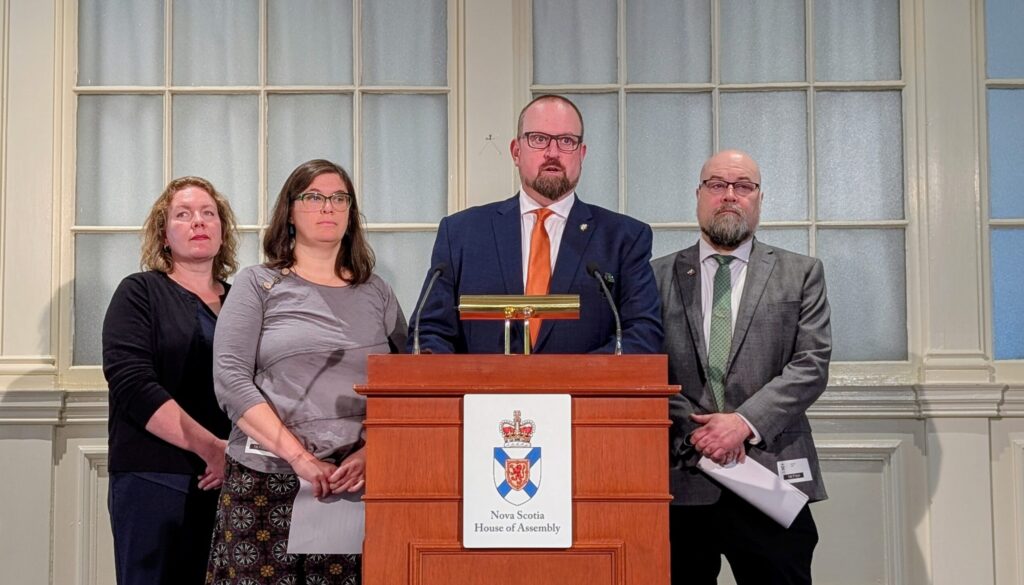
At a press conference in Halifax on Tuesday, Wozney was joined by Nova Scotia Teachers Union President Peter Day, who noted more than 80 positions are set to be eliminated by September.
This comes just over a month after Education Minister Brendan Maguire announced plans to eliminate 150 positions, about 47 of which have been vacant for years.
Day said he’s particularly concerned about the loss of specialized roles, including math and literacy coaches, mentors, and intervention teachers—positions that support classroom educators and work directly with students who have complex academic, behavioural, and emotional needs.
“Removing these positions creates a significant gap in our public education system and will have real consequences for students and classrooms.”
‘Failing to provide evidence-based reading instruction is considered discrimination’
Wozney said provincial data shows fewer than half of Grade 3 students meet writing standards, half of Grade 6 students fall short, and one in three Grade 8 students struggles to read at grade level — each statistic representing a student being left behind.
Louise Hanavan, a parent and co-founder of Literacy Justice Nova Scotia, said she is speaking for families who need a voice, calling on the government to give every child a fair chance to succeed.
Hanavan said the data means one in three Nova Scotia children enters high school unable to read well enough to learn, adding that “the Supreme Court of Canada has affirmed that learning to read is a basic human right and the responsibility of public-school systems across this country.”
She and other members of Literacy Justice Nova Scotia have begun the process of filing a complaint with the Human Rights Commission, noting Ontario, Manitoba, and Saskatchewan have all found that failing to provide evidence-based reading instruction is considered discrimination.
They are also calling on the Houston government to fund and implement a remedial literacy plan for older students by September.
‘Once experienced teachers leave Nova Scotia, it can be incredibly difficult to bring them back’
Wozney raised concerns about the ongoing teacher shortage, saying cutting staff will further strain the system.
“That will inevitably have a negative impact on the learning conditions and school safety. The government may believe it is saving money through these cuts, but the reality is that the students and families will pay the price.”
Day added, “If the government has decided that Nova Scotia needs fewer teachers, there is a very real possibility that other provinces and territories will move quickly to recruit these highly skilled professionals.
“Other provinces are actively investing in public education and working to attract educators. Once experienced teachers leave Nova Scotia, it can be incredibly difficult to bring them back.”
‘Come this time next year, I believe you’re going to see a very real profound negative effect on student achievement’
Wozney also addressed the planned shut down of five community library branches scheduled to close on July 20 due to a lack of funding, including buildings in Hantsport, Kentville, Lawrencetown, Middleton, and Port Williams.
“These communities are going to feel this impact for a generation. The cost of keeping them open is substantially less than the cost of rebooting and relaunching down the road,” he stated.
Hanavan added that, “public libraries exist in our communities as an equalizing force and a space where everyone has access to books but also to programs and other kinds of materials that can be accessed regardless of your ability.”
She emphasized that accessible learning options like these are essential for people with impairments, highlighting that if you or someone you know is struggling, “there’s something there at the library for you, and it’s free.”
Day said schools are already struggling to meet students’ needs, and removing supports at such a critical time only makes that harder.