New Brunswick advanced-care paramedics will soon be equipped with medication that can stop heart attacks, or at least reduce the damage.
Last week, the government announced it is investing $2.5 million to equip ambulances in New Brunswick with pre-hospital thrombolytics, also known as “clot busters.” These medications break down blood clots and restore blood flow to the heart, stopping or reducing the damage caused by certain types of heart attacks.
According to a press release, providing early access to these medications can help reduce mortality, limit complications and improve overall patient outcomes for people experiencing cardiac emergencies.
“By equipping advanced-care paramedics with thrombolytics, we are enabling treatment to begin sooner, when it can have the greatest impact on saving lives and reducing long-term damage,” Health Minister John Dornan said in the release.
The funding will support the initial purchase and ongoing replenishment of the medication for the current fiscal year. It also covers any technological upgrades needed to support safe and effective use in the field.
Ambulance New Brunswick will begin using thrombolytics this summer.
The initiative will also expand the skill set of Ambulance New Brunswick’s advanced-care paramedics to meet the scope of practice for administering the medication, which paramedics in provinces such as British Columbia, Saskatchewan, Manitoba, Ontario and Nova Scotia already do.
Craig Dalton, CEO of Extra-Mural/Ambulance New Brunswick, said in the release the province’s investment represents an important advancement in patient care and support for the paramedics who deliver it.
“Our advanced-care paramedics are highly skilled clinicians, and this initiative recognizes both the depth of their expertise and the critical role they play in delivering advanced care to New Brunswickers,” he added.
A couple of medics are little shook up and shocked after their ambulance fell of a wharf in the Annapolis Valley, Monday afternoon.
That’s according to the Annapolis Valley Fire Chief says who says it’s something he hasn’t seen in his 32 years with the service.
“We received the call of an MVC at the Annapolis Wharf and when we got on scene, we found an ambulance had actually backed over the edge of the wharf by accident and was in the vertical position,” says Andrew Cranton.
He says it was shocking.
“It’s the first time I’ve ever experienced anything like that off the Annapolis Wharf, let alone an ambulance,” says Cranton.
He says the two medics inside had to be removed but are ok.
Cranton added that the vehicle was removed by two heavy tow units and has “significant damage”.
Town police are doing an investigation to find out what happened.
Another step toward Koochiching County residents paying for ambulance services.
The County’s Board of Commissioners has given its blessing to a support and service district that allows the County to contract out for ambulance services and charge residents a fee.
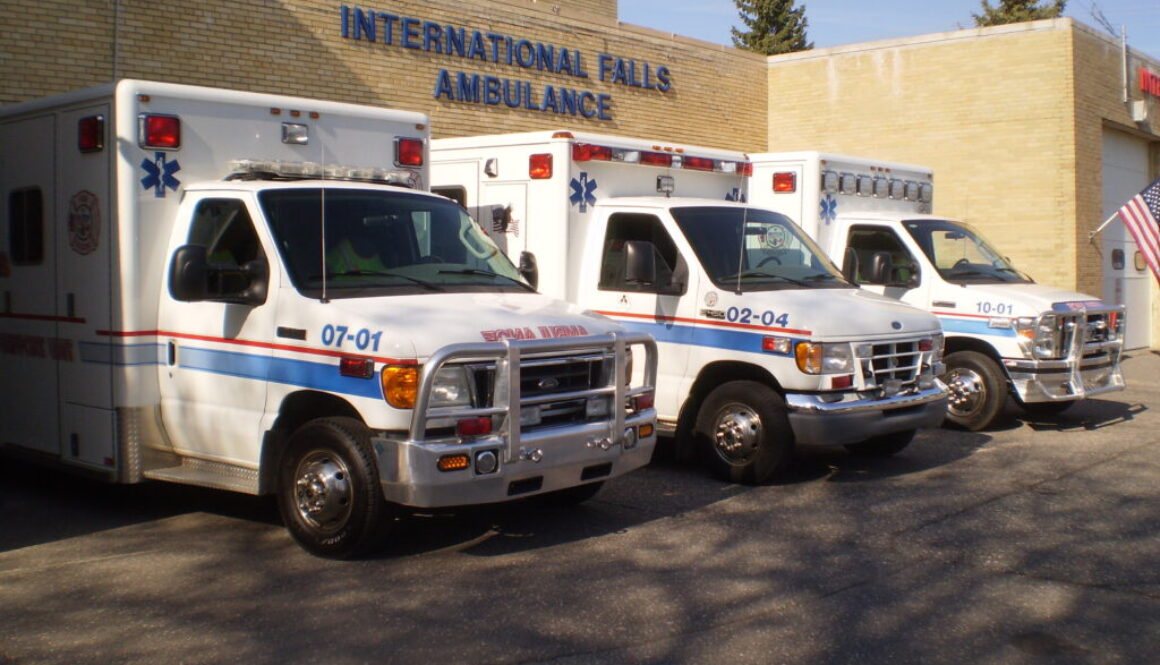
It is seen as a move to help the International Falls Ambulance Service recover from deficits caused by low insurance reimbursements.
County Administrator Adam Coe says with the Commissioners’ approval, they can take the next steps.
“Once…a district’s created, then we would need to move forward to contract for ambulance services and also decide on how we would collect that money,” says Coe.
That could be a service charge or an amount based on property valuation.
The County is also establishing a committee to oversee the negotiations for ambulance services.
Coe says final approval would still come from the full board.
“The terms would come back to the full board for consideration, just like any other negotiation for a contract to consider for approval.”
Minnesota State Statute requires a 30-day waiting period before the County can proceed.
Support for ambulance services, but some Koochiching County residents question the need for a subordinate service district to help fund the International Falls Ambulance Service.
Under the proposal, the County would contract ambulance services from the city, and impose a fee or charge to cover the cost.
The Board of Commissioners is exploring different options.
A public meeting was held on Tuesday evening to discuss the idea.
The city’s ambulance services had been debt-ridden for several years.
City officials cite insurance subsidies, which they say do not reflect the true cost of providing the services.
Former City Councillor Gail Rogenrud applauds the County’s efforts.
She says the city has long tried to resolve the funding crisis without success.
“We weren’t allowed to raise our rates beyond a certain percentage each year, which we tried to do,” says Rogenrud.
“We saw that we were going downhill, and we didn’t know what to do. Our plea to the council way back then was, well, be fair, why shouldn’t everyone who expects that ambulance to show up at their house when they have their heart attack, or they have some kind of an accident? Why shouldn’t everyone who wants that ambulance to come to their house help pay for it? “
International Falls City Councillor Pete Kalar speaks to Koochiching County’s Board of Commissioners during a public meeting on the County’s proposal to establish a subordinate service district for land ambulance services, February 24, 2026. Webcast screen shot
City of Rainer Mayor Dennis Wagner favours a sales tax to generate revenue, instead of imposing a flat fee or a charge based on property assessment.
“I . . . have no problem paying, but I’m here representing the property owners of Rainer, and they will pay their share,” says Wagner.
” I have no problem with that. I always pay my share, but how is everybody going to pay their share equally here?”
County officials admit that it is one of the issues yet to be determined.
Some residents are not in support of the district.
Bob feels the city should reconsider its ambulance service as an advanced life support one.
“Maybe we need to go back to basic ambulance service like Littlefork has, or Kabetogama has an ambulance, and things like that, without all the bells and whistles,” says Wall.
Others say ALS service is needed because the region’s limited emergency services, and that paramedics can perform medical services that emergency medical technicians (EMTs) can not.
County commissioners are expected to make a final decision on the proposal in the coming weeks.
Discussions continue around the future of the International Falls ambulance services.
The service is facing mounting debt.
Efforts continue to find alternative funding sources.
The city advocates for a special tax levy to help the service recover.
Mayor Drake Dill says help is needed to continue Advanced Life Support, or ALS service.
“I’ll be very clear about it. If we do not get a joint powers taxing district for the 989 square mile area, my vote is to end ALS,” says Dill
Koochiching County is proposing a special levy with the money directed toward equipment, such as new ambulances.
Dill says he is not sure if he supports that idea.
“The clock is ticking on this, says Dill.
“Regardless of the outcome, they’ve (the County) been to Rainier. There are discussions happening behind the scenes, but at the end of the day, we know where the service is at. It’s a good service. There’s support for the service when we have to get everyone on board.”
Dill says he would like to convene a roundtable discussion in the near future with all parties interested in creating a taxing district or supporting this service.
The Rainy River District Paramedic Services is sporting some new wheels.
Two new ambulances are now in service.
They replace ones that were aging and come with the latest in safety and medical technology.
The District of Rainy River Services Board states that having modern ambulances on the road results in fewer repairs, less downtime, and better utilization of healthcare dollars.
Two command vehicles are also in service.
They allow supervisors to attend a scene and provide paramedics with additional support if required.
The Services’ Community Paramedicine program also has its own vehicle, freeing up the need for an ambulance.
This program offers non-emergency care to residents with chronic conditions who remain at home.
The vehicle is also fully equipped and can provide additional support to frontline crews or be an immediate response to an emergency until an ambulance arrives.