Ford government says still on track to balance the budget by 2028
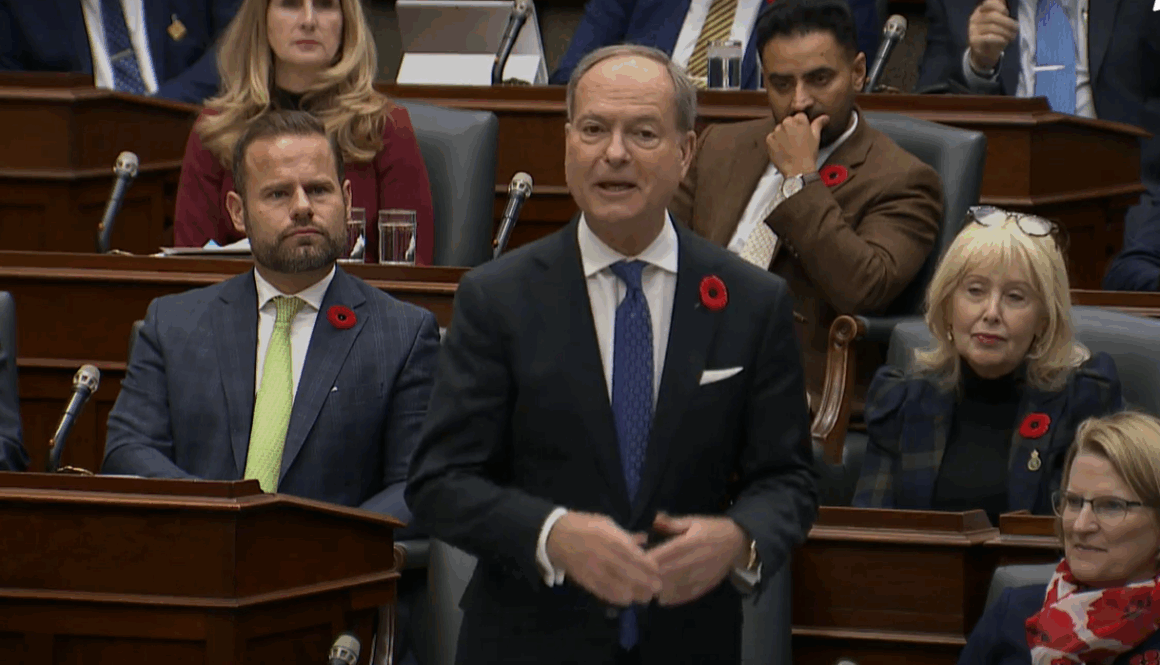
The province’s Finance Minister is calling it a Plan to Protect Ontario.
Peter Bethlenfalvy released an economic statement that includes measures designed to combat the impact of U.S. trade tariffs.
It includes the development of a Tax Action Plan that updates provincial personal and corporate income taxes to encourage more business investment.
An extra $100 million is being put into the Ontario Together Trade Fund (OTTF), designed to help small and medium-sized enterprises diversify into new markets.
There is also additional help for Ontario manufacturers and processors, with the Ford government proposing to enhance the tax credit rate from 10% to 15% and expand eligibility to the credit as a non-refundable version to corporations that are not Canadian-controlled private corporations (CCPCs).
The province is also preparing to release additional funding through the $5 billion Protect Ontario Financing Program (POFP).
One billion dollars went this year to businesses directly impacted by higher tariff rates placed on steel, aluminum, and copper and the auto sector.
Bethlenflavy notes that nearly $30 billion in relief and support have already been issued.
“In this year alone, our government is enabling $11.5 billion in financial relief for people and families and $11.7 billion in cost savings for businesses, including $5.6 billion of which would go directly to helping small businesses,” says Bethlenfalvy.
“And we’re going to keep going, keep finding more ways to lower taxes and fees and drive our economy.”
Statistics Canada says more than 700,000 people in Ontario are unemployed.
The economic statement projects the province will see 70,000 new jobs by the end of the year, but offers little in new initiatives to help those looking for work.
Bethlenfalvy says that is because the province reacted quickly to address the job loss.
“$30 billion of tariff supports, $9 billion in deferrals, $2 billion of WSIB rebates that are flowing to businesses so they can stay open. They can meet payroll and compete,” says Bethlenfalvy.
Bethlenfalvy says their approach will still help the province bring forward a balanced budget by 2028.
“We can maintain our commitment to balance, but at the same time, our commitment to grow the economy, to invest in infrastructure, to invest in workers, and continue to provide world-class services and invest in social infrastructure.”
A deficit of $13.5 billion for the 25-26 fiscal year is predicted, an improvement of $1.1 billion from the outlook published in the 2025 budget.
The government expects the deficit to be cut in half the following year before enjoying a slight surplus in 2027-28.