The Office of the Chief Medical Officer of Health issued an advisory today, warning of a possible exposure to a confirmed case of Hepatitis A.
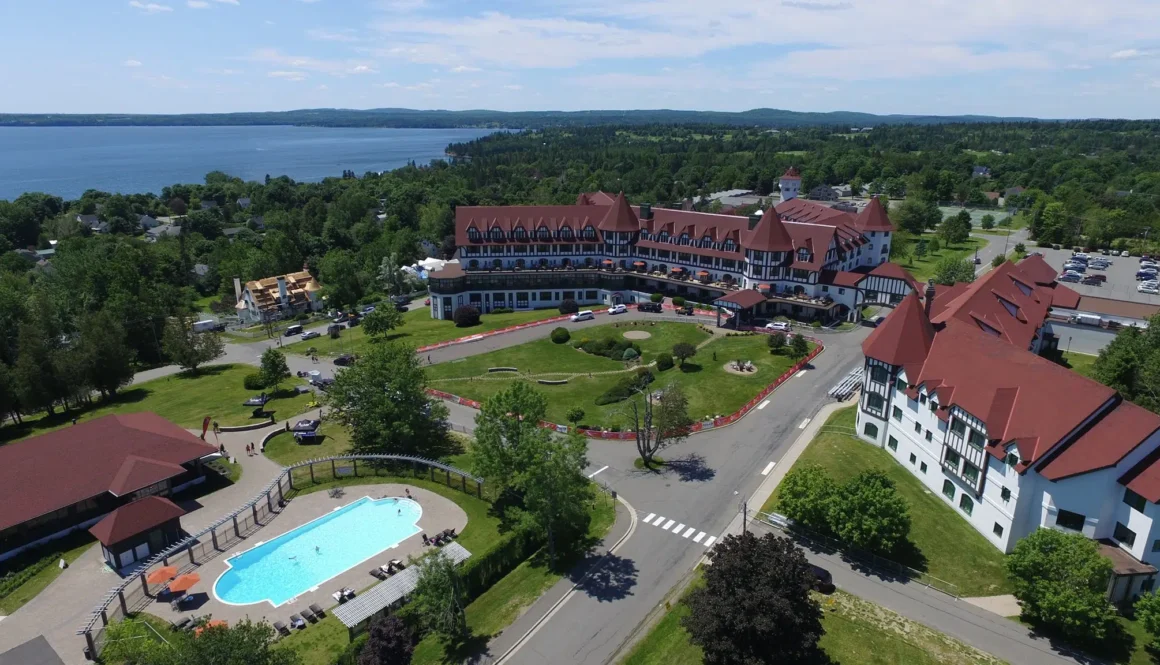
A social media post from the provincial government said the exposure happened at The Algonquin Resort on Jan. 21, 22, 24 and 25.
According to the information provided, anyone who ate at Braxton’s Restaurant and bar or Right Whale Pub on those dates should contact their local public health office to assess your risk of exposure and the need for a vaccine to prevent infection.
Exposed individuals who have not received a Hepatitis A vaccine should get one as soon as possible to help prevent the disease.
Individuals who have received two doses of the Hepatitis A vaccine or have previously been infected have immunity and don’t require further vaccine.
Symptoms typically appear 15 to 50 days after exposure and may include:
Fever
Loss of appetite
Nausea
Abdominal pain
Dark urine or clay-coloured stools
Diarrhea
Feeling unwell
Yellowing of the skin or eyes (jaundice)
People who are older, have weakened immune systems or have chronic liver disease are at higher risk of severe illness.
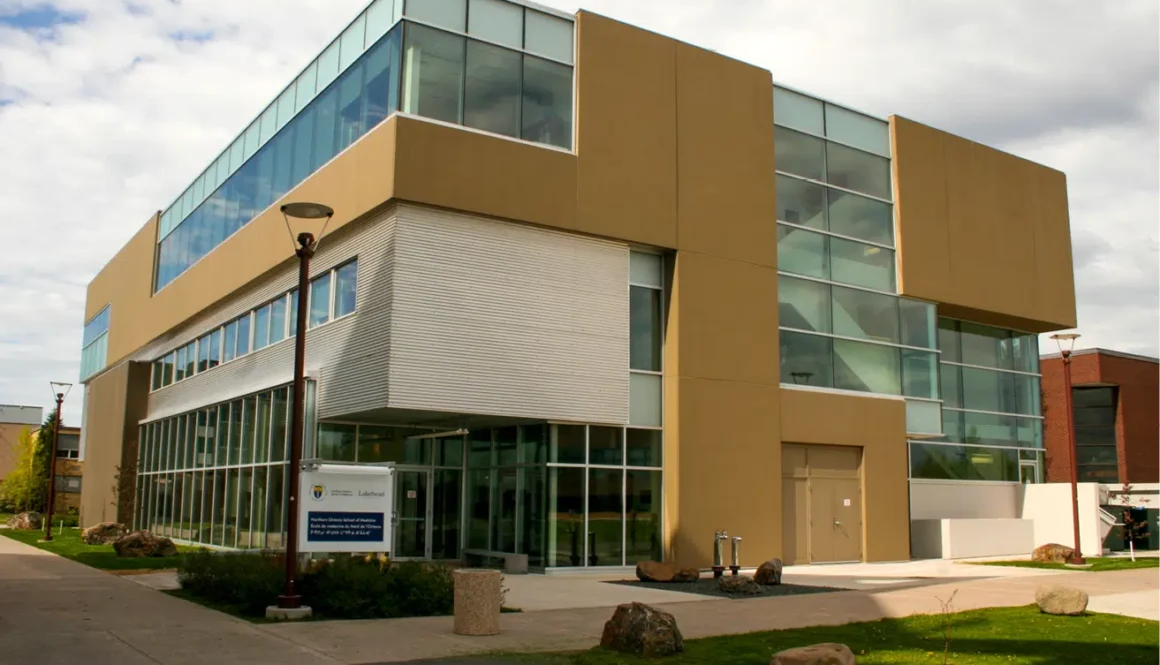
A group of anonymous donors has gifted $5 million to the Northern Ontario School of Medicine (NOSM) University to create a Circle for Indigenous Health Research and Innovation.
The Circle is meant to support Indigenous-led work in medicine to respond to “longstanding calls for indigenous leadership in health research, policy, and medical education,” according to a release published by NOSM.
NOSM frames the Circle as a way to foment collaboration in research to improve Indigenous health equity.
The Circle plans to host an Indigenous Health Gathering this year to bring together Indigenous leaders, Elders, health-care providers, researchers, and students for knowledge-sharing and establishing priorities.
The Transportation Safety Board (TSB) is pointing to increased stress on the rails from heavy train traffic as a contributing cause to a derailment west of Fort Frances.
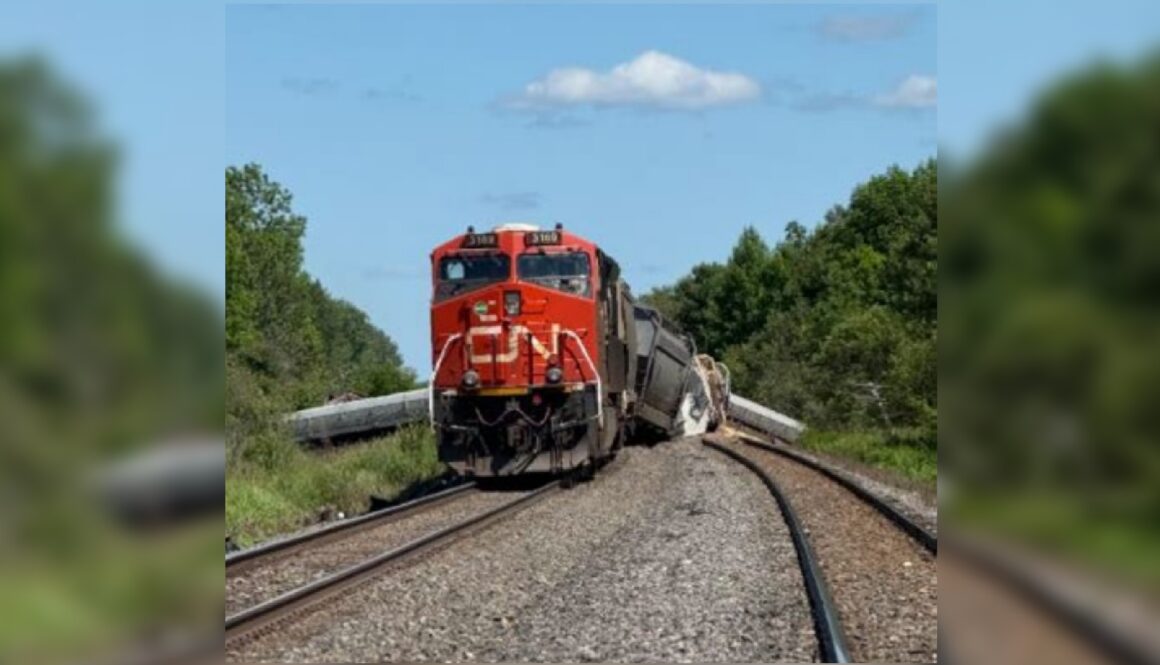
Thirteen cars carrying canola seed from a 134-car CN freight train left the track near Devlin on June 28th.
In its review, the Safety Board states that it identified signs of rail creep, described as a sign of stress in the rails that can lead to them becoming out of alignment and buckling.
“Unless the underlying compressive stress is addressed, rail creep grows increasingly more pronounced over time,” the report states.
“Rail creep is more detrimental when it is unidirectional, which occurs when there is a significant imbalance in the traffic tonnage in one direction as opposed to the other, as in the case of the Fort Frances Subdivision.
The TSB believes the track had been under stress for some time.
It also noted a similar incident related to track buckling three weeks earlier elsewhere that resulted in the derailment of eleven rail cars.
The report states that CN was in the process of making repairs earlier that month, but stopped short of the accident area to focus on repairs elsewhere.
“This left the section of track from Mile 100.42 to the crossing at Mile 101.46 (the next fixed location), including the point of derailment at Mile 101.1, particularly vulnerable to track buckling; however, the area in the vicinity of the derailment was not protected by a slow order,” the report states.
An inspection of the tracks using a hi-rail vehicle took place two days before the accident, but no defects were noted.
While acknowledging that track inspections were performed regularly by CN, and the frequency met or exceeded the minimum requirements, the TSB wrote Transport Canada to suggest that a review of CN maintenance and inspection practices along the Fort Frances Subdivision take place.
Transport Canada has responded by saying it would conduct a track inspection this year.
As Congress debates the tactics of Immigration and Customs Enforcement, data is emerging on how Minnesotans are expressing their frustrations, including a recent day of action that garnered national attention.
A new poll from May Day Strong – a coalition of labour unions – reveals that nearly a quarter of those surveyed said they or a loved one took part in a statewide strike on January 23rd.
On that day, residents were urged to refrain from work, school and shopping.
An estimated 50,000 people also marched through downtown Minneapolis in sub-zero temperatures.
There have also been tributes to Renee Good and Alex Pretti after they were fatally shot by federal agents.
Bruce Blase of Blaine took part in a bike ride for Pretti, and noticed a lot of people cheering from the sidelines.
“And along the route, there were lots of residents along the route that were urging us on. They were behind our movement,” says Blase.
Participants say the demonstrations in Minnesota and around the country illustrate that many Americans feel the Trump administration is going too far with its deportation strategy.
After voting to end a partial government shutdown, Congress faces a short negotiating window to secure reforms to the Department of Homeland Security.
A stopgap measure extends funding for DHS until February 13th.
Democrats want to end practices such as “roving patrols” while Republicans renew calls to target sanctuary cities.
Residents speaking up about ICE’s presence in Minnesota have consistently noted that people documenting arrests are not violent protesters, but instead neighbours caring for neighbours.
They say the marches and rallies are an extension of the resistance.
Blase walks around in a safety vest with the words “peaceful observer” stretched across the back.
He says he feels that ancestors who served in the military and defended the United States and its allies would have done the same.
“My dad and all of his fellow combat veterans of World War II are spinning in their graves right now if they knew what was going on in this nation,” says Blase.
The May Day Strong survey was conducted over a three-day period immediately after the January 23rd day of action, with responses from nearly 2,000 likely voters in Minnesota.
Nearly half of the respondents felt the event was an effective way for people to exercise their rights and show opposition.
By Matt Prokopchuk, Local Journalism Initiative Reporter
Source: TBnewswatch.com
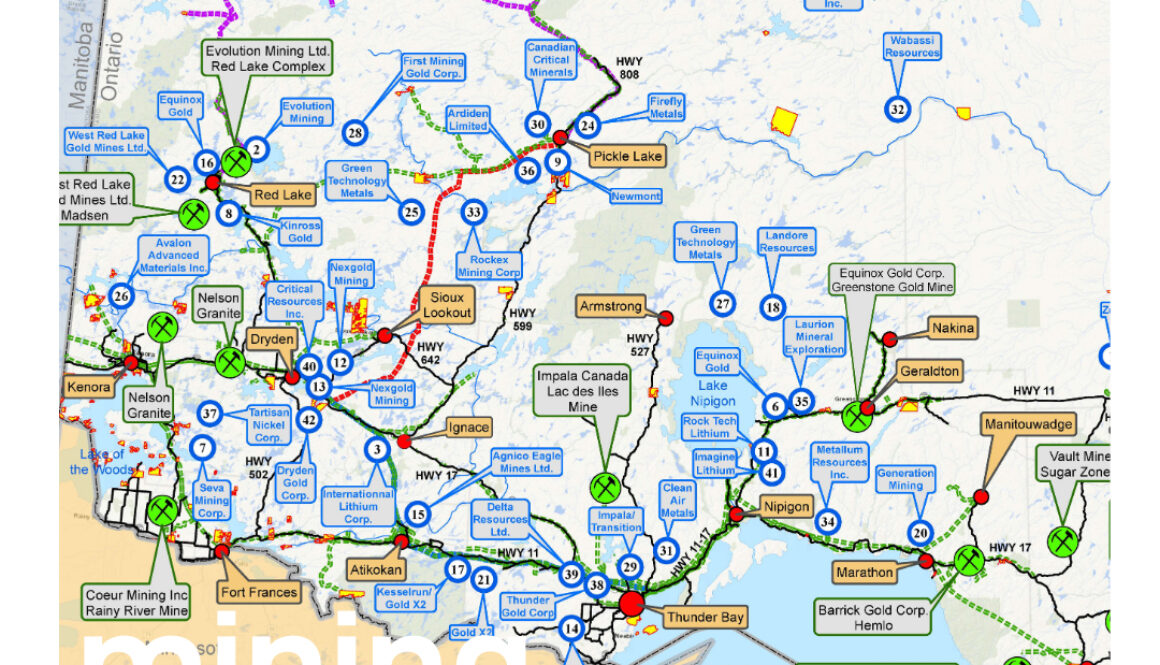
There are over 40 “major exploration projects” listed on a mining map updated yearly by local economic development officials.
And one in particular, over 500 kilometres northwest of Thunder Bay, is capturing people’s attention, said Thunder Bay Community Economic Development Commission CEO Jamie Taylor.
“We’re really tracking Kinross, the Great Bear (gold) project, just outside of Red Lake,” she said. “That’s what we feel is probably the next big one.”
“As you know, gold is high, right? So, I don’t think they can develop that mine fast enough right now.”
On its website, the company says land preparation activities for construction “are well advanced,” and selected equipment was being installed as of the third quarter of 2025. It also expects the manufacturing of certain equipment that requires long lead-in times to start in 2026.
A 2024 preliminary economic assessment called for a combined open pit and underground operation with an initial planned lifespan of roughly 12 years. It’s expected to produce over 500,000 ounces per year.
The map covers territory from the Manitoba boundary in the west, to just north of Kitchenuhmaykoosib Inninuwug, Bearskin Lake and Sachigo Lake, east to Hearst and as far south as Wawa and the Canada-U.S. border. It currently shows 43 advanced exploration projects throughout the region, as defined by the Ontario Ministry of Energy and Mines, Taylor said, as well as 13 producing mines.
The CEDC’s map dates back over five years, Taylor said, from when John Mason was the organization’s project manager of mining services, and came out of a study about how the commission should better position itself.
“It’s been a great tool for us,” she said. “All the companies, especially when we’re looking at mining supply and service, it’s an attraction tool for us when we do shows like (the Prospectors and Developers Association of Canada).”
“That’s the backdrop for our booth, and it really brings everybody into it because they’re interested,” Taylor continued. “When you look at it, there’s so much activity on there.”
“So, it really paints the picture of what’s going on in the Northwest region and why supply and service should be located in Thunder Bay to be able to service all of that activity.”
Supply and service companies are those who provide equipment and other operational support for mining. Pushing Thunder Bay as a hub for these companies to set up is high on the CEDC’s priority list, Taylor said.
“We want those companies to be located in Thunder Bay,” she said. “There’s a lot of opportunity for companies to be closer in proximity, and that saves companies time and money.”
“That really is our value proposition, and those companies contribute to our tax base, and they employ people within our community.”
The family-friendly walk is in support of Grace Ministries, a non-profit that offers shelter, meals and spiritual guidance for people experiencing homelessness in Thunder Bay.
As of Wednesday, CNOY is nearly halfway towards their fundraising goal of $100,000. Top fundraisers can earn prizes like hoodies and toques.
Participants in the walk can choose between a two kilometre and five kilometre route. If you are interested in volunteering at the event, register here.
The event is scheduled for February 28. The walk will begin at the Summit Church.
Throughout February, proceeds from every special Blue Persian sold at The Persian Man will also go towards Grace Ministries.
As Canadians discuss whether the new Canada Groceries and Essentials Benefit is sufficient, a newly announced government strategy is flying under the radar.
The federal government is planning a new National Food Security Strategy, announced alongside the upped GST rebate, to increase and improve domestic food production.
Amidst a debate over rising food costs, Minister for Jobs and Families Patty Hajdu credits climate change as an overlooked cause of food inflation.
“The drought out west meant that farmers had to reduce the size of their herds. Coffee is produced in regions that are under extreme drought. An avian flu has meant that many herds have had to be culled,” she says.
But Hajdu also acknowledges that declining competition and increased consolidation of Canada’s grocery industry are complicating the fight for cheaper food, and making it more difficult for farmers to find buyers for their products.
She says the strategy will include “measures to implement things like unit price labelling, and support the work of the Competition Bureau to monitor and enforce competition in the market.”
Hajdu also frames the food security strategy as a move to protect Canadian sovereignty: “How can we do a better job making sure that we can grow the food that we need here in Canada, and that we actually sell around the world to feed hungry populations in all sorts of countries?”
Alongside the new strategy is greater relief for Canadian food banks with a $20 million Local Food Infrastructure Fund.
“Food banks have been saying they need a better infrastructure nationally,” Hajdu explains.
But a national strategy for food security could take years to fully implement, and a growing number of Canadians need relief for rising food costs in the meantime — hence the GST rebates.
“It’s not meant to pay for a person’s entire year’s worth of groceries. What it’s meant to do is address the inflation that people are experiencing in the price of the food,” Hajdu offers.
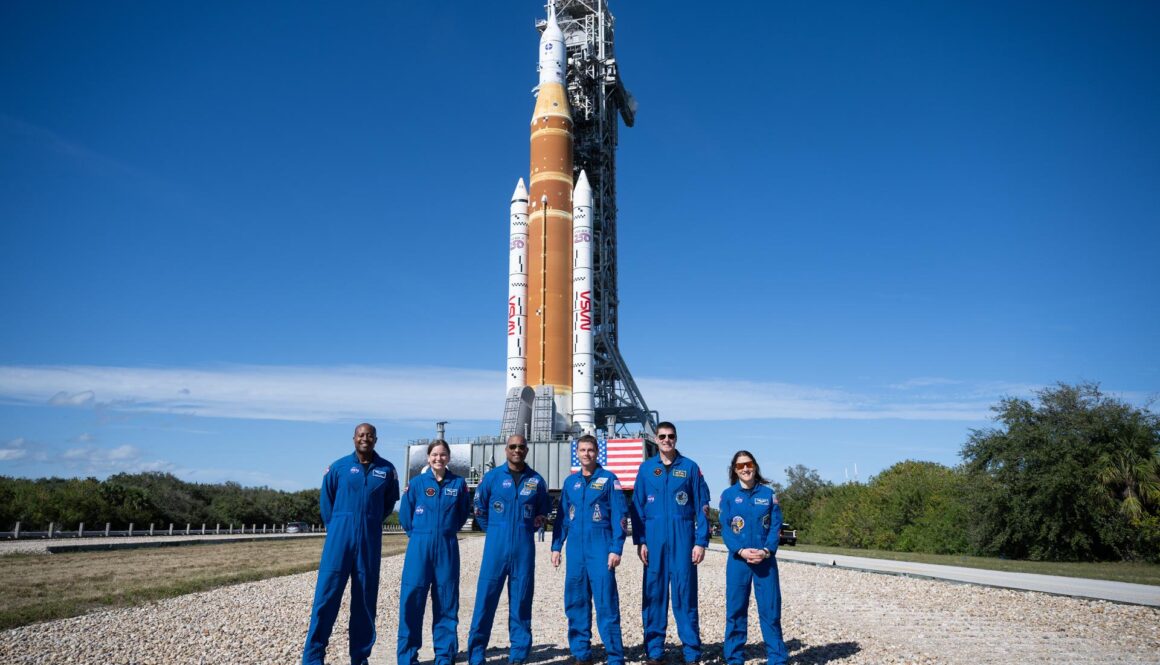
The Artemis II mission, which will launch three Americans and one Canadian around the moon on a ten-day voyage, has been delayed until early March due to a liquid Hydrogen fuel leak.
The mission was slated for February 8, but has now been pushed to the next launch window of March 6 to 11.
The leak was discovered during a “wet dress rehearsal,” when NASA takes the rocket through every stage of the launch process, including fueling and loading the crew, only stopping in the last few minutes before the rocket would liftoff during the real deal.
Canadian Space Agency (CSA) Director of Space Exploration Development Jamie Sevigny says the rehearsal did its job.
“The point of those wet dress rehearsals is really to test everything and to make sure everything is going as planned, and thanks to that, they were able to find some little issues.”
Sevigny says the delay will “give the engineers time to take a look at the data, assess it, analyze it, so that we can have another stab before the second launch opportunity.”
A Canadian space milestone
The Artemis II mission marks the first time since 1972’s Apollo 17, the last moon mission, that a human will venture beyond “Low Earth Orbit,” and fly around the moon.
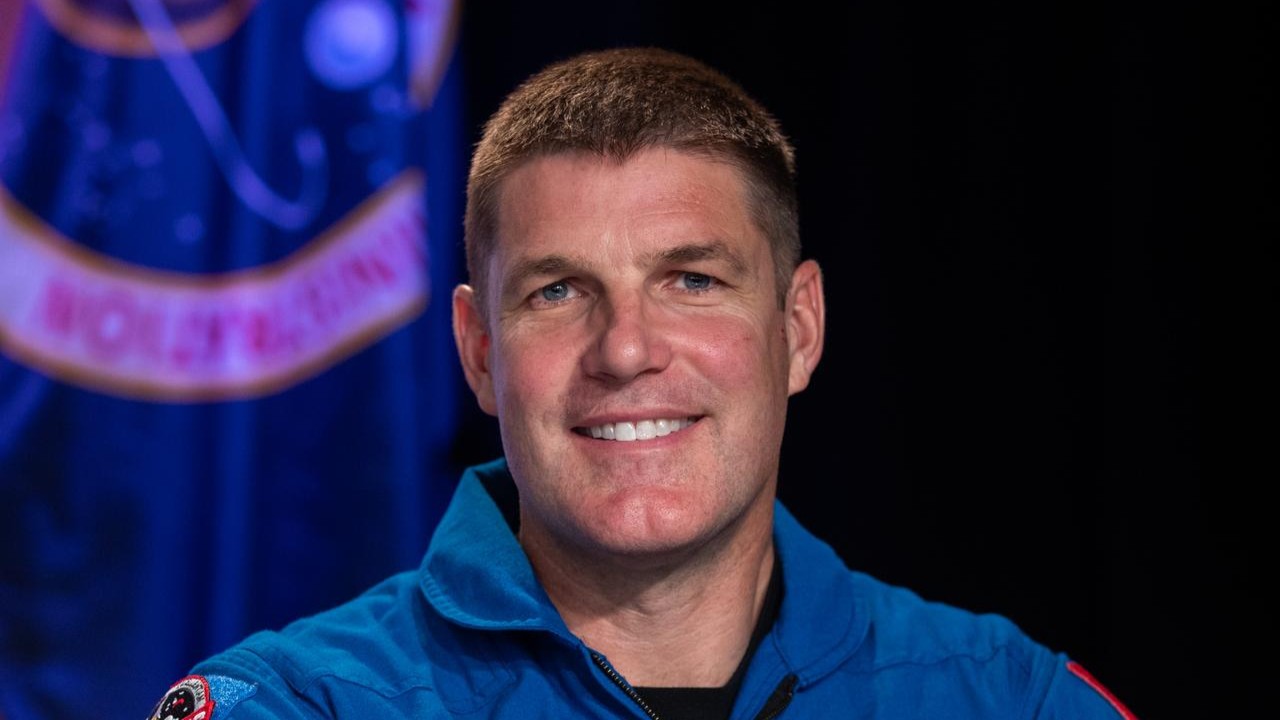
CSA astronaut Jeremy Hansen is the prime Canadian crew member on the mission, which will make him the first Canadian to voyage to the moon.
“He’s also going to make Canada the second country to send a human around the moon,” says Sevigny, “So this is pretty big.”
CSA (Canadian Space Agency) astronaut Jeremy Hansen, Artemis II mission specialist, participates in a NASA news conference on Aug. 8, 2023, at the agency’s Kennedy Space Center in Florida. (Cropped, via NASA/Kim Shiflett)
Sevigny says the long-running partnership between the CSA and NASA got a Canadian onto the mission.
But she says the most important part was “our contribution of the Canadarm 3, which is a next-generation advanced autonomous robotic system.”
Canada contributed the first-generation Canadarm robotic arm to the Space Shuttle in its heyday, and the second-generation arm to the International Space Station.
The new model robotic arm will eventually be used in the Lunar Gateway, a planned space station orbiting the moon to be built by a large coalition of countries, and meant to support future manned moon missions.
Returning to the moon
The Artemis II is meant to be the first in a series of lunar missions, all building towards a prolonged human presence beyond Low Earth Orbit and eventually towards other planets.
The next flight will be the first time the SLS (Space Launch System) rocket and the Orion crew capsule fly with a human crew.
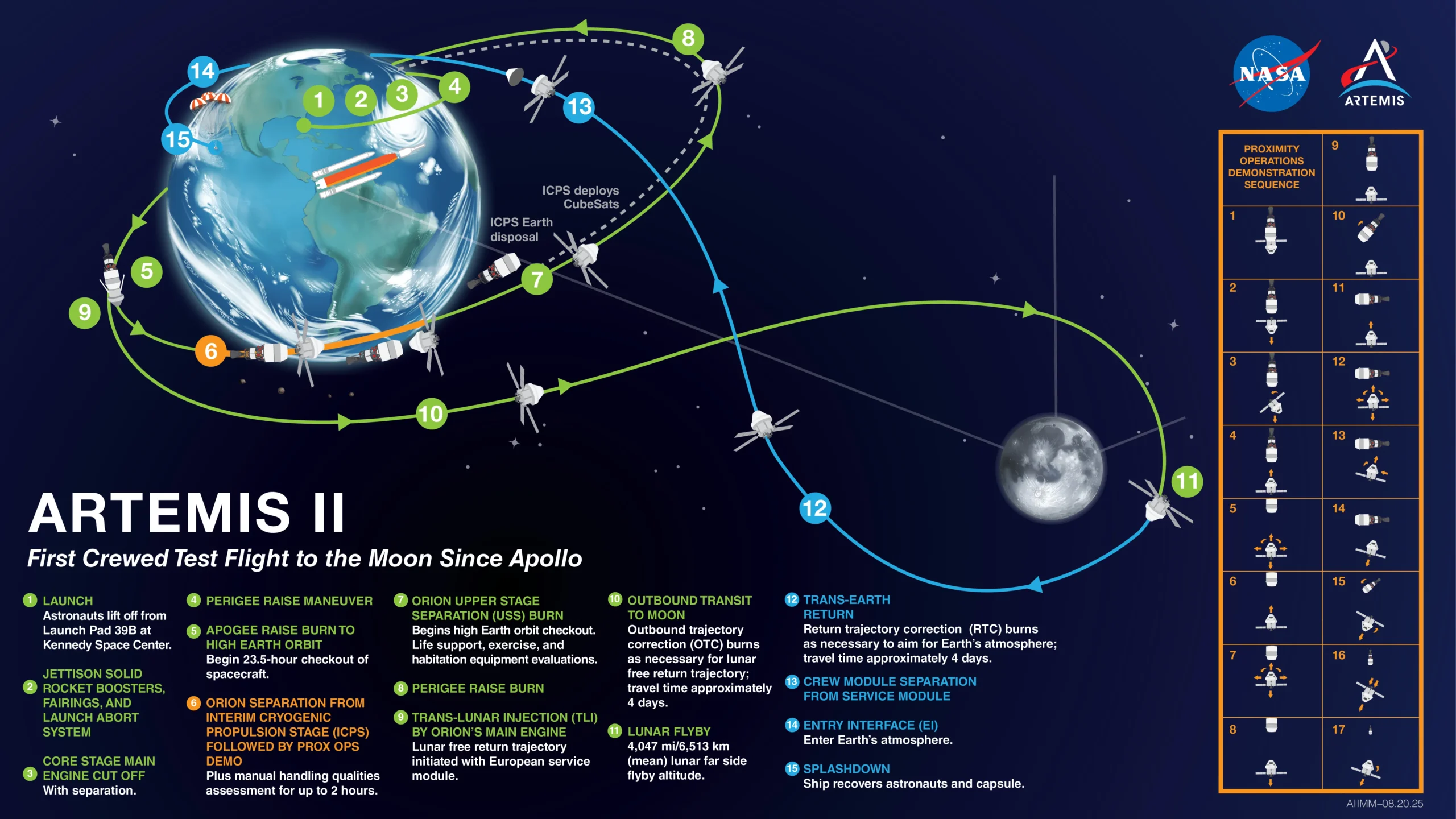
The Orion will carry its four-person crew around the moon on a “fly-by” over ten days before returning to Earth, gathering data on the function and performance of the vehicle in preparation for Artemis III, which plans to land humans on the moon for the first time since the Apollo program.
A map of the Artemis II mission plan. (Via the NASA press kit.)
To prepare the Orion for its next missions, the crew will test out its ability to manoeuvre.
“They’ll be doing simulations of proximity docking, so they’ll be turning around the Orion spacecraft, looking at the previous stage and seeing if they can line up with it properly,” explains Sevigny. “They’re really setting up for the next Artemis III mission, making sure that everything’s functioning properly.
The mission will also take advantage of the chance to conduct scientific experiments on human health in space, and practice emergency procedures and crew safety drills.
“They’re trying to jam in a whole pile of things within the limited time that they have for the mission,” Sevingy says.
While the Artemis II mission is not guaranteed to launch in the March window, NASA plans to launch by April 6.
A Minnesota man had died in a snowmobile collision south of International Falls.
It happened on Tuesday at around 12:30 p.m. on the Arrowhead Snowmobile Trail near Orr.
The St. Louis County Sheriff’s Office says two machines side-swiped each other as they approached each other on a curve.
This caused one of the snowmobiles to roll several times, ejecting the 57-year-old operator.
Multiple first responders and emergency personnel responded to the scene, including the Minnesota Department of Natural Resources, Bois Forte Police Department, Virginia Fire Department Sprint Medic, Life Link III air ambulance, Orr Ambulance, Orr Fire Department and Kabetogama First Responders.
Despite extensive lifesaving measures, the man, who has been identified as being from the south metro area, was pronounced dead at the scene.
The name of the victim has not yet been released pending notification of family members.
The driver of the other snowmobile was not injured.
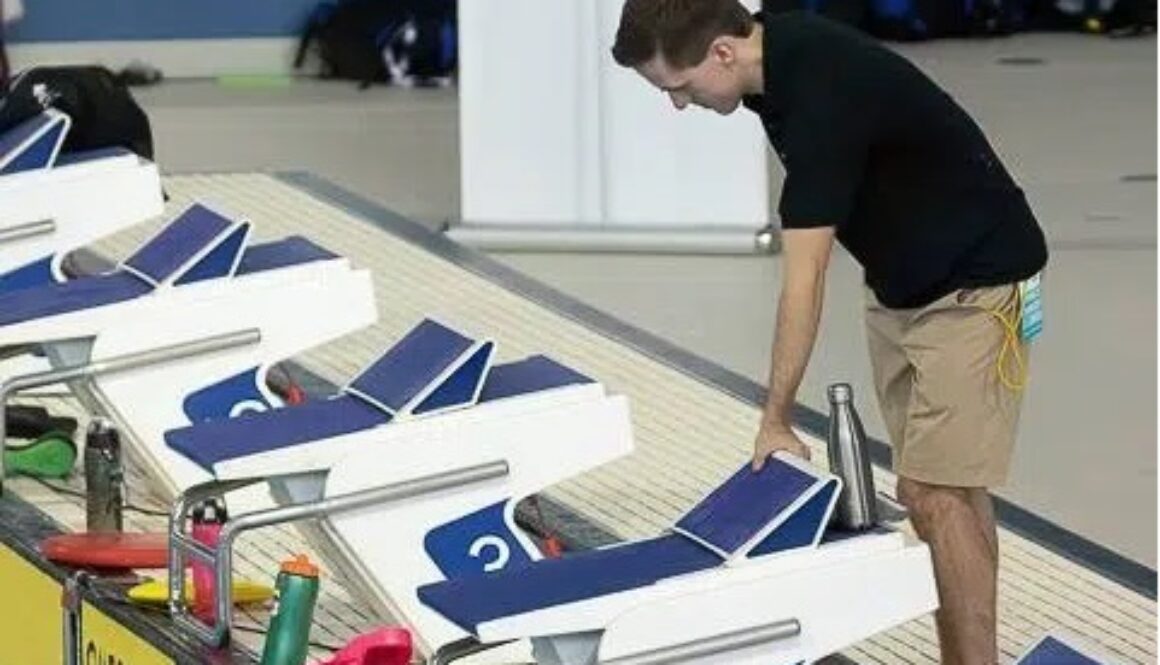
Swimming coach Ryan Allen has been named Swimming Canada’s Coach of the Year for the Paralympic Program.
The local was appointed as Paralympic Program National Coach Lead last February, leaving behind his position as head coach of Moncton’s Club de Natation Blue et Or, where he coached for more than a decade.
Allen has also been a long-time coach for fellow Monctonian Danielle Dorris, who was just named Swimming Canada’s Paralympic Female Swimmer of the Year.
The young talent performed well in the 2025 World Para Swimming Championships, winning a medal of each colour. Allen served as Canada’s head coach for the championship, where he played a key role in preparing Dorris.
According to Swimming Canada, Dorris’ remarkable showing led to Allen’s receiving the title. He told Swimming Canada that he was honoured to be recognized for his work with Danielle and that it is a testament to what she does as an athlete.
Allen will be entering his second year as the national coach lead for Swimming Canada’s Paralympic swimming program.