NB Power’s ban on disconnecting electricity does not go far enough, according to members from the ACORN advocacy group.
Starting Dec. 1, vulnerable people cannot have their power turned off if they fail to pay their bills.
That includes people 70 and older, people who rely on electric medical equipment, and households who make less than $70,000 a year.
“While it shows that NB Power and the NB government are listening to ACORN and our allies, a winter disconnection that is not permanent nor universal is not enough,” ACORN writes in a news release.
The ban lasts from today until March 31 next year, but ACORN says it should be permanent.
And it is unfair hardworking families could have their power cut if they are outside the income threshold, they say.
The utility says the new measure stems from a recommendation of the utility’s Vulnerable Persons committee, which started in May 2025.
“Electricity disconnection has always been a last resort, but we do understand that the possibility of that during the winter season can add additional stress to customers,” reads a statement from the utility’s website.
By Nathalie Sturgeon, Local Journalism Initiative Reporter, The Courier
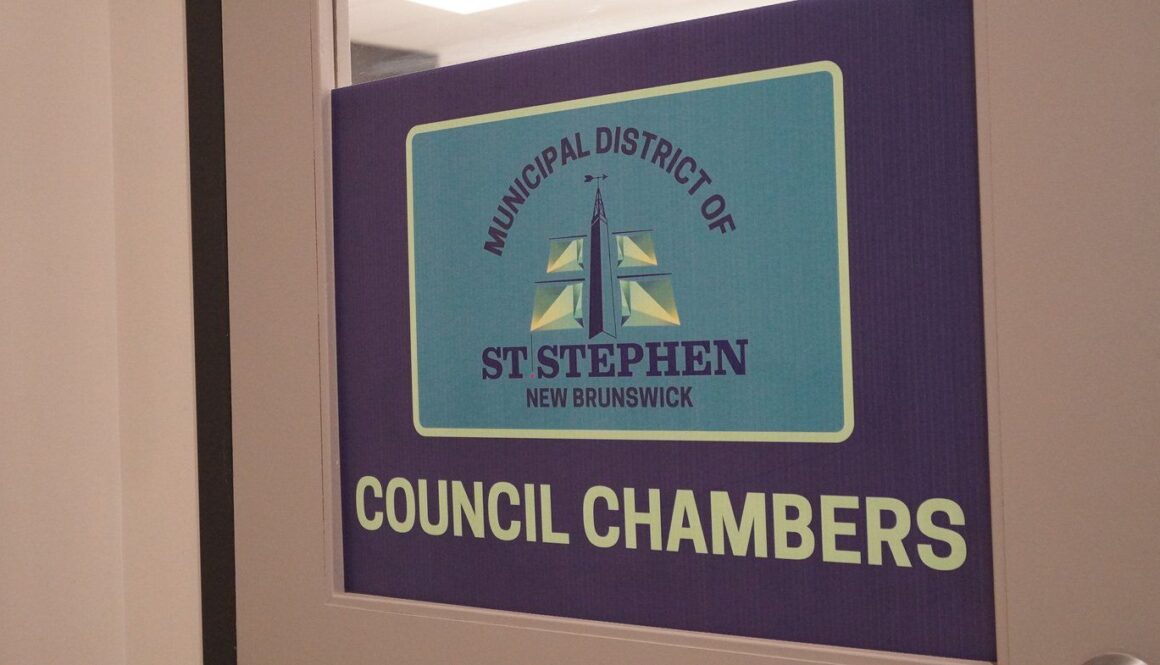
The Municipal District of St. Stephen (MDSS) is holding its tax rates amid the ongoing property assessment freeze throughout New Brunswick.
Rates will remain at 1.5561 per $100 of assessment for Ward 2 – or the urban area of St. Stephen – and 0.5597 per $100 of assessment for the rural wards. The rural wards are also charged a Department of Transportation and Infrastructure (DTI) fee of about 0.41 per $100 of assessment.
It comes amid a province-wide property assessment freeze by the provincial government for 2026. Property assessment accounts for about 83 per cent of a local government’s funding, with the remaining coming from unconditional grants.
“I like the idea of holding the tax rate and putting most of it in reserves,” said Coun. Wade Greenlaw.
Local governments are not allowed to run surpluses on the budgets; all money must be allocated, and are not required to do a capital budget, but some do.
“I’m also in favour of holding the tax rates steady and transferring them into reserves,” said Coun. Joyce Wright.
The council can take the money it sets aside for reserves to be used down the line on other projects or needs of the community.
Greenlaw said that with a lot of unpredictability, having money in the reserve might be a good thing.
“Part of the reason I want to leave it there [in reserves] is that we don’t know what the property assessment revision is going to do,” he said. “It’s nice to have a little bit of reserves there because that could take us either way.”
The capital budget does focus on infrastructure upgrades, including $5.1 million allocated for paving various roads and streets within Ward 2. Renaud told the council it would be done through the Municipal Capital Burrowing Board (MCBB).
It has also taken the opportunity to purchase a new lift station – a system used to lift wastewater to a higher level when gravity isn’t enough – that has fallen into significant disrepair.
The municipality is expected to spend $1.5 million to do the replacement.
According to Renaud, the community is on the provincial government’s radar for infrastructure in its water and sewer system.
“Through quiet conversations, they said they need to see a plan,” Renaud told the council last week. “They’re willing to help, but they need to see a plan. So, we have started that work with our engineering firm.”
The council approved setting aside funds to undertake work engaging with the federal and provincial governments on the long-term sustainability of the utility, and for the issues that may arise in the interim.
Additionally, it plans to purchase new self-contained breathing apparatuses (SCBA) units for the fire department at a cost of $150,000, alongside four sets of bunker gear for $15,000. Council has also approved the purchase of a dehumidifier for the Garcelon Civic Centre (GCC).
Council has also approved a new roof for a municipal building at 199 Union Street for $350,000 and about $40,000 for solar lights along the waterfront trail.
The council of MDSS unanimously supported the budget for 2026.
The number of cases of invasive pneumococcal disease in Thunder Bay is on the rise.
There are 95 cases so far this year, an increase compared to 77 cases in 2024, and 63 cases in 2023, according to a news release.
That is why the Thunder Bay District Health Unit is encouraging people 50 years of age and older to make sure their vaccines are up to date.
Non-invasive pneumococcal disease typically affects the ears, sinuses or throat. But invasive pneumococcal disease affects the blood, lungs and other major organs.
Pneumococcal disease is the name for any infection caused by the pneumococcus bacteria. That includes pneumococcal pneumonia. But it is not the only bacteria that causes pneumonia.
They say most cases (55 per cent) of the invasive bacteria occur in people 50 and up, and 68 per cent of people infected end up in the hospital.
The vaccine is commonly called the pneumonia shot, and adults usually get it once.
You could be eligible for the vaccine if:
you are 65 years old and have not been vaccinated yet
you have a chronic disease, certain medical conditions, including a weakened immune system
If you have already had the vaccine, you could be eligible for a second dose if you are 65 years old and have a chronic disease or underlying medical condition.
Pharmacies are not offering the vaccine right now. But you can get it through your primary care provider or by booking an appointment to visit the health unit’s routine immunization clinic at their main office in Thunder Bay at this link.
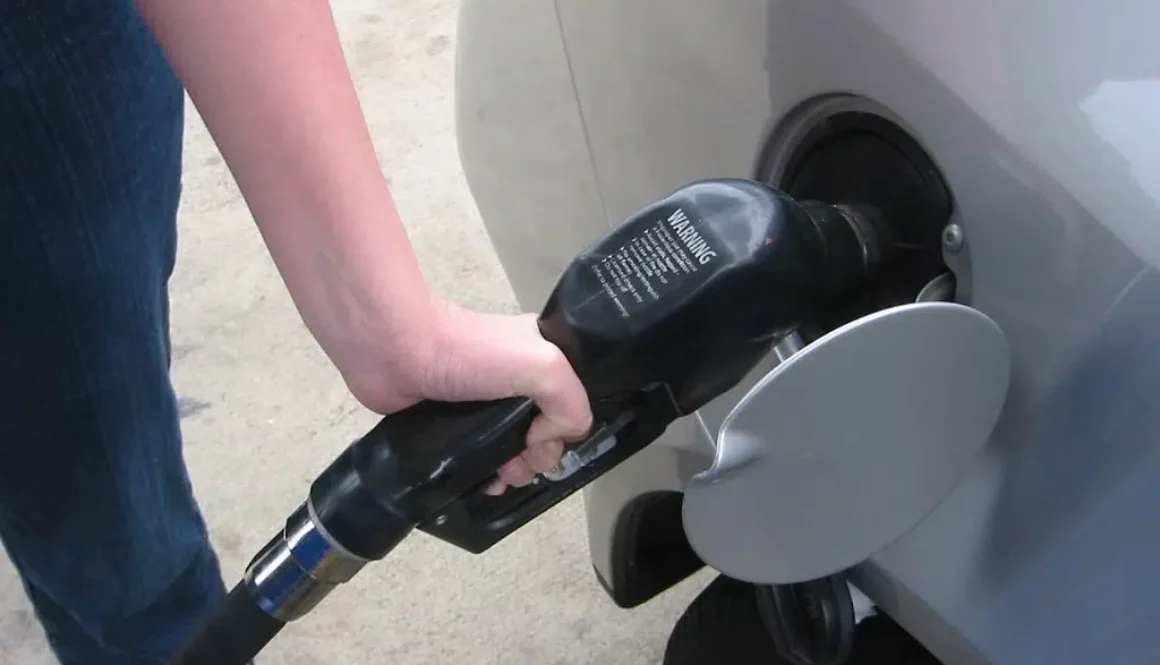
In case you missed it on Friday, and were expecting a drop in fuel prices this morning.
It’s not going to happen.
The cost of the carbon adjuster was set to come off on Monday.
Instead, an order has been issued by the Energy and Utilities Board for an increase equal to the reduction amount.
On Friday, the chair of the Energy and Utilities Board, Christopher Stewart, announced an interim order blocking the change.
Stewart said wholesale margins would increase by an amount equal to the adjuster.
That will mean the cost of fuel will remain the same.
This comes after officials from the fuel industry raised concerns that drops in prices would have major impacts, including the potential closure of stations across New Brunswick.
A full hearing on the issue will be held at a later date.
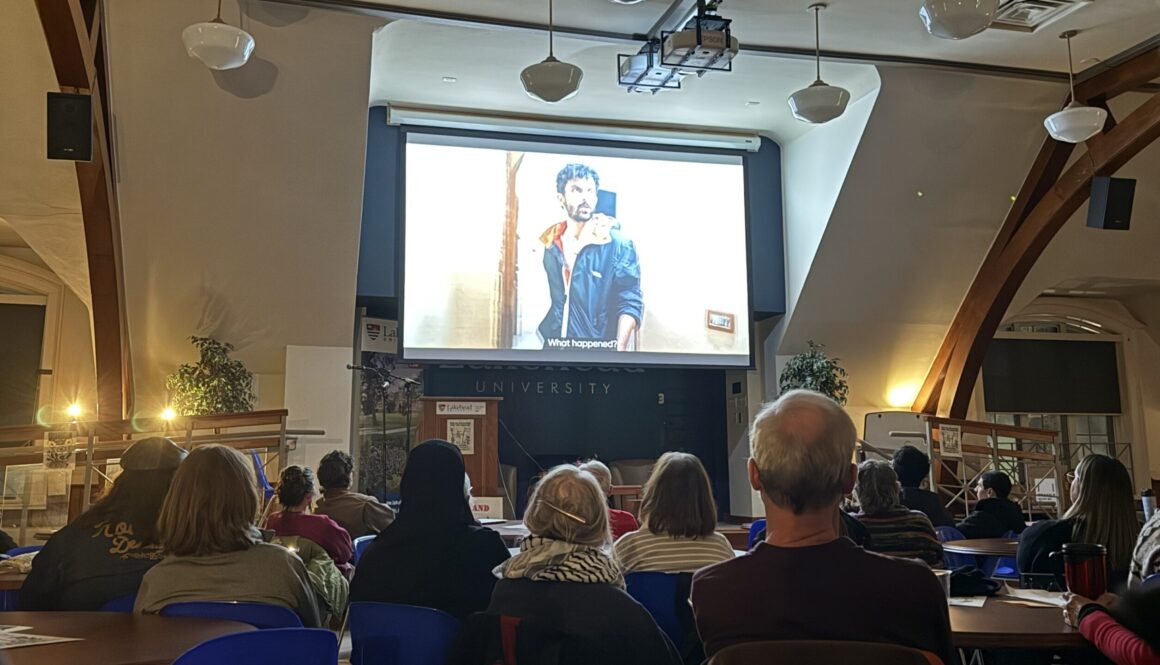
Early in November, members of Palestine Solidarity Thunder Bay and the Bora Laskin Law School’s Muslim Law Students Association organized a screening of No Other Land, the Oscar-winning documentary by Israeli and Palestinian journalists and activists.
The screening took place around the one-month mark of a ceasefire agreement between Israel and Hamas, meant to end a two-year conflict that has, at a minimum, killed tens of thousands of civilians, including 20,000 children.
The timing may seem strange to the uninitiated, but No Other Land does not tell the story of the war in Gaza: it displays one small piece of the ongoing, intractable, and ever-deteriorating situation in the Israeli-occupied West Bank of Palestine.
The documentary tells the story of Basel Adra, a young Palestinian resident of a group of villages known as Masafer Yatta, which has endured a decades-long demolition order from the Israeli military.
The Israeli military and court system have designated Masafer Yatta as a training ground for tanks, despite the hundreds of Palestinian residents who live in the villages that make up the municipality.
As Adra films his family’s struggle to prevent the demolition of homes, schools, and even water wells, he is joined by Israeli Journalist Yuval Abraham, who has come to Masafer Yatta to document the great injustices he feels are wrongly being committed in his name as a Jewish Israeli.
The film is directed by Adra and Abraham, as well as Hamdan Ballal and Rachel Szor.
It won Best Documentary Feature at this year’s Academy Awards, but has struggled to find a distributor for wide release.
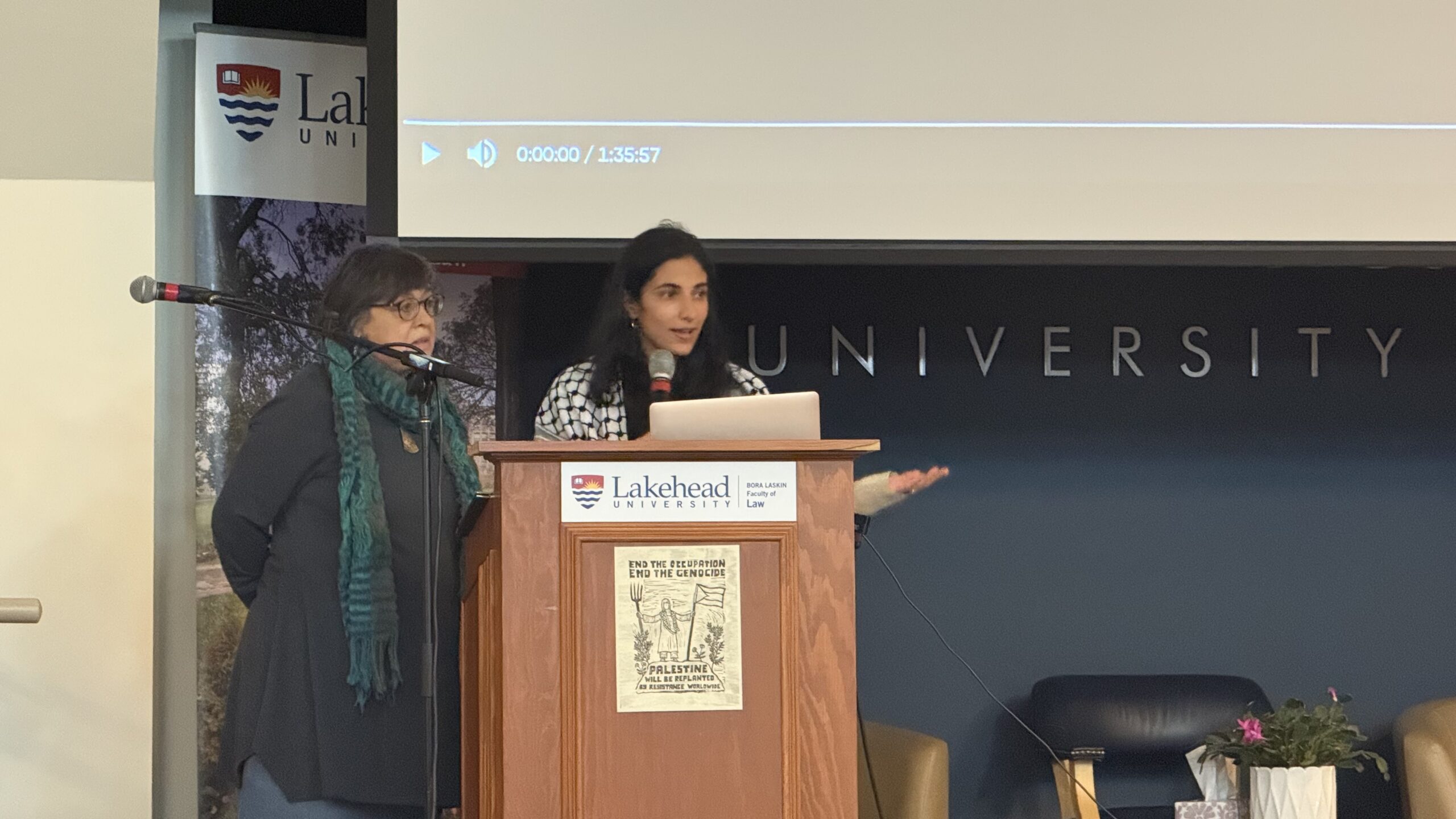
Jana Abu Deyah is a second-year student at the Bora Laskin Faculty of Law and a member of Palestine Solidarity Thunder Bay. She is a Palestinian-Canadian.
She describes the film as “a hard, but inspirational watch.”
Abu Deyah is part of a Palestinian Diaspora that today numbers in the millions, most of whom were victims of two ethnic cleansing campaigns by Israel in 1948 and 1967.
Her family fled their homes during the “Nakba” of 1948, when 750,000 Palestinians in the borders of modern-day Israel were forced to flee, or fled from fear of violence during Israel’s creation.
Palestinians in the diaspora are often forced to reckon with a choice between holding on to an ever-shrinking hope of one day returning to their homeland or of integrating into the societies they now live in.
Abu Deyah, who has never been to her ancestral home of Palestine, says “it would be a delight” to go, if she could.
Jana Abu Deyah, pictured right, introduces the documentary for the attendees. (Sam Goldstein/November 7, 2025)
Familiar Sights
The documentary depicts the everyday struggles of living under a military occupation as second-class citizens.
The heart of the film is a budding friendship that sparks between Adra and Abraham, who come from different worlds but want the same thing.
As a Jewish Israeli, Abraham has the freedom to go where he pleases, as dictated by his yellow identification card and his Israeli license plate. He can pass back and forth between Israel and the occupied territories.
At one point in the movie, Abraham laments that he is always at Adra’s home, while Adra has never been to Abraham’s home, nor met Abraham’s family.
It is no accident, but a design of the occupation that prevents Adra from visiting the home of his Israeli friend.
As a Palestinian, Adra’s green identification card limits his freedom to move, preventing him from crossing into Israel without permits.
Even with permits, Palestinians from the West Bank often risk physical harm when crossing into Israel.
The arbitrary restrictions put in place for Palestinians exist to serve the needs of a growing population of Jewish Israeli settlers who have moved into the West Bank since 1967, in violation of several international laws.
Today, there are more than half a million Jewish settlers in the occupied West Bank, serving as the foremost obstacle to any future solution to the conflict.
Settlements are often established directly in the heart of Palestinian localities, producing labyrinthine systems of military checkpoints that force Palestinians to take wildly indirect routes around settlements to travel between their cities and towns safely.
Palestinians in proximity to settlements are policed by the Israeli military, rather than the Palestinian Authority.
When detained or arrested by the Israeli military, which is commonplace, Palestinians must face an Israeli military court with a greater than 99 percent conviction rate.
Since 1967, one-fifth of Palestinians in the occupied territories have seen the inside of an Israeli jail, including two-fifths of men and boys.
The consensus among international human rights organizations and the United Nations is that Israel’s settlements and military occupation together meet the definition of “settler-colonialism,” a form of colonialism where settlers expand into a frontier while taking advantage of protection by a superior military.
Kaitlyn Harding is a third-year law student at the Bora Laskin Faculty of Law and the president of the law school’s Human Rights Law Club.
Harding, whose mother is Metis, sees parallels to Canadian history in the present situation in Israel and Palestine.
“People’s land is taken from them. They’re put into these centralized areas. They can’t leave,” she says.
Abu Deyah recognizes the similarities as well.
“Coming to law school, we are encouraged to learn a lot about the Indigenous history here in Canada. And I felt very connected to it immediately,” she remarks.
Abu Deyah sees connections to Indigenous peoples in Canada not just in terms of the oppressive structures faced in past and present, but also in values shared.
“Our connection to the land, our belief in taking care of this planet, the Earth, and what that means to us, it’s the same,” she adds. “It’s very reflective of the Palestinian struggle against colonial powers.”
Horror, frustration, and hope
Violence permeates every encounter between the Palestinian villagers and their adversaries in the film.
Early on, in an encounter between villagers and Israeli soldiers, one soldier shoots an unarmed Palestinian man, who is left paralyzed for the rest of the film.
His home demolished, this paralyzed man is forced to spend the remaining years of his diminished life living in a cave near the village.
Later in the film, an Israeli settler is filmed walking up to one of Masafer Yatta’s villages with an assault rifle and shooting an unarmed Palestinian man in the stomach, which earned several gasps of shock from the audience.
Though Hollywood action films seem able to desensitize violence with ease, presenting real violence captured on film is immediately sobering.
What makes the acts of violence all the more horrifying is the lack of justice for the perpetrators.
Were a Canadian filmed so casually walking up to someone and shooting them, the expectation would be years in prison, if not more, regardless of the identities of the shooter and the victim.
After the screening, the organizers set up a small discussion with questions and answers, to give the audience a chance to learn a bit more about the context.
A major theme in the discussion was frustration with Canada’s leadership in the conflict.
While Canada has recently recognized a Palestinian state, the recognition has come with strings attached. More to the point, many in the room wondered why that recognition took so long in the first place.
Abu Deyah isn’t sure how to feel about Canada’s move.
“I have a lot of distrust. I don’t believe certain things that are said. I feel very vulnerable towards this topic, so I’m not sure that I feel super optimistic,” she says.
Abu Deyah credits the intergenerational trauma she’s inherited from her parents and grandparents for her distrust.
“Just knowing the history that has happened to my people, and the lack of change that we’ve seen over the years, it’s just hard to believe that there will be a structural change,” she explains.
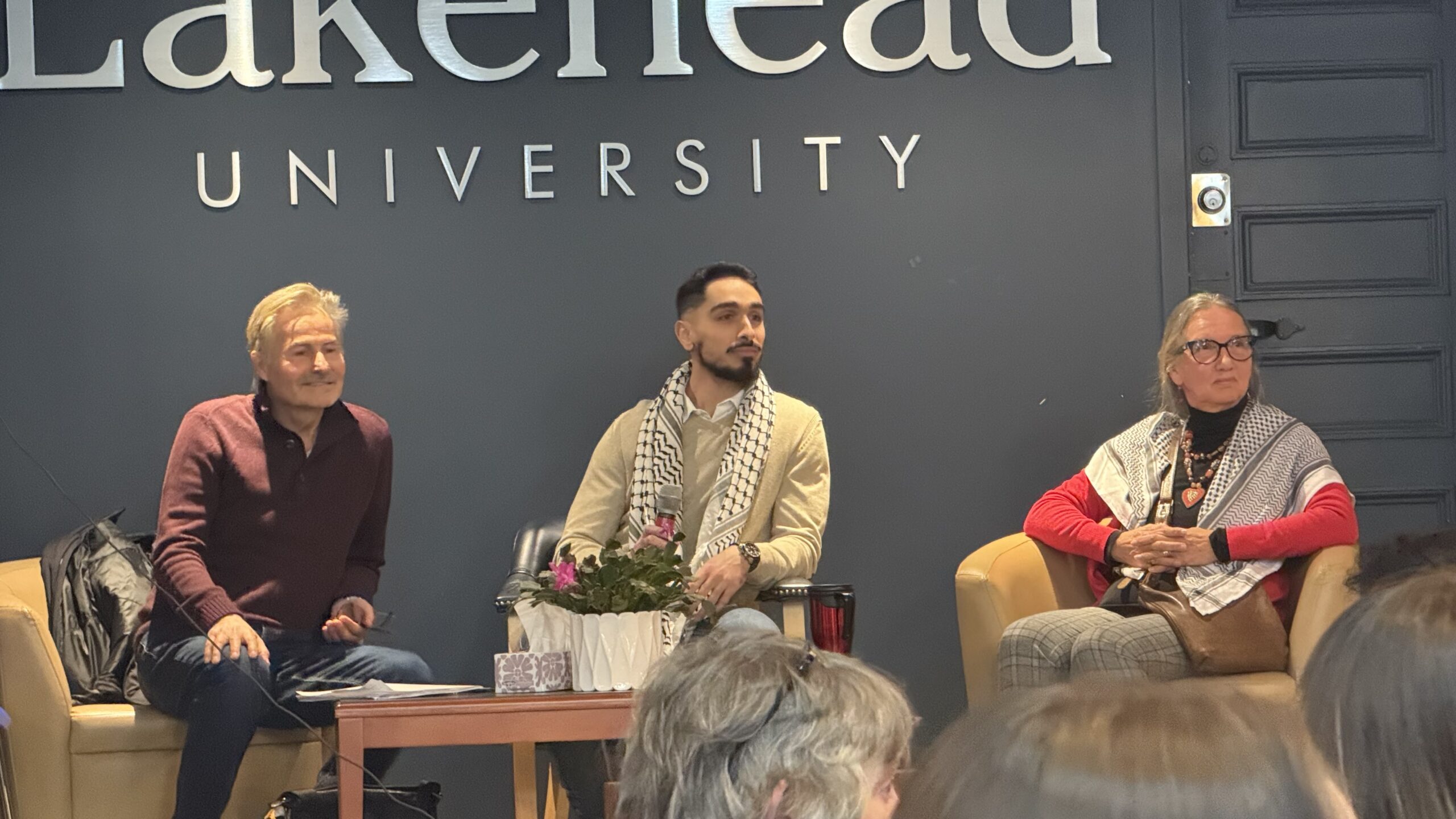
One of the speakers in the discussion after the film was Fares Ismail, a Palestinian-Canadian activist in Thunder Bay.
Despite the horrors on screen, Ismail finds ways to hope for the future.
At one point in the film, the Israeli journalist Yuval Abraham laments that his articles aren’t getting a lot of views in Israel.
“That goes to show that when we put in the work, we continue our activism, when we continue showing up, making our story heard, one day it could win an Academy Award,” Ismail says.
Ismail believes that Palestinian narratives are breaking through into the mainstream in ways that they had not before the war.
“The film speaks for itself,” Ismail says. “You have entire villages being wiped out, schools being demolished pretty much during class time. You have water tanks being brought to the ground… they’re being destroyed in front of our very eyes.”
Fares Ismail, pictured in the centre, takes a question during a Q&A after the screening. (Sam Goldstein/November 7, 2025)
Abu Deyah shares Ismail’s belief that the Palestinian experience is reaching new audiences.
“I remember my first time attending a Palestine Solidarity meeting, I walked in, and it was a bunch of people who weren’t Palestinian and weren’t people of colour,” she shares. “I was really shocked at that moment, honestly. But it really touched me that they’re here to learn and they’re open to discussing.”
Ismail finds it particularly encouraging to see Yuval Abraham, the Israeli journalist, as an ally to the villagers of Masafer Yatta in the film.
“He really brings us hope for a future where us as Palestinians and just Jews, holistically, we can live together.”
Ismail takes great ire with the way Jews and Palestinians are pitted against each other in media and government narratives.
“There’s lots of Jewish folks who support Palestine. And as a Palestinian myself, I can speak for pretty much all of us that Jews are not the issue,” he says. “The issue for us is Zionism, which ties back to the idea of colonization. That’s our issue.”
The villagers of Masafer Yatta continue to face the demolitions of their homes, representing just a tiny slice of the violence that is currently taking place in the West Bank.
In the last two years, over 1000 Palestinians have been killed in the West Bank by both settlers and military forces, of which more than 200 were children.
Meanwhile, over 300 Palestinians in Gaza have been killed since the beginning of the ceasefire in mid-October, straining the definition of a ceasefire to its limits.
Numerous international human rights organizations, as well as bodies within the United Nations, have defined the Israeli government’s actions in Gaza and the West Bank as genocidal.