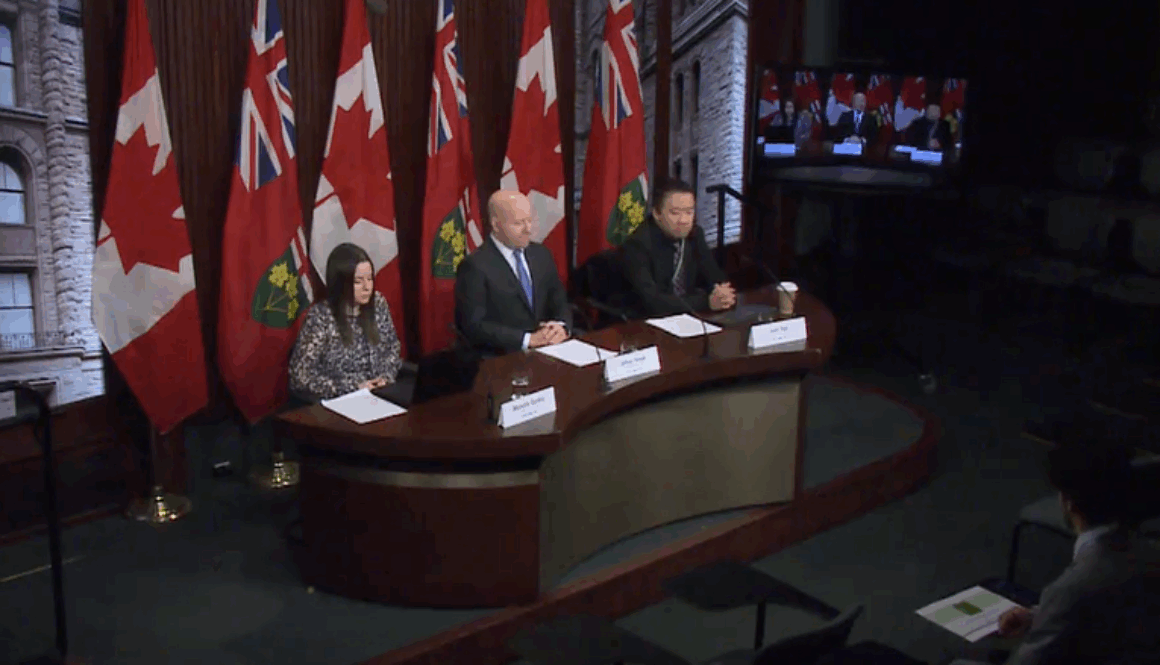
The Ford government says it has spent more than $220 billion in the last fiscal year.
That is a 4.7% increase over 2024-25.
Treasury Board President Kinga Surma says it includes more for healthcare and education.
“Healthcare saw a $6.6 billion bump in investments for hospitals, home and long-term care and OHIP-funded services,” says Surma.
“Education received over $2 billion more than the previous year, including investments in childcare. And almost $2 billion more was invested into the province’s infrastructure, including hospitals, public transit, highways and the infrastructure needed to build more homes.”
At the same time, revenue was slightly lower than expected, partly due to one-time money received last year from a tobacco legal settlement.
The deficit now sits at $13 billion, down $1.6 billion from the figure projected in the 2025 Budget.
“While deficits are not desirable in the long run, they reflect the world we are in,” says Finance Minister Peter Bethlenfalvy.
“The world has changed. Global economic conditions are becoming increasingly challenging, while the relationship with our closest ally, the United States, has changed.”
Bethlenfalvy will provide a further update to the province’s finances later this fall when he presents a fall economic statement.
One concern is a plan by the federal government to reduce provincial transfer payments.
Funding for services, including mental health, home care, labour agreements, and housing, is being reduced or joint agreements are nearing conclusion.
“Now is not the time for the federal government to cut these transfers, for if they do, reductions in services would be the inevitable result,” says Bethlenfalvy.
Ontario is also pressing the feds to lower tax rates and gasoline taxes.
After projecting a billion-dollar deficit in the spring budget, the province has spent an additional nearly $250 million dollars since then.
The budget estimate for the 2026-27 year is now sitting at a deficit of $1.4 billion. That is the same as the deficit for the 2025-2026 fiscal year.
The largest areas of increase were about $125 million went to pay for doctors, Emergency Health Services, pharmaceuticals, and other programs. While the next largest went seniors and long-term care at about $62 million.
Finance Minister John Lohr says the government is working hard to slow the growth in their expenses, but health and seniors care are more challenging.
“When people need home care, when they need an ambulance or a prescription through seniors’ pharmacare, we will be there to provide it for them,” says Lohr.
“We have worked hard to reduce the need of family practice list and to ensure more people get the care that they need. And we have been successful, but there’s more to be done.”
The budget tabled in the spring sitting at the legislature drew criticism from across the province because of cuts to arts and culture, disability supports, and more.
The province ended up restoring some of that funding, about $53.6 million, which is factored in the deficit in this update.
Overall, that brings the province’s net debt to $24.1 billion as of March 31, 2026. That is $3.26 million higher than the same day of the previous year, and $1.48 billion higher than the government initially planned in the budget estimate.
The additional out-of-budget spending has drawn criticism from the NDP and Liberals, as well as the province’s auditor general.
A report from auditor general Kim Adair highlighted that the government had spent about $6.7 billion outside of the approved budgets over the past five years.
The auditor has suggested that the government change the Finance Act to require a vote in the legislature on any out-of-budget spending.
But the government has previously argued that they need the flexibility to respond to emergencies and unexpected events.
New Brunswick’s 2026-27 budget forecasted the $1.39 billion deficit as a result of a gap in revenue to expenses.
The projected expenses amount to $15.6 billion, while revenues are only projected to be $14.2 billion. This increases the province’s debt-to-gross domestic product (GDP) ratio.
Finance Minister René Legacy says the budget reflects a changing economic reality and uncertainty in the global economy. He says the challenge of making significant investments in what is important to New Brunswickers and bolstering the economy while working to reduce the province’s debt remains.
Concern surrounding province’s debt
Devin Drover, Atlantic Director and General Counsel of the Canadian Taxpayers Federation, says New Brunswickers’ biggest concern should be that the government is redirecting tax dollars to service government debt.
Devin Drover, Atlantic Director and General Counsel of the Canadian Taxpayers Federation (Image: Wilfred Fraser)
“Right now, about $1000 that a New Brunswicker pays in taxes just goes towards servicing existing government debt as a result of this budget; we’re seeing a lot of borrowing,” said Drover. “As a result of that, a lot of money is being siphoned away servicing government debt rather than money that can be used towards healthcare or other investments or money that could be used to return to taxpayers in the form of tax cuts.”
Legacy referenced during the tabling of the budget that the province’s net debt-to-GDP ratio remains one of the best in the country.
Drover says that if the government continues to increase spending, New Brunswickers will see increased expenses in the form of interest debt charges going up annually, which will result in a worse debt-to-GDP ratio.
“I think the province is certainly heading in the wrong direction when it comes to government debt,” said Drover.
Green Party Leader David Coon says the deficit is manageable in the short term.
Green Party Leader David Coon (Image: Wilfred Fraser)
“This deficit is not something anyone should light their hair on fire for. Given our fiscal situation, we can manage,” said Coon, “but when you look at the trajectory that they are proposing, that’s a concern.”
The province’s current net debt-to-GDP ratio sits at 27.9 percent following the revised 2025-26 budget that was initially tabled last year.
The projected net-to-GDP ratio for 2026-27 is 30.8 percent as a result of the continued deficit. The trajectory that Coon mentioned points to the years to follow, that would see 2027-28 and 2028-29 plans reaching net-to-GDP ratios of 33.6 percent and 36 percent, respectively.
“Right now, given our needs in healthcare, long-term care, social services and education, as we have been saying all along, this budget and New Brunswickers could not sustain significant cuts.”
This goal of debt reduction was initially expected to have assistance from spending cuts. Premier Susan Holt wanted all government departments to look for savings of 10 to 15 percent, but the budget tabled only sees a reduction in spending from three departments, and none of them reach close to 10 percent.
What happened to the cuts?
Legacy says they are choosing to invest in health care, education, social programs, and economic opportunities as opposed to making cuts. He says the province’s strategic position means they do not have to act rashly.
“We could have chosen to respond to the pressure by slashing programs and services across government to reduce the deficit faster, but New Brunswickers told us clearly that is not what they want, and we agree.”
Don Monahan, the Progressive Conservative finance critic, says there were not major difficult decisions made despite the talk around it.
“$1.39 billion is definitely a big number. They were talking about a lot of difficult decisions and what it’s going to mean for New Brunswickers, and at the end of the day there’s a lot of fear around that,” said Monahan. “In the end, there weren’t difficult decisions made.”
Monahan mentioned cuts identified by the Office of the New Brunswick Advocate when it released a review of the 2025-26 budget, in which a $47.1 million cut to child welfare services in the Department of Social Development was identified. There was also an identified budget redirection that resulted in librarian layoffs in 2025, according to Monahan.
Alex White, N.B. New Democratic Party leader, says the budget tabled is a backtrack from massive cuts that were proposed in the pre-budget consultation.
New Democratic Party Leader Alex White (Image: Wilfred Fraser)
“Now they’re coming out and saying it’ll be $100 million in cuts over three years. That’s not what we will get out of this … I am waiting for the other shoe to drop.”
The $100 million in cuts White referenced relates to the government’s announcement that they will be reducing the size of Part 1 of the civil service by 12 percent through attrition, or the gradual reduction of a workforce by voluntary departure.
As of Dec. 31, 2024, 11,801 employees made up Part 1 and represented 22 percent of GNB’s workforce. According to the math, the Holt government would be cutting roughly 1400 positions, which represent only a small fraction of the total GNB workforce: just above 2.5 percent.
White suspects there will be more changes announced in the next six months.
A difference of opinion on the size of the Ontario government’s spending deficit.
Finance Minister Peter Bethlenfalvy says improved revenues will bring this year’s deficit to $13.4 billion.
That is better than what was forecast in last spring’s budget.
The Financial Accountability Officer has different numbers.
It predicts the deficit to reach $11.1 billion, higher than its original figure.
The FAO bases its number on a projected 3.2% increase in spending combined with a 1.2% decline in revenue.
Both the Finance Minister and FAO acknowledge that Ontario’s Gross Domestic Product, the measure of economic activity, has slowed as U.S. trade tariffs show their impact on exports and business investment.
The FAO forecasts economic growth to remain stable in 2026 before showing a slight decrease between 2027 and 2030.
It also predicts continued deficit spending until then, but lowering to $6.3 billion by 2029-30.
The FAO says numerous risks and uncertainties could impact its outlook.
Strong economic growth could leave the province with a deficit as low as $2.3 billion by 2023.
A weaker economy could result in a $10.1 billion deficit.
Bethlenfalvy is scheduled to release a new provincial budget by March 31, 2026.