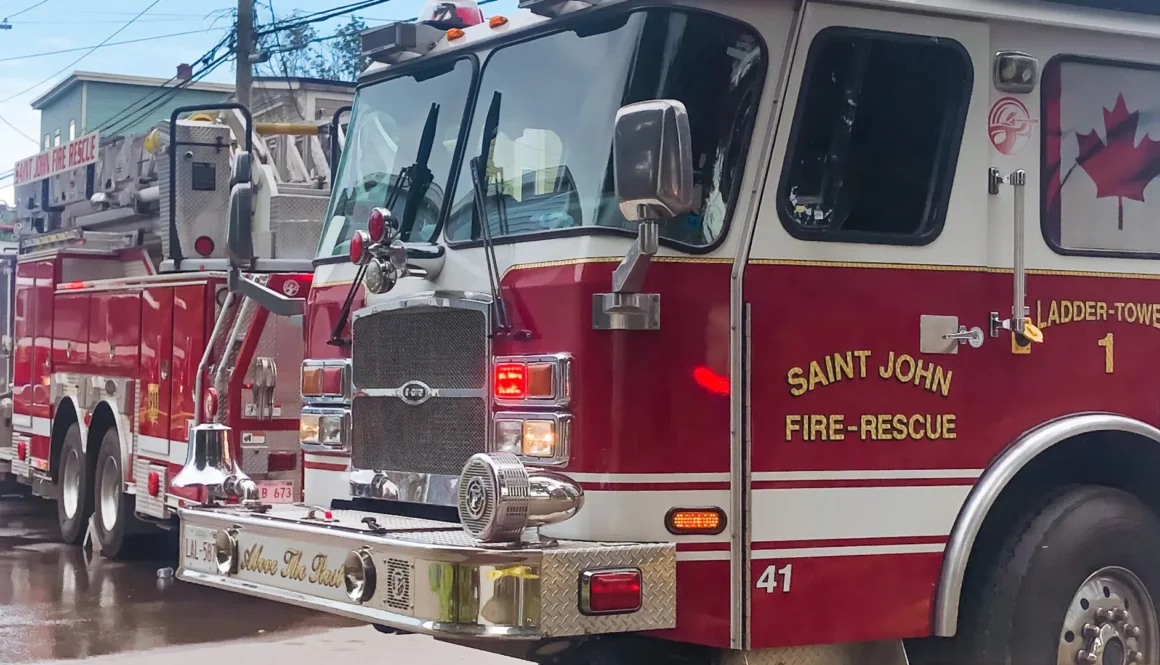
Saint John firefighters renew call to staff tanker trucks amid resource concerns
Saint John firefighters are renewing calls to staff water tanker trucks, warning limited resources and a drier summer could strain emergency response.
In a Facebook post on May 12, the Saint John Firefighters Association said responding to a structure fire and a motor vehicle accident on May 11 left the city without available firefighting resources.
In an interview with Acadia Broadcasting on May 14, association president Tyler Embree said that despite warnings of a drier summer and higher wildfire risk this year, the department still lacks the resources and staff needed to respond to additional emergencies while handling an ongoing incident.
Embree said the city continues not to staff two water tanker trucks, despite several calls to action from the association.
“Our concerns have not been met with anything,” said Embree. “If anything, the city stayed silent.”
The tankers are stationed on the city’s east and west sides and are used in areas where hydrants are not available.
According to Embree, only two firefighters — one per truck — would be needed to restore the service. However, he said the city prefers to rely on an overtime call-in model to address major incidents instead.
“The problem with calling overtime, versus having the staff, the trucks readily available and staffed every day is your strategy is one of hope,” he said. “You can’t guarantee that everyone’s going to be able to come in and fight that fire.”
RELATED: Saint John firefighters demand action on unstaffed water tanker trucks
Embree added that the city has the staff available but is choosing not to staff the trucks full time.
Over the past several years, the city has made several cuts to the fire department to address budget constraints, most recently in 2020 when it decided to close the Milledgeville fire station and cut 24 firefighter positions.
Embree said that, because of these cuts, the city lacks resources that could help improve the department’s response time during emergencies.
He explained that now any major incident takes all available fire trucks, whereas previously a second alarm would require four to five trucks while still leaving two available to respond to medical calls, car accidents and other emergencies.
City defends staffing model, prioritizes ‘smart planning’
In an emailed statement on May 14, Rob Nichol, chief of the Saint John Fire Department, said the decision not to staff the tankers is based on statistics showing that 77 per cent of calls occur when no other incidents are underway, and another 19 per cent occur when only one call is in progress.
“SJFD must operate efficiently and effectively, which based off the statistics above would show that staffing to a level that you always have trucks and crews waiting for the next call may not be the most practical approach,” he said.
Nichol said the department instead relies on “smart planning” to keep the community safe, which includes assessing risks, prioritizing calls and working closely with mutual-aid partners in neighbouring areas.
He added that the tankers are staffed whenever personnel are available, and when they are not, the city uses an alternate response model with on-duty personnel to ensure continued service.
“By using these approaches, we are able to provide reliable emergency response, even when several calls happen at the same time,” he said.
Nichol added that each day, a minimum of 28 personnel staff the department’s seven front-line heavy apparatus, including engines and ladder trucks.
Embree said that, given the amount of industry in Saint John, the city should be doing more to prevent emergencies.
The department recently received $40,000 from the Firehouse Subs Public Safety Foundation, which it used to buy a new all-terrain vehicle intended to improve response times during natural disasters and emergencies in wooded or off-road areas.
But Embree said more is needed.
Report says SJFD doesn’t have enough firefighters for bigger incidents
A fire service review completed in 2023 recommended decommissioning the tankers, suggesting mutual aid could help fill the gaps.
So far, no decision has been made on the recommendation. Nichol said the department is currently working on a fire strategy plan and standards of cover, which will be presented to the new council once completed.
However, during the last safety committee meeting in late April, the department presented a standard of cover report alongside data analytics company Darkhorse Emergency.
While the report said the department performed well — meeting 75 per cent of its initial response goals — it identified gaps in coverage for rural areas. It also found that for major incidents, the department does not have enough firefighters on scene to meet the national standard.
According to the report, the national standard for high-rise full alarm incidents requires 42 firefighters on scene, or 43 if the building includes a fire pump, but SJFD achievement rate for this standard is 42 per cent, against a goal of 90 per cent.
To better cover the city during larger incidents, the report suggested opening a new fire station in Milledgeville and considering relocating or upgrading other existing stations.
However, council decided to table adoption of the recommendations and instead have the department present the report again to the next council.
Embree said that with seven new members on council, the association is hopeful change will come.
He believes the previous council was not listening to citizens or working-group concerns.
“It speaks volumes that council has changed over the way it has, and there is a lot of good councillors in there,” he added.
He said that while the association does not endorse any councillors, it has met with several of the new members, who expressed concern about the level of fire service in the city.