Randy Thoms is a veteran news broadcaster with over 40 years' experience. He is based in Fort Frances and covers stories across northwestern Ontario. Contact Randy at thoms.randy@radioabl.ca.
Schools across the Rainy River District were visited this week by an author who cannot read or write, yet Michael Jacques has written two books based on his life experiences.
Michael has autism and intellectual disabilities, but it has not stopped him from being an advocate, volunteer and public speaker on issues of inclusion, diversity and compassion.
He was in the district, telling his life story to students, educators and community members, and illustrating that anything is possible.
“Things that are easy for other people are harder for me, but I just want to show that anything is possible,” says Jacques.
“People like myself, who are young, old, or somebody who has some challenges, to show that anything is possible with lots of hard work and dedication.”
Jacques says it started in his youth, taking part in a program that focused on inclusion and leadership that provided him the voice to speak out.
He says supportive parents, educators, and community agencies gave him the support and confidence.
He went on to compete in the Special Olympics several times, found employment at a grocery store, and was named 2019 Citizen of the Year in his community of FontHill, Ontario, west of Niagara Falls.
He became the youngest president of Community Living Ontario’s board of directors, and the only one with lived experience to advocate for others with intellectual disabilities and their families.
Former Education Minister Stephen Lecce appointed him a few years ago to a provincial advisory committee on special education.
“It was great. He knows I got my high school diploma. He knows that I wrote two books. He has both my books. And he’s a big supporter of me. It was great to have that support,” says Jacques.
Jacques is asked to make many presentations each year. His dad, Marcel, joined him on the tour across the Rainy River District.
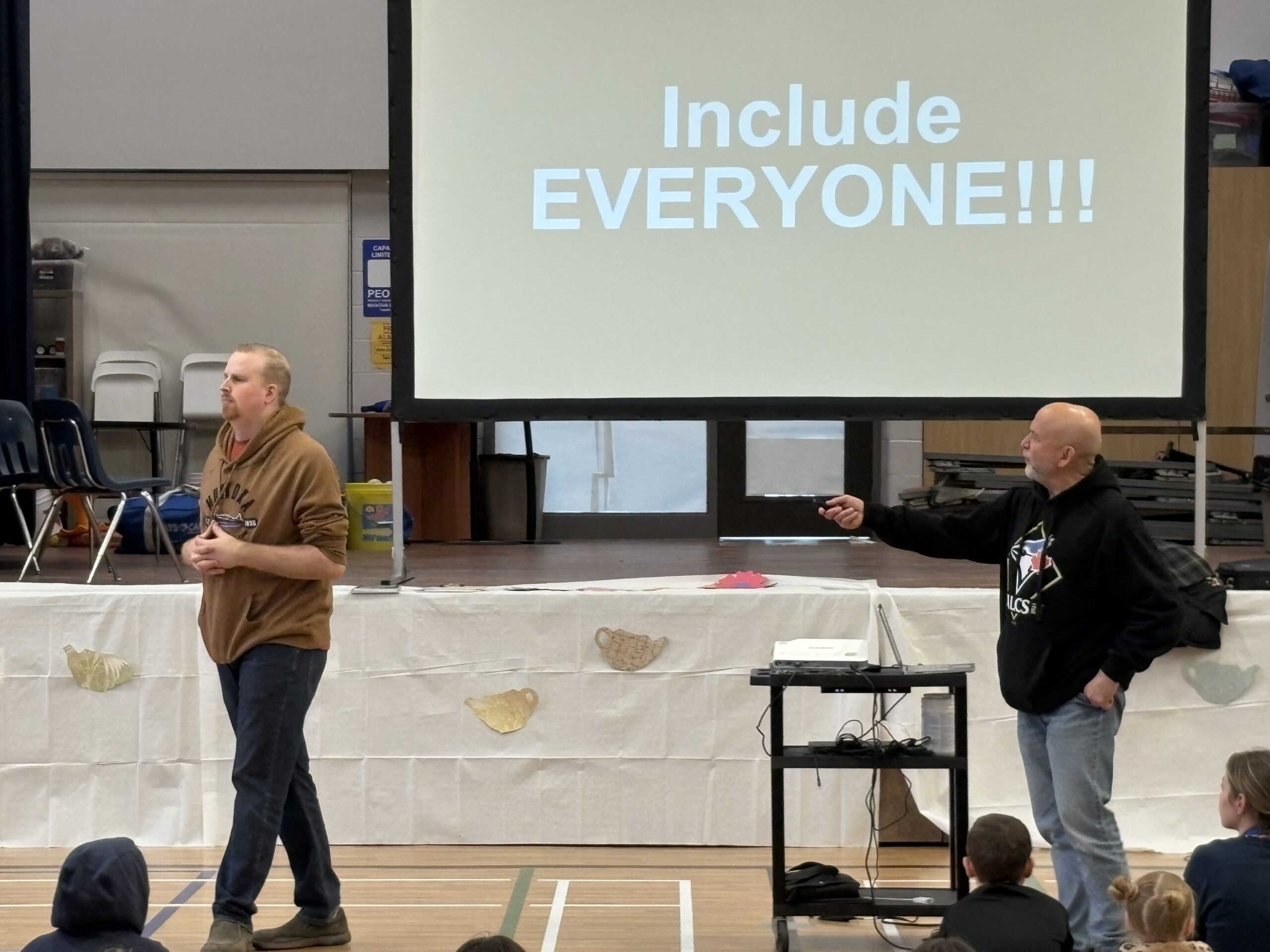
Michael Jacques and his dad Marcel (r) answer student questions during a visit to Robert Moore School in Fort Frances, May 6, 2026. Image: Randy Thoms/Acadia News
This was their first visit, though they have visited other parts of northwestern Ontario in the past.
They have visited over 600 schools and made many more tailored presentations to business leaders, educators, and support agencies.
“I would suggest 60% of Michael’s presentations are for the educational sector, whether they’re students or staff support staff,” says Marcel Jacques.
“Twenty percent in the developmental sector service sector, so community living organizations and things of that nature. And then another 20% for other organizations that want to be inspired by Michael’s story.”
He is a regular visitor to Ontario Police College in Alymer, speaking to cadets about how they interact with people with disabilities and how they can get involved with community living agencies in the communities they serve.
“Michael’s probably spoken to over 12,000 police officers in the province of Ontario,” says Marcel.
“If you walk into any police station, even here in Fort Frances, and if there’s a police officer with less than seven years’ experience, they’ve heard his story.”
Michael strikes the word can’t from his vocabulary and focuses on ways he can do something. He encourages others to do the same.
“Never give up, anything is possible. Just because people say you can’t do things, don’t worry about that. Focus on all the things you can do, and the sky’s the limit. The only one that is stopping you is yourself.”
His books, which he used speech-to-text technology, can be found on his website. Click here.
Minnesota retail sites have until August 1 to comply with a new state law banning cryptocurrency kiosks.
The state joined a short list of jurisdictions to outlaw the machines amid mounting concerns over people being scammed.
Gov. Tim Walz signed the ban hailed by consumer advocates and police departments on May 5th.
AARP reported,nationwide, machines handling virtual currency transactions were used in scams, leading to nearly $390 million in reported losses in 2025.
Jay Haapala, associate state director of community engagement for AARP Minnesota, says because there is a three-month window before the law takes effect, there is a good chance more people will be targeted.
“In between now and the start of August, people can still send money using these machines, and people will be scammed,” Haapala cautions.
“If anyone who said you ought to send them money using a crypto kiosk, it’s a big red flag.”
He stresses that if you do get scammed this summer, you need to reach out to local law enforcement and the kiosk operator to seek a refund.
A 2024 state law paved the way for relief, but Haapala acknowledges there are still loopholes, necessitating the pending ban.
Machines need to be offline starting August 1st and need to be removed from gas stations and other host sites by December 31st.
The crypto industry has fought back against tighter restrictions taking shape around the U.S.
Sara Payne, assistant commissioner of enforcement for the Minnesota Department of Commerce, says people can still make transactions through online platforms regulated by the state.
She points out that her agency will work with operators on preparing for the kiosk ban while educating the public on reporting violations.
“There are about 400 kiosk locations in the state of Minnesota,” Payne explained. “They’re found in gas stations, convenience stores and grocery stores, which make them extremely convenient for scammers and difficult for victims to resist under pressure.”
Haapala emphasized the emergence of crypto scams adds to the psychological effects older Minnesotans feel when bad actors use all kinds of technology to steal from people.
He notes the constant “second-guessing” can be disruptive.
“It’s bad enough when people lose their life savings,” Haapala observes.
“But we’ve heard stories from consumers just about the uncertainty that they have approaching their daily life, whether it’s making payments or just responding to the requests they receive by email or text.”
Ontario is lowering the age at which one can be screened for colon cancer.
As of July 1st, the eligible age will drop from 50 to 45 and 40 for those considered to be the highest at-risk.
Health Minister Sylvia Jones says it was prompted by new research that supports detection earlier than before.
“This is based on clinical advice that has changed over the years, and the fact that we were able to not only have that clinical advice but also be able to react to it suggests that when we are working as partners, we end up having very positive care and outcomes for the people of Ontario,” says Jones.
Jones adds that colorectal cancer is one of the most commonly diagnosed cancers in Canada, with rates rising among younger people.
Colorectal cancer is the fourth most common type of cancer diagnosed in Ontario, and the second most common cause of cancer death among Ontario men and third for women.
With the change in age, the province estimates more than one million additional people will have the option of early detection sooner.
“Beginning July 1st, eligible people across Ontario ages 45 to 49 will start to receive letters from the ColonCancerCheck program to help them connect to an initial colorectal cancer screening test,” says Jones.
ColonCancerCheck now performs over 780,000 tests each year.
Residents without a primary care provider can access the test by calling Health811 at 1-866-797-0007.
Some Fort Frances High School students are getting a chance to test-drive a career.
They are the latest participants to take part in the school’s co-operative education program.
The program provides students with the opportunity to spend time in a workplace, helping to guide them toward a potential career path.
Students showcased their placements at the annual Co-Op Display Day.
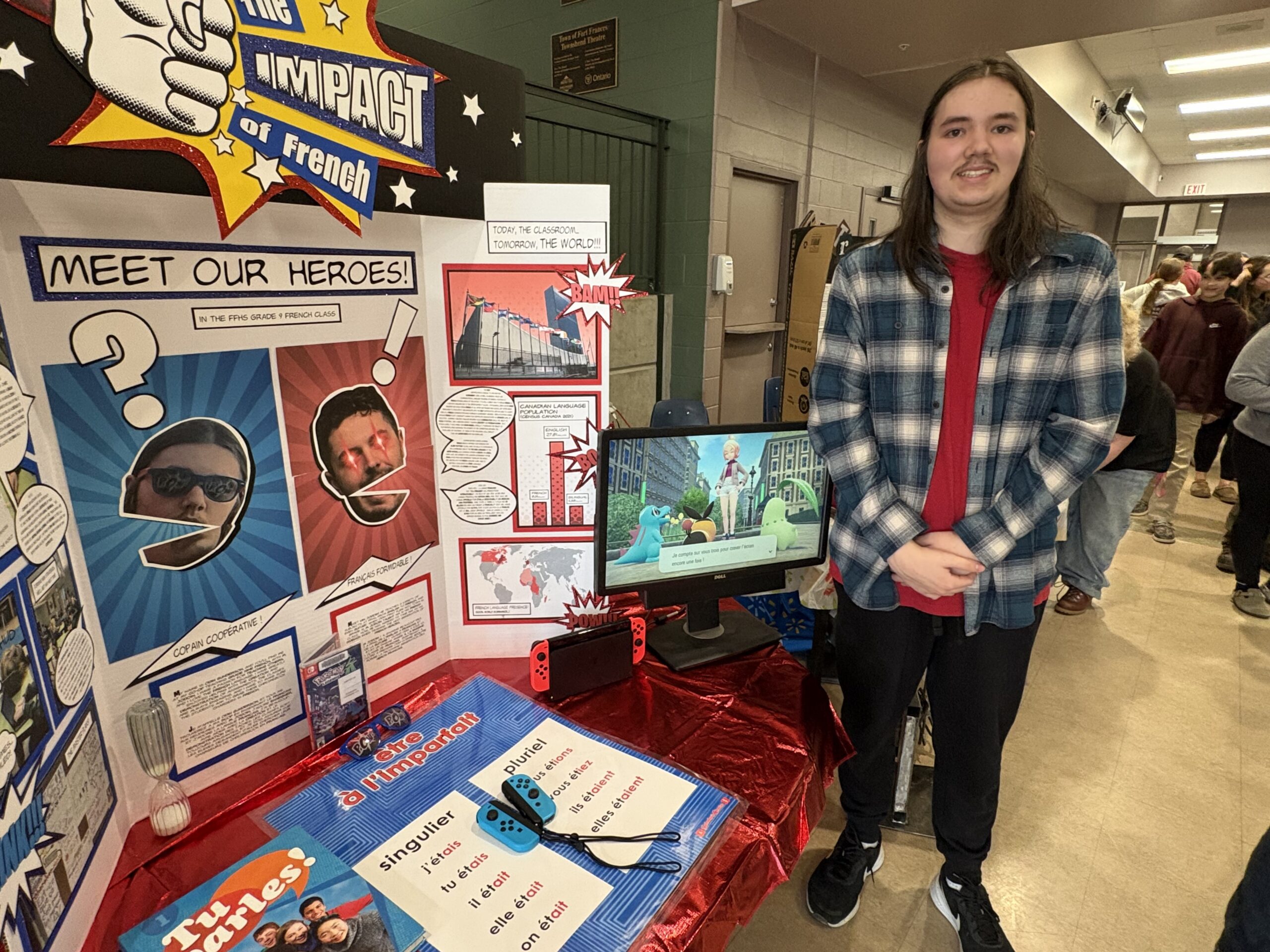
Odin Gunderson spent his time in a grade 9 French class, helping students learn the language.
Odin Gunderson explains the impact of French after assisting in a grade 9 French class, May 6, 2026. Image: Randy Thoms/Acadia News
“I personally love teaching the language French, and I love the language itself,” says Gunderson.
“A number of my family members are teachers, so I wanted to carry on with that, see how I enjoy the profession.”
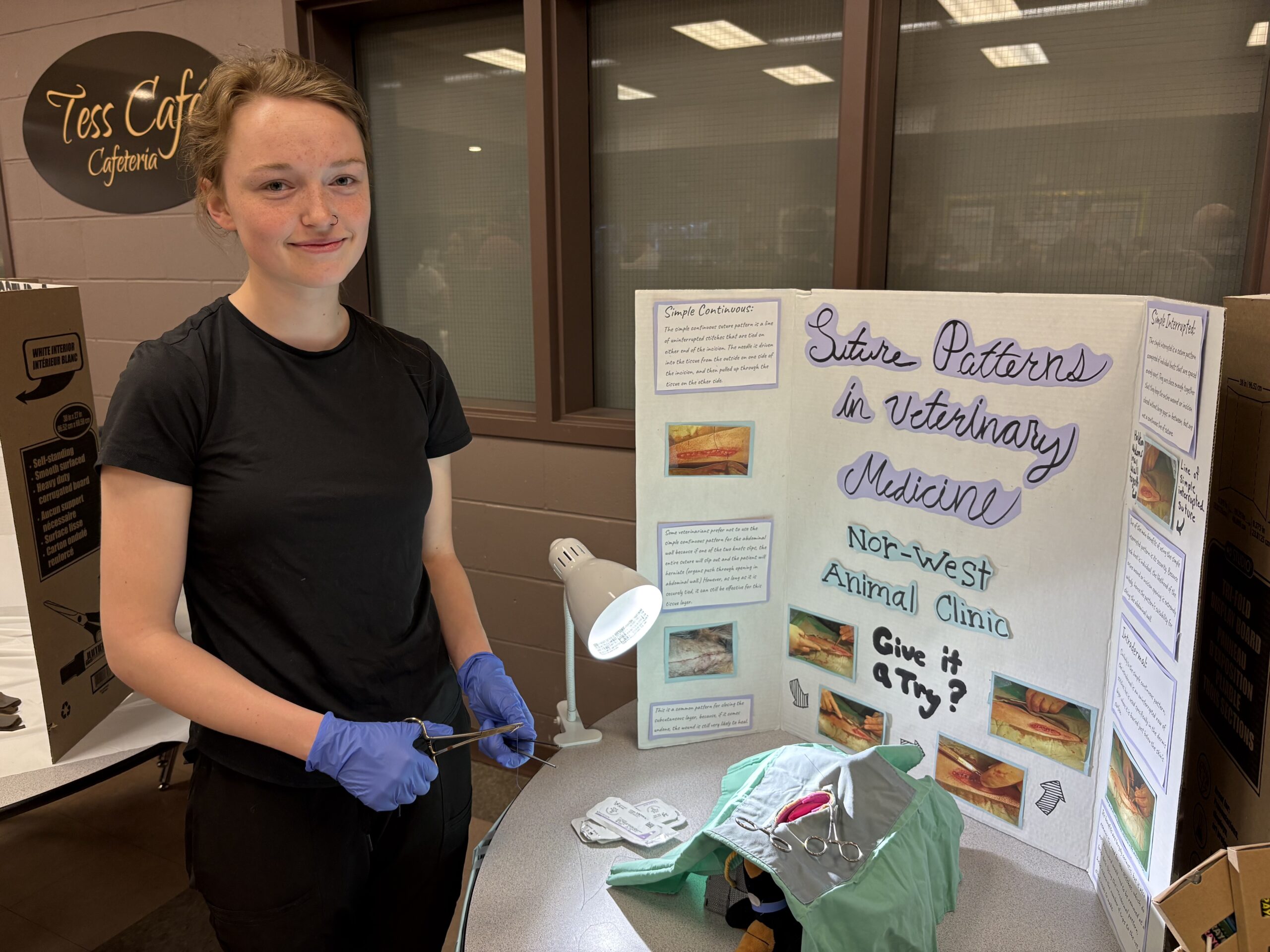
Grade 12 student Cleo Reynolds chose the Nor-west Animal Clinic for her placement, assisting with appointments and surgeries.
Cleo Reynolds practices suture patterns on a stuffed animal, May 6, 2026. Image: Randy Thoms/Acadia News
She says it is an avenue she is interested in.
“I want to be a vet, but it’s a lot of schooling, obviously, and I wanted to make sure it’s something I want to pursue before I go through with all that university education,” says Reynolds.
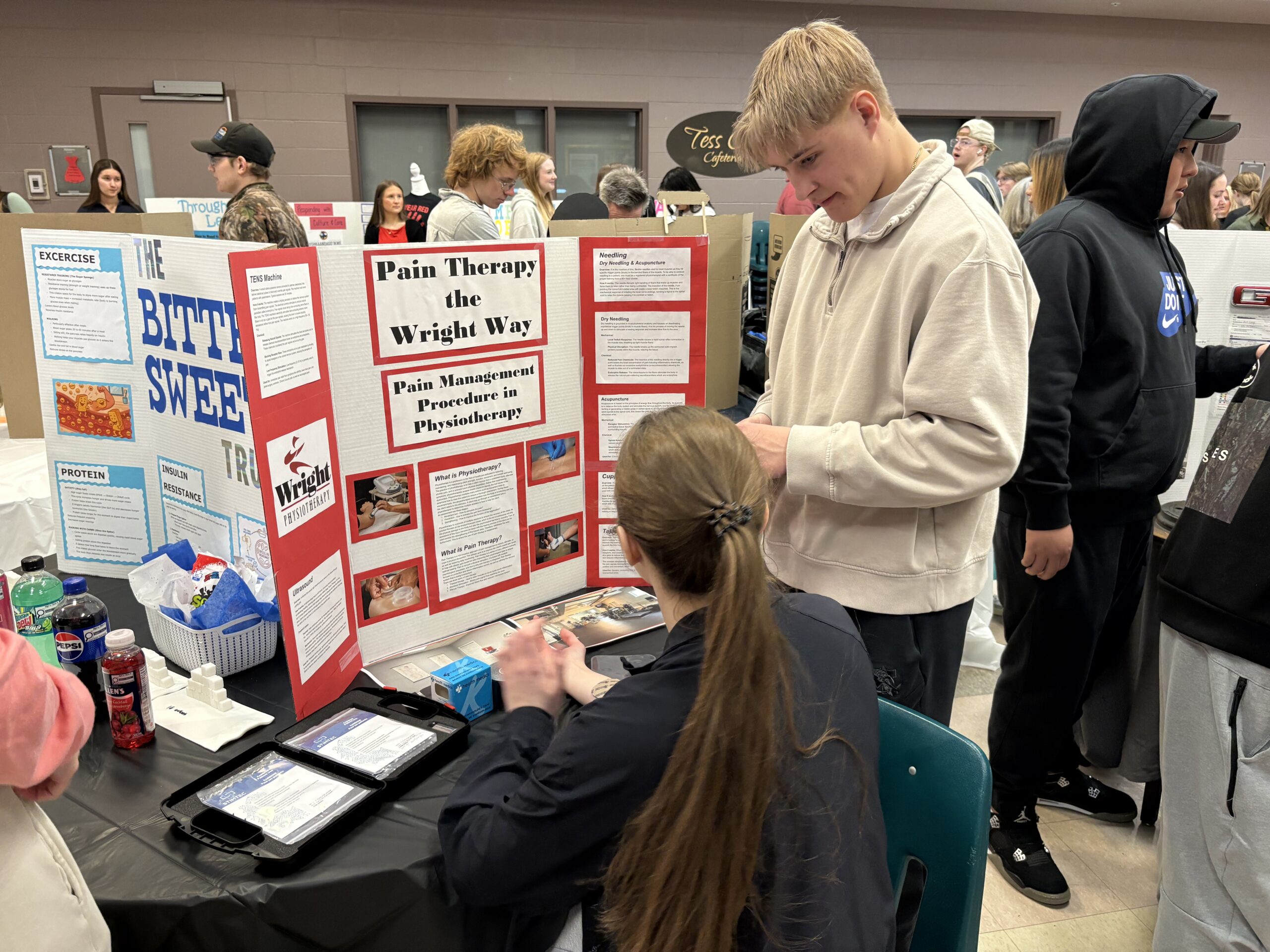
Aiden Loerzel was at Wright’s Physiotherapy, learning about various machines used in pain therapy.
Aiden Loerzel explains the equipment used for pain management at Wright Physiotherapy, May 6, 2026. Image: Randy Thoms/Acadia News
He calls it a great experience.
“I’ve always been really interested in sports medicine,” says Loerzel.
“As an athlete myself, I get hurt a lot. I was pretty interested in the physio aspect and how pain works, and how to reduce it. So I was really interested in helping out with that and learning more from professionals and researching how the chemistry and all that works with the healing and recovery.”
He is now looking at the profession as a career path.
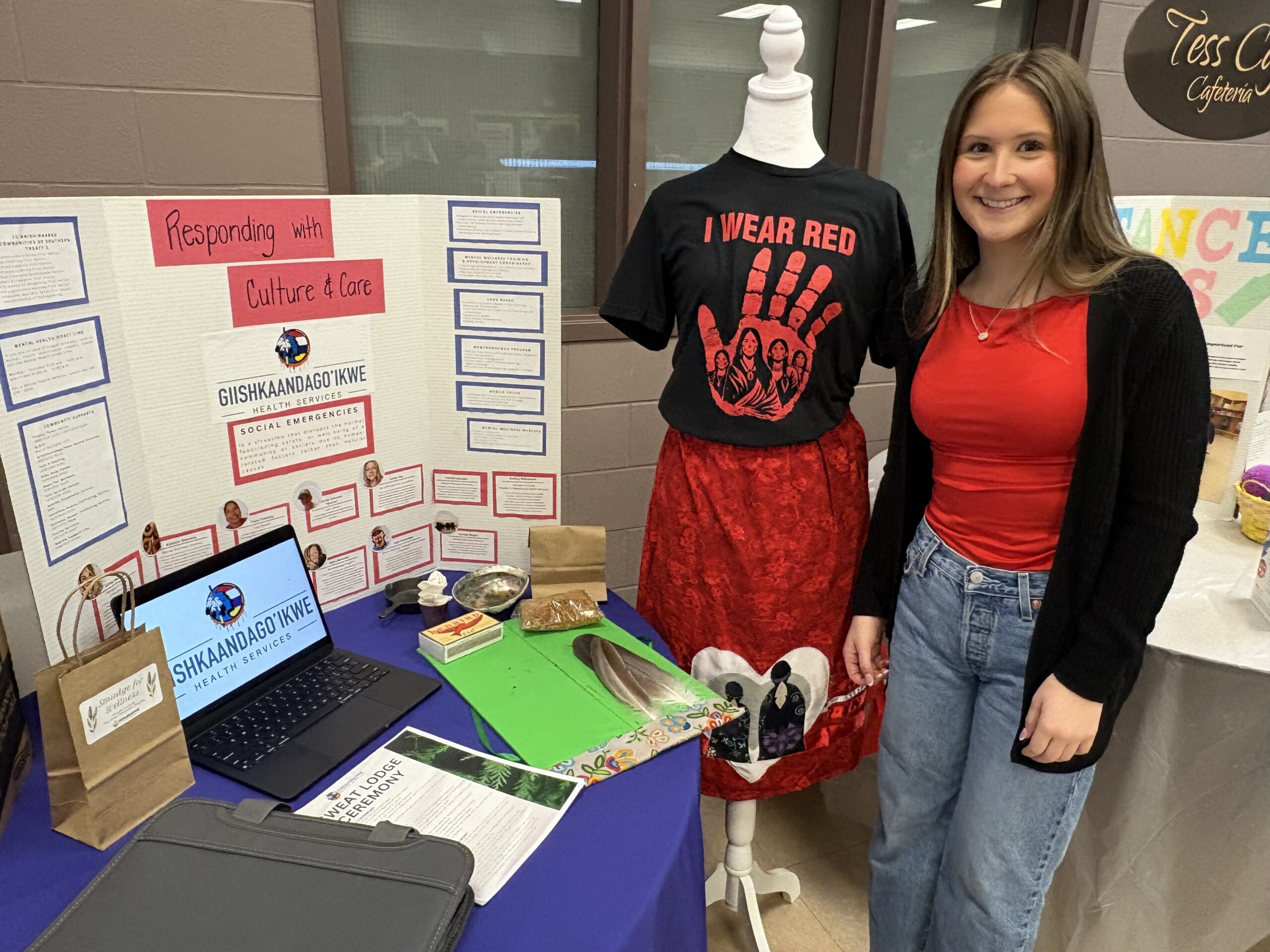
Grade 12 student Blaire Cross selected Giishkaandago’Ikwe Health Services, spending time with a program that responds to crises, as she considers a career in policing.
Blaire Cross explains how Giishkaandago’Ikwe Health Services responses to social emergencies in the area, May 6, 2026. Image: Randy Thoms/Acadia News
“I thought that this would be a really good fit for me because this is also related to mobile crisis and things like that because we’re connected very closely with the OPP,” says Cross.
“It felt really good as a person who could support and understand what other people are going through. But then it was also just a relief to understand that people are getting help and seeking the help that they need.”
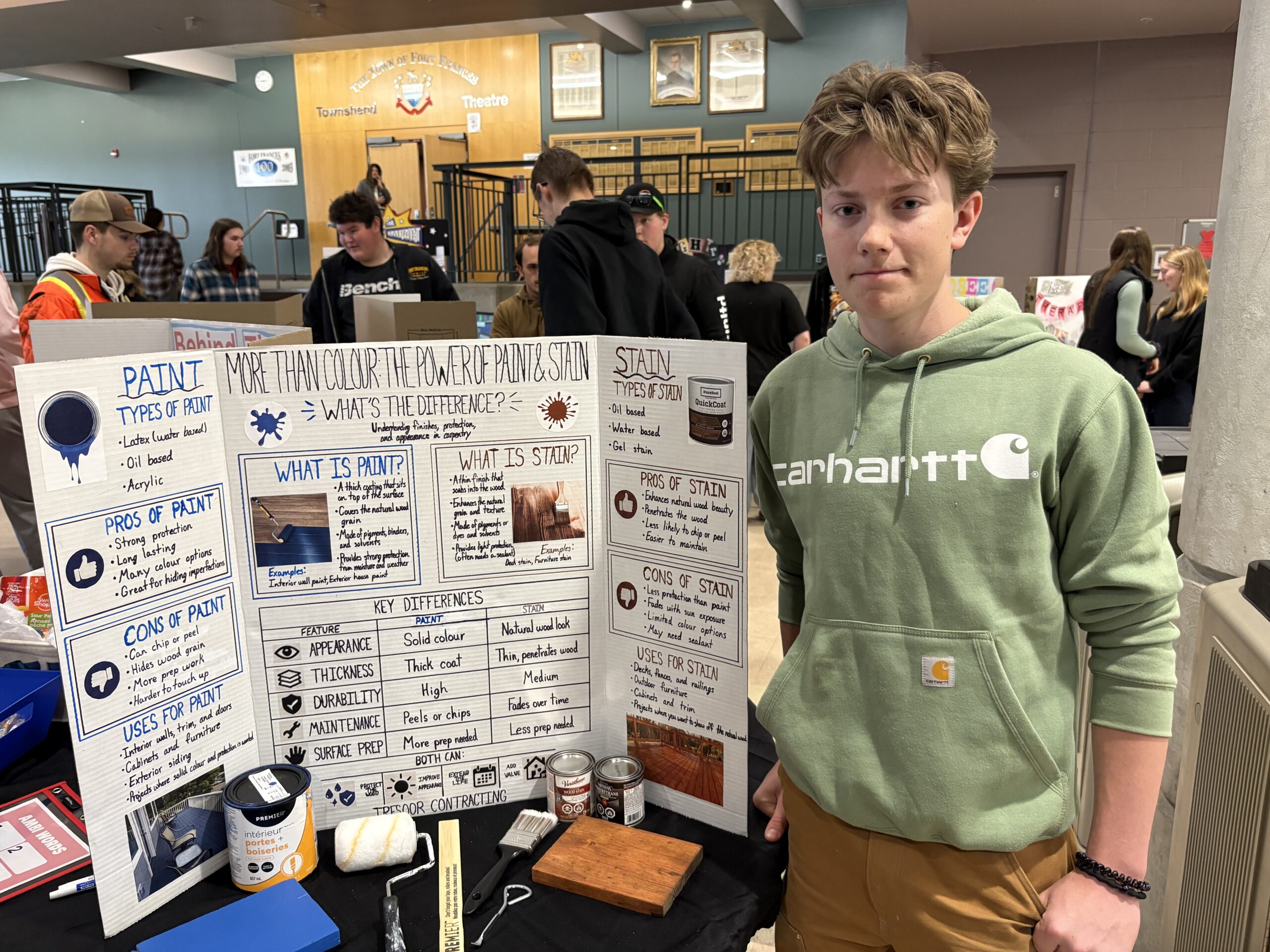
Chase Felix took a trades route, working at Tresoor Contracting, where he was involved in carpentry work.
Chase Felix outlines the difference between stains and paints used during his co-operative education placement, May 6, 2026. Image: Randy Thoms/Acadia News
He says he wanted to get experience in a field he intends to pursue.
“It definitely helped. I do want to do something in the trades for sure,” says Felix.
“It’s a great experience to get out and do stuff and see if it’s truly what you want to do and learn about what you like and don’t like about the career path you think you want to get into.”
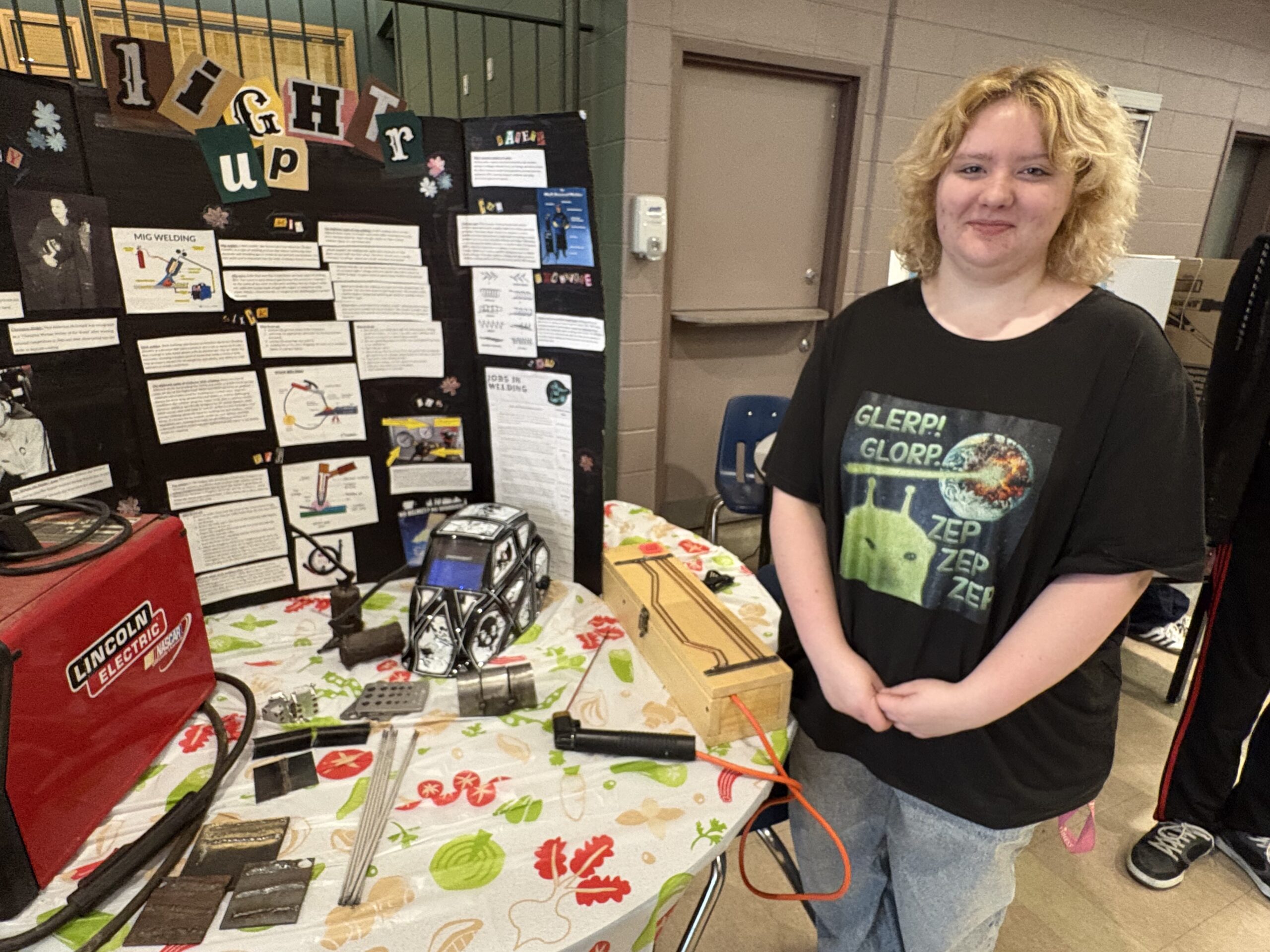
Qianna Bell is also interested in the trades.
Qianna Bell explains the use of welding equipment used during her co-operative education program, May 6, 2026. Image: Randy Thoms/Acadia News
She did placement in the high school’s shop classes, with a focus on welding.
“In grade nine, I started in shop classes, and I just continued with it. I figured out I loved welding,” says Bell.
She has already applied to enrol in Seven Generations Education Institute’s welding program.
“I have a lot of fun with co-op. I love doing it every time that I do it. This is my second year. It’s my favourite thing, and I suggest everybody goes and does it.”
Serenity McLeod also experienced the trades by working at RGB trucking to gain knowledge about being a heavy-duty mechanic.
Serenity McLeod displays a brake drum and other parts at her co-operative education display, May 6, 2026. Image: Randy Thoms/Acadia News
“I’ve been into how things work, whether medically or mechanically,” says McLeod.
“(It’s) something I’m looking into. I do want to further my schooling, though, so it’s kind of a fallback, I guess.”
Students say they enjoyed the experience and recommend other students to enrol.
“You get a credit, and you get a lot of experience,” says McLeod.
“You can make new work friends. It’s a way to get your hands on without having to spend a lot of money on tools or try a career path without continuing your education,” says McLeod.
“The co-op is very fun once you get into it. The beginning can be a little bit steep, but as soon as you settle in, you’ll figure out what you really love about it, and you’ll find yourself enjoying yourself more,” adds Gunderson.
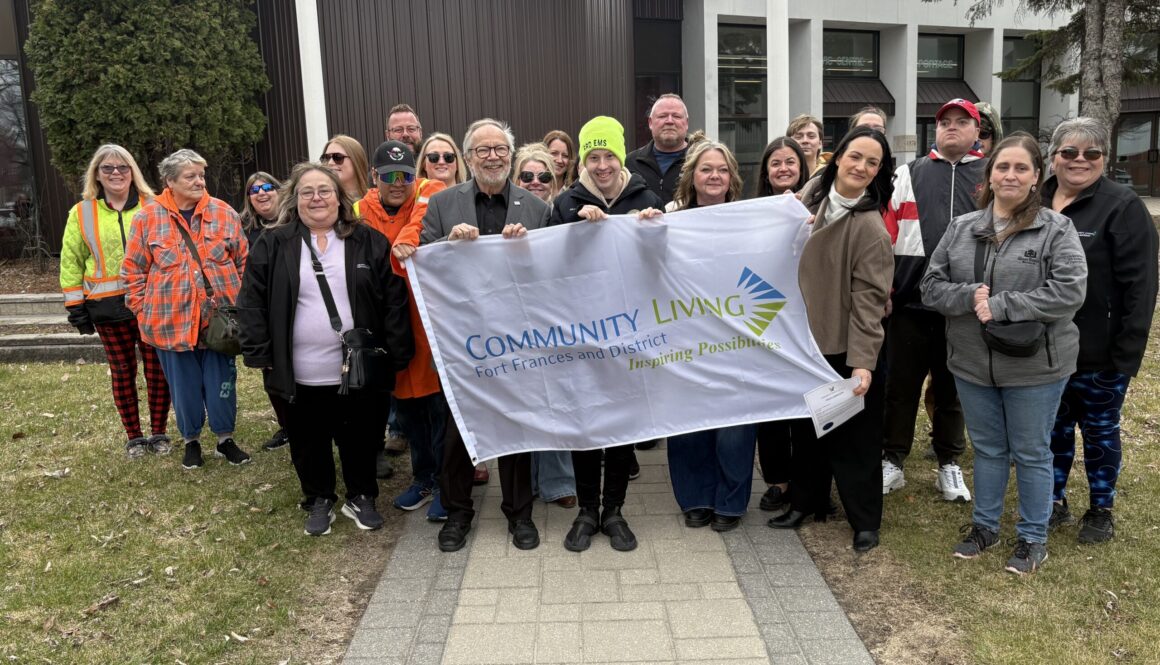
The town of Fort Frances has raised Community Living Fort Frances and District’s flag at the Civic Centre in honour of the organization that supports people with developmental and intellectual disabilities.
May is Community Living Month, which raises awareness of the accomplishments of the Community Living movement.
Mayor Andrew Hallikas proclaimed the month to draw further awareness of the local organization and the people they support.
“The Community Living organization does an amazing job of supporting individuals with developmental and intellectual disabilities throughout their lives to ensure that they live in a state of dignity and participate in all aspects of living in our community,” says Hallikas.
“We thank this wonderful organization for their contribution to the quality of life of the people that they serve.”
Community Living’s Chief Executive Officer Robyn Melville is appreciative of the town’s recognition, saying it helps achieve true inclusion.
“For our town to always embrace that and celebrate all the people we support and our agency as a whole, it is so meaningful because visibility is the key to breaking down barriers of inclusion,” says Melville.
The Community Living movement came to be in 1953 as a grassroots effort, with the Fort Frances organization establishing six years later.
The closure of institutions and group homes led agencies to help those residents adjust and integrate into the community.
“Every day we’re working to make sure that the people we support have the same opportunities as anyone else,” says Melville.
And she applauds the town’s efforts.
“This town in particular is quite ahead of its time for its ability to include and to really focus on all people when designing spaces and when looking at programming. We are just honoured to always be part of that conversation.”
Community Living Fort Francis and District provides a wide variety of supports and services such as supported independent living, supported employment, a resource centre, and workshops.
The Ontario Public Service Employees Union says the underfunding of community and social services is pushing workers to the brink.
The union has launched a campaign, calling for fair wages for workers and funding increases to the agencies they work for.
OPSEU President JP Hornick says it is a major issue in contract talks.
“Thousands of OPSEU/SEFPO members in the Worth Fighting For campaign are taking a historic stand, not just for wage justice, but for the future of the services and the care that they provide,” says Hornick.
Hornick says 27 bargaining units have filed no board reports in separate negotiations.
The union wants the government to compensate workers who were impacted by wage-restricting legislation that was eventually declared unconstitutional in the courts.
This led to agreements of retroactive increases for some public sector workers, such as those working in colleges and hospitals.
Hornick says thousands of others are waiting for the same treatment.
“These workers have been at the bargaining table with their employers, and they’ve told them as much that the funding just isn’t there. It’s on Ford to make this right.”
The union notes a $1.5 billion funding shortfall for the Ministry of Children, Community and Social Services.
The latest provincial budget shows a 2.4% decrease to the Ministry’s allocation over the next year.
The provincial NDP is looking for help to those who live in rent-controlled homes in Ontario.
Housing critic Jessica Bell proposes a two-year freeze on rent increases.
She says it would help people get through the current economic conditions and the high cost of living.
“Many Ontarians are struggling,” says Bell.
“We have record-high unemployment. We have very high youth unemployment. We have a lot of people looking for a job at a time when bills, groceries, mortgage costs, and rent have never been more expensive.”
Bell says a survey of renters found many forego buying groceries, meals, even medications, to save up for their rent.
Others have exhausted savings and worry about retirement.
Bell adds that the average rent in Ontario has increased more than 50% in the past decade.
“We don’t expect miracles from the Conservative government,” says Bell.
“We understand we have the Trump tariff war, we have the crisis in the Middle East, but I think every Ontarian out there expects the Ontario government to use every single legal tool or regulatory tool that they have got to make life more affordable for people.”
The Ford government has only once stalled rent increases since they came to power.
That happened during the COVID pandemic in 2021.
In other years, landlords of rent-controlled housing have been given the green light to increases that are near or at the allowable limit.
Bell says a two-year freeze would provide immediate stability and savings for up to 1.5 million renters.
“For someone paying $2,000 a month, it’ll save them about $600 a year and $1,200 over the two years. That’s not chump change,” says Bell.
The province is to announce in June how much landlords can increase the rent on all rent-controlled homes across Ontario.
MPPs are expected to vote on Bell’s request on Thursday.
A new record for sturgeon caught in Rainy River has been certified by the Minnesota Department of Natural Resources.
The 80-inch fish was caught by an angler last month near the mouth of the river.
It is estimated to have weighed 165 pounds.
Travis Keating was on an annual fishing trip with a group of friends when he reeled in the lunker.
They had fished Four Mile Bay for nearly eight hours, battling strong winds and cold temperatures for a few smaller fish.
By evening, Keating moved to the mouth of the river, and after an hour, his fishing rod doubled over.
Keating says it was over an hour of pure chaos before the fish finally surfaced, and a friend managed to hoist the massive fish into the boat.
“Getting the fish finally in the boat was such a surreal moment that I just couldn’t wrap my head around it,” states Keating in a release.
“Now looking back, still can’t believe I was the one to catch the fish and can’t wait to get back and try to top it!”
The DNR does not require fish to be weighed for catch-and-release records, but it estimates it to be close to 165 pounds.
Keating’s catch exceeds the former record by 2 inches of a fish reeled in at St. Croix River in 2019.
It suggests its size indicates the presence of some very old fish in the river, crediting measures taken in the 1970s to clean up the river as helping sturgeon to thrive.
Industrial activity during the late 1800s and early 1900s decimated the sturgeon population in Lake of the Woods and Rainy River.
Even when commercial fishing declined, sturgeon suffered from poor water quality and degraded habitat in the river, the primary spawning area.
Government action to improve the waters in the 1970s helped the sturgeon recover, with reproduction considered to be the best it has been in many years.
The events showcase the skilled trades and the apprenticeships and training opportunities available.
They will be held in 12 communities this year, including one in Thunder Bay in late October.
More than 60,000 people are expected to attend the fairs.
They were launched five years ago to help encourage more young people into the trades.
“Our government is focused on making sure Ontario workers have the skills, resources and opportunities they need to succeed,” states David Piccini, Minister of Labour, Immigration, Training and Skills Development, in a release.
“The Level Up! career fairs continue to open more doors for students and jobseekers to explore careers in the skilled trades, connect directly with employers and see firsthand the opportunities available to them.”
The fairs showcase Ontario’s 144 skilled trades through interactive exhibits, hands-on demonstrations and conversations with employers, unions and training providers.
“Ontario’s students deserve every opportunity to explore pathways that lead to rewarding, good-paying careers,” states Paul Calandra, Minister of Education.
“Level Up! plays an important role in connecting classroom learning with hands-on experience.”
The fairs were initially designed for students, but welcome parents, educators and others.
The demand for skilled trades workers in Ontario is expected to continue, with roughly one in three tradespeople nearing retirement.
The province states that one in six job openings in Ontario will be in skilled trades-related occupations by 2034.
Organizations interested in being a potential exhibitor or sponsor at the career fair can email LevelUp@ontario.ca or visit LevelUp! website. Click here.