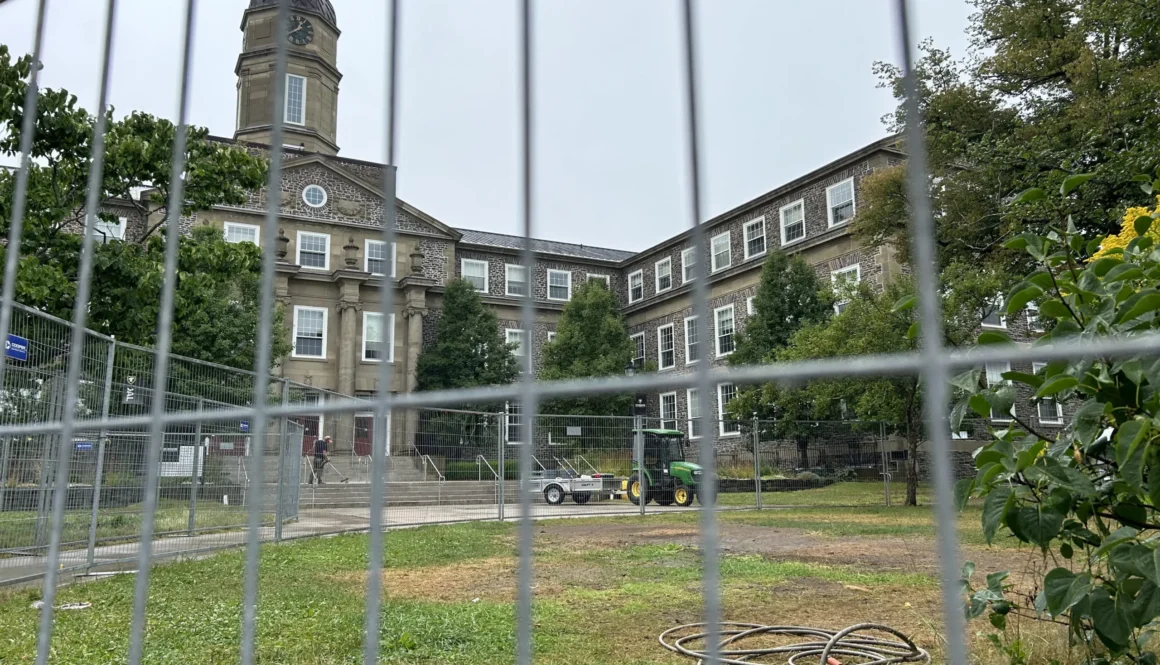
The University of New Brunswick is adding a new degree to its Saint John campus next fall.
According to a press release, the university is launching a bachelor of data science program.
The four-year degree, coming next September, was developed jointly by the department of mathematics and statistics and the department of computer science, teaching students how to use data responsibly and understand the broader impact data-driven decisions can have on society.
Students will also study programming, data management, machine learning, modelling, and data visualization, while developing communication, project management, ethics, and leadership skills.
The program will also offer opportunities for students to gain experience through industry projects, internships, practicums, applied research, and a capstone project.
Students can choose a general stream or tailor their studies through one of four concentrations, including health, business, engineering and technology, or ecology and environment.
UNB said in the release that graduates of the bachelor’s program will be prepared for careers such as data scientist, data analyst, business intelligence analyst, machine learning engineer, health data analyst, environmental data analyst, and data engineer.
As data becomes increasingly important across industries, the university said the program will help meet rising demand for professionals who can turn data into action.
Some mayors in northwestern Ontario have the support of young people.
Several schools held elections, coinciding with Monday’s vote, although their results were not counted in the official election.
It was part of Student Votes, a program that teaches young people about governments and the electoral process.
About 2,100 schools and classrooms took part, including several in northwestern Ontario.
Chief Program Officer Dan Allan says the program has been around since 2010, but participation during municipal elections is not as large as ones during a federal or provincial election because of the greater potential for acclamations that eliminate schools ability to hold mock elections.
“We have about 2,100 schools involved this year, which is the most since we’ve been doing these since 2010,” says Allan.
Allan says classroom components get into the difference between the mayor and councillor, their roles and voting methods.
He says it reveals to students the importance of local government and how the issues directly impact them.
“I think youth really enjoy kind of learning and exploring how maybe local politics at first doesn’t seem the most interesting, but it is the kind of level that kind of impacts you every day,” says Allan.
“It’s kind of the level that people are touched by every day. So maybe it may be harder to get into the topic, but I think once people explore it, it’s very interesting.”
Students also hold elections among the school body, with the candidates seeking office in their community on the ballots.
Some schools arranged for candidates to visit, while others staged candidate forums.
When the student votes were counted, they liked mayoral candidates Rob Ferguson in Atikokan, Brent Calder in Fort Frances and Fred Mota in Red Lake.
All three were elected in Monday’s election.
Students in Thunder Bay, though, preferred Trevor Giertuga over Mayor-elect Moe Comuzzi.
Allan says it is not unusual to see students’ preferences differ from their parents’.
“It really varies,” notes Allan.
“There have been examples where students have voted more to the left of adults for our national program last spring. The Liberals won in the real vote, but in the youth vote, they voted for (Pierre) Poilievre. So, you never know how it’ll go.”
Allan does hope that students, when they are eligible, become regular voters in all future elections.
The Rainy River District School Board has two new student trustees.
Ava Hartnell is a grade 11 student at Rainy River K-12 School.
Karsyn (CARSON) Mainville is a grade 11 student at Fort Frances High School.
He will serve as the board’s student representative for First Nations, Metis and Inuit students.
They join Paxton Hughes, a grade 11 student at Fort Frances, who was appointed to the board last September.
Student trustees serve two-year terms and offer a student voice to the decision-making process at the board table.
The board usually rotates between high schools in Fort Frances, Atikokan and Rainy River in the selection of the First Nations, Métis and Inuit student trustee position.
Some Fort Frances High School students are getting a chance to test-drive a career.
They are the latest participants to take part in the school’s co-operative education program.
The program provides students with the opportunity to spend time in a workplace, helping to guide them toward a potential career path.
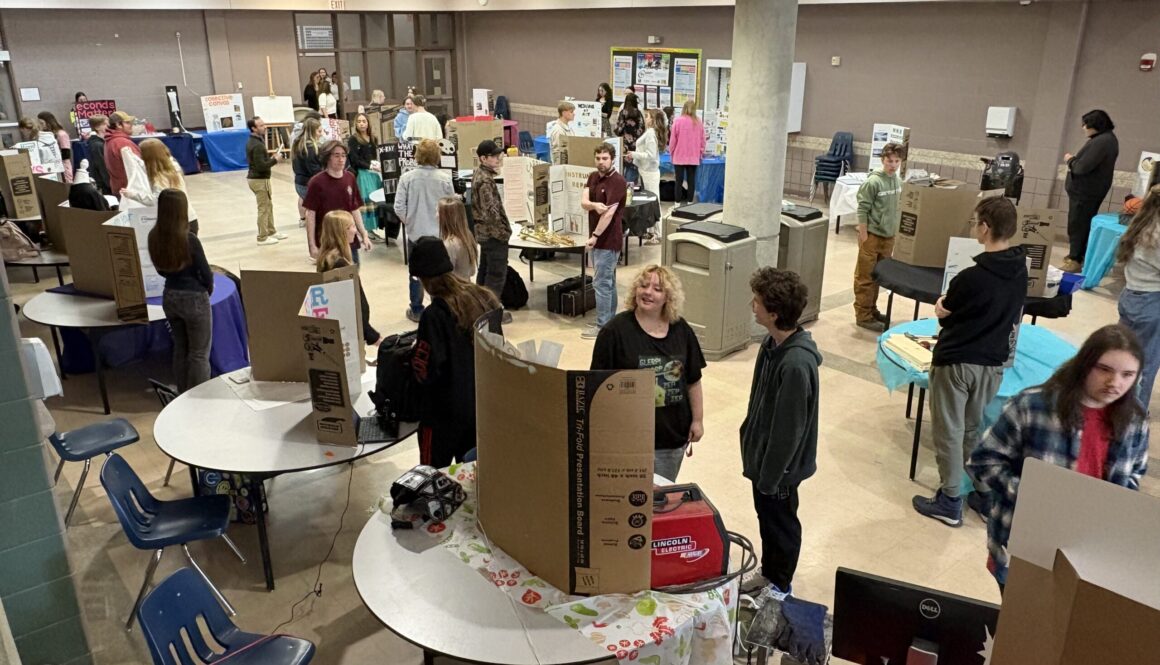
Students showcased their placements at the annual Co-Op Display Day.
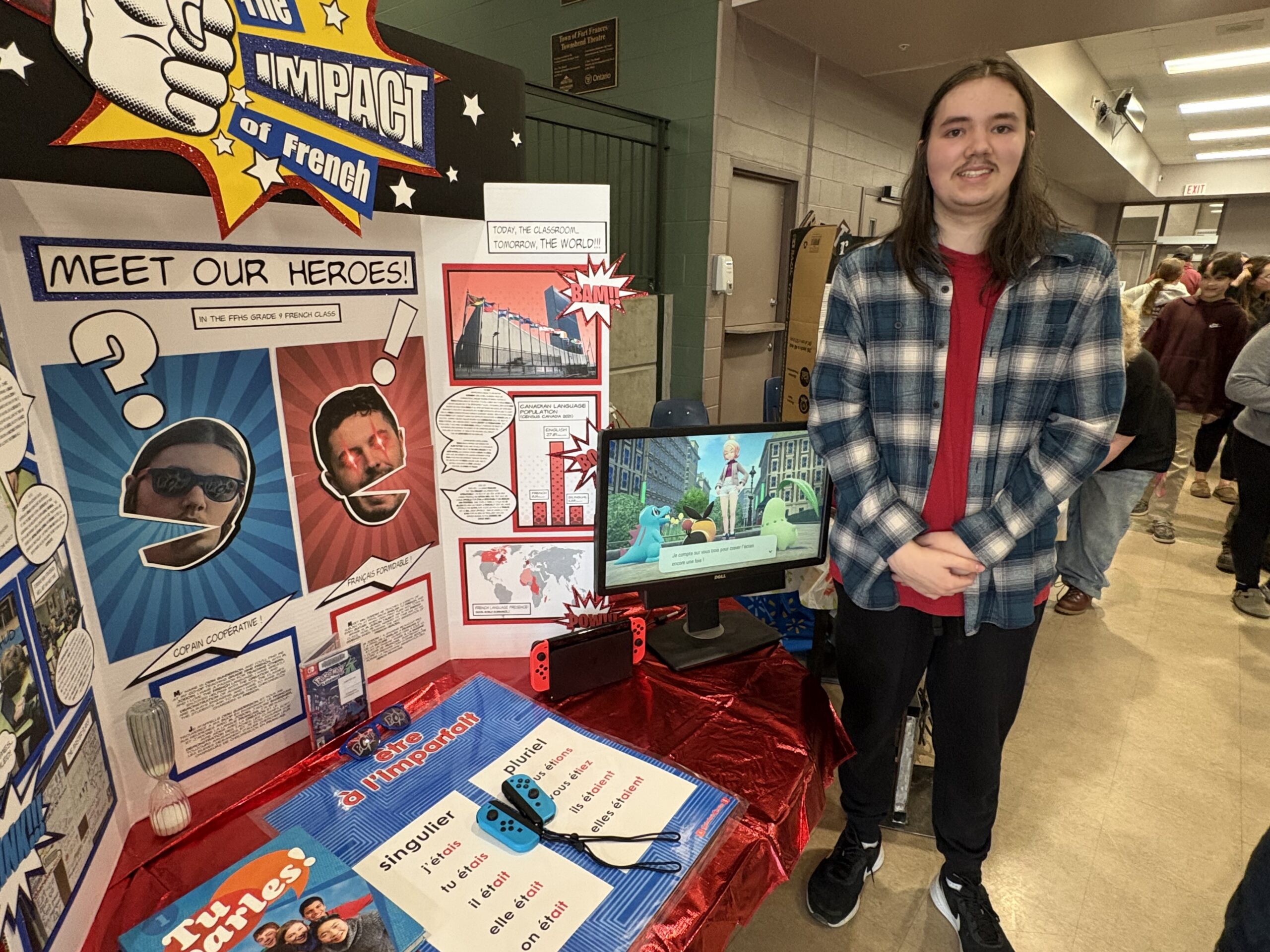
Odin Gunderson spent his time in a grade 9 French class, helping students learn the language.
Odin Gunderson explains the impact of French after assisting in a grade 9 French class, May 6, 2026. Image: Randy Thoms/Acadia News
“I personally love teaching the language French, and I love the language itself,” says Gunderson.
“A number of my family members are teachers, so I wanted to carry on with that, see how I enjoy the profession.”
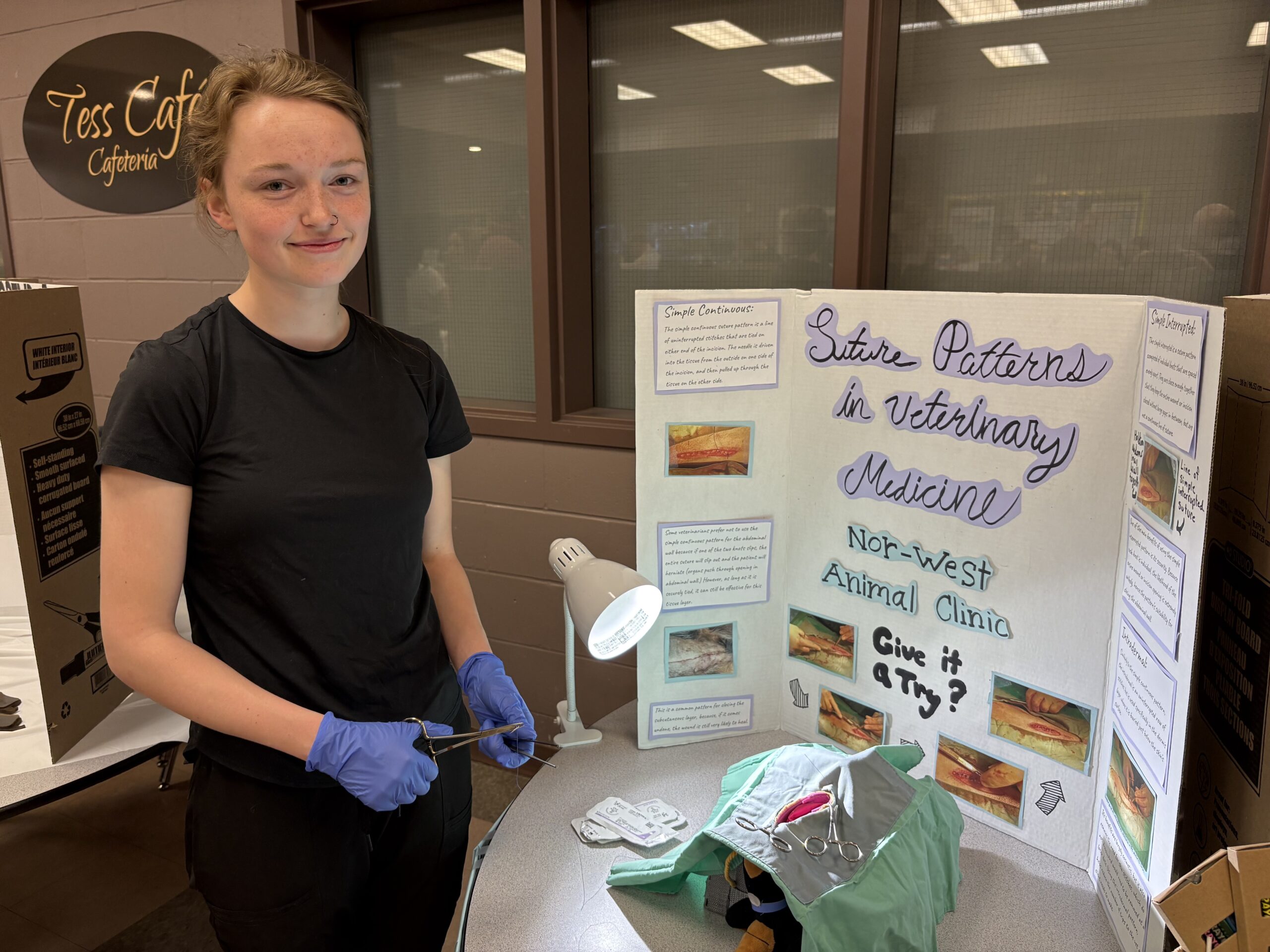
Grade 12 student Cleo Reynolds chose the Nor-west Animal Clinic for her placement, assisting with appointments and surgeries.
Cleo Reynolds practices suture patterns on a stuffed animal, May 6, 2026. Image: Randy Thoms/Acadia News
She says it is an avenue she is interested in.
“I want to be a vet, but it’s a lot of schooling, obviously, and I wanted to make sure it’s something I want to pursue before I go through with all that university education,” says Reynolds.
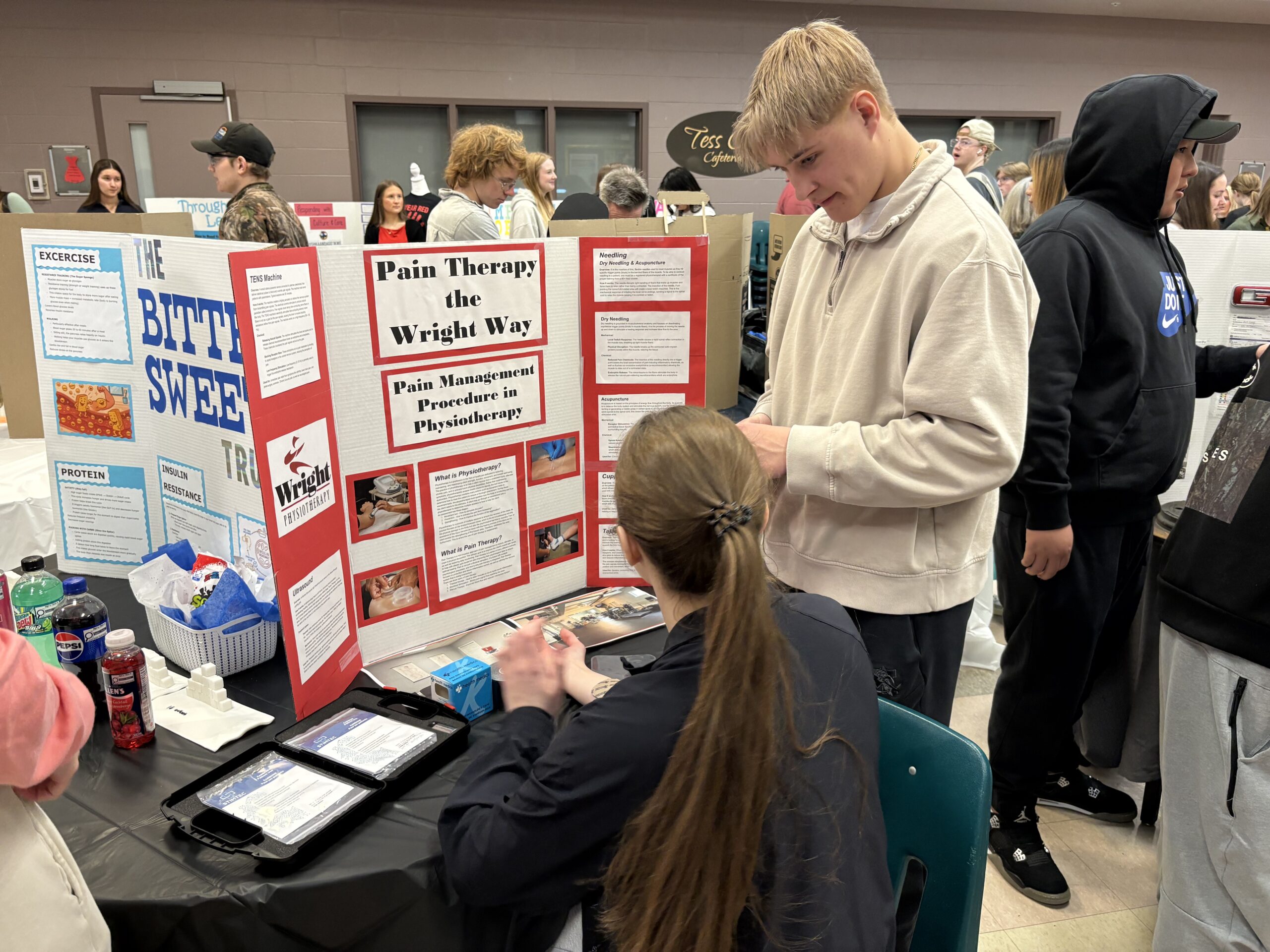
Aiden Loerzel was at Wright’s Physiotherapy, learning about various machines used in pain therapy.
Aiden Loerzel explains the equipment used for pain management at Wright Physiotherapy, May 6, 2026. Image: Randy Thoms/Acadia News
He calls it a great experience.
“I’ve always been really interested in sports medicine,” says Loerzel.
“As an athlete myself, I get hurt a lot. I was pretty interested in the physio aspect and how pain works, and how to reduce it. So I was really interested in helping out with that and learning more from professionals and researching how the chemistry and all that works with the healing and recovery.”
He is now looking at the profession as a career path.
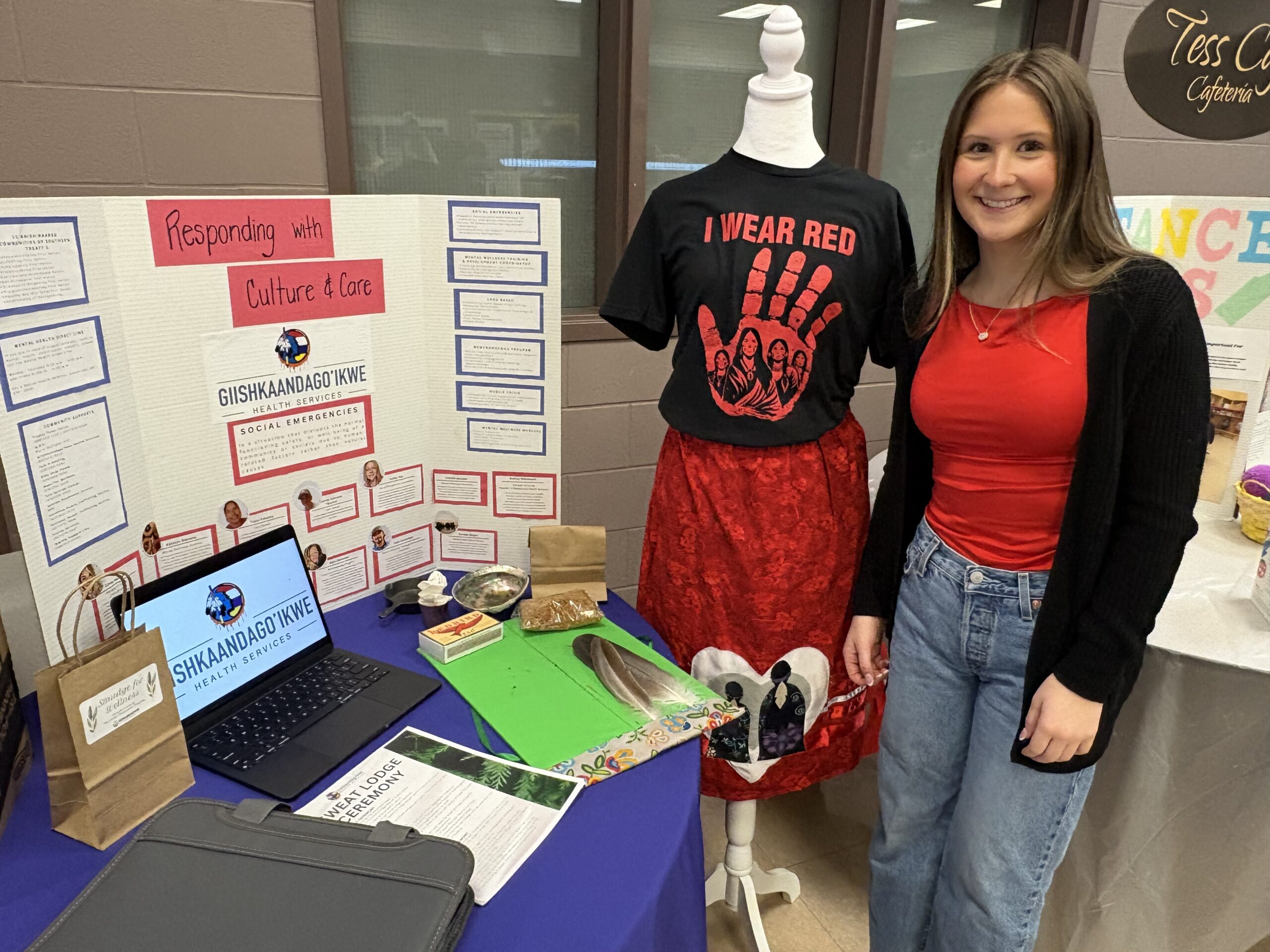
Grade 12 student Blaire Cross selected Giishkaandago’Ikwe Health Services, spending time with a program that responds to crises, as she considers a career in policing.
Blaire Cross explains how Giishkaandago’Ikwe Health Services responses to social emergencies in the area, May 6, 2026. Image: Randy Thoms/Acadia News
“I thought that this would be a really good fit for me because this is also related to mobile crisis and things like that because we’re connected very closely with the OPP,” says Cross.
“It felt really good as a person who could support and understand what other people are going through. But then it was also just a relief to understand that people are getting help and seeking the help that they need.”
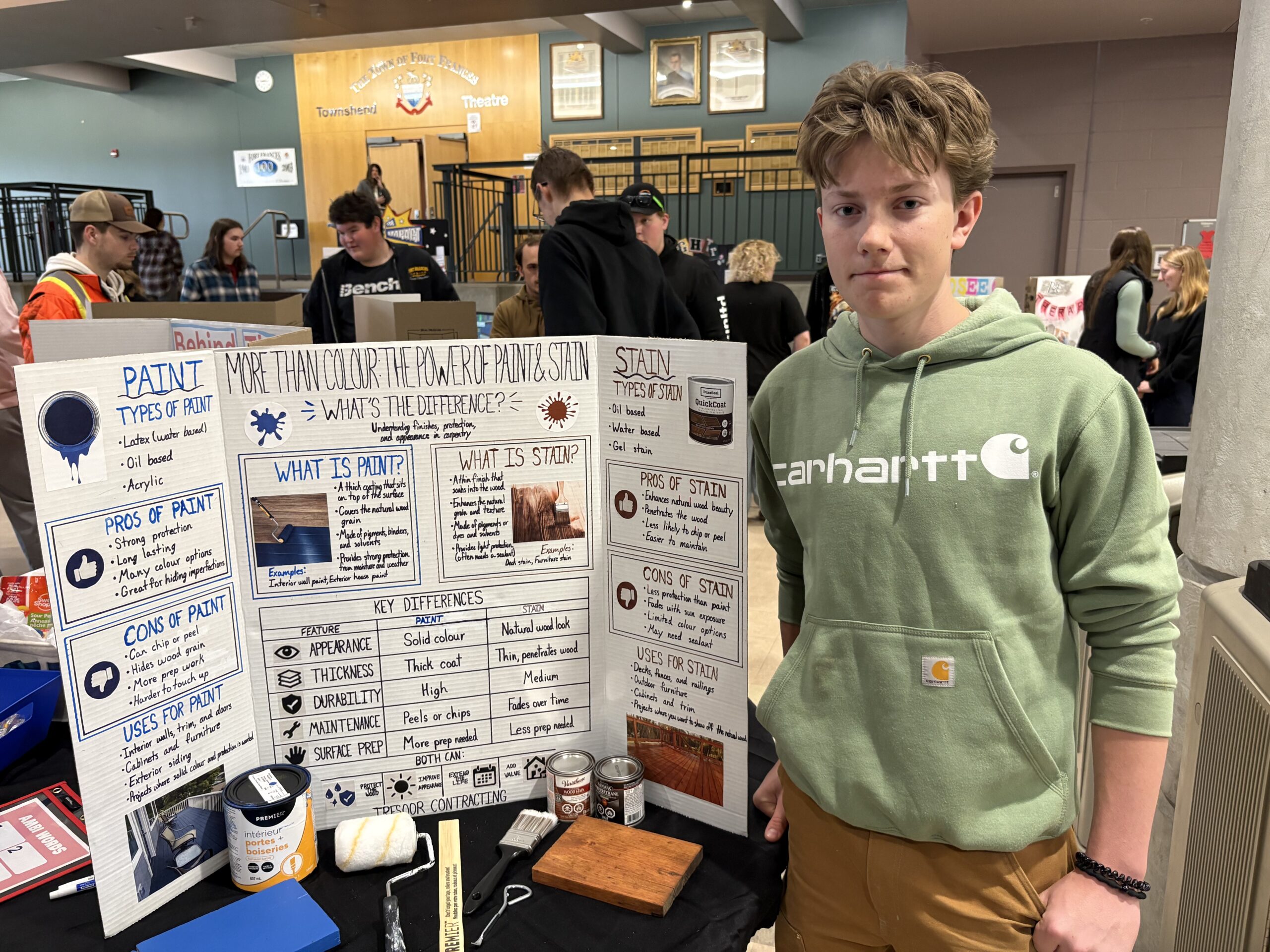
Chase Felix took a trades route, working at Tresoor Contracting, where he was involved in carpentry work.
Chase Felix outlines the difference between stains and paints used during his co-operative education placement, May 6, 2026. Image: Randy Thoms/Acadia News
He says he wanted to get experience in a field he intends to pursue.
“It definitely helped. I do want to do something in the trades for sure,” says Felix.
“It’s a great experience to get out and do stuff and see if it’s truly what you want to do and learn about what you like and don’t like about the career path you think you want to get into.”
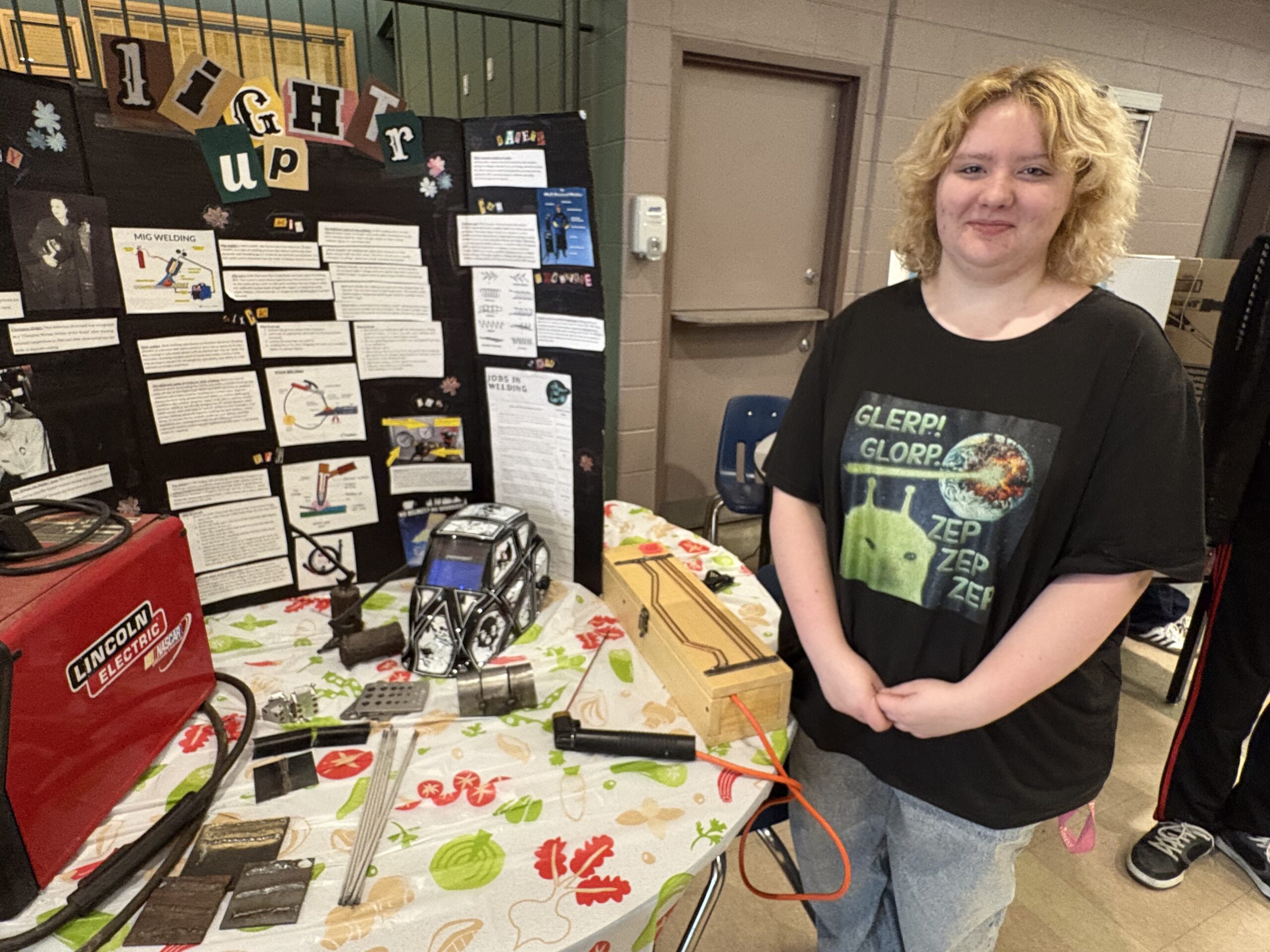
Qianna Bell is also interested in the trades.
Qianna Bell explains the use of welding equipment used during her co-operative education program, May 6, 2026. Image: Randy Thoms/Acadia News
She did placement in the high school’s shop classes, with a focus on welding.
“In grade nine, I started in shop classes, and I just continued with it. I figured out I loved welding,” says Bell.
She has already applied to enrol in Seven Generations Education Institute’s welding program.
“I have a lot of fun with co-op. I love doing it every time that I do it. This is my second year. It’s my favourite thing, and I suggest everybody goes and does it.”
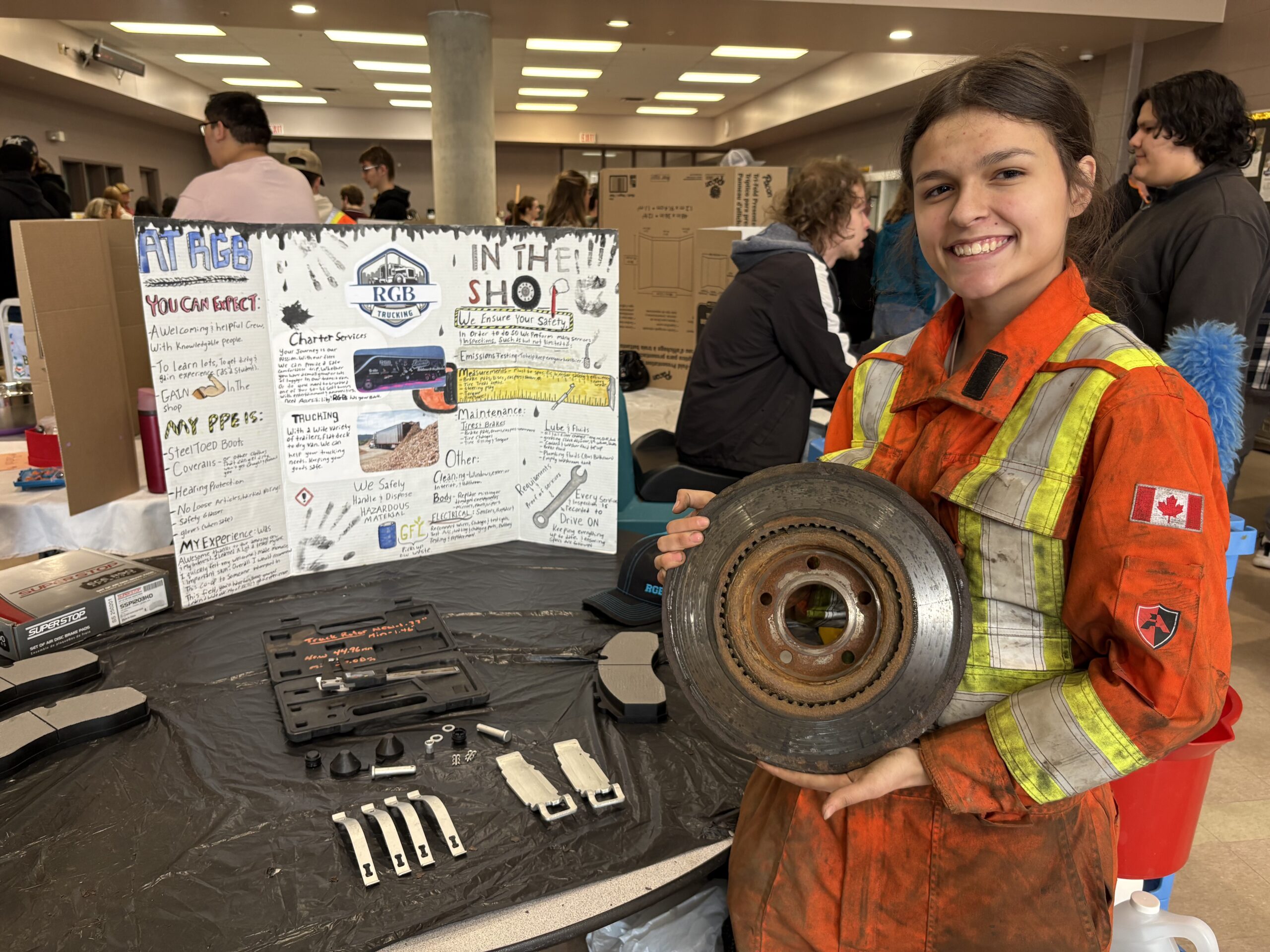
Serenity McLeod also experienced the trades by working at RGB trucking to gain knowledge about being a heavy-duty mechanic.
Serenity McLeod displays a brake drum and other parts at her co-operative education display, May 6, 2026. Image: Randy Thoms/Acadia News
“I’ve been into how things work, whether medically or mechanically,” says McLeod.
“(It’s) something I’m looking into. I do want to further my schooling, though, so it’s kind of a fallback, I guess.”
Students say they enjoyed the experience and recommend other students to enrol.
“You get a credit, and you get a lot of experience,” says McLeod.
“You can make new work friends. It’s a way to get your hands on without having to spend a lot of money on tools or try a career path without continuing your education,” says McLeod.
“The co-op is very fun once you get into it. The beginning can be a little bit steep, but as soon as you settle in, you’ll figure out what you really love about it, and you’ll find yourself enjoying yourself more,” adds Gunderson.
Ten-year old Kenora native Lochlan Hawes is in the running for $20,000, a tour of the Planetary Society with Bill Nye, and a feature in Reader’s Digest.
Hawes is among the top 1% of applicants for “America’s Favorite Student,” a contest for young students aged 6-17 from Canada and the US.
“We’ll donate some of [the prize money] to my cousin Harper’s GoFundMe, because she has CTNNB1,” Lochlan said.
CTNNB1 Syndrome is an ultra-rare genetic disorder that impairs growth of the brain and central nervous system. When Lochlan’s cousin Harper was 20 months old, her parents were told that she would most likely not walk or talk and would have severe global and intellectual delay. Harper has since learned to walk short distances with the help of leg braces and a walker. She began to communicate verbally shortly after her 5th birthday.
Some of Lochlan’s prize money would go to his cousin Harper Tanton’s treatments. (via Christopher Hawes)
Now eight years old, Harper has been selected as just the third child worldwide to participate in a groundbreaking human clinical trial for a new gene replacement therapy designed specifically for CTNNB1 Syndrome.
“After years of investing in Harper’s therapies (upwards of $20,000 annually), [Harper’s parents] Scott and Tara find themselves financially stretched, making it challenging to provide Harper with this unique opportunity,” Harper’s family wrote in their GoFundMe.
Lochlan says his prize money will go towards Harper’s treatment and his future post-secondary education.
“Harper’s a really great kid,” said Lochlan’s dad Christopher Hawes. “She’s really sweet and funny. We’re supporting her in many ways, and this will be another great way to do that.”
Lochlan and his family (via Christopher Hawes)
According to Lochlan, math is his favourite subject because he enjoys the rules and patterns behind solving problems.
“He legitimately loves learning,” Lochlan’s dad said. “Honestly, it’s been so exciting to learn with him and take him to his limits of understanding things.”
Born in Kenora, Lochlan moved to Thunder Bay two years ago. He plays competitive soccer and trains several times a week. He likes to play chess and cross country skis in his spare time.
“I’d like to meet Bill Nye,” Lochlan said. “We see him in science. He’s happy and always positive.”
With enough votes, Lochlan will advance to the semifinals of America’s Favorite Student. Click here to place your vote.
“We’ve had some wonderful support from friends and family and we’re now at the quarterfinal phase, which is amazing. The next step is to get some more momentum. We’re hoping people will vote for Lochlan help him go to the Planetary Society and meet Bill, and win some money for his education and to share with his cousin,” Lochlan’s dad said.
University and college students are planning to rally at Dalhousie University Wednesday afternoon over tuition fees, the province’s recent budget cuts, and to call on schools to divest from weapons and fossil fuel companies.
Four student unions recently voted to go on strike by skipping assignments and class from March 15th to 21st.
Our newsroom spoke to Q Pritchett, who said they planned to participate.
“I found it very frustrating that in the beginning of the last semester, the teachers were locked out, and for a few weeks, we couldn’t even go to classes, but we were still paying for it, and a lot of our classes, as a result, were really cramped in terms of content,” says Pritchett.
Pritchett also says they were disappointed to see the province’s budget cuts for universities and students.
A group of students, called Nova Scotia Student Strike, put together the petition for the strike, which had more than the required 1 per cent of students sign it, according to the Dalhousie Student Union. That prompted them to call a Special General Meeting, they say, where the union then voted in favour of strike action.
Students are calling for affordable tuition and for the university to move its investments away from fossil fuel and weapons companies.
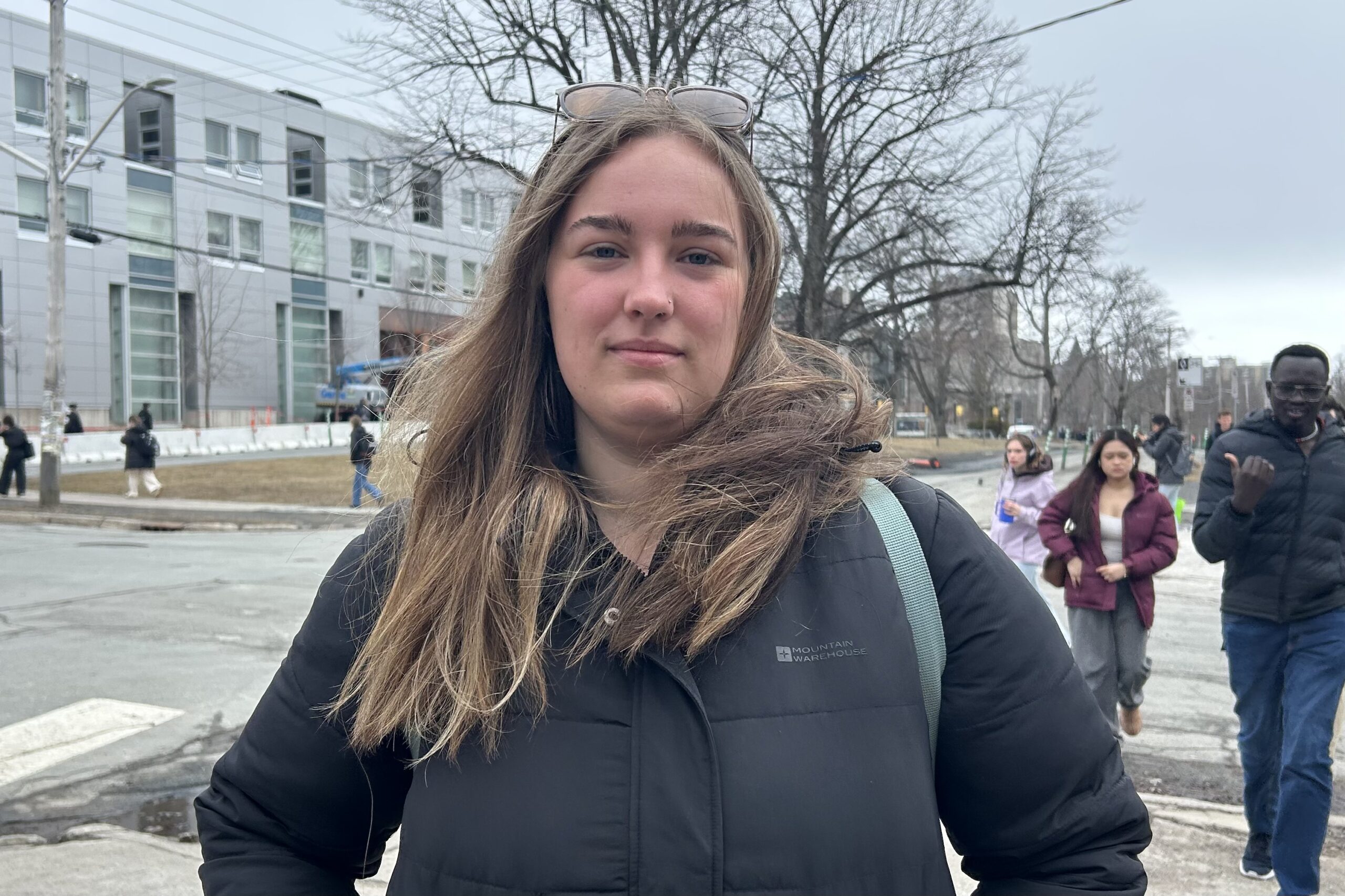
Laura Earl is a fourth-year neuroscience and entrepreneurship student. She says tuition is already high enough.
“So I would love to see that come back down, and especially [because], moving into residence and across country is already a bit of a charge,” says Earl.
She says she is also frustrated that tuition was not reduced after the weeks-long teacher strike in the fall.
Laura Earl, fourth-year student at Dalhousie University, says tuition is high enough already. Pictured March 16, 2026. PHOTO BY JACOB MOORE/ACADIA BROADCASTING
The Dalhousie Students Union says they do not have a way to mandate that students walk out of class, according to a statement.
And it is hard to gage how many people are participating, according to DSU President Maren Mealey, especially because she has not been to any classes to see the attendance.
But from what she has seen outside of classes, more people are striking than she initially anticipated, and the food provider at the university also said enough students were staying home that their sales are down.
“It shows that there is a lot of unity across the province that the status quo is unacceptable,” says Mealey.
There is a campaign underway aimed at reversing changes to the Ontario Student Assistance Program.
The provincial NDP has initiated it.
Save OSAP includes a website that asks people to sign petitions and letters objecting to the reduction of the grant portion of funding provided to eligible post-secondary students from 85% to 25%.
NDP leader Marit (MAR-it) Stiles says the move will leave students graduating into debt instead of opportunities.
“You cannot build a strong economy on the backs of a generation buried in debt,” states Stiles in a release.
“While Ford is busy insulting young people trying to get an education, students and their families will be forced to bear the costs of his cuts.”
The Premier insists the changes are necessary because the program is not sustainable under its current format.
He is standing behind them.
“It’s going to be 25%. And that puts us in the middle of the pack. That’s more than British Columbia. That’s more than Alberta. That’s more than Saskatchewan. Equal to Manitoba and other provinces across our country,” says Ford.