Partners working together on traffic flow improvements across Halifax
Halifax commuters could spend less time in gridlock thanks to a new partnership aimed at improving traffic flow on the peninsula.
The initiative brings together several community partners to implement targeted improvements at key intersections, including adaptive traffic signals, lane reconfigurations, and left-turn restrictions.
Minister of Public Works Fred Tilley said the collaboration is a significant step forward.
“It’s exciting to see all of the partners coming together on a common goal. Halifax Harbour Bridges, Link Nova Scotia, HRM, the province – all of these groups working together in conjunction to make things better for citizens is very heartwarming.”
Tilley said officials are working to complete the plan’s short-term goals by the end of the year.
“Right now, we’re starting off with that North Nantucket corridor for the adaptive signal technology,” Tilley said.
According to Tilley, adaptive signal technology uses camera equipment mounted at intersections to monitor traffic flow and adjust signal timing in real time.
“[Camera] equipment that is placed on the signals. They are looking at the traffic flow, the traffic patterns, and they’re able to change signals based on that traffic flow. They’re also able to speak to one another in an area to let the next light know what’s happening.”
Some of the equipment has already been installed, and Tilley said it will take several months to collect data on vehicle and pedestrian movement.
“It’s really like a smart light system, if you want to put it that way.”
Tilley said the cameras are designed specifically to monitor traffic flow and cannot be used to identify vehicles, licence plates, or pedestrians.
Justin Tanner, Executive Director of Planning and Partnerships with Link Nova Scotia, says, “There are several intersections that will be addressed as part of this program. A lot of these fall on major corridors, especially [ones] that have heavy commuter use.”
The project is intended to improve travel for drivers, public transit users, cyclists, and pedestrians.
Tanner says safety remains a key consideration.
“I think one example would be the restriction of left turns. [It’s] an attempt to improve safety as well as manage vehicle flow.”
Intersections slated for all-day or peak-period left-turn restrictions include:
- Nantucket Avenue near the Dartmouth Shopping Centre and Joseph Zatzman Sportsplex
- North Street and Gottingen Street
- Oxford Street and Jubilee Road
- Gottingen Street at Brunswick and Duke streets
Corridors set for new or improved traffic lanes include:
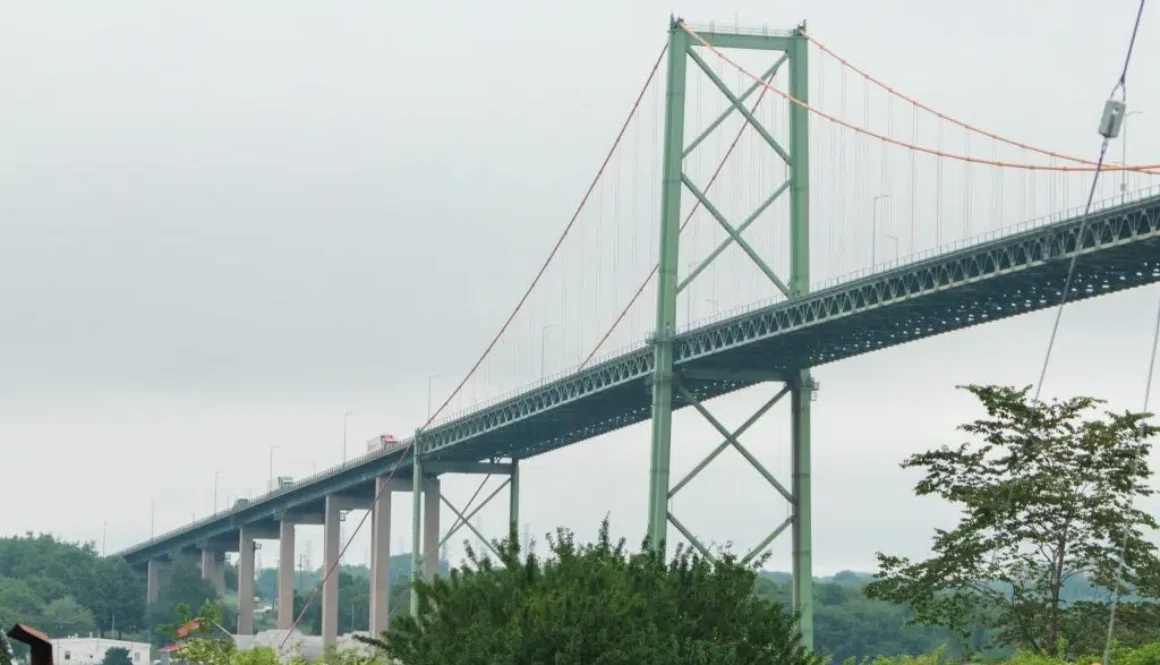
- Wyse Road and the Angus L. Macdonald Bridge
- Connaught Avenue and Quinpool Road
- Cogswell Street and Brunswick Street
Signal timing will also be adjusted at Oxford Street and Coburg Road to improve traffic movement while maintaining safe pedestrian crossings.
“The nice thing about these improvements – they don’t involve a lot of new construction. A lot of it is changing signs, paint, and are minimally disruptive to traffic,” Tanner said.
Tilley said officials are also considering expanding adaptive signal technology to areas such as Barrington Street and the Windsor Street Exchange.
Tanner noted that related projects are already showing results, including improvements at Exit 3 of Highway 102 at Hammonds Plains Road.
“We’re seeing some significant improvements to traffic flow through that intersection and reduced backups onto Highway 102. So that one I’m happy to say is already complete. Several others are in motion, and the rest will be all completed by the end of 2026.”